
Let's Talk About Dancers and Depression #mentalhealthawarenessmonth
May is Mental Health Awareness Month! In this series, we are giving the staff here at DWC a platform to talk about their personal mental health journeys. We believe in supporting the wellbeing of the whole dancer; both body and mind. We want you to know that you are not alone. We believe in the importance of talking about mental health openly, especially within the dance world. So let’s talk about it!
In this article, Cherie, Social Media Director here at DWC is sharing her experience with depression.
May is Mental Health Awareness Month! In this series, we are giving the staff here at DWC a platform to talk about their personal mental health journeys. We believe in supporting the wellbeing of the whole dancer; both body and mind. We want you to know that you are not alone. We believe in the importance of talking about mental health openly, especially within the dance world. So let’s talk about it!
Trigger Warning: Depression.

By En Avant Photography
Medical Disclosure: Dancewear Center does not claim to have any professional medical experience on the subjects discussed. This is Cherie’s personal experience and opinions. If you need help or are in a medical emergency, see the resources listed at the bottom of this post or call 911 for immediate medical attention.
Over the years, I have become very well acquainted with this feeling; my limbs are heavy and it feels like someone is sitting on my chest. I oversleep and lose my appetite. I get headaches, and the world around me feels dull and colorless. Sometimes it lasts a day, sometimes months. This is what depression looks like for me.
Talk to someone you trust. No one's meant to go through life alone.
For a long time I struggled with holding myself to an unrealistic standard. I had an ideal version of myself that I was constantly striving for. I was adamant about “fixing” myself; so I would isolate and try to fix all of the things I didn’t like, emerging on the other side as who I thought I should be. Not wanting to burden anyone else with my personal struggles, I drew further and further away from the people who cared about me. The first person I opened up to about what was going on was my Mom. That was the first step I took out of the little cave I dug myself. When I started going to therapy in high school, the very first exercise my therapist had me do was write out all of the people I had in my support system. These were the people I knew I could reach out to. When I first wrote this list, I think there were only two people I felt like I could talk to. If I were to write out that list now, there are at least a dozen people that come to mind. In reality, those people were ALWAYS THERE, the only thing that’s changed is my ability to ask for help when I need it. Look at the people you have in your life that you love and trust. Asking for help can be scary, and can be hard on our ego sometimes, but no one is meant to go through life alone. Whether it be a parent, a friend, a teacher, or mentor, find someone to talk to.
It’s important to take each moment as it comes and allow our body and mind to process these feelings. I often rely on the list below to help guide my actions when I feel stuck or in a particularly bad place.
Go for a walk. Something as simple as fresh air and movement help lift our spirits.
Take a shower. It’s the little things that count. Focusing on small tasks like taking a shower or brushing your teeth can help your brain kick into motion.
Practice circular breathing: inhale for 4 counts, hold for 4 counts, exhale for 4, hold for 4. This is helps get more oxygen to your brain and body, as well as grounding your brain in the present moment
Talk about it. I know it can be uncomfortable, but talking about how you are feeling to someone you trust can lift a huge weight off your shoulders.
Write a gratitude list. It’s easy to get caught up in a sense of lack or hopelessness. Take 3 minutes to write down the things in your life that bring you joy.
Here is an example of what I might write:
I’m grateful for my morning coffee
I’m grateful for my walk outside; the sun felt warm on my skin
I’m grateful for the time I get to spend on the phone with my mom
I’m grateful for lighting candles in the evening that make my home feel cozy.
I think especially as dancers, we place an unrealistic expectation on ourselves to be perfect. We must learn to enjoy the process, not the outcome. I think a lot of times we use our training to be overly critical of ourselves and our bodies. While we are constantly striving to push our limits, it’s important we take time to appreciate and thank our body for all it does for us in the moment. Dancing for me has always been the one aspect of my life where I could escape my brain. Even on the days I felt I couldn’t get out of bed, if I made it to dance class in the evening I would begin to feel better. As I write this, we are currently over two months into a stay-at-home order put in place due to COVID-19. Myself and countless others are having to grieve the loss of many aspects of our normal lives. Not being able to gather and dance with my peers has been the hardest to grieve. Rehearsals and classes have been such a vital aspect of my self care because they give me the space to reconnect with my body and quiet my brain from the outside world. I knew going into quarantine would trigger depressive responses. I experienced oversleeping and lack of appetite in the beginning. I have had to reintroduce movement back into my daily routine to help me cope with this difficult time. Wherever you are in your mental health journey, remember it’s a process.
Even writing this now brings up uncomfortable emotions and memories of the hard times in my life. If you are reading this and are in a similar situation, I want you to know that it’s okay not to be okay. You are worth living for, you are worthy of love, and it does get better. These things take time and it’s not easy, but it’s worth it. I promise you it’s worth it.
RESOURCES:
Mental health resources for Washington State :
https://www.rtor.org/directory/mental-health-washington/
If you are a parent who is wanting to help their children with COVID-19 related depression and anxiety, read this:
http://www.schoolmentalhealth.org/COVID-19-Resources/
If you have suicidal thoughts, click the link below:
https://www.helpguide.org/articles/suicide-prevention/are-you-feeling-suicidal.htm
Or call 1-800-273-TALK in the US, or visit suicide.org to find a helpline in your country
How to Cultivate Inclusivity in Food and Dance Work
Perfectionism is a challenge that Mindy has experienced in the dance world as well. Her biggest challenge as a dancer has been countering those perfectionist ideals by accepting herself as she is each day. As a “recovering perfectionist,” Mindy shares that it’s a journey: some days it’s a lot harder, some days a lot easier, and other days it’s somewhere in between. She encourages others struggling with perfectionism to practice self-compassion, directing the kindness they offer to others towards themselves.
Certified Nutritionist Mindy Lu on Challenging Fatphobia in Dance Classrooms
By Madison Huizinga, Former DWC Blog Editor

Photo by AJ Ragasa
Similar to many mainstream dance spaces, the world of nutrition and eating disorder care has not been entirely welcoming to people from marginalized communities. This exclusivity, rooted in ideals of white supremacy and colonialism, can put up many barriers for people trying to receive eating disorder treatment and educate themselves on nutrition. At Sunrise Nutrition, nutritionists and therapists are cultivating a space that invites all people into food and body work, fostering a “nonjudgmental approach that celebrates the diversity of each individual.” Read on to learn more about Clinical Director, Therapist, & Certified Nutritionist Mindy Lu’s dance journey and the philosophy behind her work at Sunrise. And stay tuned to Sunrise Nutrition’s social media, as workshops will be coming up this summer, specifically for dancers.
Growing up, Mindy gravitated toward art, learning to play various instruments, but performance art always felt out of reach for her. After high school, a close friend of Mindy’s pushed her to take a drop-in dance class and she fell in love with it. “It’s never too late to start something that you’ve always wanted to do,” Mindy says to adults who want to try dance for the first time. She shares that she enjoys being able to perform and share the stage with others, as well as be a part of a choreographer’s vision. “One of my favorite things about performing is the energy,” Mindy gushes. She shares that she participated in a lot of local dance projects before getting more involved with teaching. Mindy loves being able to see the “sparkle” in students’ eyes when they feel engaged and proud of what they’re learning.
Mindy shares that teaching dance requires instructors to “give” so much of themselves to their students. After a while, feeling the need to focus on her own relationship with dance, she stepped away from teaching. This led to Mindy taking an extended break from dancing entirely. This year, she’s recently returned to dancing as a student and has been enjoying it immensely.
Mindy has always been interested in nutrition as well, specifically how to fuel and take care of her body. She points out that there is often a hyper fixation on the size and shape of dancers’ bodies in the dance world. “I really struggled with that for a lot of my 20s,” Mindy says. She decided that if she learned more about the science behind food, she could learn how to eat in a way that made her feel her best.

Mindy earned her MS in Nutrition & Clinical Health Psychology from Bastyr University. The more that Mindy learned about food, the more she learned that food is much more than something people eat. “It’s about the culture that we live in, the messages that we receive about food…and our bodies,” Mindy shares. “The reality of it is that we live in a really unkind culture that benefits off other peoples’ oppression.”
Following graduation, Mindy started working in eating disorder treatment. She voices that standard eating disorder care is “really rooted in white supremacy and colonialism,” sharing that the field is predominantly white-centered and heavily gendered and can promote harmful ideas regarding binaries and ultimatums. There’s an assumption, perpetuated by mainstream media, that white, thin, cisgender women are the only ones experiencing eating disorders. In reality, people of all races, genders, body sizes, religions, nationalities, and more experience eating disorders.
“I want to practice in a way that invites marginalized communities into this work,” Mindy shares of the idea behind Sunrise Nutrition. “Eating disorders don’t discriminate.”
Being a second-generation Taiwanese American in a white-dominated field, Mindy shares that she’s experienced a lot of racism in the realm of nutrition and eating disorders. She says that she’s had to do a lot of self-advocacy and advocate for her clients.
In addition, being a child of immigrants, Mindy shares that she feels a high drive to achieve, which can fester into perfectionism. This extreme level of perfectionism is something she’s constantly trying to challenge for herself and for her clients. She strives to promote autonomy and agency within those she works with, as those are attributes she values herself.
Perfectionism is a challenge that Mindy has experienced in the dance world as well. Her biggest challenge as a dancer has been countering those perfectionist ideals by accepting herself as she is each day. As a “recovering perfectionist,” Mindy shares that it’s a journey: some days it’s a lot harder, some days a lot easier, and other days it’s somewhere in between. She encourages others struggling with perfectionism to practice self-compassion, directing the kindness they offer to others towards themselves.

Something that Mindy hopes to see challenged in the dance world is weight stigma and fatphobia. “I think there needs to be more education around how we’ve constructed these messages about our bodies and how harmful it is when we internalize this idea that there are certain bodies that are more valuable than other bodies,” Mindy says. Creating more size-inclusive spaces in the dance world is an important part of bringing this change to fruition. This can start with building awareness and education about what fatphobia in the dance community looks like and acknowledging thin privilege, identifying what accountability may look like, and figuring out actionable steps community members can take to create size-inclusive spaces.
This summer, Sunrise Nutrition will be offering workshops specifically for dancers, including one dedicated to “creating a body positive dance classroom.” Dancers can check out Sunrise Nutrition’s social media, including Instagram and Facebook for updates.
Disclaimer
All content found on the Dancewear Center Website, Instagram, Facebook, Pinterest, and all other relevant social media platforms including: text, images, audio, or other formats were created for informational purposes only. Offerings for continuing education credits are clearly identified and the appropriate target audience is identified. The Content is not intended to be a substitute for professional medical advice, diagnosis, or treatment. Always seek the advice of your physician or other qualified health provider with any questions you may have regarding a medical condition. Never disregard professional medical advice or delay in seeking it because of something you have read on this Website.
If you think you may have a medical emergency, call your doctor, go to the emergency department, or call 911 immediately. Dancewear Center does not recommend or endorse any specific tests, physicians, products, procedures, opinions, or other information that may be mentioned on dancewearcenter.net. Reliance on any information provided by dancewearcenter.net, Dancewear Center employees, contracted writers, or medical professionals presenting content for publication to Dancewear Center is solely at your own risk.
Links to educational content not created by Dancewear Center are taken at your own risk. Dancewear Center is not responsible for the claims of external websites and education companies.

Getting To Know DWC Ambassador Kendall Hadley
Being a part of the dance community has been something that DWC Ambassador Kendall Hadley has loved with her ambassadorship. Earlier in her dance career she made this realization and knew that she wanted to apply to become an ambassador at DWC. We got a chance to speak with Kendall about what inspired her to become an ambassador and what dance means to her. Read on to learn more about Kendall’s dancing journey and what she’s looking forward to most about becoming a DWC Ambassador!
Pronunciation: Can-doll Had-lee | Pronouns: she/her
By Nicole Barrett, DWC Blog Editor

Being a part of the dance community has been something that DWC Ambassador Kendall Hadley has loved with her ambassadorship. Earlier in her dance career she made this realization and knew that she wanted to apply to become an ambassador at DWC. We got a chance to speak with Kendall about what inspired her to become an ambassador and what dance means to her. Read on to learn more about Kendall’s dancing journey and what she’s looking forward to most about becoming a DWC Ambassador!
Kendall started dancing when she was about five years old. She is currently a senior in high school and has been dancing at Fidalgo DanceWorks. Kendall also shares that she is hoping to dance in college as well.
When Kendall went into her first photoshoot as an ambassador, she was so excited to be around the community of dancers. She is also looking forward to expanding her knowledge of the dance community and talking about some of the hard topics that dancers go through. Kendall also shares that of course she is excited to open her PR boxes and see the results from the photoshoots with the other ambassadors.
We are so happy to have Kendall as one of our DWC Ambassadors! Watch the full interview below to hear more about Kendall’s dancing journey!
About the Author

Disclaimer
All content found on the Dancewear Center Website, Instagram, Facebook, Pinterest, and all other relevant social media platforms including: text, images, audio, or other formats were created for informational purposes only. Offerings for continuing education credits are clearly identified and the appropriate target audience is identified. The Content is not intended to be a substitute for professional medical advice, diagnosis, or treatment. Always seek the advice of your physician or other qualified health provider with any questions you may have regarding a medical condition. Never disregard professional medical advice or delay in seeking it because of something you have read on this Website.
If you think you may have a medical emergency, call your doctor, go to the emergency department, or call 911 immediately. Dancewear Center does not recommend or endorse any specific tests, physicians, products, procedures, opinions, or other information that may be mentioned on dancewearcenter.net. Reliance on any information provided by dancewearcenter.net, Dancewear Center employees, contracted writers, or medical professionals presenting content for publication to Dancewear Center is solely at your own risk.
Links to educational content not created by Dancewear Center are taken at your own risk. Dancewear Center is not responsible for the claims of external websites and education companies.

How To Adjust Your Flexistretcher
Flexistretchers have been one of the top strength and flexibility training tool for dancers around the world. Using elastic resistance, this tool safely improves your flexibility while strengthening muscles at the same time! Here is the easiest way to adjust the straps to your flexistretcher!
By Nicole Barrett & Emma Neilson
Flexistretchers have been one of the top strength and flexibility training tool for dancers around the world. Using elastic resistance, this tool safely improves your flexibility while strengthening muscles at the same time! Here is the easiest way to adjust the straps to your flexistretcher!
Take the flexistretcher out of the mesh bag.
Fold the stretcher in half and lay it down on the floor.
Hold the loop of the strap and pull the slider towards the middle to your desired length.
Repeat on the other side.
Make sure to line everything up evenly and you have your adjusted flexistretcher!
This product can be found at Dancewear Center in store or online! Be sure to check out the video below for the full how-to!
Disclaimer
All content found on the Dancewear Center Website, Instagram, Facebook, Pinterest, and all other relevant social media platforms including: text, images, audio, or other formats were created for informational purposes only. Offerings for continuing education credits are clearly identified and the appropriate target audience is identified. The Content is not intended to be a substitute for professional medical advice, diagnosis, or treatment. Always seek the advice of your physician or other qualified health provider with any questions you may have regarding a medical condition. Never disregard professional medical advice or delay in seeking it because of something you have read on this Website.
If you think you may have a medical emergency, call your doctor, go to the emergency department, or call 911 immediately. Dancewear Center does not recommend or endorse any specific tests, physicians, products, procedures, opinions, or other information that may be mentioned on dancewearcenter.net. Reliance on any information provided by dancewearcenter.net, Dancewear Center employees, contracted writers, or medical professionals presenting content for publication to Dancewear Center is solely at your own risk.
Links to educational content not created by Dancewear Center are taken at your own risk. Dancewear Center is not responsible for the claims of external websites and education companies.
A Conversation About Acceptance In Dance Studios
When asked what her favorite thing about dance is, Amanda shares that the constant need to be present is something that she appreciates the most. “As a child, dance was really that escape for me, where I knew that I could go to the studio and just forget about everything else,” she shares. The empowerment that she says she felt in her body while being in the studio was something that felt really good to her. She’s also noticed that as she has gotten older that it is very hard to stay present with everything in life going on, but once she walks into the studio, every worry washes away.
Local Studio Owner Amanda Records On Body Positivity
By Nicole Barrett, DWC Blog Editor

From starting dance in the fourth grade to dancing in Rome, Italy Amanda Records is no stranger to how the dance industry operates. Now, the Artistic Director of Spotlight Dance Center in Renton, Washington, she hopes to share her knowledge of the dance world with every student that walks through the studio doors. Read on to learn more about Amanda’s dance journey!
Amanda Records started dancing when she was in the fourth grade at British Dancing Academy in Kent, Washington. The woman that watched her after school took her daughter there and Amanda got to observe the ballet class that she was in. “I was like ‘This is amazing, I want to do this,’” she shares. She was able to get signed up and she danced there until she graduated high school. After graduating, Amanda then went to Hobart and William Smith Colleges in Geneva, New York, and got her BA in Dance and Movement Sciences. After taking a break from school for a year, she returned to school at the University of Oregon to get her MFA in Dance, where she held a Graduate Teaching Fellowship.
Before moving back to Washington and co-founding The Barefoot Collective, (tBFC) a cooperative in Tacoma, Amanda spent six weeks in Austria on scholarship attending ImPulsTanz. There she completed the Danceability teacher training program and performed with Joint Forces Dance Company. Adding to her extensive resume of performance work, she also studied abroad in Rome, Italy, and got to perform amongst the picturesque ruins.
When asked about what sparked her decision to join Spotlight, she shares that the previous studio owner approached her hoping she could take over her position. “This was actually the second studio owner that approached me about taking over their business, so I thought there’s something in the stars because this opportunity keeps being presented to me,” she says. She was just wrapping up her graduate degree when she got the offer and she shares that she was very thankful that these women presented these opportunities to her. Ultimately, she took the job and has been the Artistic Director of Spotlight since 2011.
Every dance studio has its own flair that makes it stand out from the rest, so when asked about what made Spotlight stand out amongst others, Amanda had many things to share. She spoke about Spotlight’s Assistant Teacher Training Program (ATTP), which allows dancers to participate in lessons and mentorship in their teaching journey. She also shares that Spotlight has performing companies that allow dancers of all ages to perform in various events around the community. For middle and high school students in the performing companies, she expresses that Spotlight tries to open opportunities for them to perform at more prestigious events like the Western Washington University Dance Festival, BOOSTmeUP and Olympia Dance Festival. Spotlight is one of only five studios in Washington that has an NHSDA (National Honors Society for Dance Arts) chapter and that is something that Amanda believes is very important in her dancers’ journey. This program recognizes dancers’ work in and out of the studio and comes with many benefits once in the program.
When asked what her favorite thing about dance is, Amanda shares that the constant need to be present is something that she appreciates the most. “As a child, dance was really that escape for me, where I knew that I could go to the studio and just forget about everything else,” she shares. The empowerment that she says she felt in her body while being in the studio was something that felt really good to her. She’s also noticed that as she has gotten older that it is very hard to stay present with everything in life going on, but once she walks into the studio, every worry washes away.
As dancers, we all are used to dancing in front of a mirror and getting the corrections needed in order to make our moves look better. This is something that Amanda says was a struggle for her growing up in the studio. The constant need to compare what she looked like and the perfectionism that comes with that caused some insecurities and worry in her. She would like dancers that are struggling with this issue as well to simply know their own worth.
Moving forward in the dance world, Amanda would like to see much more body inclusivity and for studios to deemphasize the mirror. She shares that teachers can include moments of class oriented away from the mirror, thereby encouraging dancers to not rely solely on the mirror for how something looks, but on how certain moves feel in their bodies. Spotlight engages in Love Your Body Week, a national campaign to encourage body positivity and celebrate all the wonderful things our bodies can do every year, and Amanda would love to see more studios participating in this impactful campaign.

Coming up for Spotlight is the fall dance season! Starting on September 8th, all classes will be held in Spotlight’s new location, making this the first full year in their beautiful new space! Amanda is so excited to welcome new students and families into classes this fall.
Be sure to check out their website here for more information on events and classes that will be at Spotlight this upcoming dance season!
About the Author
Disclaimer
All content found on the Dancewear Center Website, Instagram, Facebook, Pinterest, and all other relevant social media platforms including: text, images, audio, or other formats were created for informational purposes only. Offerings for continuing education credits are clearly identified and the appropriate target audience is identified. The Content is not intended to be a substitute for professional medical advice, diagnosis, or treatment. Always seek the advice of your physician or other qualified health provider with any questions you may have regarding a medical condition. Never disregard professional medical advice or delay in seeking it because of something you have read on this Website.
If you think you may have a medical emergency, call your doctor, go to the emergency department, or call 911 immediately. Dancewear Center does not recommend or endorse any specific tests, physicians, products, procedures, opinions, or other information that may be mentioned on dancewearcenter.net. Reliance on any information provided by dancewearcenter.net, Dancewear Center employees, contracted writers, or medical professionals presenting content for publication to Dancewear Center is solely at your own risk.
Links to educational content not created by Dancewear Center are taken at your own risk. Dancewear Center is not responsible for the claims of external websites and education companies.
A Conversation About More Accessible Information for Dancers
When asked about what her favorite thing about dance is, Mallory shares that the ability to walk into the studio and leave everything at the door is something important to her. Growing up, she knew that she could always go to the studio and get lost in her movement and not have to think about anything else. “I could just be in a place that made me happy,” she shares.
Fulfilling the Legacy of Bremerton Dance Center with Mallory Morrison
By Nicole Barrett, DWC Blog Editor

Photo by Iklil Gregg Photography
The beginning of Mallory Morrison’s dancing journey doesn’t just start with her; she has a long family history of dancers stretching back to her grandmother. After starting dance at the age of 11, her grandmother opened up a studio in her basement that started with just 30 students. She then expanded to another location and that is where Bremerton Dance Center has been since 1969. Read on to learn more about Mallory’s dance journey and her ownership of Bremerton Dance Center!
Mallory’s first appearances on a dance stage were when she was just 18 months old. “I was told that when I went onstage, and then they just couldn’t get me off of the stage,” she shares. She then continued to dance at Bremerton Dance Center and shares that she participated in many dance intensives and has worked with numerous choreographers and guest teachers through her time at the studio. Later in her dance journey, she got asked to perform with the Peninsula Dance Theater, which is a non-profit pre-professional company, all the way until her senior year of high school.
After graduating high school, Mallory decided to steer away from a dance path and went to college for business. She studied at Central Washington University and received her Bachelor’s Degree in Business Administration while still continuing some dance training at school. When she returned from college, she continued on with dance but shares that she stayed more on the business and teaching side of things at the studio. Now, she has fully taken over Bremerton Dance Center and Peninsula Dance Theater and shares that she is teaching classes every day and strives to better the studio as a whole.

Photo by Iklil Gregg Photography
When asked about what her favorite thing about dance is, Mallory shares that the ability to walk into the studio and leave everything at the door is something important to her. Growing up, she knew that she could always go to the studio and get lost in her movement and not have to think about anything else. “I could just be in a place that made me happy,” she shares.
Mallory shares that one of her biggest struggles in the dance world was finding and having access to dance programs outside of her studio. She shares that she struggled with having the right information about different dance programs that she just didn’t know about. Mallory shares that the differences in technology from when she was having these struggles to the present day are very different, but still thinks they can be prevalent. She shares that information overload is something that dancers can struggle with, and the constant need to sift through this information can be draining. For her own students and others struggling with this issue, she shares the need to pick certain schools and programs that speak to them the most and that they enjoy. “It’s about not overwhelming yourself with all that information out there, because it is a lot,” she shares.
Although there are lots of changes being made in the dance world to further equality, Mallory believes that schools should normalize the need for more integrated schools. Her main goal in her own studio is to make sure that she has the same mindset that everybody in the dance world should be accepted. She shares that she wants to make sure that she is holding lessons for dancers that are appropriate for everybody and to continue the efforts of making sure that all bodies can dance. She emphasizes on the matter that she wants to make a space where everybody can dance and feel comfortable.

Bremerton Dance Center started its fall season with classes on August 29th after doing numerous camps during the summer for their dancers. The performing companies have been hard at work rehearsing for their performances coming up in the fall and spring and like many other studios, they are working on rehearsals for the Nutcracker! Along with that, Mallory is getting ready with her junior company to do school tours around the area. The company puts a storybook ballet to a certain book each year and travels to schools around the area and performs them in front of the students and allows them to ask questions and meet the dancers.
Be sure to check out their websitehere for more information on classes and performances!
About the Author
Sources:
Disclaimer
All content found on the Dancewear Center Website, Instagram, Facebook, Pinterest, and all other relevant social media platforms including: text, images, audio, or other formats were created for informational purposes only. Offerings for continuing education credits are clearly identified and the appropriate target audience is identified. The Content is not intended to be a substitute for professional medical advice, diagnosis, or treatment. Always seek the advice of your physician or other qualified health provider with any questions you may have regarding a medical condition. Never disregard professional medical advice or delay in seeking it because of something you have read on this Website.
If you think you may have a medical emergency, call your doctor, go to the emergency department, or call 911 immediately. Dancewear Center does not recommend or endorse any specific tests, physicians, products, procedures, opinions, or other information that may be mentioned on dancewearcenter.net. Reliance on any information provided by dancewearcenter.net, Dancewear Center employees, contracted writers, or medical professionals presenting content for publication to Dancewear Center is solely at your own risk.
Links to educational content not created by Dancewear Center are taken at your own risk. Dancewear Center is not responsible for the claims of external websites and education companies.
Envisioning Intersectional Feminism in the Dance Industry
What do you think of when you heard the word “feminism”? Perhaps you envision women protesting in the streets and outside government buildings. Maybe you picture historic milestones, like women…

Madison Huizinga has been dancing for 13 years, and her favorite styles are ballet and contemporary. Currently, she attends the University of Washington and is studying Communications, Business, and Dance. Madison is presently a company member with Seattle-based dance company Intrepidus Dance. Dance has always been a positive creative outlet for her to express her emotions—so it’s always nice to meet members of the local dance community that relate!
Outside of dance and work, you will find Madison exploring new cafés and restaurants around Seattle, hiking, reading, and traveling.
By Madison Huizinga
What do you think of when you heard the word “feminism”? Perhaps you envision women protesting in the streets and outside government buildings. Maybe you picture historic milestones, like women receiving the right to vote with the ratification of the 19th amendment or Kamala Harris becoming the first female vice president of the United States. Some of you may even think of all of those promotional products companies produce for Women’s History Month, like form-fitting t-shirts that say “this is what a feminist looks like” in rhinestone letters. These different pictures of feminism proliferate throughout our culture and serve as models for what feminists should look like and stand for.
That being said, our general view of feminism in the U.S. tends to be pretty unitary. Most people assume that “doing feminism” requires breaking the “glass ceiling,” increasing female participation in male-dominated workspaces, and making women feel safer walking home at night. These are all admirable goals that feminists should strive to achieve. But while we work to achieve these aspirations, it’s important to consider whether all women’s lives are being advanced. For example, a major goal of the mainstream Western feminist movement is closing the gender pay gap. As of 2019, senior executive women earn approximately 84.6 cents for every dollar a man earns. However, this gap isn’t the same for all women. While white women earn around 82 cents for every dollar earned by a white man, Black women only earn about 65 cents for every dollar earned by a white man. For Latina women, the gap is even wider, as they on average earn about 58 cents for every dollar earned by a white man. In addition to considering what must be done to bring about gender equality, we should also ask if our efforts are serving all women.
These disparities are not just visible when analyzing the gender pay gap. When looking at nearly every industry, in every sector, there are disparities in discrimination based on women’s race, sexual orientation, ability, and every other facet of their social identities. While it can be useful to view the feminist movement as a completely unified campaign against sexist oppression, it can also cause disillusionment. When embarking on the journey to end patriarchal injustice, not all women are starting at the same place. Assuming that all women experience the same maltreatment is misguided. Rather, we must re-envision how we view and enact feminism in every space in our lives so that all women’s lives are progressed, not just a select, privileged few. To accomplish this, we must adopt intersectional feminism.
Intersectional feminism was coined by lawyer and civil rights advocate Kimberlé Crenshaw in 1989. Crenshaw introduced this term as a way to examine “overlapping, concurrent forms of oppression” to better understand the depths of inequalities in given contexts. Intersectional feminism acknowledges that the impact of various crises or inequities isn’t always the same, as our different marginalized identities interlock with one another to create unique challenges. In this way, “all inequality is not created equal,” according to Crenshaw. The impact of hardships like sexism won’t be the same for women of all ethnicities, ages, sexual orientations, religions, and nationalities.
Using an intersectional lens does not just apply to specific social justice movements. Such a framework can and should be applied to all areas of our lives, especially the dance industry. Many people assume that the dance industry is a female-dominated space, which is fairly accurate. However, while about 65.9% of ballerinas in the U.S. are white females, only about 2.27% of ballerinas are African American females. In professional companies around the world, white females dominate, while women of color hold far fewer spots. When women of color are depicted on stage, they are often presented in roles that are extremely racialized and stereotyped, such as the “Chinese Tea” or “Arabian Coffee” roles in The Nutcracker. Sometimes white women will even pretend to play women of color on stage, such as in the more extreme case of blackface in Bolshoi Ballet’s 2019 production of La Bayadère. Also, when women portray lead roles in ballets like The Sleeping Beauty and Swan Lake, their characters tend to be involved in romantic relationships with heterosexual men. Same-sex pairings are absent in nearly every popular ballet. And when we look at the body types that are presented on stage, they are almost always tall, thin bodies, as those are the only types of bodies that have been historically celebrated in the dance industry.
Sure, large strides have been made for diversity in the dance industry. Misty Copeland becoming the first female African American principal dancer at American Ballet Theatre is a huge milestone, as well as Charlotte Nebres becoming the first Black dancer to be cast as Marie in NYC Ballet’s The Nutcracker. Across the country, choreographers are re-imagining the traditional depictions of women in ballets and creating new works that uplift a wider array of girls and women. But the work can’t stop now. It’s not enough to look at a women-dominated industry and think that it’s somehow “achieved feminism” by simply having female participants. For this Women’s History Month and onwards, consider the ways your studio is depicting women of all races, sexual orientations, ages, and body types and hold your instructors accountable. We won’t truly eradicate sexist oppression until all women are treated with respect.
Here are some ways we can all practice intersectional feminism in the dance world:
Educate yourself and others
Conduct research on the ballets and other dance works you’re participating in. Consider who created the original choreography and how their biases may impact how different groups of women are portrayed on stage. Communicate the information you learn with those around you, whether that be through face-to-face communication or social media posts.
Be a good listener
Listen to the stories of those around you, particularly groups of dancers that possess social identities that are marginalized in American society. Do not dismiss or minimize their experiences and understand that you shouldn’t always do all of the talking.
Make a deliberate effort to not be isolated
Actively seek out the perspectives of dancers who possess different social identities than you and who dance in different communities than you. Find ways to interact and collaborate with them, either through viewing their dance works, co-choreographing a dance, or simply exchanging contact information and discussing your experiences in the dance world.
Be critical of the dances you view
When watching various dances, think critically about what you are watching and how it may be perceived by different individuals. Consider the changes you would make if you were a choreographer and how you will avoid reifying negative representations in your creations.
Provide constructive criticism to people in your dance community
If you are a dancer, talk with your studio owners and dance instructors about changes you would like to see in the curriculum, studio policies, and choreography. Point out the ways in which certain groups of women may be hurt by certain aspects of your studio’s culture and co-create solutions. If you are a studio owner or dance instructor, be open to feedback from your dancers on how to make your studio an equitable environment for all individuals.
Create your own work!
If there are stories out there that aren’t being told, find ways to tell them through dance! This could involve choreographing a new work on your own, revising an older production in a more appropriate way, or collaborating with other members of the dance community to bring important, untold stories to light.

Getting To Know Denail Weyer, DWC's Newest Staff Member
Dancewear Center looks for staff that follows our mission that “every body is a dancing body.” New DWC staff member Denali Weyer fits that description perfectly! Her passion for the ballet world spans inside and outside of the studio and we are so excited to have her on the team. Read on to learn more about Denali’s dancing journey and what sparked her decision to be a part of the team!
By Nicole Barrett, DWC Blog Editor
Dancewear Center looks for staff that follows our mission that “every body is a dancing body.” New DWC staff member Denali Weyer fits that description perfectly! Her passion for the ballet world spans inside and outside of the studio and we are so excited to have her on the team. Read on to learn more about Denali’s dancing journey and what sparked her decision to be a part of the team!
Denali grew up in a small studio in Enumclaw, Washington, and knew that her one true love in dance was ballet. Right before high school, she attended two summer programs at Evergreen City Ballet and eventually transferred there from her small studio. She shares that she liked the push that she got at a more professional-based studio which is why she transferred there. Denali ended up finishing her four years of high school at Evergreen City Ballet and after graduating auditioned for Ballet Arizona. She then did two years in Ballet Arizona’s pre-professional program and unfortunately got injured which resulted in her having to come back home. After returning, Denali went back to Evergreen City Ballet for a couple of months and then transferred to Oregon Ballet Theater and went through some of their pre-professional training there. She ended up stopping dancing after that due to injuries, but still incorporates massage and anatomy in her dance teaching now.

When asked what sparked her decision to be a part of the DWC team, Denali shares that she likes being a part of the ballet world. She thought that she would be the perfect fit for the team and she shares that the more time that she spends working with dancers of any age the more she enjoys it. Denali shares that as a ballet teacher it allows her to communicate with families better and have a greater understanding of what they need.
We are so excited to have Denali on the DWC team! Be sure to check out her interview on our YouTube channel to hear more about Denali’s dancing journey!
About the Author
Disclaimer
All content found on the Dancewear Center Website, Instagram, Facebook, Pinterest, and all other relevant social media platforms including: text, images, audio, or other formats were created for informational purposes only. Offerings for continuing education credits are clearly identified and the appropriate target audience is identified. The Content is not intended to be a substitute for professional medical advice, diagnosis, or treatment. Always seek the advice of your physician or other qualified health provider with any questions you may have regarding a medical condition. Never disregard professional medical advice or delay in seeking it because of something you have read on this Website.
If you think you may have a medical emergency, call your doctor, go to the emergency department, or call 911 immediately. Dancewear Center does not recommend or endorse any specific tests, physicians, products, procedures, opinions, or other information that may be mentioned on dancewearcenter.net. Reliance on any information provided by dancewearcenter.net, Dancewear Center employees, contracted writers, or medical professionals presenting content for publication to Dancewear Center is solely at your own risk.
Links to educational content not created by Dancewear Center are taken at your own risk. Dancewear Center is not responsible for the claims of external websites and education companies.
Dancer To Dancer: Audition Advice
Sometimes the audition process can be daunting. We’ve all felt the butterflies in our stomach, or the pre-audition jitters. Believe us when we say we’ve been there! DWC staff, ambassadors and friends offer their prep routines and advice on getting ready.
Sometimes the audition process can be daunting. We’ve all felt the butterflies in our stomach, or the pre-audition jitters. Believe us when we say we’ve been there! DWC staff, ambassadors and friends offer their prep routines and advice on getting ready.

Robbi
Approach each audition with curiosity. Sometimes we put opportunities on a pedestal without knowing all that a process entails. Just try to be excited for the audition itself the same way you would be excited for a performance you were dancing in or going to see. The pressure is on for everyone, including the person running the audition, and you will see some of the most exhilarating performances of your career in an ordinary studio.

Laurie
I really emphasize preparing well ahead and prioritizing. There’s so much emotional and physical energy involved so be reasonable and realistic with your choices and the extent of what’s involved in auditions. It’s better to have a few good auditions for what you’re really vested in and show up at your best or have well practiced exercises or numbers, rather than spread yourself too thin. It goes without saying to come dressed and feeling your best with everything in your dance bag you could possibly need in shoes, etc etc.! Even invest in a new Leo for instance that makes you feel fresh and really good in it. Stand in front whenever possible and show consistent affirmation and acknowledgment of what the audition director or judges are sharing with good non verbal cues and enthusiasm. Perform with conviction and maximum effort irregardless of whether you like a particular combination or not— Don’t just save it for your “good side!” You may never get that chance! Finally, be extremely diligent and thorough in everything required for paperwork, headshots or online submissions to assure everything is correct and you’re not missing anything, including any important deadlines!

photo by: @janaearlyphotography
Emma
I start my prep as soon as I wake up. I do my makeup and hair as perfectly as I can- I want to present my best self. What you wear matters too! Usually auditions call for a black leotard, and I always wear one that I feel the most confident in.
After I finish getting ready I eat a pretty substantial meal. You need to fuel your body for what you're going to be asking it to do. On the drive over I listen to either some soothing classical music or some pump up jams to get me going! Once I get there and finish checking in, I find a place that's quiet and secluded to do some stretching and warm ups. If the place lets you into the studio before the audition starts, I like to go in and find a good place at the barre- I usually go as far as I can to the front without actually being in the front. Some auditions place you by number so you may not have a choice. Once I'm in there, I do some breathing and meditation exercises to ground myself. I also find that talking to the other dancers helps too! Remember, everyone is probably just as nervous as you are, we're all just trying to hide it.
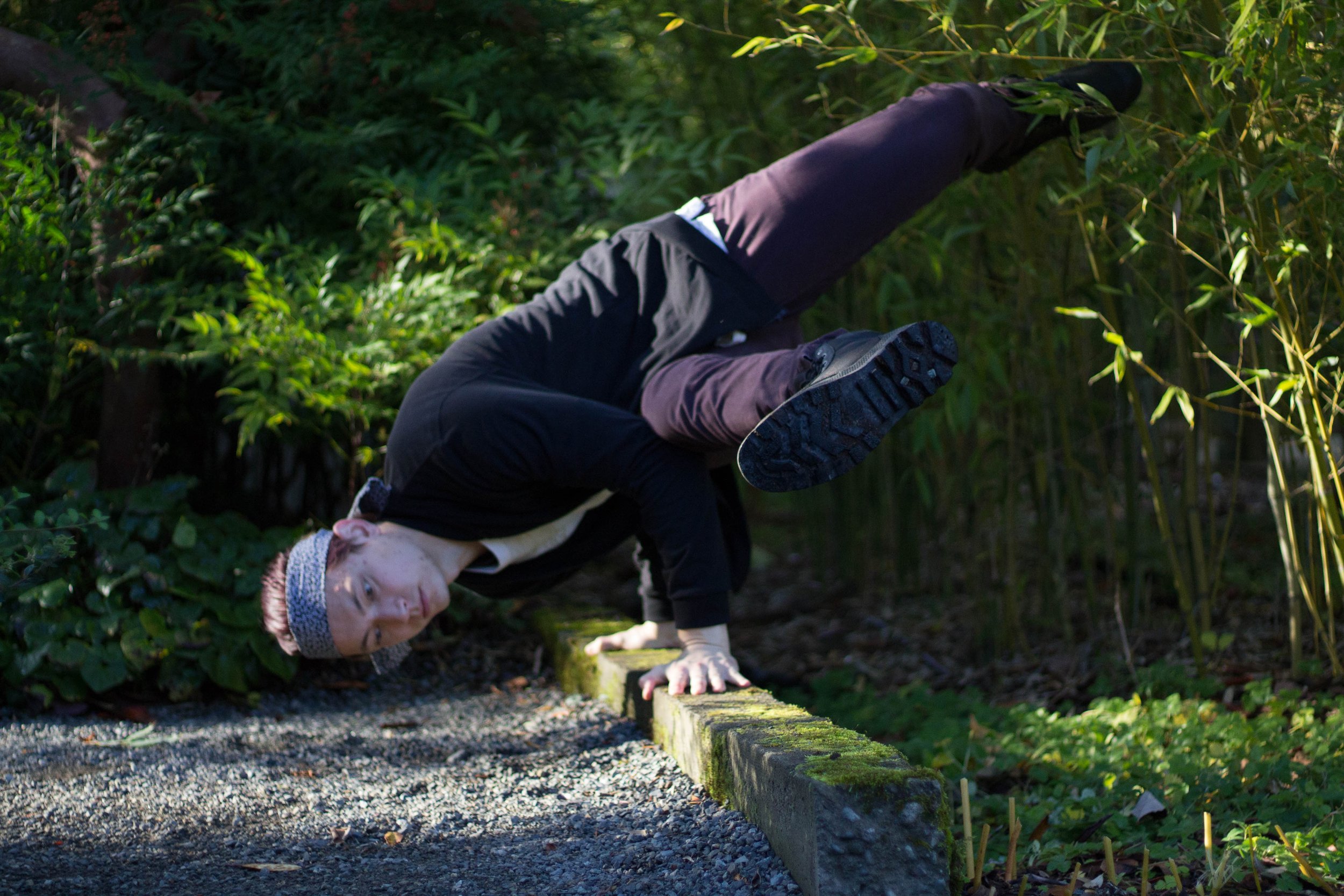
photo by Catlyn Griswell
Ethan
I do my best to stay well-nourished, rested, and calm in the week leading up to the audition. Morning of, I try to eat as big a breakfast as I can without becoming uncomfortable. I make sure to extra warmed-up, some auditions will not provide a warm-up, but most will provide open space for a little bit beforehand. When I warm-up I want to get all of my muscles activated, I want to have gotten my heart rate up, and to get a quick stretch in. Lastly, as I warm-up I listen to some of my favorite music to get amped up and try to get into the flow state. I always feel a little anxious and nervous before an audition but I can mitigate that by taking these steps.
Cherie
Going into an audition used to scare me more than anything. I think when I was younger especially I was constantly comparing myself to everyone else in the room, and I often saw myself as unworthy to be there. I let the nerves get to my head, so fast combinations would confuse me and difficult technique left me very flustered.
During my senior year of high school I was able to identify why I wanted to dance after taking some time off. I want to dance because I love being in a room full of dancers and feeling their energy. I love to dance because I enjoy the challenge. I love finding new movement pathways. So when I go into an audition, I just focus on the present. I don’t like to think about whether or not I’ll be cast or get into a certain program. I put a lot of energy into experiencing the moment, interacting with the other dancers, and getting lost in the movement. When I’m able to get myself in the right mindset, that is when I do my best work.
For some more ideas and products to help get ready see our “Competition & Convention Prep Piece!”
As you all enter into auditions, remember to take deep breaths, put your best foot forward, and dance with all your heart. You got this.
Seeing Color in the Dance Industry
It’s safe to say that most of us didn’t anticipate the first half of 2020 to go the way it has. Our lives have changed drastically in the past few months, some more than others. Not only has the COVID-19 pandemic modified nearly all aspects of our daily routines, but a national movement supporting black lives and opposing police brutality has ignited. The heartbreaking murder of George Floyd in Minneapolis has stirred global attention towards police brutality and racial inequity in America. There have been protests in solidarity with George Floyd in all 50 states and at least 40 additional countries on nearly every continent. Anger towards this grueling act of police brutality has transformed into a larger revolution against systemic racism that’s gone on for too long in the United States.
This piece was originally written in 2020 and has been reposted in February 2023.
By Madison Huizinga, DWC Blog Editor
It’s safe to say that most of us didn’t anticipate the first half of 2020 to go the way it has. Our lives have changed drastically in the past few months, some more than others. Not only has the COVID-19 pandemic modified nearly all aspects of our daily routines, but a national movement supporting black lives and opposing police brutality has ignited. The heartbreaking murder of George Floyd in Minneapolis has stirred global attention towards police brutality and racial inequity in America. There have been protests in solidarity with George Floyd in all 50 states and at least 40 additional countries on nearly every continent. Anger towards this grueling act of police brutality has transformed into a larger revolution against systemic racism that’s gone on for too long in the United States.
As we partake in protests, sign petitions, and watch riots unfold on television, many of us are contemplative of our position in this movement and greater society. And in light of social distancing, many of us are in close quarters with family members and roommates who may disagree with the demonstrations developing throughout the country. This can result in some uncomfortable conversations that some people may have never had before, especially among white people.
As a white person who grew up in a white family, race is an aspect of my identity I have never needed to consciously consider. I expect to see people who look like me on my favorite TV shows. I expect to purchase a foundation that matches my skin tone at the mall. I expect to learn how historical figures with my racial identity founded America in history class. I can walk around my community confidently knowing that nothing adverse will happen to me solely because of my race. I feel seen and heard wherever I go because I have learned that being white means being the default. And I have been taught to think that this is valid.
When it comes to discussions about race at my family dinner table and within the walls of my classrooms, I am often told that all people are the same regardless of their skin color. I am told that to push for justice, we must simply view all people equally to achieve equality within social systems and institutions. Throughout my education and upbringing, I have been taught to be “color blind,” which may sound beneficial in theory. But being blind to racial difference means ignoring white privilege and the disadvantages others have because of it. Choosing to be “color blind,” means choosing to ignore the flawed systems that white people benefit from at the expense of people of color’s rights. It means choosing to be blind to systemic oppression, and thus indifferent and complacent to the suffering of black people. It’s time that I, and white people everywhere, open their eyes.

Niyah Pratt, DWC Ambassador
Now is a more important time than ever to listen and learn about the systemic racism that’s embedded in the world we live in. It’s time that we identify how racism not only withholds power from people of color but actively contributes to white people’s success. This does not mean denying the existence of white privilege but utilizing privilege to amplify anti-racist sentiment. This does not just involve taking a stand during a moment of tragedy but constantly analyzing the systems we are a part of and understanding how prejudice is woven into their fabrics. For many of us, this means turning to the dance industry.
As a white woman, I see dancers who look like me strewn throughout the dance community. I constantly see my identity presented through the types of stories told on stage, as well as through the types of dancers telling those stories. In the United States, about 67% of dancers and choreographers are white, while only 16.6% are black. Like all art, dance is meant to express emotions, transport audiences to different worlds, and explore unique narratives. However, when the majority of these narratives are choreographed and performed by white people, it can be difficult for people of color to feel as represented on stage. When white people make up two-thirds of the American dance industry, we cannot expect dance to be a comprehensive art form that communicates widely shared anecdotes. We cannot expect people of color to feel as accepted in the dance community if they aren’t represented across every area of the industry.
Niyah Pratt is a black dancer who has trained in the greater Seattle area since she was six years old. She’s performed at numerous showcases, attended conventions across the west coast, and has even spent a summer dancing at Debbie Allen Dance Academy. Today she studies dance at the University of Nevada, Las Vegas. While dance currently plays a paramount role in Niyah’s life, she hasn’t always felt embraced by the dance community throughout her childhood. Niyah says that “it has always been hard being an African American pursuing dance,” largely because she rarely saw people within her classes and acclaimed companies that looked like her. Niyah recalls that she “didn’t fully know that there were companies other than Alvin Ailey that were started and ran by African Americans until [she] was sixteen.” It wasn’t until she attended a summer intensive at the Debbie Allen Dance Academy that she began learning about the history of African Americans in dance. Before that, her view of the dance world was skewed towards white dancers and their contributions.
Niyah notes that growing up she was “one of four African American dancers” at her studio, and often felt singled out as a result. She has attended ballet auditions in which she is the “only person of color in the whole building.” Niyah “never forgets walking into a room and every girl looking exactly the same except for [her].” She says that from her own experiences “having a darker complexion while dancing is mentally challenging.” Being surrounded by solely white dancers can instill imposter syndrome in many black dancers, otherwise known as a lack of belonging. Not feeling seen, accepted, and represented within the dance industry can easily deter many people of color from pursuing a career in dance, as they may feel that they aren’t talented or qualified enough to belong in the industry because of their race.
According to Niyah, being a black dancer is not only mentally challenging but “it’s physical as well” due to the lack of costuming options for black dancers. Niyah says that “anything skin-toned or with mesh” often makes black dancers “feel uncomfortable” because “they are made for someone ‘fair toned.’” Especially when it comes to shopping for tights, black dancers often struggle to find anything close to matching their skin tone. Niyah recounts a vivid memory of a faculty show in college, in which her ballet teacher requested to speak with her in the hallway and asked “why [she] didn’t have skin-colored tights or pointe shoes.” Niyah was extremely confused because she was wearing tights and shoes that were marketed and labeled as “skin tone,” even though they were much lighter than her complexion. Niyah’s teacher told her that “when you have darker skin, you are supposed to wear your tone of tights and shoes when you perform.” Niyah was surprised that no one had ever told her that. This a conversation that a white dancer would never need to have. As a white dancer myself, I can purchase “skin toned” tights and shoes at any store and expect them to resemble my skin tone. But for black dancers, this simply isn’t the case because “skin tone” is synonymous with “white” across the dance industry and society.
Despite the challenges Niyah has faced in the dance industry, she notes that there “has been significant progress” and she is “ecstatic seeing [the industry] evolve.” She has noticed that in recent years more dancers of color and dancers of different shapes and sizes have gained attention. While it’s certainly inspiring to see individual performers like Misty Copeland gain recognition for their talents, a large-level change is needed so that seeing black dancers in the spotlight becomes a standard and not an anomaly. What Niyah wishes to see across dance communities is “inclusion” and dance that “is taught for anyone and everyone.” This means telling stories through dance that are relevant to people of color. This means seeing black dancers in lead roles that are complex and powerful, rather than vilified, racialized, or minimized. This means creating nude leotards, tights, and pointe shoes that don’t just match a pale skin tone, but compliment dancers of all races. It’s about a complete metamorphosis of the dance industry on every level. In the words of Niyah Pratt, dance “is already so beautiful, diversity is the only thing keeping it from being stunning.”
The past few months have presented challenges that many of us may have never foreseen. But we have the opportunity to move forward with a more compassionate and critical outlook on the world. We have the chance to not let this movement be a moment in time, but a catalyst for change. It is never too late to break the silence to provide support for black lives today and forever. Here are some ways to get started:
Educate yourself:
Learn more about the history of racism in America, and more about how black identity is widely perceived in institutions. This is an essential way to understand the meaning behind the large injustices that take place throughout the United States.
Here are some books to read to learn more about the experiences of black people and how to have productive conversations about racial identity:
The New Jim Crowe: Mass Incarceration in the Age of Colorblindness by Michelle Alexander
We Were Eight Years in Power: An American Tragedy by Ta-Nehisi Coates
Here are some documentaries, films, and series that incapsulate the experiences of black people in the United States:
13th on Netflix and YouTube
When They See Us on Netflix
Moonlight
Dear White People on Netflix
The African Americans: Many Rivers to Cross
Consume and support art from black artists
There is a plethora of beautiful art produced and performed by black artists across the Internet. Here are some that are dance-related:
“SHOT” by Donald Byrd
DTH On Demand Presents: VESSELS by Dance Theatre of Harlem
“ink” by Camille A. Brown and dancers
Alvin Ailey American Dance Theater: Chroma, Grace, Takademe, Revelations (2015)
Sign petitions
On change.org, there are a variety of petitions relating to racial justice for people to sign. Learn about different causes that need support and share them with your friends and family.
Donate
A donation of any size is welcome to nearly every cause. If you are capable of donating, consider doing so. Here are some organizations to consider:
Interested in writing for the DWC Blog? Click below to fill out the DWC Contributor application!