
What Is a Pointe Shoe?: A Guide to the Advanced Dance Footwear
Dancers often try on many pairs of pointe shoes in their first fitting to ensure that the best fit possible is selected. At DWC, we strive to make out fittings both a fun and educational experience, so dancers can expect to be informed about the different properties of the different shoes they try. Once the best shoe for the dancer is selected, it’s important that students have their teacher approve of them before they begin sewing them.
By Madison Huizinga, DWC Blog Editor
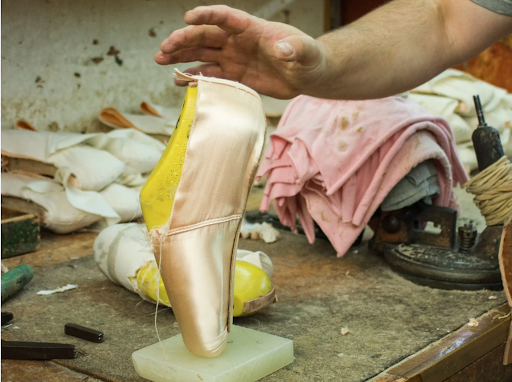
Pointe shoe from Freed of London being made on a last from Business Insider
Dancing “en pointe” is a common phrase in the dance industry. We often hear about prima ballerinas at large companies wearing “pointe shoes” or adolescent dancers working to earn their “pointe shoes.” But what exactly is a pointe shoe?
Pointe shoes are footwear specially designed for experienced dancers to wear to dance on the tips of their toes. In most classical ballets, like The Nutcracker, Swan Lake, and The Sleeping Beauty, you’ll see professional dancers donning pointe shoes onstage. While these dancers appear to glide across the stage in these shoes with ease, it takes years of training to be qualified to dance in them. Importantly, pointe shoes are not meant for beginning dancers who haven’t been cleared to wear them by a professional.
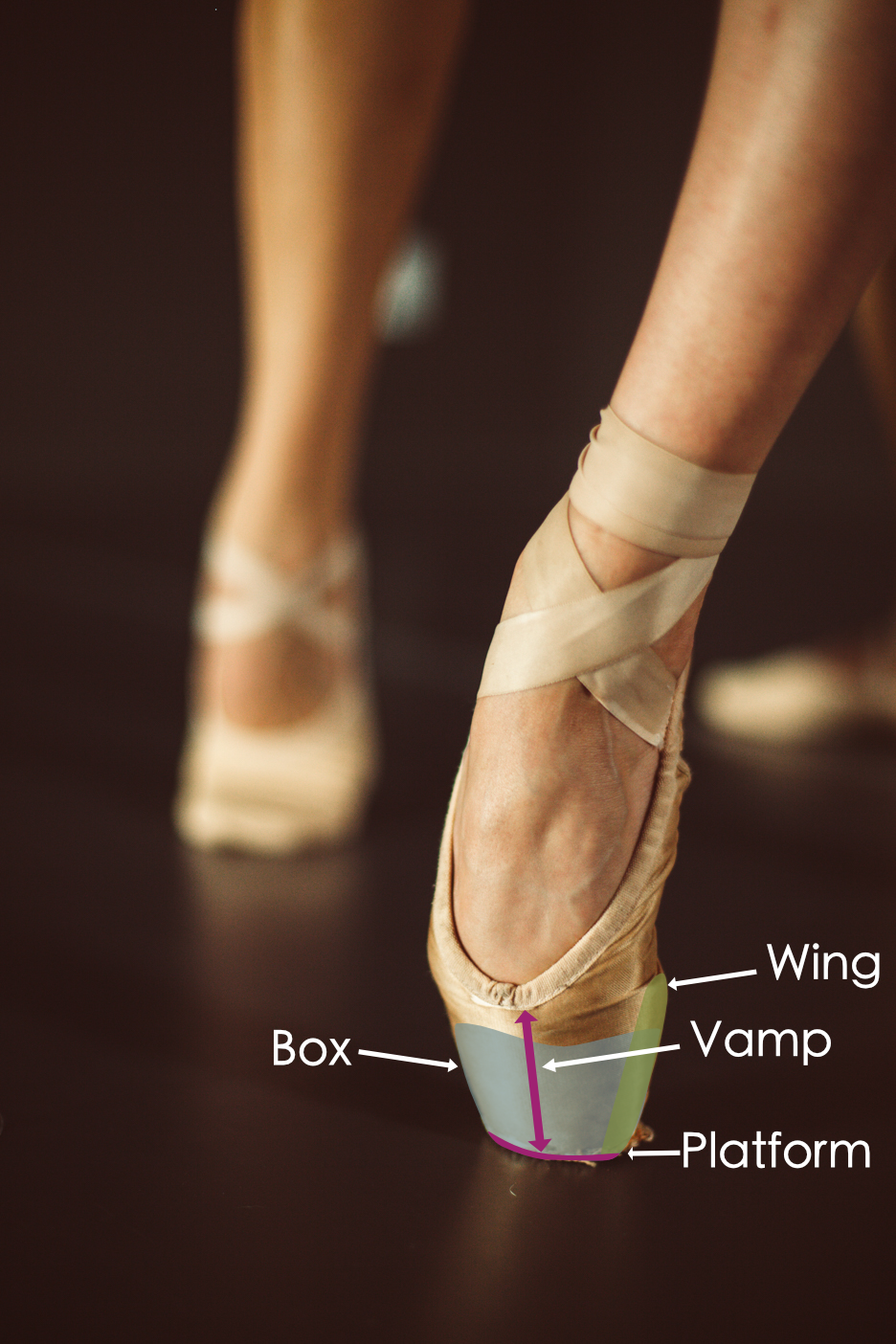
There are many different parts to a pointe shoe:
The Box
The “box” of a shoe is the hard, rectangular area that the toes and top of the feet are inserted into. This part of the shoe is made by applying layers of paper/cardboard and paste to a “last”: the mold that a pointe shoe is made on.
The Shank
The “shank” of the pointe shoe is the section that runs lengthwise across the bottom of the foot that helps support the foot’s arch. The shank is made out of leather and other composite materials. Added after the box is made, the shank is attached to the pointe shoe through a nailing and gluing process. Before the pointe shoe is sent to retailers and consumers, the maker will hammer and smooth out the box and finalize it by sewing on a drawstring and, in some cases, adding pleats.
The Crown
The “crown” of the shoe, otherwise known as the shoe’s “profile” or height when viewed from the side. Some pointe shoe profiles are graded, flat, or round, all of which impact how the dancer uses the shoe en pointe.
The Platform
The “platform” of the pointe shoe refers to the hard, flat surface at the tip of the shoe upon which the dancer balances.
The Vamp
The “vamp” of the pointe shoe refers to the length from the platform to the opening or “throat” of the shoe. Vamps can be “high” meaning there is a longer length from the platform to the throat of the shoe, and others can be “low” meaning there is a shorter length. Some vamps are U-shaped and others are V-shaped, and some have elasticized satin while others don’t.
The Wings
The “wings” of a pointe shoe are an extension of the vamp that provide support along the sides of the dancers’ feet. Some wings are high, meaning they extend further along the sides of dancers’ feet, and others are lower, meaning they don’t extend as far. Some wings are more collapsible and some are harder, some are rounded and some are straight.
The Drawstring & Casing
The drawstring, often made of either cotton or elastic, passes through the binding around the pointe shoe and ties at the top of the vamp. The drawstring casing is a piece of material stitched around the edge of the pointe shoe containing the drawstring. Pointe shoes with a drawstring and casing often have a U-cut style. Other pointe shoes may have no drawstring and instead, have an elasticized casing that fits snug around the foot. And other pointe shoes may have a V-cut style vamp and have no drawstring at all.
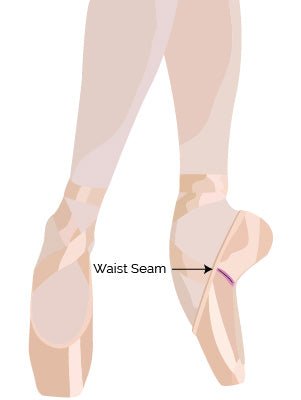
Photo from Inspirations Dancewear
The Waist Seam & Heel
The waist seam of a pointe shoe is a seam that joins the front and the back of the pointe shoe together. The heel of a pointe shoe can be structured or loose, wide or tapered, made of special stretch satin, made with structured, double-backed satin, and sometimes feature a “heel cup” designed to provide structure and create a seamless look.
Getting Fitted for Pointe Shoes
Getting fitted for pointe shoes is not like getting fitted for street shoes. Across the vast amount of pointe shoe brands available, there are a variety of styles that have different qualities. In addition, when fitting pointe shoes, fitters don’t just account for the length of a dancer’s foot, but also the width of their feet, the strength and flexibility of their feet, their toe shape and length, their heel shape, their foot profile, training experience, current dance goals, previous and current injuries, medical conditions, and more! All of these factors will influence what shoe the dancer ultimately ends up with.
In addition, getting properly fitted for pointe shoes requires the expertise of pointe shoe fitters. Pointe shoe fitters at Dancewear Center participate in required continuing education on a weekly, monthly, and quarterly basis, and have been trained in an array of professional fitting methods, including those from Bloch, Russian Pointe, So Danca, and most recently, the Progressive Pointe Method from ThePointeShop. There are a variety of factors our fitters consider when fitting dancers for pointe shoes, like making sure the dancer is over the shoe’s box, making sure the shank is providing adequate support, making sure they aren’t “sinking” or sitting in the shoe, and much more.
How To Prepare for your First Pointe Shoe Fitting with DWC
Get Assessed for Pointe Readiness
If you’re a student, you should be approved by your dance teacher to get fitted for pointe shoes or demi-pointe shoes before coming to Dancewear Center. If not trained under the guidance of a professional, dancing in pointe shoes can be a dangerous experience. Here at DWC, we also love fitting adults who wish to train en pointe or those returning to dancing en pointe. Many studios in the Seattle area offer classes for adults, including Dance Conservatory Seattle, Dance Fremont, American Dance Institute, Second Act Dance, ARC Dance, Westlake Dance Center, and more. We recommend that adults interested in dancing en pointe get assessed by a physical therapist for pointe readiness. Check out our dance medicine specialist page for information about dance specialists in the Seattle area.
Book a Pointe Shoe Fitting
Expert pointe shoe fitting teams require dancers to make an appointment. If a dancer arrives without an appointment, they will be assisted in scheduling one for a later date. Appointments can be booked through DWC’s website for our Kirkland or Renton locations, and group or mobile fittings can be requested by emailing info@dancewearcenter.net. It’s important that dancers allot around 45 minutes for their first appointment with DWC to allow for a thorough assessment and fitting process. Pointe shoe fittings are subject to a $25 service fee that is waived with the purchase of pointe shoes, and late arrivals will be charged the $25 fitting fee and asked to reschedule at a later time.
Prior to Your Fitting
Prior to their appointment, dancers will be sent information about what to expect and how to prepare for their appointment. Dancers should make sure their feet are clean and toenails are trimmed - we recommend trimming toenails two days before their appointment. Dancers should also wear transition/convertible tights to their fitting and bring the most recent pair of pointe shoes and the padding they normally wear with them. For more information, dancers and parents can also check out this pointe shoe fitting informational page on DWC’s website and this informational video on our YouTube page.
During the Fitting
At the beginning of a dancer’s first fitting, dancers will be greeted by one of our knowledgable pointe shoe fitters who will give dancers an overview of the fitting process. The fitter will ask questions and take notes about previous pointe shoes, injuries, current training, and much more, as well as take a visual assessment of the dancer’s bare feet. This will allow the fitter to have a better understanding of what types of pointe shoes they should pull for dancers to try on and the padding they suggest. For example, for dancers who have bunions and experience bunion pain, our fitters may advise them to use a silicone gel spacer and to see a physical therapist who specializes in dance medicine. Also, dancers will often be advised to wear padding like “Ouch Pouches,” made from gel and polyester upon their first fitting.
After the feet are assessed and additional equipment is administered, it’s time for the fun part: trying on the shoes! Notably, pointe shoes fresh out of the package have no elastic or ribbon attached. Elastics and ribbons will need to be purchased separately, as well as a sewing kit for dancers to sew them on themselves.
Dancers often try on many pairs of pointe shoes in their first fitting to ensure that the best fit possible is selected. After trying on many pairs, the fitter and dancer will narrow down the best final options. The dancer will be asked a lot of questions to ensure that the best possible shoe is selected. At DWC, we strive to make our fittings both a fun and educational experience, so dancers can expect to be informed about the different properties of the various shoes they try. Once the best shoe for the dancer is selected, it’s important that students have their teacher approve of them before they begin sewing them.
Following their appointment, dancers will receive a follow-up email reminding them that the DWC fitters are available at any time after the fitting to answer questions about their shoes. The DWC staff also keeps records of dancers' preferred pointe shoes and sizes to provide more information for future refittings.
Important Reminders
Pointe shoes only last 10-20 dancing hours on average. To help prolong the life of pointe shoes, it’s important to give them the opportunity to dry out in between wears, which takes up to 48-72 hours. Storing and transporting pointe shoes in mesh bags can aid with the drying process as well as help alleviate their sweaty smell. It’s also important to remember to keep pointe shoes out of the reach of pets!
We recommend that dancers schedule refitting appointments for their first 2-3 pairs of shoes and every six months after that or if they’re experiencing issues with their shoes. Refittings are important, as dancers’ feet can change drastically after dancing en pointe. At pointe shoe refittings, fitters will take a look at the dancer’s old pair of pointe shoes to analyze how they’re breaking down to figure out how the dancer’s needs have changed since their first fitting. The fitters will have a conversation with the dancer about their shoes, asking what they liked and disliked about them and what their typical experience in the shoe was like.
Working consistently with a professional fitter throughout a dancer’s journey is essential for ensuring that dancers are performing their best and are in the shoes that fit their needs best at that time. The pointe shoe industry is rapidly innovating and DWC fitters are constantly working to improve their skillset by involving themselves in continuing education, learning about the latest medical research and technology, and more. Dancers can feel confident that they are in good hands with DWC fitters.
This is just the tip of the iceberg when it comes to pointe shoes! But we hope it provides you with a solid baseline of knowledge about the complex and exciting world of pointe shoes. Book your pointe shoe fittings with Dancewear Center today here!

Sources:
https://www.pbt.org/learn-and-engage/resources-audience-members/ballet-101/pointe-pointe-shoes/
https://www.businessinsider.com/what-its-like-ballet-pointe-shoe-maker-freed-of-london-2021-6
https://dancewear-center.myshopify.com/products/super-spacers-cap?_pos=3&_sid=f912ccba0&_ss=r
https://dancewear-center.myshopify.com/products/ouch-pouch-jr-large-cap?_pos=6&_sid=61d304c77&_ss=r
https://www.rpcollection.com/perfect-fit/finding-your-perfect-fit/pointe-shoe-drawstring/
https://creativeartsacademyutah.wordpress.com/for-dancers/learn-reflect/pointe-shoe-anatomy/
Disclaimer
All content found on the Dancewear Center Website, Instagram, Facebook, Pinterest, and all other relevant social media platforms including: text, images, audio, or other formats were created for informational purposes only. Offerings for continuing education credits are clearly identified and the appropriate target audience is identified. The Content is not intended to be a substitute for professional medical advice, diagnosis, or treatment. Always seek the advice of your physician or other qualified health provider with any questions you may have regarding a medical condition. Never disregard professional medical advice or delay in seeking it because of something you have read on this Website.
If you think you may have a medical emergency, call your doctor, go to the emergency department, or call 911 immediately. Dancewear Center does not recommend or endorse any specific tests, physicians, products, procedures, opinions, or other information that may be mentioned on dancewearcenter.net. Reliance on any information provided by dancewearcenter.net, Dancewear Center employees, contracted writers, or medical professionals presenting content for publication to Dancewear Center is solely at your own risk.
Links to educational content not created by Dancewear Center are taken at your own risk. Dancewear Center is not responsible for the claims of external websites and education companies.
Inside Dancewear Center’s Continuing Education
“One of our core values is integrity and I feel like that shines through in the fitting process,” Samantha says. “We’re here to make sure that the dancer goes home in something that is as safe and comfortable as possible. We always prioritize the dancer over the sale, every single time.” She’s excited to be a part of a pointe shoe fitter community that works to empower dancers with informed knowledge about their pointe shoes, as well as help build out a larger fitter knowledge base.
A Look Into DWC Pointe Shoe Fitters’ Processes
By Madison Huizinga, DWC Blog Editor
Since Samantha Weissbach took over ownership of Dancewear Center in 2018, she and the rest of the DWC team have tasked themselves with offering dancers high-quality products and pointe shoe fittings. A big part of providing community members with knowledgeable pointe shoe fittings is staying up to date on the latest product knowledge and progressing the staff’s knowledge base with continuing education training sessions and programs. Read on to learn more about Dancewear Center’s continuing education processes from the staff members themselves.
Owner & General Manager Samantha Weissbach says that new pointe shoe fitters go through an initial training that involves shadowing another fitter. “When somebody is in training, [I try] to get them with as many senior fitters as possible,” she shares. Pointe Shoe Fitter Tija Dupont recalls sitting in on fittings, in which she would take notes and ask questions. Once onboarded and fitting on their own, fitters meet weekly with Samantha for one-on-one check-ins, in which case studies are reviewed and questions are answered. “We go over notes from their past week,” Samantha says, sharing that they also go over notes for the upcoming fittings for the week.
Samantha shares that the fitters also undergo in-depth quarterly training sessions and monthly fitters educational meetings, where case studies are discussed, new products are introduced, and more. Assistant Store Manager Anna Peters says that the quarterly sessions are useful, as the team discusses product knowledge, customer interactions, and more. Tija recalls her first training seminar with Dancewear Center, in which she was introduced to every single shoe the store carries. She shares that the initial seminar was extremely helpful, as she was able to take detailed notes which she still references from time to time. Tija also shares that in later training sessions, fitters were given extensive training on customer service, including role-playing sessions in which different scenarios were acted out with the staff. Anna says that Samantha makes an effort to intermix more written, textbook-style learning with hands-on learning so there’s something for many types of learning styles.
Outside of the internal training, DWC fitters and staff also undergo training sessions with different pointe shoe manufacturers, such as Russian Pointe, So Danca, and Bloch. Anna recalls undergoing virtual fitting training sessions with all brands. Samantha shares that fitters even observed Freed fitters fit pointe shoes at Pacific Northwest Ballet.
Senior pointe shoe fitters also undergo external certification processes, including the Progressive Pointe Method, a pointe shoe fitting curriculum offered by ThePointeShop. Dancewear Center is also closely connected with ThePointeShop and Master Pointe Shoe Fitter Josephine Lee through ThePointeShop Retail Partnership, making DWC a recommended store by experts like Josephine.
Anna says that just the basic training was eleven weeks long and was focused on the basics of fitting, sizing, troubleshooting, product knowledge, and much more. Samantha also views continuing education as a collaborative effort, creating dialogues with other dancewear store owners and pointe shoe fitters across the country including Beam & Barre in Greenwich, Connecticut.
Samantha is also a member of DanseMedica and participates in monthly “mastermind” calls in which she connects with specialists in the dance medicine world. She is also currently enrolled in the Pointe Safe Certification course, where she’s learned more about anatomy, strength, and how to progress young students en pointe safely. This course informs her teaching efforts outside DWC as well as her fittings. Samantha is also a part of Seattle Performing Arts Medicine (SeaPAM), which features Seattle-based medical professionals. She attends SeaPAM journal club meetings every other month in which members meet together to review case studies, look at medical journals, discuss work they’re doing in realms relating to dancers’ physical and mental health, and more.
“I try to stay up to date with dance medicine and bring anything that’s relevant up with the team,” Samantha shares.
Tija says that Samantha makes an effort to be hands-on with fitters during the training process and allows them to be hands-on when learning. She shares that there are a lot of opportunities for fitters to explore fitting in non-judgmental environments before they work with customers so that they can learn by doing. “I feel super confident,” Tija says of her fitting abilities following the training sessions she’s experienced. After much practice, she feels comfortable finding dancers the best shoe for them in a reasonable amount of time.
Anna also expresses the confidence she’s gained from training, sharing that the knowledge she’s gathered is much more intuitive, allowing her to have much more efficient fittings. “I think we’ve managed to streamline the whole process. We’re a lot more organized,” Anna says, referencing the notes that DWC has on hand on customers’ pointe shoe preferences. She also says the DWC community as a whole has gotten much more friendly, happy, and confident as they’ve gained more fitting knowledge and experience.
“We try to help each individual develop their own fitting style because it is going to be different for everyone,” Samantha says of the different ways individuals can approach pointe shoe fitting.
Samantha shares that the extensive training and resources available to DWC fitters today have allowed for the establishment of a more helpful guiding framework for employees to use when fitting pointe shoes. “People are progressing a lot faster and part of that is [due to] having a solid knowledge base,” Samantha says.
Being able to pair the newer fitters with more experienced pointe shoe fitters has also greatly facilitated the fitter onboarding and education process. Samantha says that being able to split the fitting process into different categories and sub-categories, has allowed fitters to understand both the mechanics and empathy required of the process. In general, Samantha says that the more detailed training process has allowed new fitters to feel more confident when they fit on their own for the first time.
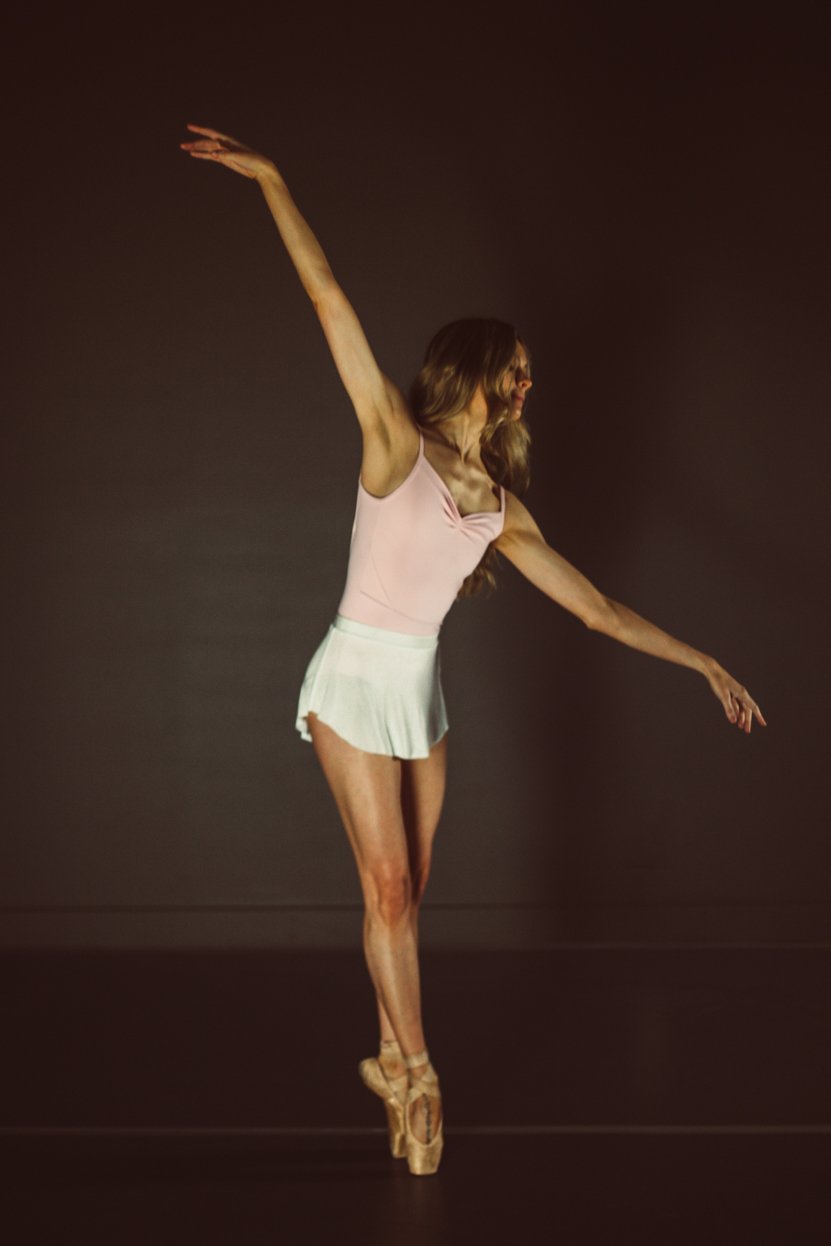
click below to shop the look
Tija shares that the learning process never stops as a fitter. “Every time I go into watch a fitting or do a group fitting, [it’s] still very educational,” she vocalizes. Tija also expresses her appreciation for the relationships she’s developed with customers, sharing that she’s grateful for the mutual understanding and transparent communication that’s developed between fitters and dancers.
Anna appreciates how available and accessible Samantha makes continuing education. “She’s very supportive of any continuing education that [we] want to take part in,” Anna says.
“One of our core values is integrity and I feel like that shines through in the fitting process,” Samantha says. “We’re here to make sure that the dancer goes home in something that is as safe and comfortable as possible. We always prioritize the dancer over the sale, every single time.” She’s excited to be a part of a pointe shoe fitter community that works to empower dancers with informed knowledge about their pointe shoes, as well as help build out a larger fitter knowledge base.
Sources:
Disclaimer
All content found on the Dancewear Center Website, Instagram, Facebook, Pinterest, and all other relevant social media platforms including: text, images, audio, or other formats were created for informational purposes only. Offerings for continuing education credits are clearly identified and the appropriate target audience is identified. The Content is not intended to be a substitute for professional medical advice, diagnosis, or treatment. Always seek the advice of your physician or other qualified health provider with any questions you may have regarding a medical condition. Never disregard professional medical advice or delay in seeking it because of something you have read on this Website.
If you think you may have a medical emergency, call your doctor, go to the emergency department, or call 911 immediately. Dancewear Center does not recommend or endorse any specific tests, physicians, products, procedures, opinions, or other information that may be mentioned on dancewearcenter.net. Reliance on any information provided by dancewearcenter.net, Dancewear Center employees, contracted writers, or medical professionals presenting content for publication to Dancewear Center is solely at your own risk.
Links to educational content not created by Dancewear Center are taken at your own risk. Dancewear Center is not responsible for the claims of external websites and education companies.
Interested in writing for the DWC Blog? Click below to fill out the DWC Contributor application!