
How to Create a Dancer Warm Up and Why it is Important
As a young dancer I never really considered the importance of warming up. If you looked across the room before a ballet class I remember seeing dancers sitting in their middle splits, legs on the barre stretching forward and chatting about their weekend plans. When I got to college level dance I discovered my schools recreation center and weight room. It was not until my Anatomy and Physiology class in college that I learned how to strength train and why it is so beneficial in activities like jumping and leaping that was necessary in dance.
By Caroline Schmidt, ACE CPT, DWC Ambassador
pronouns: she/her | pronunciation: kay-row-line sh-midt
As a young dancer I never really considered the importance of warming up. If you looked across the room before a ballet class I remember seeing dancers sitting in their middle splits, legs on the barre stretching forward and chatting about their weekend plans. When I got to college level dance I discovered my schools recreation center and weight room. It was not until my Anatomy and Physiology class in college that I learned how to strength train and why it is so beneficial in activities like jumping and leaping that was necessary in dance. In undergrad I started personal training and discovered a warm up routine that worked for my body. The first most important thing when creating a warm up is to ask yourself what is required of me? In running you need strong legs and core, for rock climbing you need mobility and upper body strength, in swimming you need length and power. My warm up routine is a combination of yoga, running and strength training that I have found over the years!
You might ask: why do I need to warm up? I am a young dancer I can just jump right in to my dancing right? Well, there are many benefits to a good warm up. The most important thing is that it is a gentle way to start preparing your body for what is to come. If you were to do a heavy squat you wouldn’t just jump in to lifting the heaviest weight right? You start with a gentle activation of the muscles to tell them it’s time to work. It is also good for your muscles and your heart to gradually build up to movements. A warm up is also really important to decrease the likelihood of injury. If you go too hard too fast you might tear a muscle or hurt yourself.
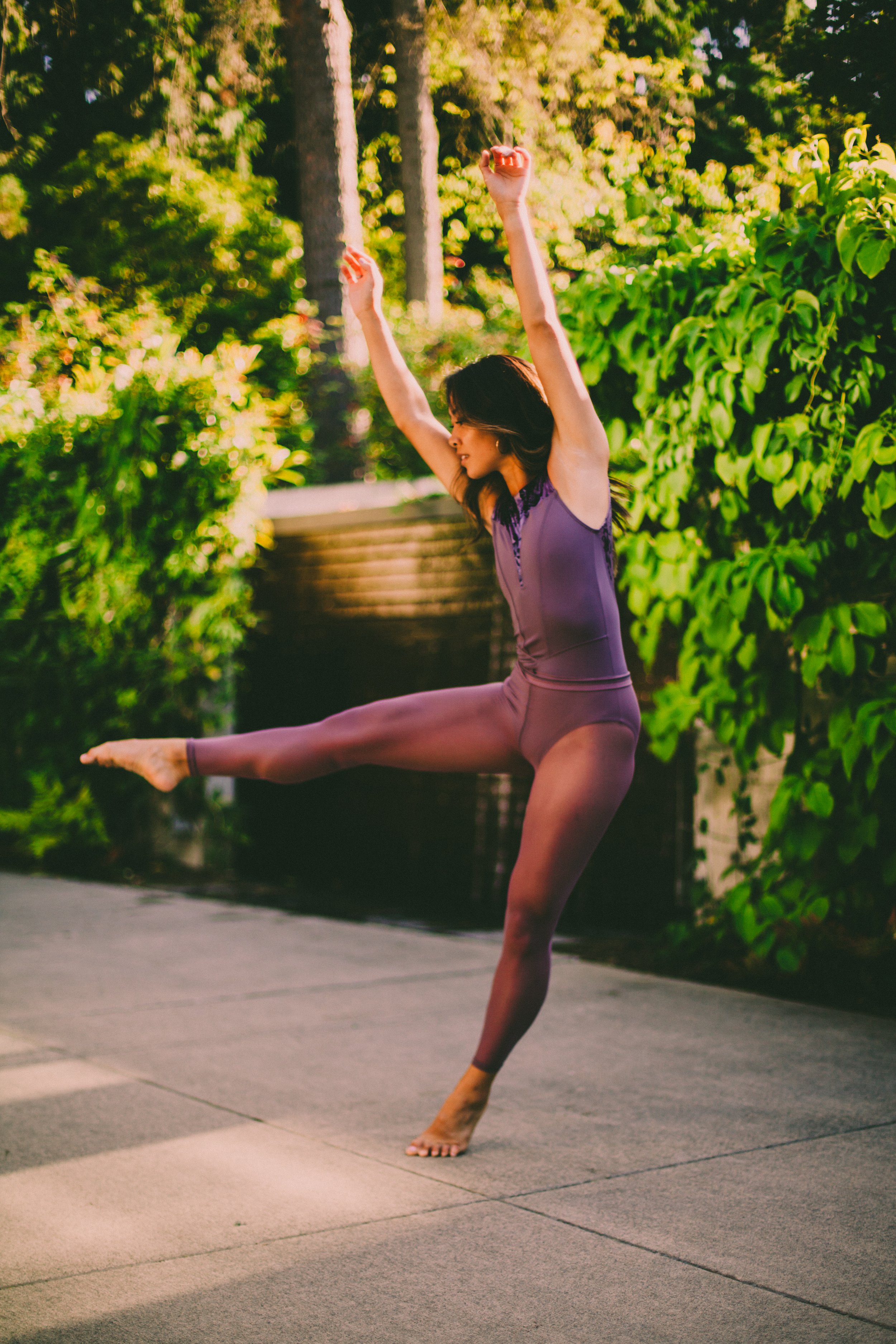
Studies have shown the importance of a good warm up and how it can increase your performance in 79% of all aspects being analyzed. This analysis has shown that performance improvements can be seen after completion of adequate warm-up activities, and there is little evidence to suggest that warming-up is detrimental to sports participants. (Fradkin et al, 2010). There has been a large debate regarding if static stretching before activity decreases physical athletic performance. I prefer a dynamic stretching approach which you can see is built into my example warmup program. Dynamic stretching is where you are stretching throughout a range of motion however you aren't just sitting in a position for prolonged period of time. You are active and using your muscles to move through the range. I like this because it is more functional in dance! There are also some detrimental effects to just static stretching especially before you are warm enough including decreasing your ability to produce a strong muscle contraction for powerful movements like jumping and thus decreasing performance (McMillan, 2006).
I like to take a very analytical approach to my warm up. You have your major joints and its a good idea to warm up each major muscle group. Major muscle groups include: glutes/hamstrings, quads/ hip flexors, shins and calves, abdominals, chest pushers and pullers. An exercise for each with a gentle activation will start to remind these muscles it's time to work! I like to start with a whole body connection to get the blood flowing and end with a full body connection moment putting everything together. I also like to do exercises where I am not only stretching but strengthening to start to build the neural connections. This is an example warm up routine that I have found works for my body but may not necessarily for everyone!

My Warm Up Routine:
Step 1: whole body connection movement
- Sun Salutation from standing into plank and hip stretch with worlds greatest stretch
Step 2: chest pushers
- Plank shoulder taps
Step 3: back pullers
- Superman and lat pulls
Step 5: quads/ hip flexors - Bird dogs
Step 4: glutes/hamstrings - Bridges
Step 6: abdominals
- Dead bugs
Step 7: shins and calves
- Squat into a calf raise
Step 8: full body connection moment puting everything together
- Single leg RDL with arm movements (balance incorporated into the movement)
Resources
Fradkin AJ, Zazryn TR, Smoliga JM. Effects of Warming-up on Physical Performance: A Systematic Review With Meta-analysis. Journal of Strength and Conditioning Research. 2010;24(1):140-148. doi:https://doi.org/10.1519/jsc.0b013e3181c643a0
Kozai A, Surgenor B, Ma. The Importance of a Good Warm-Up: Are You Warm Enough to Start Dancing?; 2017. https://iadms.org/media/3598/iadms-resource-paper-the-importance-of-a-good-warm-up.pdf
McMillian DJ, Moore JH, Hatler BS, Taylor DC. Dynamic vs. Static-Stretching Warm Up: The Effect on Power and Agility Performance. The Journal of Strength and Conditioning Research. 2006;20(3):492. doi:https://doi.org/10.1519/18205.1
NYSMI | The Importance of Stretching and Warm Up Exercises Before Physical Activity. Accessed August 24, 2023. https://nysportsmedicineinstitute.com/the-importance-of-stretching-and-warm-up-exercises-before- physical-activity/#:~:text=Warming%20up%20exercises%20increase%20blood
Disclaimer
All content found on the Dancewear Center Website, Instagram, Facebook, Pinterest, and all other relevant social media platforms including: text, images, audio, or other formats were created for informational purposes only. Offerings for continuing education credits are clearly identified and the appropriate target audience is identified. The Content is not intended to be a substitute for professional medical advice, diagnosis, or treatment. Always seek the advice of your physician or other qualified health provider with any questions you may have regarding a medical condition. Never disregard professional medical advice or delay in seeking it because of something you have read on this Website.
If you think you may have a medical emergency, call your doctor, go to the emergency department, or call 911 immediately. Dancewear Center does not recommend or endorse any specific tests, physicians, products, procedures, opinions, or other information that may be mentioned on dancewearcenter.net. Reliance on any information provided by dancewearcenter.net, Dancewear Center employees, contracted writers, or medical professionals presenting content for publication to Dancewear Center is solely at your own risk.
Links to educational content not created by Dancewear Center are taken at your own risk. Dancewear Center is not responsible for the claims of external websites and education companies.
Ian Howe on His Journey with Mental Health & Dance
DWC Ambassador, Ian Howe, speaks about his journey through dance during the pandemic. His story is especially interesting as a studio owner! Often we don’t hear from that aspect of the dance industry and it’s refreshing to get a different perspective on the dance world. He also bravely speaks to his difficulties with mental health, anxiety and depression. Ian shares that while things can still be difficult, he is progressing forward and you may be able to relate. Watch the video for the full talk!

“One of the biggest things I needed to learn, is that it’s okay to not be able to do EVERY thing.”
DWC Ambassador, Ian Howe, speaks about his journey through dance during the pandemic. His story is especially interesting as a studio owner! Often we don’t hear from that aspect of the dance industry and it’s refreshing to get a different perspective on the dance world. He also bravely speaks to his difficulties with mental health, anxiety and depression. Ian shares that while things can still be difficult, he is progressing forward and you may be able to relate. Watch the video for the full talk!
Disclaimer
All content found on the Dancewear Center Website, Instagram, Facebook, Pinterest, and all other relevant social media platforms including: text, images, audio, or other formats were created for informational purposes only. Offerings for continuing education credits are clearly identified and the appropriate target audience is identified. The Content is not intended to be a substitute for professional medical advice, diagnosis, or treatment. Always seek the advice of your physician or other qualified health provider with any questions you may have regarding a medical condition. Never disregard professional medical advice or delay in seeking it because of something you have read on this Website.
If you think you may have a medical emergency, call your doctor, go to the emergency department, or call 911 immediately. Dancewear Center does not recommend or endorse any specific tests, physicians, products, procedures, opinions, or other information that may be mentioned on dancewearcenter.net. Reliance on any information provided by dancewearcenter.net, Dancewear Center employees, contracted writers, or medical professionals presenting content for publication to Dancewear Center is solely at your own risk.
Links to educational content not created by Dancewear Center are taken at your own risk. Dancewear Center is not responsible for the claims of external websites and education companies.
How To Tie Ballet Flats
Ballet shoes come in many different shapes and sizes. Some can be black, pink, or white and have strings or no strings, but for shoes with strings, it is important to know how to tie them for classes. DWC Staff Member Emma Neilson is here to help give you some tips and tricks on how to tie your strings properly! Read on to learn more!
By Emma Neilson, DWC Social Media Manager & Pointe Fitter

Ballet shoes come in many different shapes and sizes. Some can be black, pink, or white and have strings or no strings, but for shoes with strings, it is important to know how to tie them for classes. DWC Staff Member Emma Neilson is here to help give you some tips and tricks on how to tie your strings properly! Read on to learn more!
Materials needed:
Ballet flats with strings
Tape
To start, put the shoe onto your foot and pull the drawstring so the extra fabric around the shoe is flat against your skin.
Once the drawstring is pulled, tie the two elastic pieces into a bow.
Take off the shoe and get a small piece of tape.
Grab the ends of the bow, pull them together, and put the tape around the strings.
Tuck the strings into the front of the shoe and push the tape down on the front inside of the shoe.
Try on the shoe and make sure that the tape doesn’t fall off. If needed, use more tape!
We hope that these steps can help you if you need to tie your ballet flats. Each teacher is different so be sure that you find out what they would like first before cutting or tying your shoes! Be sure to watch the full video for a visual step-by-step on how to tie your shoes!
Disclaimer
All content found on the Dancewear Center Website, Instagram, Facebook, Pinterest, and all other relevant social media platforms including: text, images, audio, or other formats were created for informational purposes only. Offerings for continuing education credits are clearly identified and the appropriate target audience is identified. The Content is not intended to be a substitute for professional medical advice, diagnosis, or treatment. Always seek the advice of your physician or other qualified health provider with any questions you may have regarding a medical condition. Never disregard professional medical advice or delay in seeking it because of something you have read on this Website.
If you think you may have a medical emergency, call your doctor, go to the emergency department, or call 911 immediately. Dancewear Center does not recommend or endorse any specific tests, physicians, products, procedures, opinions, or other information that may be mentioned on dancewearcenter.net. Reliance on any information provided by dancewearcenter.net, Dancewear Center employees, contracted writers, or medical professionals presenting content for publication to Dancewear Center is solely at your own risk.
Links to educational content not created by Dancewear Center are taken at your own risk. Dancewear Center is not responsible for the claims of external websites and education companies.
What's In Your Dance Bag?
Everyone knows as dancers that our dance bag is a sacred place. It holds all of our stinky shoes after dancing for hours on end and seems to be an abyss for endless amounts of bobby pins. With each new dance season, new goodies are needed to last the dance season which can add up quickly. We asked some of our DWC Ambassadors what was in their dance bag to give a special look into their go-tos and their necessities they need for classes! Read on to learn more about what is in their dance bags!
By The DWC Ambassadors
Everyone knows as dancers that our dance bag is a sacred place. It holds all of our stinky shoes after dancing for hours on end and seems to be an abyss for endless amounts of bobby pins. With each new dance season, new goodies are needed to last the dance season which can add up quickly. We asked some of our DWC Ambassadors what was in their dance bag to give a special look into their go-tos and their necessities they need for classes! Read on to learn more about what is in their dance bags!

Caroline
Hair bands or claw clip
Water bottle
Snacks (fired mango or granola bar bc I am always hungry!)
Sweatshirt or long sleeve to wear for warmups
Kindle and computer if I have some downtime
Native deodorant
Apple Watch
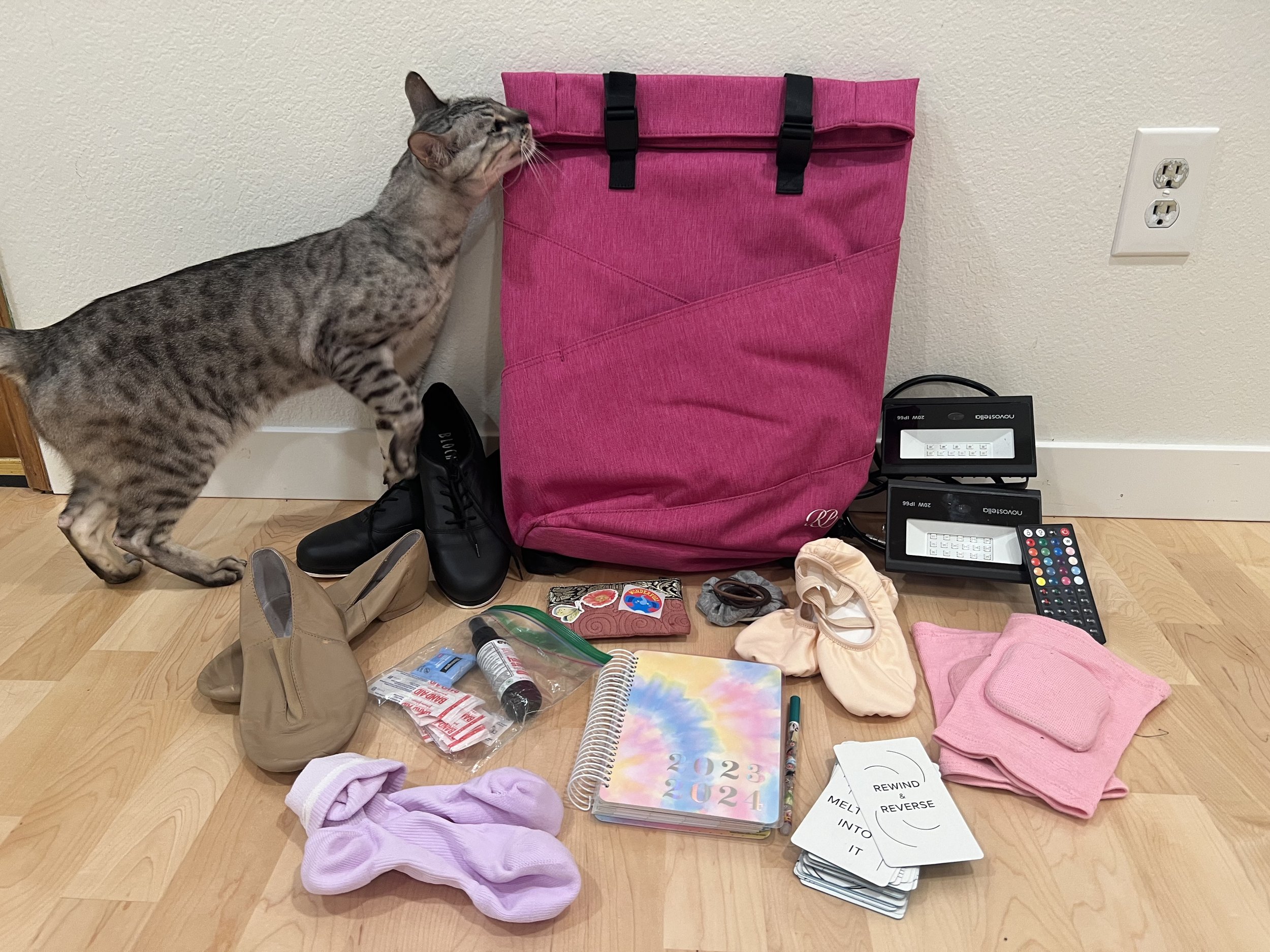
Marika
Band aids, hand sanitizer, makeup wipes
Sticker pouch
Hair ties
Planner
Movement cards
Knee pads
Colored room lights
I always carry a snack :) (Not shown)
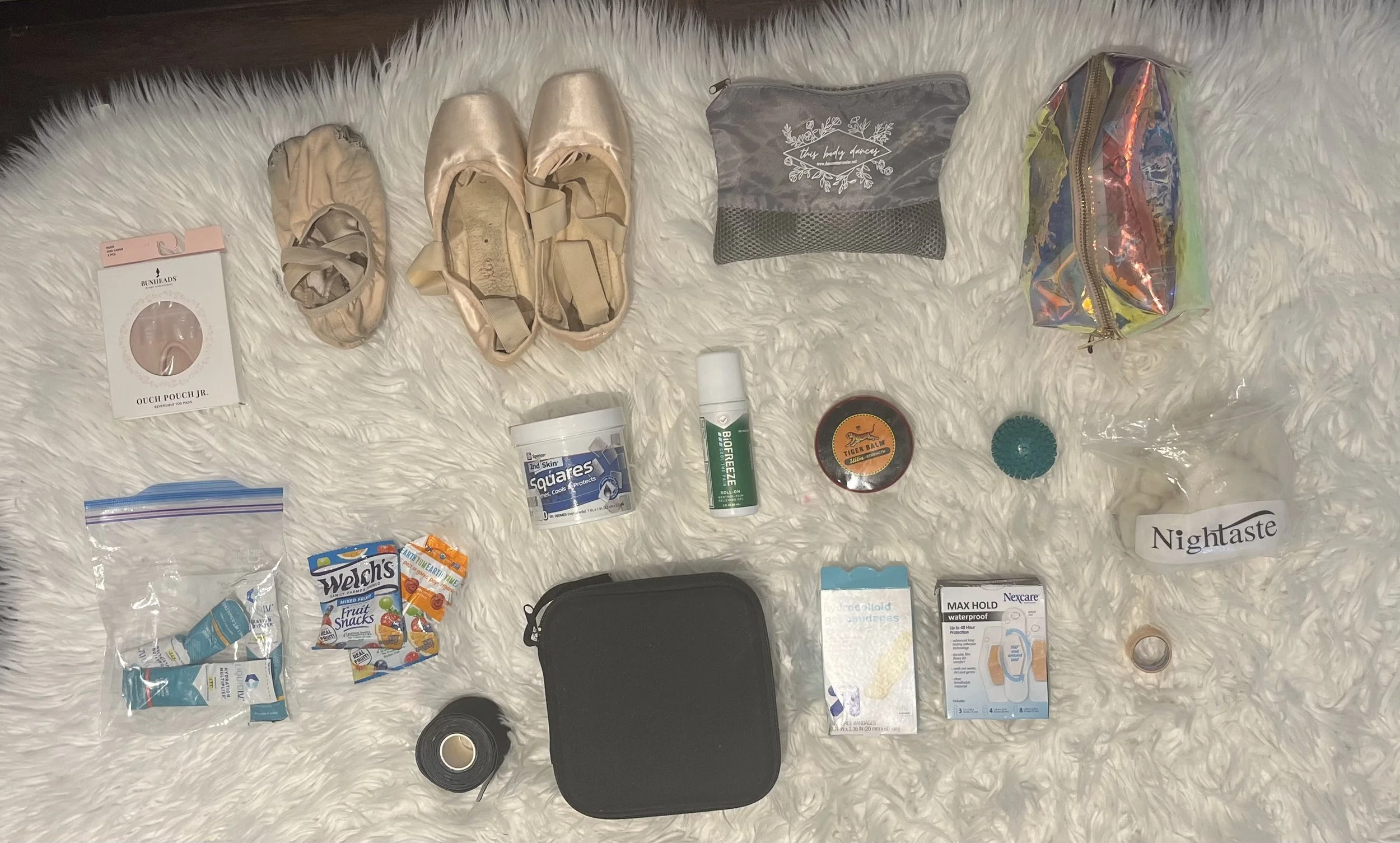
Alaina
In my dance bag I try to keep only the essentials, so I can have a clean and organized bag. I also keep my pointe shoes and flat ballet shoes with me. I currently love the SoDanca ballet flat shoes, and the Mirella whisper pointe shoes. I keep all of my pointe essentials in my Dancewear Center mini zip bag. My favorite toe pads are from Bunheads. 2nd Skin Squares are my favorite for blisters so I always keep them on hand. I also keep blister bandaids and other types of tape with me for injuries and injury prevention. Biofreeze and Tiger Balm are two of my absolute essential items. There is also a mini Thera gun I keep in my bag for post class muscle recovery. Finally I like to keep a few snacks that are high in sugar and easy to digest for quick in between class energy boosts.
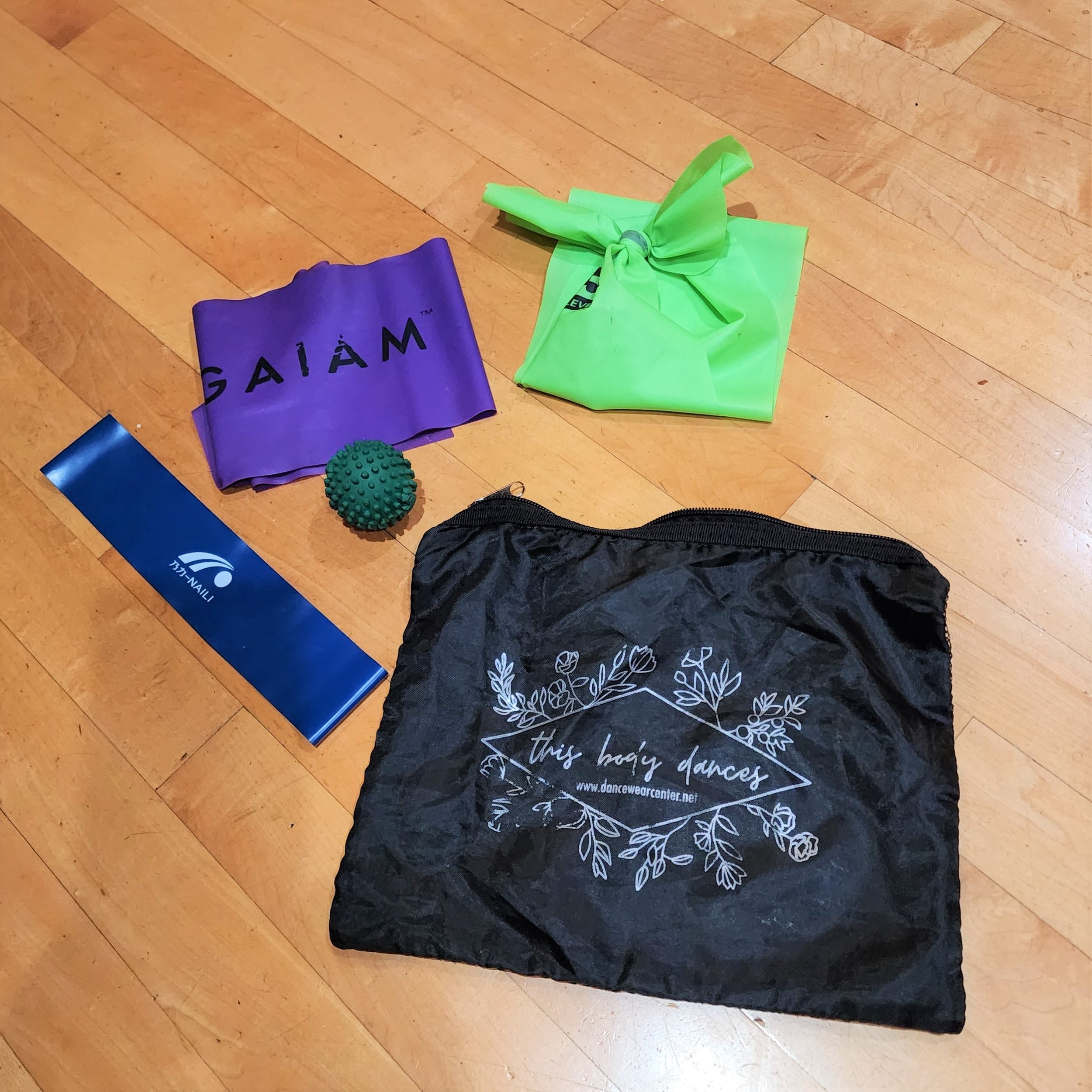
Vania
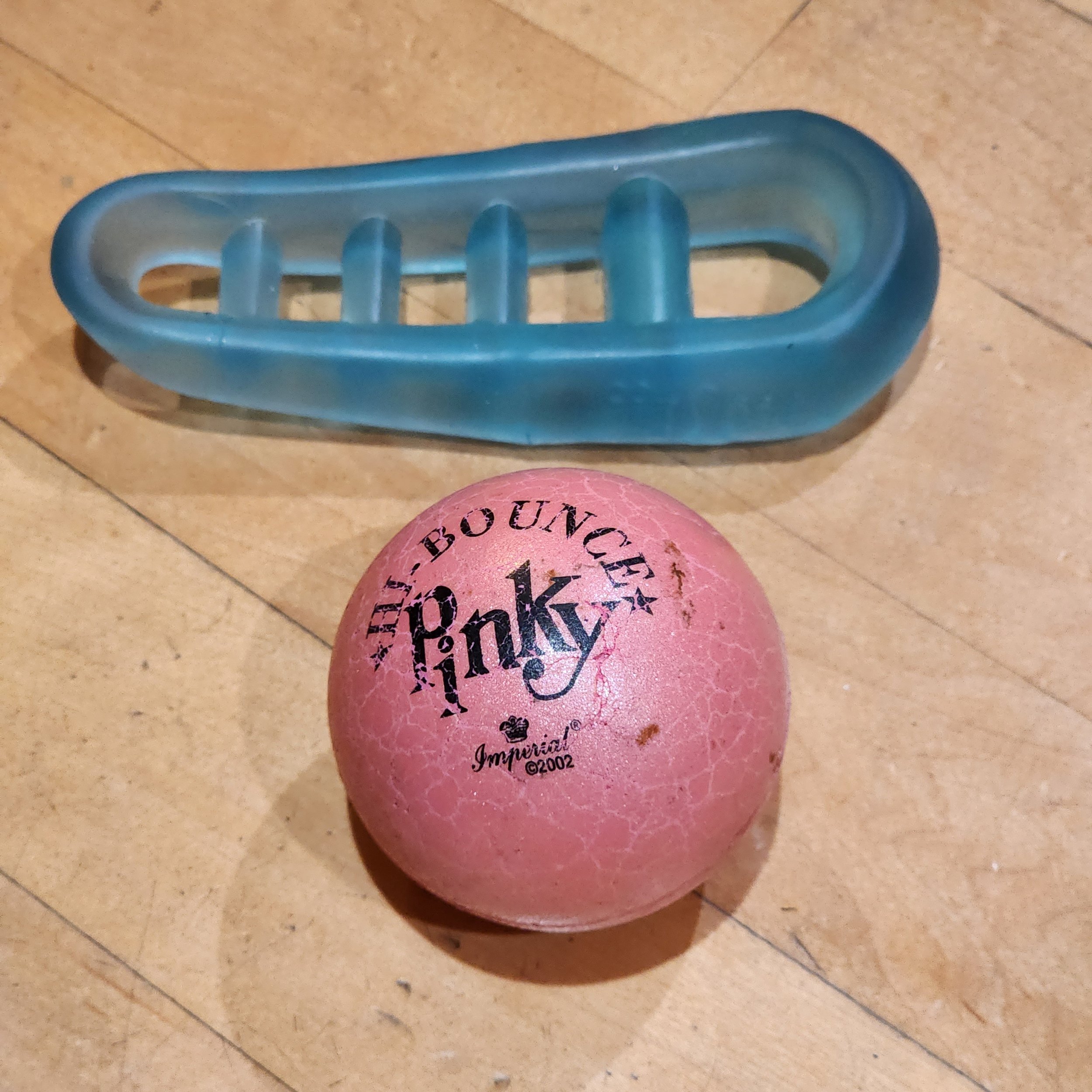
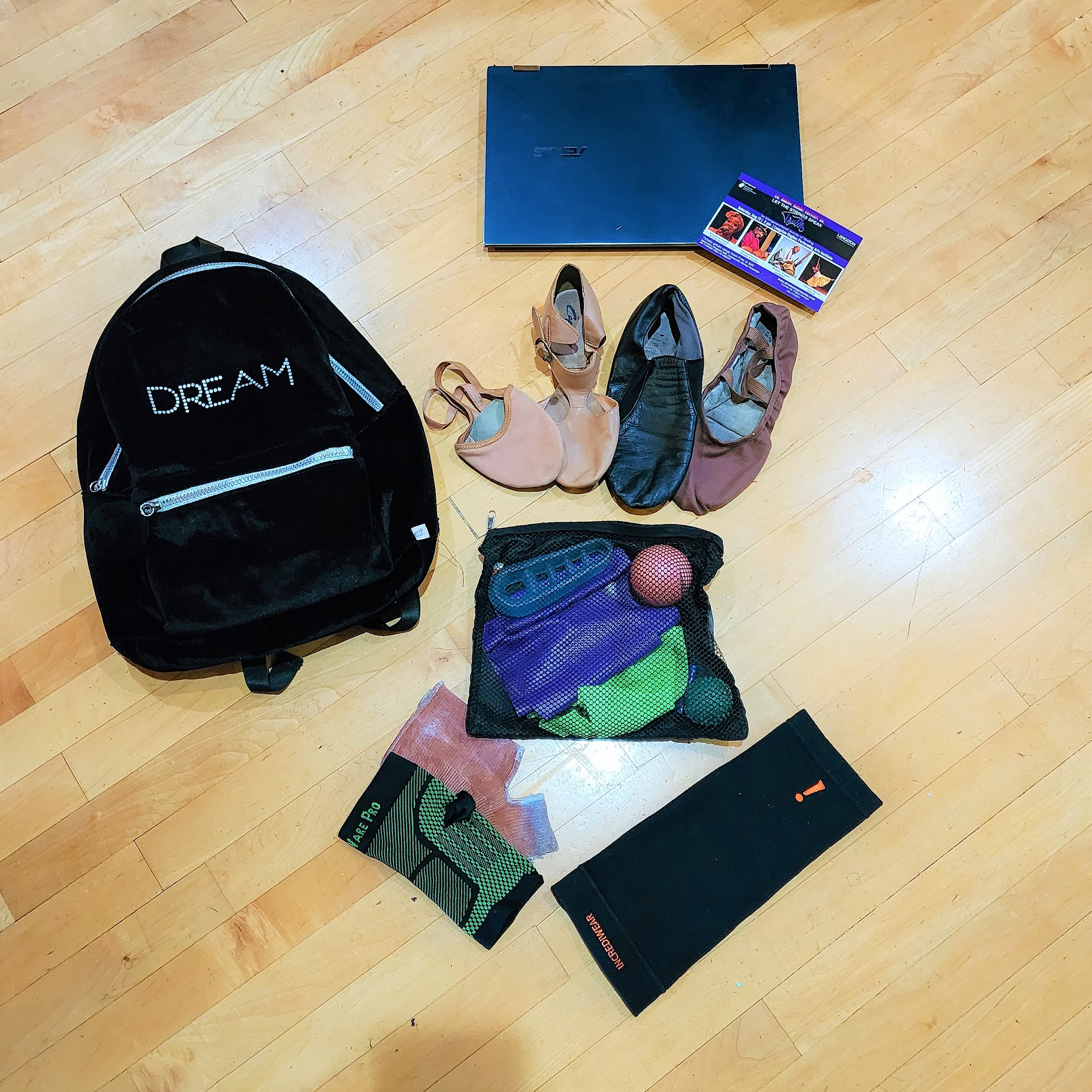
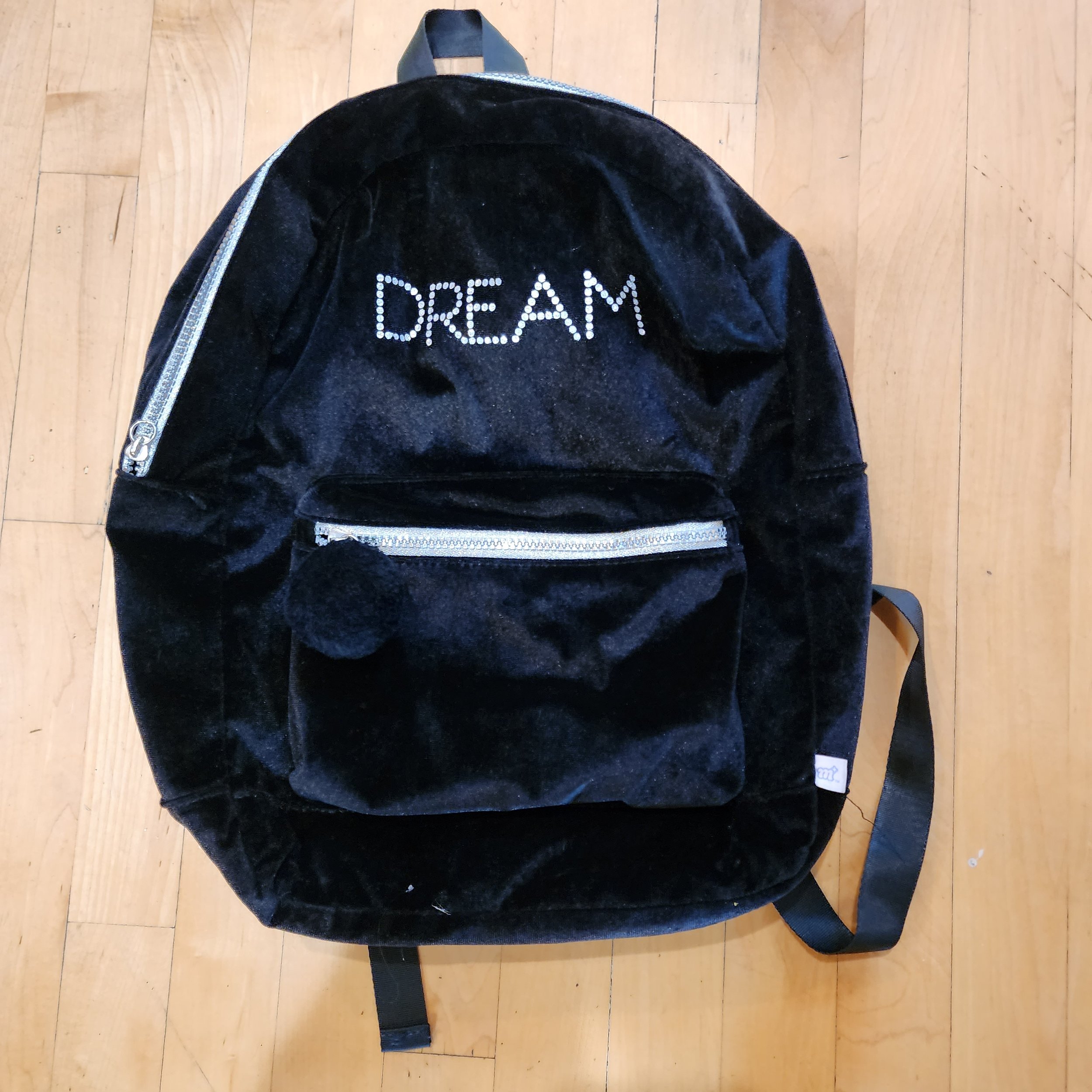
My dance bag (BACKPACK) varies based on whether I am taking class, teaching, choreographing, or working on a show. But in general, I like to make sure that I have jazz and ballet options. In addition, it is important to have a few things that help stretch, strengthen and release my body. When I looked in my dance bag, the first thing I saw was my black Dancewear Center pouch with TheraBands inside. :-) I also like to keep my Foot Rubz or Pinkie ball close by to help release my feet. And my ankle supports are a must have for heavy rehearsal times. When I travel, I like to take at least one of my yoga toes to increase circulation to my extra tight feet. :-) Last but not least, these days I need my computer for business and music editing. So, I carry it along with a portable speaker and a notebook/pencil.
Dancewear Center pouch - TheraBands, therapy balls for my feet and legs
Jazz shoes (regular and with a little heel sometimes for teaching)
Ankle braces/Knee brace
Yoga toes
My computer
The latest flyer for any events I am working on
Portable speaker and notebook - not shown
We hope you enjoyed finding out what is in our DWC Ambassadors dance bags! Shop for these necessities in store or online!
Disclaimer
All content found on the Dancewear Center Website, Instagram, Facebook, Pinterest, and all other relevant social media platforms including: text, images, audio, or other formats were created for informational purposes only. Offerings for continuing education credits are clearly identified and the appropriate target audience is identified. The Content is not intended to be a substitute for professional medical advice, diagnosis, or treatment. Always seek the advice of your physician or other qualified health provider with any questions you may have regarding a medical condition. Never disregard professional medical advice or delay in seeking it because of something you have read on this Website.
If you think you may have a medical emergency, call your doctor, go to the emergency department, or call 911 immediately. Dancewear Center does not recommend or endorse any specific tests, physicians, products, procedures, opinions, or other information that may be mentioned on dancewearcenter.net. Reliance on any information provided by dancewearcenter.net, Dancewear Center employees, contracted writers, or medical professionals presenting content for publication to Dancewear Center is solely at your own risk.
Links to educational content not created by Dancewear Center are taken at your own risk. Dancewear Center is not responsible for the claims of external websites and education companies.
Everything You Need For Your First Ballet Class!
Are you or your little one getting ready for their very first ballet class? Follow along with DWC Fitter, Emma, as she guides you through everything you need to be ready for a ballet class!
By Emma Neilson, DWC Social Media Manager & Pointe Fitter
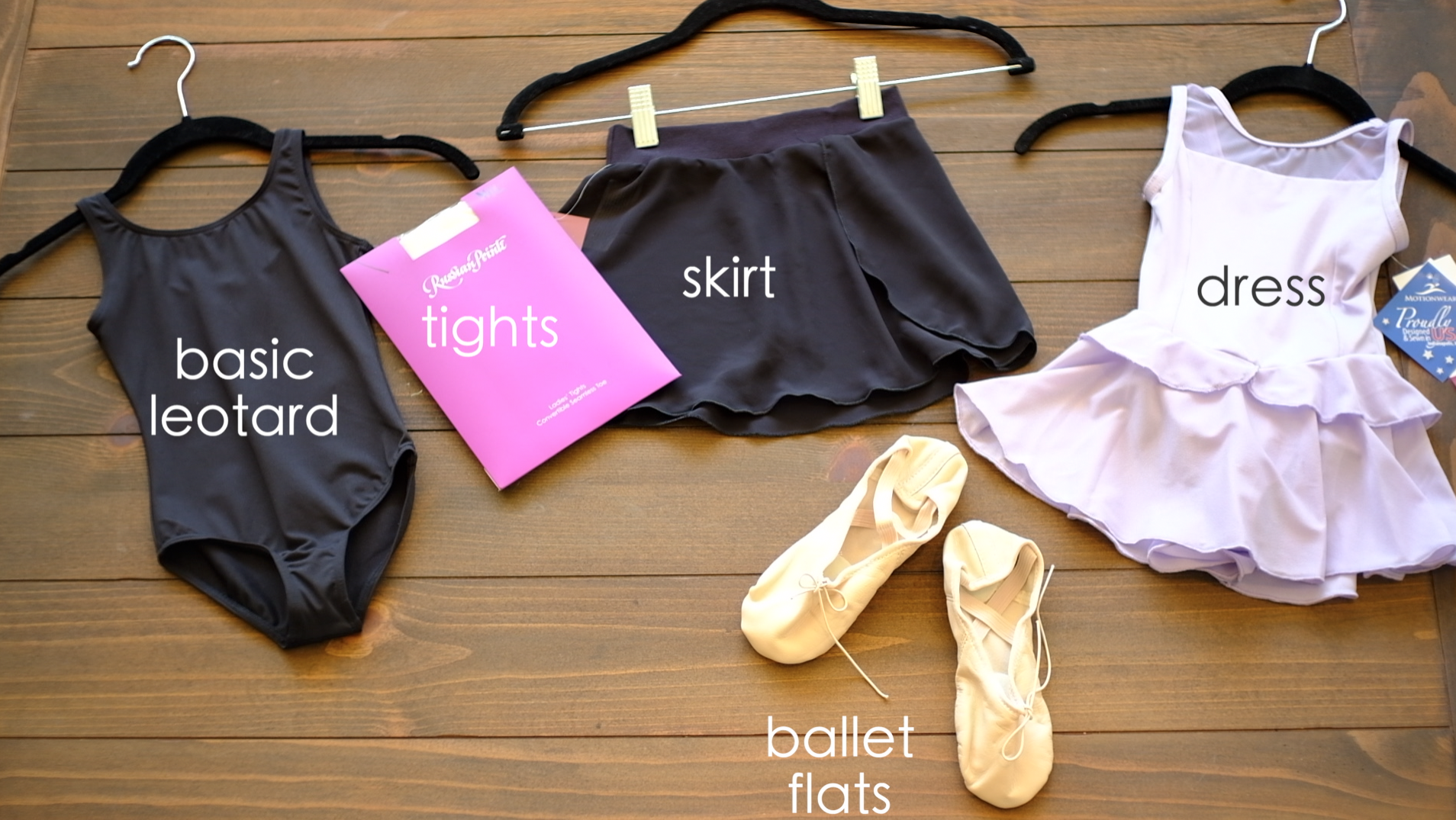
Are you or your little one getting ready for their very first ballet class? Follow along with DWC Fitter, Emma, as she guides you through everything you need to be ready for a ballet class!
Ballet Flats
Ballet shoes come in many varieties! There are leather and canvas, with or without drawstrings. Some people prefer the feel of leather, while others like that canvas can stretch. Often your studio will specify which they prefer so be sure to check what is required and then come in to Dancewear Center to try some on!
Transition Tights
Tights also have many varieties, often the go-to tights are transition or convertible tights, which allow you to roll them up off of your feet for before and after class. Check with your studio for color and style guidelines!
Leotards
Leotards are essential in ballet. They allow dancers to move freely and securely. And they are the best thing to wear so teachers can give adequate corrections to students. Colors vary by studio guidelines, feel free to try some on in one of our stores!
Skirts
Skirts are a classic ballet accessory that goes over your leotard. Be sure to check on styles and colors from your studio!
Dresses
Some studios require that younger dancers wear dresses instead of leotards to prevent fiddling with skirts. We have a variety of options and colors to try on!
Disclaimer
All content found on the Dancewear Center Website, Instagram, Facebook, Pinterest, and all other relevant social media platforms including: text, images, audio, or other formats were created for informational purposes only. Offerings for continuing education credits are clearly identified and the appropriate target audience is identified. The Content is not intended to be a substitute for professional medical advice, diagnosis, or treatment. Always seek the advice of your physician or other qualified health provider with any questions you may have regarding a medical condition. Never disregard professional medical advice or delay in seeking it because of something you have read on this Website.
If you think you may have a medical emergency, call your doctor, go to the emergency department, or call 911 immediately. Dancewear Center does not recommend or endorse any specific tests, physicians, products, procedures, opinions, or other information that may be mentioned on dancewearcenter.net. Reliance on any information provided by dancewearcenter.net, Dancewear Center employees, contracted writers, or medical professionals presenting content for publication to Dancewear Center is solely at your own risk.
Links to educational content not created by Dancewear Center are taken at your own risk. Dancewear Center is not responsible for the claims of external websites and education companies.
Providing Opportunity Through Community Classes
Moving forward, Lex wishes for dance teachers to communicate with one another more. There’s a strong feeling of competition that runs across the dance industry, causing teachers, dancers, and other industry professionals to retreat to their silos. Lex points out that it’s hard for dancers and teachers to grow when they feel like they’re being judged. “There’s this weird expectation that if you’re a teacher, you have to be good at everything and that’s just not realistic,” Lex says. “So it’s hard to find a space in your community as a teacher, where you feel like you can work on yourself free of judgment.” She says that it would be great for Drop Zone to host events where teachers can come into conversation with one another about their unique struggles.
Drop Zone’s Lex Ramirez on Offering Equitable Access to Dance
By Madison Huizinga, DWC Blog Editor

Photo by Val Gonzales
The world of dance is replete with gatekeepers, holding many people interested in learning more about the art form and cultivating community back from succeeding. There’s a great need for community spaces where people of all social identities can show up free of judgment and feel like they’re a part of something bigger than themselves. Thanks to Lex Ramirez, spaces like that are coming to fruition. Drop Zone is Lex’s latest creation: a creative dance hub featuring “classes, events, and groups centering artists from marginalized communities.”
Lex was first exposed to dance through Mexican folk dancing around age eight. She was also a part of a Catholic youth cheerleading organization. In school, she found a community of girls who loved hip hop, like her. The group got together outside of school to dance together and teach one another. In college, Lex’s passion for hip hop persevered, as she joined a hip hop dance team.
She moved from her hometown of Oakland to Seattle when she received a fellowship in multicultural education, involving a program interested in getting more people of color involved in outdoor education. “I knew it was a good opportunity to learn some skills about teaching in an accessible way to BIPOC youth,” Lex says. She had intended to only move to Seattle for a year to do the fellowship. However, one day, Lex decided to stop into the dance studio she always passed on her way to work. She took a class and loved it, eventually teaching several classes herself. “It was like the universe being like ‘no, stay here,’” Lex says.
“I never did studio dance [as a kid],” Lex shares. “I think that’s an important part of my journey.” She shares that the spaces she danced in growing up were always extremely welcoming. While many dance studios focus on catering to pre-professional dancers, Lex felt like the dance communities she’s been a part of welcomed all dancers, from those who wanted to pursue it as a career to those who saw it as a passionate, recreational outlet.
However, after struggling with a traumatic experience within the dance community, Lex realized that no dancer should feel unwelcome and put down in the ways she felt. Having worked in dance administration, taught, and danced as an artist herself, she decided to bring all of her skills together to create a safe and equitable hub for dancers in the Seattle area.
Lex currently teaches at Dance Underground and is shocked at how many people are unaware of the space. “I have a lot of students and I wanted a way for instructors to be connected to my student base, but also for my students to be exposed to them,” Lex says. “I also wanted to uplift artists from marginalized communities...I wanted to create a space where both teachers and students could grow.” Thus, Drop Zone was born.
Currently, Drop Zone offers community classes for the public in styles like hip hop, breaking, hustle, contemporary, and sensual floor work, as well as a dance crew called Drop Squad, open for hip hop dancers of all experience levels. The community classes are on a sliding-scale cost, from $5-20. Funds go towards supporting the instructors. Looking forward, Lex hopes to host events through Drop Zone that foster community, as well as bridge the gap between dancers, musicians, photographers, videographers, and other artists. She looks forward to organizing more dance projects that feed dancers and instructors creatively.
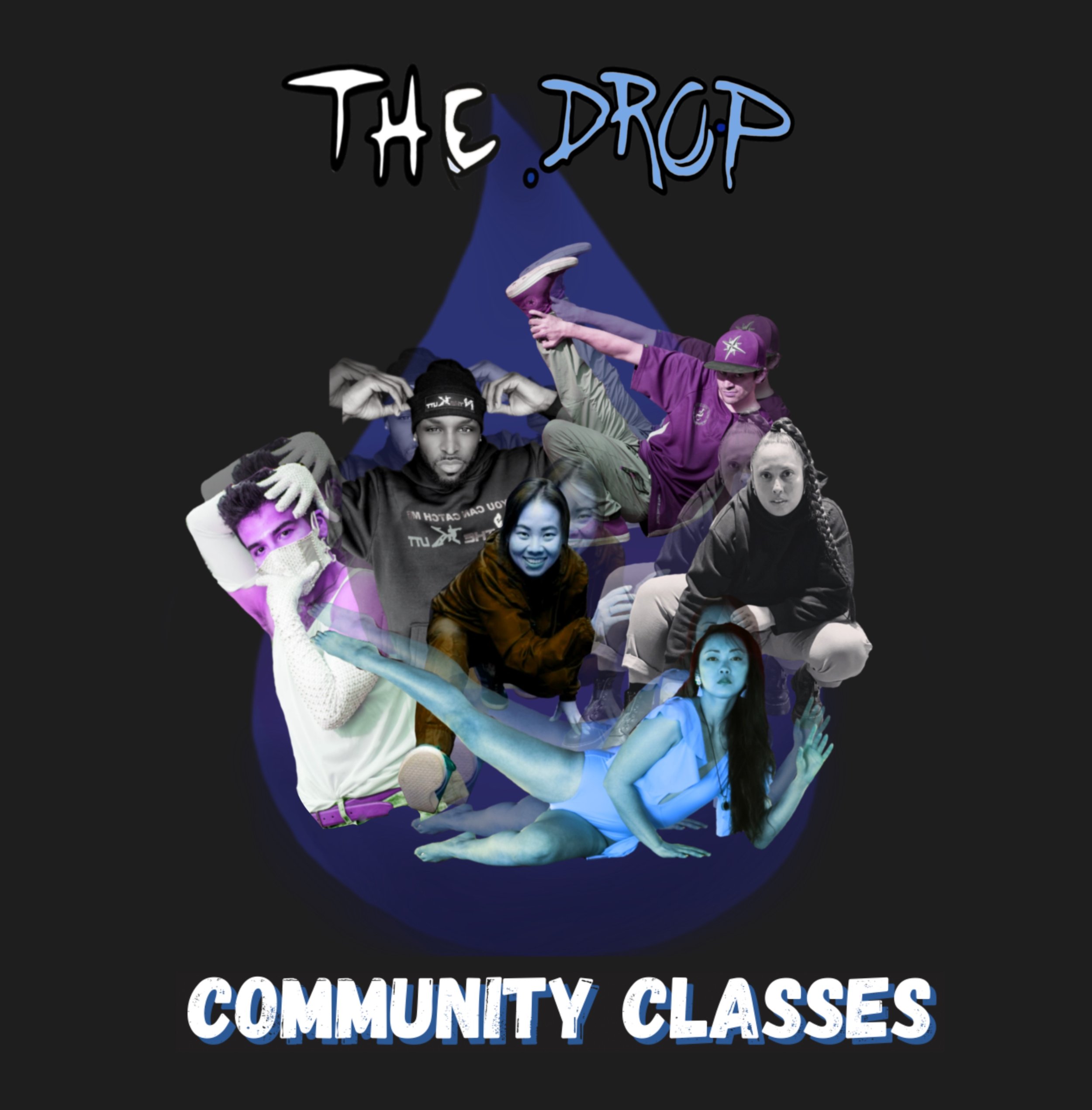
Moving forward, Lex wishes for dance teachers to communicate with one another more. There’s a strong feeling of competition that runs across the dance industry, causing teachers, dancers, and other industry professionals to retreat to their silos. Lex points out that it’s hard for dancers and teachers to grow when they feel like they’re being judged. “There’s this weird expectation that if you’re a teacher, you have to be good at everything and that’s just not realistic,” Lex says. “So it’s hard to find a space in your community as a teacher, where you feel like you can work on yourself free of judgment.” She says that it would be great for Drop Zone to host events where teachers can come into conversation with one another about their unique struggles. “I think it’s really important to collaborate, so that we can all differentiate ourselves and what we offer.” There should be a space for every teacher and every dancer to exist in the community.
Be sure to follow Lex and Drop Zone on Instagram to hear about upcoming events.
Disclaimer
All content found on the Dancewear Center Website, Instagram, Facebook, Pinterest, and all other relevant social media platforms including: text, images, audio, or other formats were created for informational purposes only. Offerings for continuing education credits are clearly identified and the appropriate target audience is identified. The Content is not intended to be a substitute for professional medical advice, diagnosis, or treatment. Always seek the advice of your physician or other qualified health provider with any questions you may have regarding a medical condition. Never disregard professional medical advice or delay in seeking it because of something you have read on this Website.
If you think you may have a medical emergency, call your doctor, go to the emergency department, or call 911 immediately. Dancewear Center does not recommend or endorse any specific tests, physicians, products, procedures, opinions, or other information that may be mentioned on dancewearcenter.net. Reliance on any information provided by dancewearcenter.net, Dancewear Center employees, contracted writers, or medical professionals presenting content for publication to Dancewear Center is solely at your own risk.
Links to educational content not created by Dancewear Center are taken at your own risk. Dancewear Center is not responsible for the claims of external websites and education companies.
Interested in writing for the DWC Blog? Click below to fill out the DWC Contributor application!