
Getting to Know DWC Ambassador Niki Kothari
DWC Ambassador Niki Kothari’s dancing journey might sound familiar to a lot of fellow dancers. “I started dancing when I was 3,” Niki tells us. “I was in Tap, Ballet, and Bollywood, and…
By Samantha Weissbach
Samantha Weissbach is a dancer, choreographer, and business professional born & raised in the Pacific Northwest. She has been dancing since the age of 2, and continues to dance and teach ballet and pointe professionally in the Greater Seattle Area. Samantha has trained at numerous establishments and programs; however, her primary training was received at Cornerstone Studio, Ballet Bellevue, and Emerald Ballet Theatre.
Currently, she serves as Executive Director of Intrepidus Dance, and is a company member with Intrepidus Dance and Forthun+Rome Dance Theater.
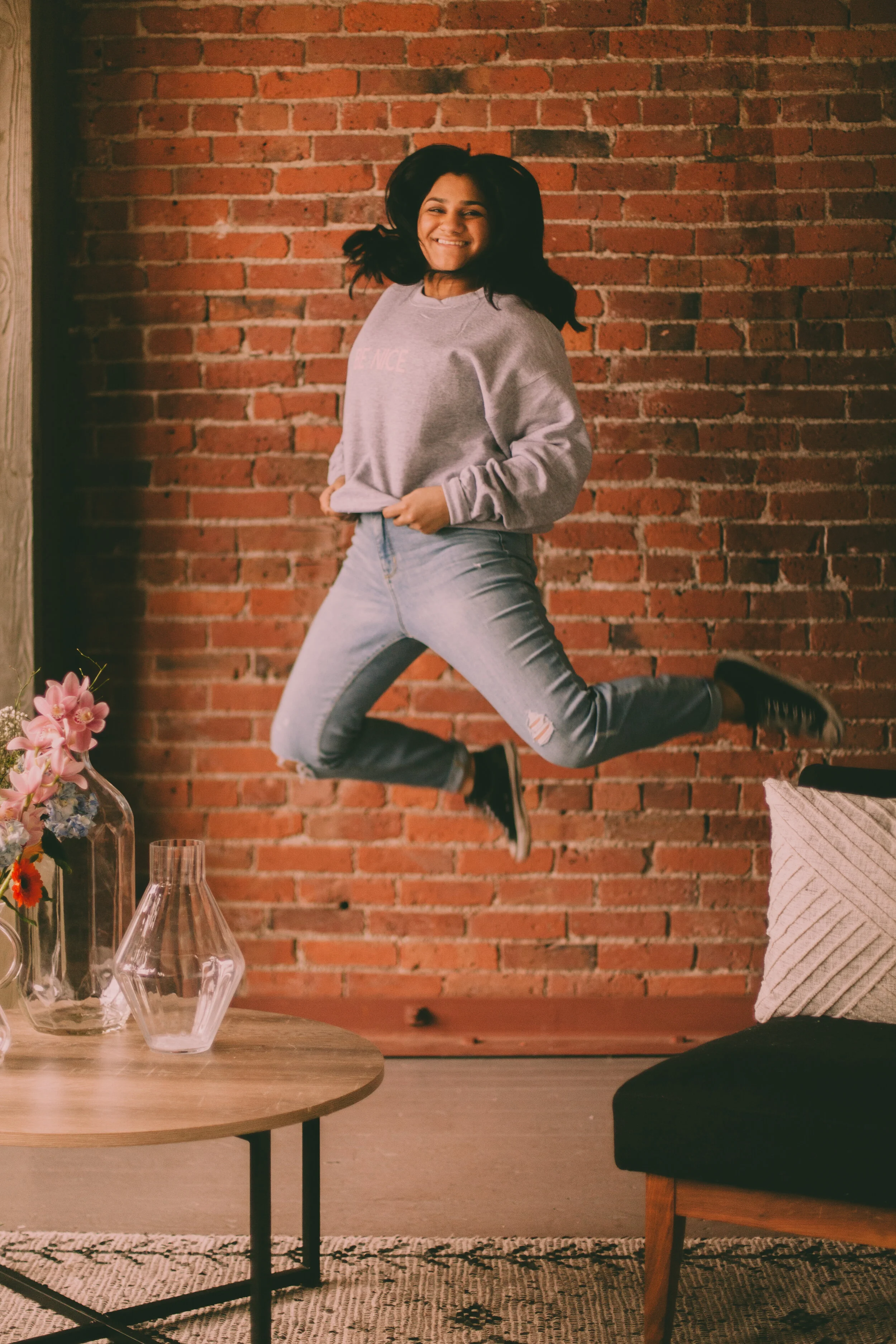
PICTURED: Niki Kothari, DWC Ambassador
Click Below to Shop the Look:
By Samantha Weissbach
DWC Ambassador Niki Kothari’s dancing journey might sound familiar to a lot of fellow dancers. “I started dancing when I was 3,” Niki tells us. “I was in Tap, Ballet, and Bollywood, and I was a little tomboy and I decided that I hated it. I hated the hair, the makeup…” Niki hated every single part of it. Shortly after expressing her great distaste for dance, Niki’s family signed her up for every sport imaginable. “I did Soccer, Basketball, Softball, Badminton, Tennis… I did everything!” says Niki with a smile.

Click Below to Shop the Look:
Allison Misty Blue Leotard by Eleve Dancewear | Delia Skirt in White by WearMoi | Joule Shock in Nude 1 by Apolla Performance
However, in 3rd grade, Niki became enraptured with hip-hop. “I thought hip-hop was the coolest thing in the world, and the very next year started taking every single class I could take.” At her old studio (which is no longer) Niki found herself in Musical Theater, Jazz, Acro, Ballet, and also as a part of the competition team. While she learned a lot, she unfortunately did not enjoy herself socially, but stuck it out for a few years. Finally, in 7th grade, Niki moved to Glass House Dance, where “she’s the most happy.”
At Glass House, Niki has become a part of a thriving community of dancers. She takes as many classes as she can, competes, and is a teacher’s assistant. One of her favorite things about dance (and dancing at Glass House specifically) is the friends and general connections she’s made. Last year, Niki sustained an injury to her feet, and the support she felt from her ballet teacher was overwhelmingly positive. She feels that the community she is a part of is truly invaluable.
When asked what her biggest challenge has been in the sphere of dance, Niki shared that even though she’s in advanced classes, has a competition solo, duo, and 2 group numbers, she can’t accept that people think she’s a good dancer. “[It’s] the one thing I can’t tell myself. If we’re doing improv or a new combination across the floor and my teacher says ‘wow that was awesome, go again’ I just think it’s all from pity.” So what helps Niki break through the quagmire of negative self-talk? “Remember that you’re doing it for you. You’re not dancing for every other person. You’re not dancing for the judge, you’re not dancing for the teacher, you’re dancing for yourself because you like it.” This is something all of her teachers have said to her in the past, and she hopes to pass this on to other dancers who may be struggling with their self-worth.
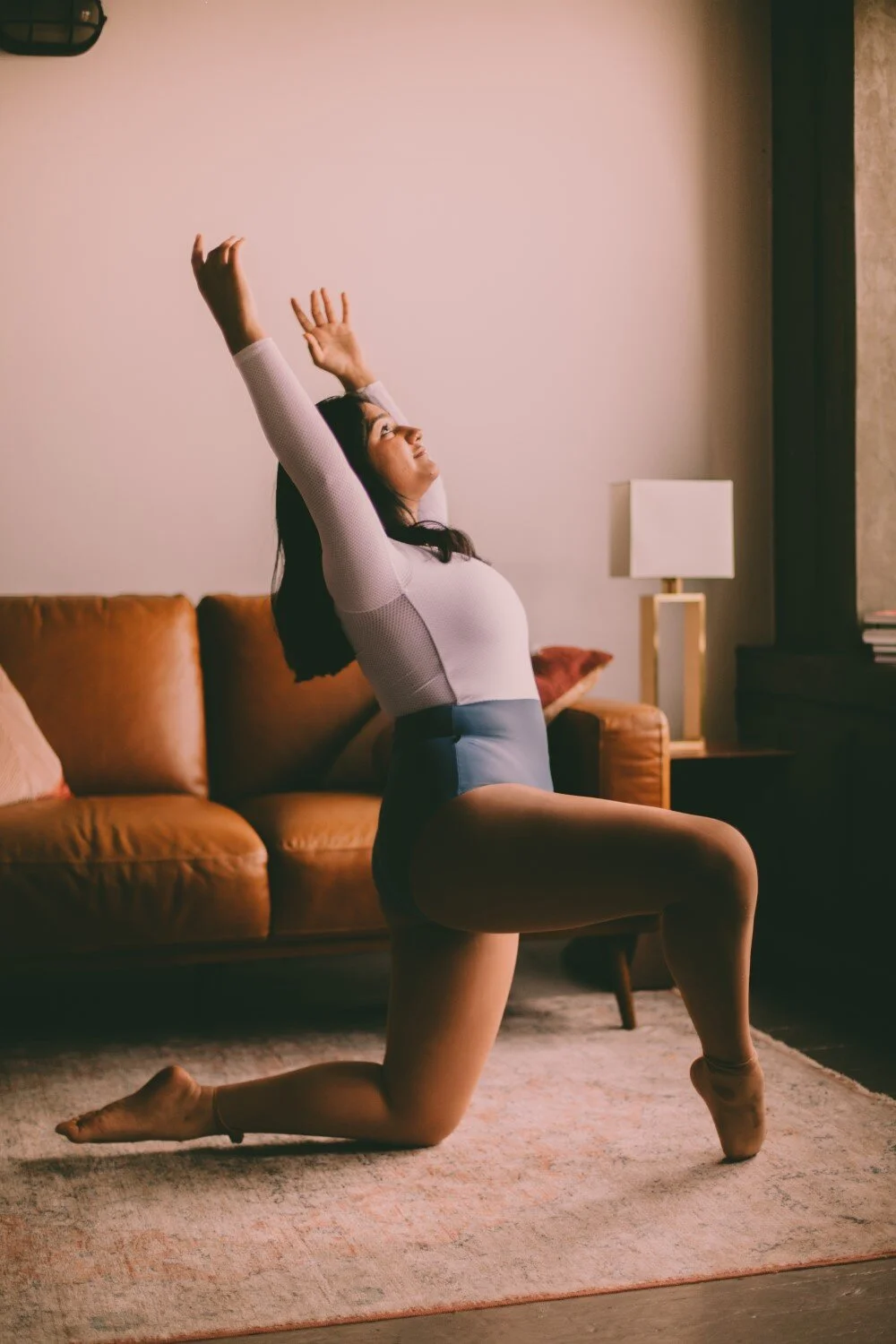
Click Below to Shop the Look:
What’s something Niki would like to see change in the dance world? “I don’t have a generic ‘perfect ballet body’, and it always stressed me out when it came around to costume time.” At previously attended studios, Niki recalls all of the dancers in her class putting on their costumes when they arrived, being lined up, and then evaluated one by one based on the fit of the costume. She was told often that her costume was too tight or didn’t look good on her arms. “It was never something super bad or outright mean, but it still hurt.” Niki feels that being mindful of the language we use surrounding how an article of clothing fits ensures that we are prioritizing the dancer as a sovereign human being over a piece of clothing which is inanimate and holds no bearing on our self-worth.
Another thing that Niki has found isn’t always considered is how a costume’s color is going to pair with her complexion, being of Indian heritage. “There are just certain colors that don’t look good with my skin tone.” She feels that there is a huge opportunity for teachers and studio owners alike to consider their costume choices in the context of all bodies being represented in their classroom, including size and skin tone.
She also wants to encourage dancers of all different sizes, colors, and abilities to bravely and boldly show up. “Be brave and step out of your comfort zone. Literally anyone can dance. I don’t care what you say, anybody can dance. Anybody who wants to and is putting in all their best effort can.”
To read more about Niki, check out the links below!
Getting to Know DWC Ambassador Kelsey Wickman
The way DWC Ambassador Kelsey Wickman found dance is truly like a fairytale. One day, Kelsey recounts, “my mom, my sister, and I took an adventure walk,” which magically led them to the doorstep…

By Samantha Weissbach
Samantha Weissbach is a dancer, choreographer, and business professional born & raised in the Pacific Northwest. She has been dancing since the age of 2, and continues to dance and teach ballet and pointe professionally in the Greater Seattle Area. Samantha has trained at numerous establishments and programs; however, her primary training was received at Cornerstone Studio, Ballet Bellevue, and Emerald Ballet Theatre.
Currently, she serves as Executive Director of Intrepidus Dance, and is a company member with Intrepidus Dance and Forthun+Rome Dance Theater.
PICTURED: Kelsey Wickman, DWC Ambassador
Click Below to Shop the Look:
By Samantha Weissbach
The way DWC Ambassador Kelsey Wickman found dance is truly like a fairytale. One day, Kelsey recounts, “my mom, my sister, and I took an adventure walk,” which magically led them to the doorstep of their local dance studio. Like many dancers, she started around age 4 in combo tap/ballet, and eventually when her family moved to Colorado, found herself enrolled at the resident competition studio. In her early years of high school, Kelsey found herself caught in a game many dancers are familiar with: trying to balance dance and school, while squeezing in other social activities.

Click Below to Shop the Look:
The Luster Leotard by Jule Dancewear | Lilac Skirt by Bullet Pointe
Looking for an opportunity to find some breathing room, Kelsey backed off from competing midway through high school. This allowed her the opportunity to participate in one of her high school’s musicals, refocus on her studies, and participate in the local community Nutcracker.
After high school, Kelsey attended Gonzaga University, intending to focus her efforts entirely on earning her B.A. in Public Relations while taking some dance classes on the side to fulfill her elective requirements. However, by the time her senior year rolled around, Kelsey was anything but a stranger within the dance department. One night, when at a gathering at Gonzaga dance director Suzanne Ostersmith’s house, one of her peers asked, “Kelsey, you’re already taking all of the dance classes… why aren’t you a minor?” Kelsey recounts with a laugh, “I didn’t really have a good answer!” It was then that she decided to bravely and rather ambitiously add the minor in her final year of college.
After college Kelsey moved to Salt Lake City, where she was blown away by the warm and welcoming art scene. Kelsey smiles broadly as she recalls, “the dance community in Salt Lake City is incredible.” It was because of relationships built there that Kelsey found her way to the artÉmotion Summer Intensive led by BalletWest Company Dancers Alison DeBona and Rex Tilton, who are passionate about fostering a dance environment dedicated to operating diversely, equitably, and inclusively.
Since then, Kelsey has moved back to Seattle, and continues to participate in artÉmotion intensives (albeit virtually for the time being) and also dances with local dance company Syncopation Dance Project led by Artistic Director Elbert Lubas.
When asked what her favorite thing about dance is, Kelsey says, “right now what really stands out is being able to show up at a ballet barre and it’s routine, yet also there are always more ways to challenge yourself.” As a young dancer, Kelsey definitely used the art form as an outlet; however, as an adult she has grown to appreciate being able to refine, work, and stay challenged physically in a way that she doesn’t get sitting at a desk each day.
On a more personal note, we asked Kelsey to share what her biggest challenge has been in the sphere of dance. “Growing up, I was definitely a part of the era still where we didn’t fully accept people of all shapes and sizes.” While she doesn’t hold a grudge, she felt during the course of her training she was not identified by her instructors as a dancer who would have opportunities post high-school. Standing at only 5 foot, with an athletic build, Kelsey didn’t believe there would be opportunity for her in the realm of dance. That voice in her head would often creep up, ““Am I good enough? Am I skinny enough? If I don’t fit in here… where do I fit in?” This was especially hard to process, as Kelsey shares that she “loves ballet.” As she has gotten older, and her body and ability has continued to change, and that voice sometimes gets a little bit stronger which can be really hard.
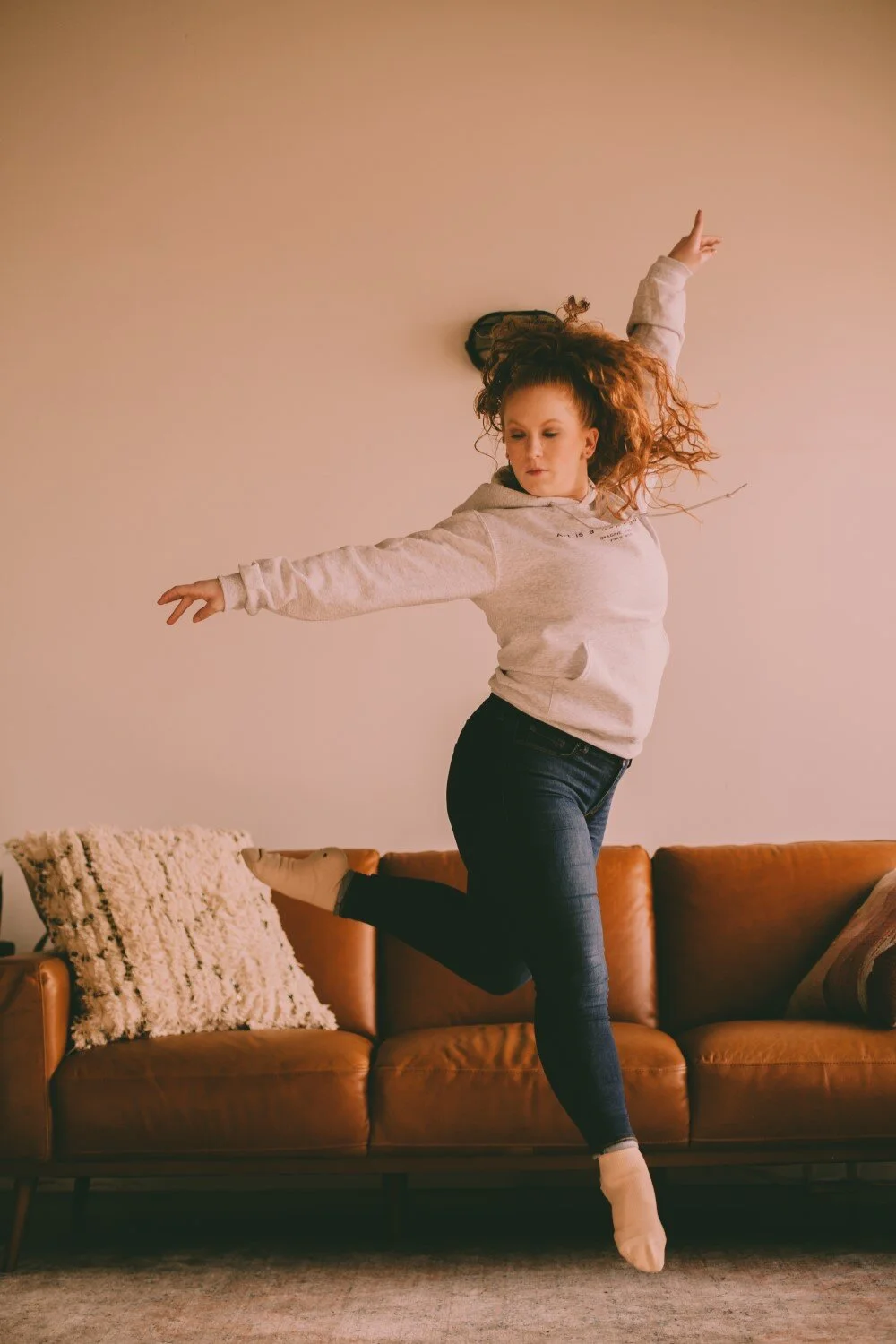
Click Below to Shop the Look:
Support the Arts Hoodie by Sunday Outfitters | The Performance Shock by Apolla Performance
Kelsey’s advice for other dancers who are struggling with the same thing? “Find what you really love, and find that community that supports you doing what you love.” For her, artÉmotion and Syncopation Dance Project have been safe havens for her to continue her dance training in a supportive environment, where she is continually challenged and encouraged to push herself to the next level. “I want to be that 90 year old woman on a poster with my leg up to my ear! Even if I have some metal hips going on.”
Something Kelsey wants to see change in the dance world is the breadth of opportunity for dancers of varying body shapes and backgrounds. She feels that there is a lot of focus on two primary buckets: commercial work and company contracts. “Having a more diverse variety of people to look up to would have helped me believe in my own opportunity more as a young dancer.” She remembers thinking that her final performances in high school or college would be her last.
She believes a huge opportunity in changing the narrative lies within the classroom: specifically, with our teachers. “The reason I didn’t believe I had opportunities was because I wasn’t being identified as someone who would have a change to perform and go beyond. Putting the emphasis less on fitting this historical mold and [instead on] finding your path is so, so powerful. I think that means healthier dancers all around.”
Kelsey goes on to share that another possibility to influence change is for leaders (like Alison DeBona, Rex Tilton, and Elbert Lubas) in our community to create opportunities where there previously were none. She’s been encouraged and invigorated by the change that has already taken hold, and is excited for the growth that she’s seen blossoming in the last few years to continue to multiply.
To read more about Kelsey, check out the links below!
Refilling the Creative Well and Excavating Creativity: How to Hold on to Inspiration and the Motivation to Dance
I have two terms for you: Refilling the creative well and excavating creativity. Two concepts in the ever-frustrating realm of inspiration, motivation, and creativity…

ANNA PETERS HAS BEEN DANCING FOR 10 YEARS, AND IS CURRENTLY A STUDENT AT THE UNIVERSITY OF WASHINGTON WHERE SHE IS STUDYING BIOLOGY AND DANCE. IN ADDITION TO GOING TO SCHOOL, ANNA PLANS TO CONTINUE TEACHING BALLET IN THE GREATER SEATTLE AREA. IN HER SPARE TIME, ANNA ENJOYS RE-READING HARRY POTTER (FOR THE BILLIONTH TIME), BINGE-WATCHING ALL OF THE SPIDERMAN MOVES, SINGING LOUDLY TO HAMILTON, AND PAINTING AND PHOTOGRAPHING DANCERS.
By Anna Peters
I have two terms for you: Refilling the creative well and excavating creativity. Two concepts in the ever-frustrating realm of inspiration, motivation, and creativity.
Refilling the Creative Well: This is a term that is used a lot in writing, especially for fiction, but it works in all realms of creativity. This is the act of finding inspiration. Of going outside of yourself and drawing in new ideas. Of filling that corner of your mind that is dedicated to nurturing these ideas.
Excavating Creativity: This is a term that I picked up from one of my dance professors. Excavate. To unearth. To dig out. To reveal. Excavation implies force. It is something you have to work for. In terms of excavating creativity, it is forcefully pulling it out of the recesses of your mind, digging for it until you find it, and then bringing it to the surface so that it can be used.
I would argue that one cannot exist without the other. What use is excavating if there is nothing to be found? You can sit and think all you want, but if you are suffering from a creative block, I find that looking elsewhere for creativity tends to have faster results. You must first refill your creative well with a multitude of ideas, feelings, and concepts. Vague implications of creativity. A raw diamond. From there, you excavate. You uncover. You take your raw diamond, and you polish and cut it until it is the glittering jewel you desire.
But what happens when the creative well runs dry? When there seems to be nothing left for you to draw out of its depths? This is when you have to start refilling, which can sometimes be exhausting; because guess what? That also requires creativity.
Especially now, with perceived limits placed around our creativity due to COVID-19, refilling this creative well and excavating creativity can be difficult tasks. I’m sure I speak for all of us when I say that we are tired of being at home. We are sick of taking classes over zoom. With the vaccine slowly rolling out, there is an end on the horizon, but for now, we must do our part to keep ourselves and others safe. For many dancers, that means staying at home. We simply cannot do all that we want to do when we’re dancing in our living rooms over zoom, and this puts a huge damper on creativity and inspiration.
For me especially, I have been struggling with holding on to my inspiration and motivation to dance. My creative well feels empty. I’m not sure if there is anything for me to excavate. Yes, that is incredibly depressing, but worry not! There are things that we can do as dancers to rekindle our inspiration and find the motivation to move.
It can be hard to think of ways to find inspiration, so I have compiled a list of different activities and ideas to help refill creative wells. Some are things that I do regularly. Some are things I picked up from my dance instructors in high school and some are what I have been learning in my dance major. All are meant to be fun and freeing! So, take a look, see what calls to you. Try a few out. Replenish your motivation to dance! Refill your creative wells!
First some tips and tricks:
Watch dance:
A lot. We live in an age where we can watch dance for free on platforms like Instagram and YouTube. Take advantage of that! Watch all sorts of dance in all sorts of styles. Let yourself be inspired by them! Watch them for enjoyment, but also for learning. When writing, we talk about how if you want to get better at writing, you have to read. A lot. I think that can be applied to dancing as well. Consume exorbitant amounts of dance media. Learn by osmosis. What did you like about that last dance you watched? Is there a way to incorporate that into your own dancing? Let it motivate you to become a better dancer! And above all, let it be enjoyable!
Dance to a different type of music:
I have been having a lot of fun with this one lately. Of course, this wouldn’t really work in a class you are taking, but if you are dancing on your own it’s a fun way to shake things up. Who says you have to do a ballet class to classical music? I did the most epic waltz ever to Total Eclipse of the Heart, and not to toot my own horn, but it was glorious. Throw some rap into your contemporary improv. Try something more lyrical sounding for hip hop or breaking. Does the music still work? Is it causing you to move in different ways? All dance styles are intricately connected to a corresponding music style, but sometimes changing the music is a good way to rekindle some passion. Anything you can do that will make your typical routine different might just be the thing that helps you remember why you love to dance. Don’t allow yourself to stagnate in your dancing. Routine is important, but so is being dynamic. So is being spontaneous.
Try a new style:
This one can be tricky, especially for people who take a lot of different styles of dance. I challenge you though to look for a dance form that you know very little about and use YouTube to check out a few tutorials. You might find that you enjoy it, and you can incorporate it into your individual style for whatever your primary dance form is. For example, these past few months I have been watching a lot of lindy hop videos and learning a few moves that I can dance on my own without a partner (think Charleston/swing sort of moves). It has been a lot of fun!
Look outside of dance:
Maybe dancing isn’t doing it for you right now. That is alright. As is the case with any art, there will be times when it feels like the easiest thing in the world and times when it is a struggle to get yourself to practice. Sometimes, looking outside the field of dance can help you be inspired to dance more. Paint a mini watercolor. Do some coloring pages or a sketch. Read a book. Listen to music. Allow yourself to rest and recuperate. Give yourself time. While there is a lot we can do to surpass a creative block, sometimes, all you need is some self-care. Sometimes the best thing you can do for yourself is take a break, knowing that when you come back, you will be inspired and healthy again.
Alright, now that we have looked outside ourselves for our raw, uncut diamonds of inspiration, it’s time to excavate them. Here are some fun activities you can channel your inspiration into. I have broken down the activities into two categories: Improvisation and Choreography. Sometimes, taking a break from technique and doing some other fun dance prompts is just the thing to get you back into your creative groove and fill that well!
Improv prompts and ideas:
Prompts can range anywhere from quality of movement to giving yourself confines to work in. Here are a few that I enjoy:
Have someone else pick your music. Sometimes, you can get bogged down by your own tastes and interests. Have a friend send you a song. Ask a family member for a suggestion. And stick with it, even if it isn’t your cup of tea. This will pull you out of your comfort zone and generate new movement, thus refilling your creative well.
Pick a part of your body. Any part. You are not allowed to move that part. Now improv.
Pick another part of your body. That body part is now the initiation point behind all your movement. Feel free to try with several different body parts!
Randomly pick an animal and an adjective. You must embody this animal and adjective in your improv.
Pick four textures. Switch between embodying these textures while you improv.
Look around your dancing space. What does it look like? What objects are in your space? What is the shape of your space? Are there any windows? Doors? Kitchen appliances? As you improv, keep an eye on the space around you and try to embody what you are seeing. Also, feel free to use the space for more than just inspiration. If there is a couch, lie on it! If there is an open wall, lean against it! There are so many ways we can use our at home spaces to dance. I challenge you to think about it less as a confinement and more as an opportunity for new types of movement.
Choose an area or object in your space. It could be a couch, a corner, a water bottle, anything! While you improv, make your way to this object or area. All you want in the world is to get to that object/area, but things keep getting in the way. Try to resolve this problem by the end of your improv.
Choreography prompts and activities:
A lot of these are prompts and activities that I picked up from classes that I have taken for my dance major that I had a lot of fun doing. They are great ways to generate movement ideas, so hopefully they inspire you to do some more dancing.
Playing with space:
What is something that you can do in your at home dance space that you can’t do at the studio? What movements, if you were to take them out of your at-home space, would no longer work or no longer make sense? I think we can get stagnant when we dance in one small space for too long, so try something new in it. Do you have a porch or a backyard? Patio? Stairs? What kinds of movement can you do there that you cannot do in your at home dance space or your studio? Shake things up a bit. Find a new space to dance and see if it sparks your creativity.
Love Solos:
This was one of my favorite projects I did for my choreography class. It requires the use of a partner, so find a dance friend and meet up (socially distanced or over zoom of course). Each partner picks three to four songs that all sound very different. The goal is to generate a variety of movement qualities. Then, watch your partner improv to these songs and get a feeling for the way they like to move. After that, take a few minutes to create a short piece of choreography for your partner, a solo tailored specifically for them. Teach each other the solos you both created and have fun watching each other dance!
Playing with Music:
There are so many different ways to play with music while you dance. So. Many. Ways. Here is one that can be fun to work with. Once again, this activity works best if you have a friend to do it with. Start by listening to a random piece of music, preferably one that you have never heard before. Listen to it once, then set it aside. You will not need it again. Think about this music. What did it make you see in your mind’s eye? How did it make you feel? How did it make you want to move? Sometimes, it can help to generate a short narrative to go with it. For example, I did this exercise once and the song I listened to made me think of driving at night after it had rained, the pavement glistening in the glow of the streetlights. After you have figured something out, make a short phrase of choreography to go with the mood/feeling/narrative you picked up from the music, but without listening to the original music. It doesn’t have to be more than a couple eight counts. Perform your dance for your partner, without any music. Then, your partner will meticulously dig through their own music and find something that they think matches the choreography. Then dance your choreography one more time with the music your partner picked out. Switch roles.
These activities aren’t meant to add stress to your life. They aren’t meant to be one more assignment you have to complete or one more job you have to finish or one more exercise you have to do. They’re purely meant to be fun, because that is one of the reasons we dance, right? We dance because we love it. Otherwise, why would we put ourselves through the grueling process of creating art?
So, try some of these tricks and activities out, not because you need them, not because you cannot become a better dancer without them, but because they are fun! Because you love to dance.
Fun and enjoyment are at the heart of inspiration. You are inspired because you like something, or because you want to make something better. You are inspired because you are passionate. So next time you have a creative block, or you can’t summon the resolve to go to dance class, or you can’t seem to motivate yourself to dance on your own, think about what you love about dance. Think about why you are passionate about it. Then do what you love and what you are passionate about. Maybe that’s improv. Maybe that choreography. Maybe that’s working on a specific technical move. Whatever it is, do it because you love it. Refill the creative well because you intend to excavate.
The Power of Movement in Healing Trauma
As a part of my recovery process, I continuously turned to dance improvisation, which has always been movement I find incredibly healing. Many times, my body has felt weak, dirty, used, and not my own. The only thing I have found to mend this damage is the power of proving these feelings wrong. Feeling the strength and control I have over my frame during times when I feel that this body is not my own. When I am able to hold myself in a mind-space of healing and patience, dance is able to release and teach myself what an infinite amount of words simply cannot.

Isabel Reck
has been dancing for 5 years; the majority of her training being at Cornerstone Studio. She has trained in ballet, contemporary, lyrical, jazz, hip-hop, tap, break dancing, and aerial silks, although contemporary has always been her go-to. Her favorite thing about being a Dancewear Center Ambassador is being able to explore a side of being a dancer she never thought she would be a part of.
By Isabel Reck
Medical Disclosure: Dancewear Center does not claim to have any medical expertise on any circumstances or illnesses discussed. This writing speaks to Isabel’s personal experience and opinions. If you or someone you know needs help please refer to the resources listed at the bottom of this post. If you or someone you know needs immediate medical attention, call 911.
Trigger Warning: Trauma, Sexual Assault, Rape, Suicide, Depression, and Anxiety.
Many of us have been through trauma. I have read so many inspiring articles from amazing women saying “#metoo,” “TimesUp,” or “I am not a victim, I am a survivor.” They all have something to say, some good to come from this betrayal of humanity. It is gruesomely common and, at times, the trauma sustained can feel irreparable and impossibly taxing. I would know. At 17, I became a victim of statutory rape.
The Rape, Abuse, & Incest National Network (RAINN) states that 1 in 6 women have been raped--and that’s just the bare minimum; because how can we get accurate statistics when this is an issue that goes mostly unreported? This heinous crime has seeped into every industry, every neighborhood, every community.
Only five months later, I feel more like a victim than a survivor. No matter how hard I try--and I have been trying really hard--I haven’t been able to find that empowering spin other people have about being sexually assaulted and raped. I am someone who has always been a hard-core optimist. Maybe that's why my inability to find the silver lining is so crushing? I feel this drive to share my story in the hopes it will empower others—but what do I have to say that those before me haven’t already said? Some close to me are scared of me sharing this story because they worry about the consequences; but my gut tells me it’s something I need to do - and I’m done not listening to my gut.
Over my life, and especially recently, I have experienced some considerable lows. I have been in therapy since I was 12, when I landed myself in the ER for suicidal ideations. Since the night I was raped I have developed PTSD (Post Traumatic Stress Disorder) in addition to my pre-existing anxiety and depression. As my lovely therapist can tell you, I have talked a lot. I have talked about my feelings, dredged up my past, and attempted to heal my soul for 5 years in talk therapy. Despite this, there has always been a need for more than words to heal.
As a part of my recovery process, I continuously turned to dance improvisation, which has always been movement I find incredibly healing. Many times, my body has felt weak, dirty, used, and not my own. The only thing I have found to mend this damage is the power of proving these feelings wrong. Feeling the strength and control I have over my frame during times when I feel that this body is not my own. When I am able to hold myself in a mind-space of healing and patience, dance is able to release and teach myself what an infinite amount of words simply cannot.
I won't sit here and lie, saying that even on my worst days, dance is my cure-all. That said, I truly believe that my body is, and always has been, trying to look out for me. Dance taught me this, and it is knowledge I wish I could pass along to everyone hurting. Every time I dance, I feel like I am taking back one more piece of myself that I lost that summer night.
In my mission to help others through their own trauma, I am hosting a series of online (for now) movement workshops facilitated by Heather Smith of ObnoxiouslyFit. These workshops are for anybody who has experienced trauma, but will be specifically tailored towards those recovering from rape and/or sexual assault. All are welcome: our first few workshops will be “pay-what-you-can,” and no formal dance training is required. Click here for more information and to register!
In closing, I leave you with this:
Lift up your foot and look at the calloused sole. Think of the thousands of steps, both pedestrian and in dance, your feet have taken with you. Now hold your thighs. Remember every time they have helped you rise up off the floor again. Feel your heart, still beating even when you thought you were going to collapse, puke, and die.
I challenge you to do one simple thing. Next time you dance, be it in a crowded master class or alone in your bedroom, dance for you. Find that gut feeling within you, and go where it leads you. Witness the power of your biology. Know it's ok to feel sad, and anxious, and angry, and grief: but never forget the beauty of you.
RESOURCES
If you or someone you know is struggling with a sexual assault: (RAINN) Call 800.656.HOPE (4673) to be connected with a trained staff member from a sexual assault service provider in your area.
If you have suicidal thoughts, click HERE.
Call 1-800-273-TALK in the US, or visit suicide.org to find a helpline in your country.
Text “HOME” to 741741 Crisis Text Line serves anyone, in any type of crisis, providing access to free, 24/7 support via a medium people already use and trust.
If you are a parent who is wanting to help their children with COVID-19 related depression and anxiety, read this.
Click HERE for Mental health resources for Washington State.
READ: The Body Keeps the Score by Bessel van der Kolk, M.D.
Click HERE for resources from the American Psychological Association (APA) on trauma in children and youth.
Getting to Know the Creator of Sunday Outfitters: Juliet Prine
For professional ballet dancer Juliet Prine, creating stylish and comfortable loungewear was a way to use up her increased spare time. But what started as a simple way to take up free time transformed into Sunday Outfitters, a popular online business that sells cute and cozy clothes while supporting important social causes. How exactly did this transition happen?

By Madison Huizinga
Madison Huizinga has been dancing for 13 years, and her favorite styles are ballet and contemporary. Currently, she attends the University of Washington and is studying Communications. Madison is presently a company member with Seattle-based dance company Intrepidus Dance.
PICTURED: Juliet Prine, Founder of Sunday Outfitters
By Madison Huizinga
When the COVID-19 pandemic intensified in the United States during March 2020, the majority of dancers across the country were ordered to stay home, as schools, workplaces, stores, and dance studios shut down to prevent the spread of the virus. While quarantining, many people adopted hobbies to help pass the time. On social media, people shared pictures of the banana bread they were baking, the TV shows they were binge-watching, and the countless DIY home projects they decided to begin. For professional ballet dancer Juliet Prine, creating stylish and comfortable loungewear was a way to use up her increased spare time. But what started as a simple way to take up free time transformed into Sunday Outfitters, a popular online business that sells cute and cozy clothes while supporting important social causes. How exactly did this transition happen?
The creator of Sunday Outfitters is Juliet Prine, a professional ballet dancer at Pacific Northwest Ballet in Seattle, WA. Juliet grew up in Minneapolis, Minnesota as an all-around competitive dancer. While Juliet danced in a variety of genres, she seemed to have a particular knack for ballet, as teachers repeatedly reached out to her mother and encouraged her to send Juliet to a ballet school. Juliet decided to narrow her focus on ballet and began dancing at a strictly ballet-focused school. She trained rigorously throughout her adolescent years, even traveling to Los Angeles to study at Colburn Dance Academy. Juliet participated in a variety of summer intensives at the School of American Ballet, San Francisco Ballet, Chautauqua Institution, and Pacific Northwest Ballet School. Eventually, Juliet joined PNB as an apprentice in 2019 and was promoted to the corps de ballet that same year.
However, when COVID-19 hit the United States and intensified in Seattle, PNB shut down quickly the day before an opening night. Juliet was disappointed, as she was planning on performing “one of the biggest roles in her career and couldn’t do it.” Like the rest of the dance community, Juliet sat at home for months on end, eagerly anticipating the dance world to re-open.
A few months into this isolation period, Juliet was doing some online shopping, searching for a cute loungewear set to wear in the fall. She looked all over the Internet and couldn’t come across anything that she liked that was under $150. So, in her spare time, she decided she would try to make her own!
The first loungewear set that Juliet created was the “star set,” a sweatshirt and matching bottoms covered in big white stars. She sent the set to her sister in college, and she was obsessed. Her friends in her sorority begged Juliet to send over more and build a website. Juliet began making sets for her friends and family and before she knew it, she was building a website, something she hadn’t ever done before.
Initially, Juliet figured that she would make her loungewear sets through the end of the year and then call it quits after the holidays. She assumed she would return to dancing at PNB soon and wouldn’t have as much time to create her sets. But it quickly became clear that she wouldn’t be dancing at PNB as frequently, as the pandemic stretched into the new year. And to her surprise, her brand began taking off! Juliet was excited to see how many people wanted her products.
One of the most unique features of Sunday Outfitters is its incorporation of philanthropy. A variety of Sunday Outfitter’s loungewear sets connect to specific causes, with a portion of proceeds going to organizations that are helping advance different causes and alleviate social problems. For example, Sunday Outfitter’s “support the arts” crewneck is an adorable, minimalistic piece that features the Yoko Ono quote “art is a way of survival.” 50% of the profits made from the “support the arts” crewneck go to Pacific Northwest Ballet’s Future Fund. The “suicide awareness” line features sweatshirts that say the phrase “take it one day at a time” in a wavy font, an expression that’s especially comforting amid of a global pandemic. 50% of the proceeds from the “suicide awareness” hoodies go towards raising suicide awareness and preventing teen suicide.

Moving forward, Juliet hopes to continue bringing awareness to important causes and stories through her work at Sunday Outfitters. She is excited to continue creating new products and connecting with new causes. Her advice for aspiring entrepreneurs is simple: “just start, don’t put it off, just start it.” Juliet shares that “if you want to be an entrepreneur, you need to have that drive, and be inspired and committed.” One of the most important parts of starting your own business or creative endeavor is to make sure you love what you’re doing.
“Whatever you are going to do, don’t do it because other people are going to love it,” Juliet says. “Make sure you’re in love with it”
Sunday Outfitter’s products will be available through Dancewear Center on Sunday, March 7, so don’t forget to purchase your own cozy loungewear set then!
A Place of My Own: A Conversation with Ashton Edwards
Earlier this month, Director of Marketing Cherie Rendón sat down with DWC Ambassador Ashton Edwards to discuss his journey and experiences surrounding starting pointe training as a gender fluid dancer. Ashton is currently a Professional Division student with Pacific Northwest Ballet, and is one of the first dancers to be allowed to train in both male and female classes: breaking down barriers in an industry that

A Place of My Own: A Conversation with Ashton Edwards
Ashton Edwards, originally from Flint, Michigan, has studied dance since the age of four years old at the Flint School of Performing Arts. Ashton has attended summer ballet intensives on full scholarships at The Joffrey Academy of Dance in Chicago, Houston Ballet School, and Pacific Northwest Ballet. In 2018, Ashton represented Flint in the NAACP’s National Afro-Academic, Cultural, Technological and Scientific Olympics (ACT-SO) competition in San Antonio, Texas, against over 250 students of all high school grades all over the country. In the Performing Arts, Ballet dance category, Ashton came in 3rd place, winning a bronze medal. Ashton is currently a Professional Division student at Pacific Northwest Ballet.
Earlier this month, Director of Marketing Cherie Rendón sat down with DWC Ambassador Ashton Edwards to discuss his journey and experiences surrounding starting pointe training as a gender fluid dancer. Ashton is currently a Professional Division student with Pacific Northwest Ballet, and is one of the first dancers to be allowed to train in both male and female classes: breaking down barriers in an industry that has historically been divided into uncompromising female/male binary categories.
CR: What led you to start training en pointe?
AE: It was a desire I had as a child. It’s always been something I wanted to do, to just… be a pretty ballerina. So I guess it was just natural, it was just a desire as a kid. It wasn’t until I was brave enough to come out and say it that I did.
CR: Since starting your training, what challenges have you run into?
AE: One of the biggest challenges has been exhaustion. Getting back up every day, and taking ample time to rest after the long day. That’s been the hardest part: pushing, and then recovering, pushing, and then recovering - every day. We have pretty long schedules at PNB, so we are dancing all day. For me, it’s going back and forth from pointe to flat, from pointe to flat. At the end of the day, my body in so many different ways is just… worn. It’s not just your normal stretch routine, it’s my stretching, and then my icing, and then my bath. I have a new routine now--it’s just… adapting.
CR: Speaking on recovery, what have you found really works for you as far as recovery practices? What does that look like for you?
AE: I come home, and I start with a long stretch [routine]. Usually my stretch takes about 10-15 minutes. I stretch, and then I roll out. I roll out all the muscles, so I start with a tennis ball and my feet, then with my roller I go: calves, quads, IT band, hip flexors, and back. I usually go then into an ice bath--just for my feet up to my knees. Next, epsom salt bath, shower, and then a heating pad for my back--then I go to bed! Then in the morning, I have a pre-class workout I have to do because of my back. I have a really flexible back, but also that leaves me in a vulnerable position. I went through a really bad injury last December, so now I have pilates exercises that I use to prepare for my day, and then I do all of these [recovery routines] after my day.
CR: Has anything surprised you about starting dancing en pointe?
AE: I think the most surprising part… is to know how different it is. Not to say that one is harder or one is easier, but they are just so different. It’s been mind boggling switching back and forth. Just the approach of a movement or a variation has to be so different, because the work requires so many different things. At the end of the day, my entire body is just worn because I’ve been switching back and forth, from muscle to muscle. I’m just exhausted by the end. It’s been very surprising to see how different the women work. [Even the] setup of the class--the energy of the class--how competitive (it’s a lot more competitive for the women), [and] just how hardworking and determined they have to be. It’s been really surprising and interesting to see.
CR: What sort of successes have you experienced since starting your training?
AE: [Most recently] PNB has nominated me for the Princess Grace [Awards]! But also, just general day-to-day successes… it’s been really fun completing variations in both male and female work now, and just feeling--still exhausted--but more at ease. I feel like a big success generally has been how strong my technique has become, and how I feel more mature in all of my dancing now, because I’ve dabbled in so many different things and created my own type of movement. That’s been a big success I feel for me, when I dance I feel good about what I’m doing.
CR: Since you have become an ambassador with [DWC] and we’ve all followed your progress throughout the last 6 months, we’ve gotten a lot of dancers from all over the country commenting about your progress and your story, and being really inspired by what you’re doing pioneering this normalization of more men dancing en pointe in a very serious fashion. What do you have to say to those people who may want to start training like you are? Any tips, words, advice, wisdom for those people?
AE: First, theraband, theraband, theraband! Get those feet as strong as possible! After that, don’t stop. Don’t stop emailing, don’t stop contacting whoever you have to contact. You have to push yourself through, because no one is going to invite you into the room: you have to put yourself there. So I guess my biggest advice--even for moms of these children--[is] to be the biggest advocate you can for yourself. Make your own place. Reach out to me, because I love to hear it, and I also love to help! Show people what I did and what PNB is doing: what it could be! You have to keep pushing for yourself. Make sure your technique is also up to where you’re saying it is, and be realistic in what you can do! My biggest thing is, I’m not asking to be Sugar Plum--but I’m asking to be back of the line corps de ballet: and I know I can do that. So I should have the opportunity. Know what you can do, and know what should be available to you, and make it available to you.
I’ve been getting a lot of those messages, and it’s just so cool. Especially the moms who [tell me], “I have a 4-year-old son, who heard about you!” I just well up every time. I was that person! I’ve gotten that before just as a black dancer, “oh, you’re so good!” But it means a little something different now, because this is something I never would have imagined being possible, and somehow I did it. I had a lot of help along the way, but also a lot of it was just down to me. I’ve cried so many times already, I don’t know how to describe it. I can not wait to be on the other side of my career, and bring so many people with me. Things are just falling into place--it’s so exciting.
CR: I’m so thankful for social media. If this were happening 10 years ago, it would take so much more to get in front of people and to get your story told. Just the way our culture communicates now online it’s so amazing to see more peoples’ stories just being out there and available so so many more people can see others like them and realize “yeah, I can do this too!” It’s great. I think what you’re doing is very inspiring. We’ve talked before, and you know that I think of you very highly, but I'm very happy that more people are able to see people like you.
AE: I love that I get to connect with these people, I love that there is a community of people that just are so strong together. I see the same people a lot in the comments of different posts, and it just feels like we are together. We are all in one mind and one body and just pushing through this together. It’s so nice to feel so supported.
To read more about Ashton Edwards and follow his journey, click any of the links below. To help support Ashton in his training, you can donate to his GoFundMe here.
Body Shaming in Ballet

Olivia Floyd is DWC’s Operations Manager and one of our highly skilled pointe shoe fitters! She has been dancing in the Pacific Northwest for 16 years. She has trained in various styles including ballet, tap, jazz, contemporary, and hip-hop. Post graduation, Olivia opted to continue her training in ballet and pointe, and teaches creative movement, ballet, tap, jazz and hip-hop in the Greater Seattle Area. One of her favorite things about working at Dancewear Center is meeting new dancers from all over!
Shop the look:
*DWC recognizes and acknowledges that this perspective on body shaming is written from and with a eurocentric, female-identifying focus in mind, and does not address the unique struggles that dancers of color, differently abled, and other marginalized groups experience, and that this is just a small part of a much more complicated web of problems to be found within the ballet community. To read more on these subjects, please refer to “Disability Stereotypes in the Dance World: An Introduction” and “Seeing Color in the Dance Industry”, and sign up for our newsletter to receive more articles that are currently in the works!
I want to share with you all a story not of myself, but of a professional ballet dancer that many of my fellow dancers know and love: Kathryn Morgan. To be more specific, this story belongs to a friend of Kathryn Morgan who has chosen to remain anonymous. Kathryn shared this story in her YouTube video titled “REAL TALK: “My Today Show” Appearance | Body Image & Mental Health in Ballet.”
Kathryn’s anonymous friend was signed to a professional company. Despite her natural talent and passion, this dancer was told by the artistic director of her company that she would not be thin enough until every bone in her chest was visible. When this dancer told the artistic director that was impossible for her, he responded, “Well, have you thought about cocaine?”
As many of us dancers know, ballerinas have a long history of being admired for their slender figures and athletic abilities. This reputation however has created a culture of body shaming that has shaped the ballet community for hundreds of years.
To start, let’s explore the history of body shaming in ballet in order to determine how it started.
If you ask any dancer involved in the ballet world (young or old), we will tell you that body shaming is a huge issue. The reality of the situation is it is rarely spoken about due to the scandalous nature that society has assigned the subject. According to an article by Kaityln Pierce in The Daily Campus, the issue of body shaming and eating disorders in ballet was not well known until 1997 when 22-year-old ballerina, Heidi Guenther died on a family vacation due to cardiac arrest caused by her eating disorder. She was 5’6 and 96 pounds.
According to an article in SFGate, media outlets found Heidi had been told by her artistic director at Boston Ballet that she needed to lose 5 pounds. After Heidi’s death, the artistic director was questioned about this recommendation. In response she defended herself saying, “[Heidi] was looking a little pudgy.” At the time she was 115 pounds.
Horror stories of body shaming in ballet date back decades with some of my own teachers (currently in their 30s or 40s) having stories to share about pressures put on them to stay thin. The first public outcry regarding the subject though was after Heidi’s death. Her passing opened the floodgates to a world of pushing eating disorders on dancers and body shaming in hopes of forcing ballerinas to slim down to the “ideal” dancer weight.
Some people outside the dance community might be thinking “okay but how widespread is body shaming in ballet really?”
It is difficult to say how many professional companies employ body shaming tactics to keep their dancers thin--because it would most definitely lead to huge backlash from the media and the public.
From Heidi and Kathryn’s personal stories, we know at the very least that body shaming was prevalent at Boston Ballet and Miami City Ballet, two major ballet companies in the industry. As an involved member of the dance community, this is enough to tell me that the issue is much bigger than I even originally thought.
So now that we know that body shaming is an issue, let’s talk about what some of the causes may be.
There are several causes of body shaming and eating disorders in ballet. According to Kaitlyn Pierce’s article, companies often have costumes for their performances that fit one size of dancer. If the dancer does not fit the costume, they do not get the role regardless of their talent. This essentially means that if a dancer wants to be a lead, they have to fit the artistic director’s ideal body type.
Kaitlyn Pierce also mentions that eight of the major ballet companies today are run by men. This means that men are choreographing roles, choosing parts, and in some cases encouraging their dancers to adopt an eating disorder. Pierce notes that hearing those words from a man often makes it sting more for dancers. In other words, having a man in power tell a dancer they need to lose weight makes them more willing to listen to his advice.
In most cases, it should also be noted that men are not fully aware of what is really required of a woman in order to lose weight. Women’s bodies are built to maintain a certain amount of fat, thus in order to get rid of that fat, women must resort to drastic measures.
The issue of body shaming extends beyond professional companies as well.
Oftentimes, young dancers will look up to signed members of companies as inspiration. If the dancers these young people look up to are suffering from an eating disorder encouraged by their company, many of their young fans can develop the idea that their bodies should look like that as well, causing younger and younger dancers to consider their weight for the first time ever.
The history of body shaming in dance is long and turbulent, but there are major steps being taken to change the way we see beauty in dance. Let’s talk about how the current ballet community sees body image.
The current outlook of body image in ballet is finally starting to move away from glorifying rigid, standardized aesthetics that encourage eating disorders and towards embracing and celebrating dancers of all sizes.
YouTubers Kathryn Morgan and Luna Montana have spoken about their experiences with poor body image throughout their ballet careers. Before 1997, people rarely talked about body image in ballet. With the help of these YouTubers, the community has grown to accept different body images and discourage body shaming practices.
According to an article in Swaay, there has been a recent shift in the ballet community in which dancers are now emphasizing the importance of a positive body image. Social media has helped reinforce this new narrative quite a bit with plus size dancers like Lizzy Howell, Iliana Vera, and Colleen Werner sharing their passion for dance on Instagram and in turn encouraging young plus size girls to embrace their shape and follow their dreams.
There are also many new companies that offer plus size dancewear for larger dancers like Jule Dancewear and Luckyleo. These small steps towards inclusion emphasize the growing trend of embracing plus size dancers and encouraging a positive body image.
As we can see, the ballet community has come a long way from body shaming girls to their deaths. Body shaming has an extensive presence among the ballet community; however, those ways are slowly being replaced with a more inclusive outlook. Whatever body you reside in, take pride in the fact that THIS BODY DANCES.
For more reading on eating disorders within the dance industry, read “Dance, My Eating Disorder, and Me” By Emma Neilson. If this is something you or someone you know struggle with, click HERE for a list of resources.
References
Baker, K (1999, April 4). Heidi Guenther’s Short Tragic Life – And Death. SFGate.
Grasso, N. (2018, April 5). Instilling Body Confidence Through the Art of Dance. Swaay.
Pierce, K. (2018, January 18). Body Shaming in the Dance Industry. The Daily Campus.
Heather’s Top 5 Exercises for Dancers!

I get these questions often –
“What should I do if I want a higher extension? What exercises will help me reduce my chance for injury? How can I gain more control over the flexibility I’ve worked so hard for?”
Well my dearest dancer friends – here they are.
My top 5 most prescribed exercises for dancers!
*Click the video links for each exercise for a demonstration!
Stand next to a wall with a band around your thighs. Begin with your feet hip width apart and in parallel. Hinge your hips back and come into a shallow squat. Lift your inside leg and press the side of your shin into the wall while keeping your pelvis level. Hold for 30 seconds on each side. Repeat 2 more times.
This move is perfect for dancers wanting to train proper hip, knee ankle alignment and strengthen their standing leg…. which is all of us. A stronger standing leg equals a higher working leg, ability to pump out more pirouettes, and less chance of injury when landing from jumps.
Begin by kneeling on one knee and extending the other leg in front of you. Using socks or sliders, glide the front leg away from you towards your splits and then back again. Move slowly and with control while making sure your body stays upright. Repeat 5-10 on each side.
I like this move for all dancers as a replacement of the passive static splits. When we sit in a stretch there is no muscle activity needed. While in the eccentric sliding splits you’ll quickly come to realize what your muscles have control over. This makes a huge difference in your passive vs. active range of motion. A great example of this is how your battement height relates to your developpe height and how your splits transfer into your leap.
Tri Plane Lunges with Passe Balance:
Front lunge balance, back lunge balance. Repeat 3 times. Side lunge balance, curtsy balance. Repeat 3 times. Lunge to front corner, lunge to back corner. Repeat 3 times.
Dancers need to be able to keep their equilibrium while moving in all directions. This lunge series trains strong legs while practicing the skill of finding balance when entering from multiple angles.
Tabletop Press into Ipsilateral Dead Bug:
Lie on your back and come into tabletop. Start by keeping your low back actively touching the ground (as you advance you will be training this move in a neutral spine). Press the heels of your hands into your knees and tighten the core by actively pressing your knees back into your hands. Release your right hand and reach it over head while extending the right leg in opposition. Alternate Sides for 10 repetitions.
When I was training at the University of Illinois our motto was “find your core and go from there.” In essence they were drilling into us - all movement is in response to how strong or weak your core is. So train a strong center and see your balance, control, and power expand and grow!
Pushups: I start all clients on their knees. Align the wrists under the shoulders, tighten the core and find the neck in a neutral position. Shoulder blades are sliding down into your back pockets as you bend your elbows at a 45 degree angle away from your body. Only go as low as you can while continuing to maintain control over the entire shoulder girdle and core. Perform 10 repetitions, rest and repeat 2 more times.
We’re seeing it everywhere. Ballerinas aren’t just ballerinas anymore. They’re doing contemporary and modern as well--to name a few! We need to be able to not only support ourselves safely during floor work, but also be able to be a safe and confident partner during lifts to our fellow dancers.
Dealing With Injuries: How to Make the Most of Recovery Time and Come Back Stronger
Many dancers face injuries at some point in their training or careers, and they are never easy to deal with.
Although an injury can be frustrating in the moment, it can be helpful to use the downtime to reflect as a dancer, and learn a few things along the way.

by
Cynthia
Randriamanohisoa
Many dancers face injuries at some point in their training or careers, and they are never easy to deal with.
Although an injury can be frustrating in the moment, it can be helpful to use the downtime to reflect as a dancer, and learn a few things along the way.
//
Shop the look!
Staying motivated
When an injury occurs, it can be dreadful to think about what will happen next and what the impact on your training or career will be. However, if you’re really committed to dancing, you can get back to your previous level, even if you have to stop dancing for several months.
In my first few years of training in ballet, I dislocated my kneecap, which put me out of dancing for three months. During the first few weeks after the injury, I was wondering if I would continue to do ballet. It was a pretty serious injury and I would not be able to dance for a while, so I thought maybe it’d be easiest for me just to give up.
One thing that helped me was the support from my physicians. Instead of telling me to stay away from dancing, they told me the goal for me was not just to heal, but also to get back to my previous level of dancing. They said I would need to do more conditioning, to prevent the injury from happening again, but they were really supportive in helping me get back to dancing like before.
This helped me stay motivated through the healing process and trust that I would be able to dance as much as I used to. In fact, I strengthened other areas in my body while going through physical therapy and when I came back to ballet classes, some exercises felt easier than before the injury!
Staying productive while recovering
When you’re used to taking a lot of dance classes every week and you suddenly have to take a long break, you may not know what to do with all the extra time. You can use the time to focus on non-dance-related things, like trying a new hobby, but you can also do quite a few things that will help with your dancing, even while being injured.
For instance, you may be able to do more conditioning for the areas of your body that are not injured, and build strength in those areas. Or you could use this time to watch dance videos, read articles about dance, or catch up on some dance events happening in your local community. These are a great way to stay connected with the dance world and spend more time on the non-“technical” aspect, which can be neglected when you have a busy dance schedule.
If you’re training at a dance school, you can ask your teachers what things you can do and they should be able to help and guide you. Sometimes, you may even be able to continue going to class and start with working on some exercises on the side, then do part of the class until you can do the entire class again.
Learning about your body
Injuries usually teach us (the hard way!) what our limits are, and how our bodies are working. I began having issues with my ankles when I started taking up to five classes a week and doing more pointe work. I went through physical therapy for both this and my knee injury. Both times were great opportunities for me to learn about how my muscles, joints, etc. were connected and how I needed to strengthen them.
One thing I learned was how much I needed to strengthen some specific parts of my body, to prevent overuse in other areas. For instance, a lot of my physical therapy exercises were designed to strengthen my core and upper leg muscles to prevent overuse in my ankles when doing pointe work. Going through this process also helped me become more aware of my own limits and weak spots. I now know more which of my muscles need extra warm-up before a class or which ones need more conditioning in general, and I have adapted my training based on that.
Being patient
Last but not least, don’t rush the process and make sure to take the time you need to recover. It’s hard to stay patient while being injured and it can be really frustrating to see your peers continue dancing, while you have to rest. However, trying to go back to dancing too early will only hinder your progress in the long run, as it will either slow down your recovery or worse, get you injured again.
Something that helped me stay patient through my injuries was to focus on the things I could still do. As I mentioned before, there are probably other areas that you can work on to improve your dancing, such as conditioning. After some time, I started getting back to dancing progressively, doing just barre in ballet classes initially, then adding a bit of center work, and finally going back to pointe work. It was a long process, but it was actually motivating to gradually do more and more things and see my progress.
All these things have helped me handle injuries better and stay motivated through the recovery. Injuries are never fun, but when they happen, it’s important to make the most of the recovery time and use the learnings along the way to become a better dancer over time.
Choosing Joy: 2020 in Review
At the end of this tunnel, when the arts are able to return in full force, and we are able to gather together in packed theatres, travel for intensives, dance packed together with other sweaty, passionate beings in a hotel ballroom for the latest convention in town, and laugh, cry, dance, and sing, together once again… we will be here for you.

Choosing Joy: 2020 in Review
by Samantha Weissbach, DWC Director of Operations
“Dad is probably rolling over in his grave right now.”
These were the words I nervously chuckled to my mother Carla in late November 2018, while we sat together outside Dancewear Center awaiting one final call from the landlord to ensure we would be able to assume the current lease on the space at 8425 122nd Ave NE.
Earlier that November, when I learned that Marv & Patrice (the former owners of Dancewear Center) had decided to close their doors and enter into retirement, I was deeply saddened. It was heartbreaking to think that the first place I was ever expertly fit for a pair of pointe shoes would simply cease to exist in our dancing community.
Over the next few days, I shared the sad news with my ballet students. “Dancewear Center is closing at the end of the month!” That was when Madison, one of my students at the time, floated this wild idea: “Miss Samantha, you should buy the store!”
I laughed. “No way. Absolutely not. I have a full-time sales job that requires me to travel frequently, a husband and two step-kids, am dancing and serving as Executive Director for Intrepidus Dance, and am teaching three days a week… to name a few things! There’s no way.”
But it was too late. The seed had been planted… and over the next few days that wild idea took flight. Fast forward to late November, as my mom and I sat in the parking lot, ready to walk in and sign the final sale documents to assume ownership of Dancewear Center.
So why would my father be rolling in his grave at the thought of my mother and me partnering to take over an established, specialty dance retail store that hosts one of the largest inventories of pointe shoes in the PNW (not to mention one run by owners with decades of fitting knowledge that they were joyfully passing on to us?)
“Sam, I’d be dead before I’d start a retail business. Think about all those dollars tied up in inventory. What a huge liability!” This was the sentiment of my father, a very successful businessman with decades of experience. Read: lots of failure + key successes = experience. This man knew what he was talking about.
Technically, when listing inventory in your books it isn’t listed as a liability… since a liability in accounting terms is considered something you owe (i.e. a business loan, outstanding invoices owed to you, etc.) However, tied up capital is simply this: money that isn’t available for other expenditures. The more inventory you have that you can’t sell, the higher the chance that you will find yourself short on cash for more immediate needs such as rent, payroll, utilities, etc.
Enter 2020: “The New Normal”
Between studio closures, classes moving virtual, summer programs and live performances cancelled, and studio enrollment for ages 11 and below in the toilet, etc… the dance industry as a whole is absolutely not okay. Revenue loss for NYC dance organizations, groups, and projects alone was estimated at nearly $24 million in August 2020--and has since grown. 63% of professional dancers have reported cash flow issues, only 8% of responding dance organizations have insurance coverage to help offset the effects of the pandemic, and the median hourly wage for dancers is $19.96--so things really weren’t looking all too great to begin with (read more here).
Again, In the accounting sense, inventory is technically not listed as a liability. But many times as we’ve counted said inventory that was intended to carry us and our dancing families through competition, summer program, and Nutcracker seasons, I have found myself lamenting, “I beg to differ!” However, one could argue that this is simply a matter of perspective.
Here at Dancewear Center, our core values are Integrity, Laughter, and Grit.
Integrity - Because I believe in doing what is right, not easy--especially when times are hard.
Laughter - Because there is truly no greater inspiration or balm for the soul.
Grit - Because I believe that any meaningful change we wish to affect requires us to persevere and be passionate--even especially in the face of great difficulty or failure. (Thank you Angela Duckworth!)
At the end of this tunnel, when the arts are able to return in full force, and we are able to gather together in packed theatres, travel for intensives, dance packed together with other sweaty, passionate beings in a hotel ballroom for the latest convention in town, and laugh, cry, dance, and sing, together once again… we will be here for you.
Despite my father’s warnings, I still have no regrets. When I look back at the incredible relationships we’ve built in 2020 within our dance community here in the PNW, I can’t put a dollar amount on this feeling in my gut… the feeling that we are a part of something so much bigger.
“As we collectively enter into 2021 amid great uncertainty, I invite you all to join me as I choose these certain things: I choose joy. I choose love. I choose to smile in the face of great adversity. “
To our customers, our local dance teachers and studio owners, and to my cherished DWC team (I could not have endured this year without these incredible women by my side!): thank you for inspiring me to keep on going, do better, and hold steady through some very dark and difficult times. As we collectively enter into 2021 amid great uncertainty, I invite you all to join me as I choose these certain things: I choose joy. I choose love. I choose to smile in the face of great adversity. I choose to honor our core values at every turn: integrity, laughter, and grit.

Interested in writing for the DWC Blog? Click below to fill out the DWC Contributor application!