
Responsive Teaching
On the first day of a theater camp for homeless and abused teens, I walked down the line of 40 campers and tried to teach what I had naively considered a “basic” ripple of movement. I stood next to a kid I would later learn was named Bruno, demonstrating and loudly explaining to the room how they should reach and hold each other and told the camper behind him, “now put your hand up on her shoulder like this.”
Bruno flinched at the sudden touch, and then his head snapped around, big brown eyes flitting from straight at me to the ground and back again.
Part 1: Bruno
Name pronunciation: Em-me Fan-s-ler | Pronouns: she/her
By Emmy Fansler, DWC Ambassador
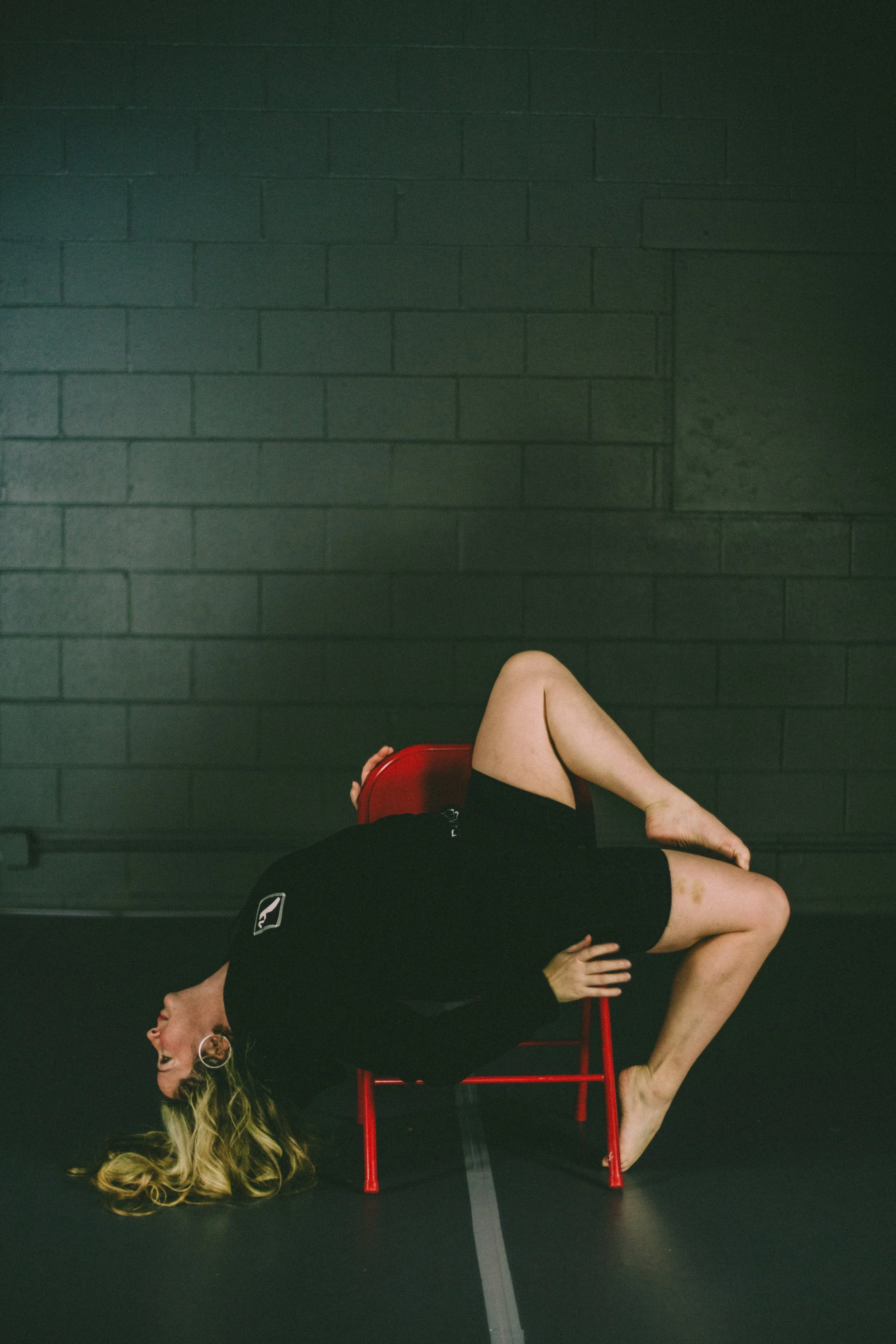
On the first day of a theater camp for homeless and abused teens, I walked down the line of 40 campers and tried to teach what I had naively considered a “basic” ripple of movement. I stood next to a kid I would later learn was named Bruno, demonstrating and loudly explaining to the room how they should reach and hold each other and told the camper behind him, “now put your hand up on her shoulder like this.”
Bruno flinched at the sudden touch, and then his head snapped around, big brown eyes flitting from straight at me to the ground and back again.
“I’m a boy.”
Dead quiet. But soon after, a snicker came from across the room. And then a, “Say what?!” from somewhere down the line.
After that, the whole room laughed, aside from the 10-12 counselors and volunteers who tried to calm everyone down, a demoralized and humiliated Bruno, and me. The horror struck teaching artist that just publicly misgendered this kid whose trauma had already made it difficult to trust anyone or feel like he belonged anywhere. The activity was over and no one was willing to pick it back up, even before I’d finished teaching the entire ripple.
Talk about a humbling moment. This was not the place for the choreography I had dreamed up. I hadn’t even met these kids or considered their stories. I just assumed they’d be excited to learn what I had to teach them.
From this large group activity, the campers were split into groups and brought through my dance and movement class in 45-minute rotations. I don’t remember how many groups I worked with before Bruno’s, but I remember feeling the palpable anxiety when he came into the room— some of it (or perhaps most of it) being my own.
The goal for that day was to get to know the campers and start generating ideas for the piece they would perform at the end of two weeks. The morning had proven to me that throwing them into my preconceived routines and patterns was not going to work, so I had them stand in a circle and tell me some random things— maybe their name, pronouns, something they wanted me to know about them, something they were good at, a time they felt brave… something like that— so I could determine my next move.
Truth be told, I don’t remember any of their answers— at all. What I remember is the way Bruno nervously moved as he answered the questions— shuffling forward a few steps, then backward, over and over. His eyes everywhere but at me, hands fidgeting first in his pockets, then in his long hair, then with each other. And then when his turn was over, he stopped. I had been mesmerized, and his abrupt stop disarmed me and the “cool” I’d been trying to keep.
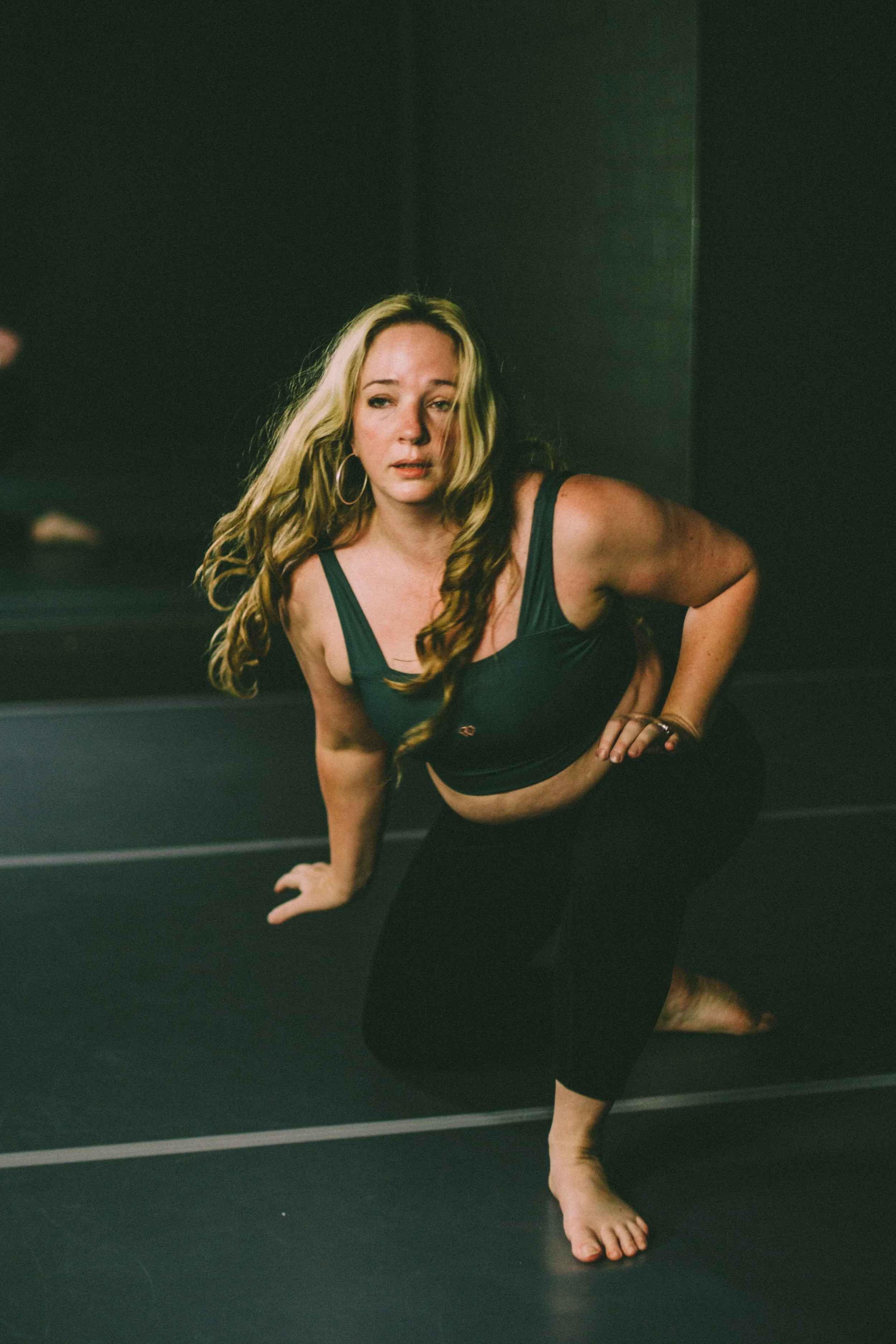
He noticed my staring, and I blurted out that the way he moved had sort of hypnotized me. He blushed and people stood around awkwardly, but I was inspired and his nervous movement had given me an inkling of an idea I wanted to play with. I asked him if he realized that he’d been moving, and then showed him with my body what he’d been doing. I asked the entire circle to try the forward and backward steps with me, and reluctantly they did. I added a look over the shoulder when they stepped backward, and then after a few more sets added a sigh and a single fidgeting gesture. They fell into a rhythm and suddenly I realized they were doing it without needing my continuous prompting. They listened to each other’s footfalls and coordinated their breaths organically. Watching it all come together in my head, I asked them to face the same direction instead of into the circle. The whole group trudged forward two steps, stumbled back one, brushed their hands on their pant legs, looked back, and sighed. Starting the process over and over and over.
With Bruno at the front of the formation, I asked him to make it travel, and lead it all the way across the floor. I asked a couple of them if they’d be comfortable trying it while carrying someone on their backs. I asked two more if they’d be willing to be carried. This, it seemed, was the moment they knew there was magic in the making.
The teens were engaged, excited, and enthusiastic at the way the sequence progressed from Bruno’s organic movement into the soul-stirring piece they performed for a packed house the following Friday. They partnered. They rippled. They rolled and reached and leapt and lifted Bruno up to the sky with a blue cyc and remnants of broken furniture hanging from the flies. They started with diagonal trudging and ended with eyes up, chests open, backs arched, hands on shoulders, showing support and care for each other in front of hundreds of strangers. Not one of them having taken a dance class before camp, but all of them KNOWING they had just moved the hearts of every single person witnessing them. There were no pirouettes, no high kicks, no tricks of any kind… maybe four pointed feet, total. Just a bunch of beautiful teens with a story to tell— one that began unfolding out of the anxious movement and emotional responses of one brave and vulnerable student named Bruno.
This was a formative experience, not only for the kids who found a platform to share their stories of resilience, but for me as a teacher and choreographer. It forever shifted the way I choreograph and opened my eyes to the beauty of teaching the non-traditional dancer. You don’t need years of training, the perfect body, or endless financial resources to be a dancer and tell your story through movement. You need a body and space. And… you don’t need dancers with a life of devoted ballet technique, marley floor, and perfectly performed etiquette to choreograph and create a life-changing piece— you need the willingness to see the humans in front of you, an openness to what they’re sharing with you just by existing, curiosity, creativity, and love for the incredible work you get to do.

Disclaimer
All content found on the Dancewear Center Website, Instagram, Facebook, Pinterest, and all other relevant social media platforms including: text, images, audio, or other formats were created for informational purposes only. Offerings for continuing education credits are clearly identified and the appropriate target audience is identified. The Content is not intended to be a substitute for professional medical advice, diagnosis, or treatment. Always seek the advice of your physician or other qualified health provider with any questions you may have regarding a medical condition. Never disregard professional medical advice or delay in seeking it because of something you have read on this Website.
If you think you may have a medical emergency, call your doctor, go to the emergency department, or call 911 immediately. Dancewear Center does not recommend or endorse any specific tests, physicians, products, procedures, opinions, or other information that may be mentioned on dancewearcenter.net. Reliance on any information provided by dancewearcenter.net, Dancewear Center employees, contracted writers, or medical professionals presenting content for publication to Dancewear Center is solely at your own risk.
Links to educational content not created by Dancewear Center are taken at your own risk. Dancewear Center is not responsible for the claims of external websites and education companies.
Have you heard of Relative Energy Deficiency Syndrome AKA Female Athlete Triad?
Over 80% of athletes, including dancers and figure skaters are unaware of a highly prevalent condition known as Female Athlete Triad or sometimes, more recently termed Relative Energy Deficiency Syndrome (RED-S)(Tosi & Dodson, 2019). You may find that you are in this category. It was many years until I got a first-hand experience of the manifestations of RED-S. Three weeks before my dance company’s spring recital I broke my arm in multiple places while mat tumbling in acro class. Since then, I have learned a lot about RED-S from my physical therapy education and my own desire to learn about and spread awareness of this condition.
Pronouns: she/her
By Emily Borders, DWC Ambassador

click below to shop the look:
Over 80% of athletes, including dancers and figure skaters are unaware of a highly prevalent condition known as Female Athlete Triad or sometimes, more recently termed Relative Energy Deficiency Syndrome (RED-S)(Tosi & Dodson, 2019). You may find that you are in this category. It was many years until I got a first-hand experience of the manifestations of RED-S. Three weeks before my dance company’s spring recital I broke my arm in multiple places while mat tumbling in acro class. Since then, I have learned a lot about RED-S from my physical therapy education and my own desire to learn about and spread awareness of this condition. This injury likely could have been prevented if I had been taking care of my body the way I should. RED-S is a form of energy deficiency that occurs due to excessive energy output or inadequate energy input. Basically, this occurs if someone is not putting enough fuel (energy) into their body to support their daily physical activity or they are doing so much rigorous physical activity that they are using up all their stored energy; both of these situations lead to an energy deficit and sometimes this can result as a combination of both. As you can imagine, these situations are common in dance training. Many hours of high-intensity dance training, a desire to maintain a certain body aesthetic and lack of proper nutrition, all contribute to RED-S being highly prevalent amongst dancers.
For me, proper nutrition and taking rest days was not strongly emphasized in my dance training. I developed a strong work ethic in dance, which I am grateful for and has shaped me into the person I am today. Due to this work ethic, I found myself extremely dedicated to my dance training. I would train for many hours a day 5-6 days a week, which would often turn into 7 days a week on a competition or convention weekend. I would sometimes even go to the gym after dance or on my day-off to get an extra workout in. If this sounds like you, or even if it doesn’t but you are still involved in dance or another form of physical activity at a high volume, I encourage you to read further and look at the following components to RED-S.

click below to shop the look:
GF Collective Paloma Racerback Bra | GF Collective Compressive Pocket Leggings
RED-S or Female Athlete Triad includes a triad of symptoms. These symptoms include low energy availability, menstrual disturbances including lack of menstrual cycle or irregular menstrual cycle and decreased bone mineral density. Low energy availability can cause increased fatigue, weakness, mood changes, and increased risk of injuries. Decreased bone mineral density increases one’s risk for fracture, which is what happened to me. Injuries and chronic fatigue can be detrimental to a dance career, but these things can often be prevented by fueling one’s body with a proper diet to support high-intensity dance training and incorporating rest days. Endurance athletes including dancers need about 1.4 g/kg of body weight of protein per day, which I can guarantee is a lot more protein than most young dancers are getting. Another way to decrease your risk of this condition is making sure to add rest days and strength training into your routine. Rest days are vital to restoring energy that has been depleted during physical activity and allowing bones and muscles to recover and adapt. Rest days don’t have to look like sitting on your couch. Going on a walk or doing another form of light activity can be a great way to “rest” but still move your body. Furthermore, bones become stronger through weight bearing activities; lifting weights can be a great way to increase bone mineral density and decrease injury risk. Keep in mind that if you are already dancing many hours, nearly every day of the week, I am not encouraging you to add a day of weight training, but having your instructors add some weight training into class or replacing some dance time with cross-training will be beneficial to dance and overall health. If this doesn’t seem possible, making sure to get some weight training in during dance breaks or off-season is another great idea!
Factors that may increase one’s risk for developing this condition include endurance athletes, female gender, having an eating disorder, ages 12-24, and people who feel pressured to maintain a certain body aesthetic for their sport. If any of these seem to apply to you or you think you may be experiencing some of the symptoms described above, I hope you look further into this condition and take steps to prevent it. Don’t wait until a major injury occurs to make a change for your health. Feel free to email emily.stadt@outlook.com if you have any questions or check out the resources below!
Sources:
https://dancenutrition.com/relative-energy-deficiency-in-sport-dancers/
Reference:
Tosi M, Maslyanskaya S, Dodson NA, Coupey SM. The Female Athlete Triad: A Comparison of Knowledge and Risk in Adolescent and Young Adult Figure Skaters, Dancers, and Runners. J Pediatr Adolesc Gynecol. 2019;32(2):165-169. doi:10.1016/j.jpag.2018.10.007
Disclaimer
All content found on the Dancewear Center Website, Instagram, Facebook, Pinterest, and all other relevant social media platforms including: text, images, audio, or other formats were created for informational purposes only. Offerings for continuing education credits are clearly identified and the appropriate target audience is identified. The Content is not intended to be a substitute for professional medical advice, diagnosis, or treatment. Always seek the advice of your physician or other qualified health provider with any questions you may have regarding a medical condition. Never disregard professional medical advice or delay in seeking it because of something you have read on this Website.
If you think you may have a medical emergency, call your doctor, go to the emergency department, or call 911 immediately. Dancewear Center does not recommend or endorse any specific tests, physicians, products, procedures, opinions, or other information that may be mentioned on dancewearcenter.net. Reliance on any information provided by dancewearcenter.net, Dancewear Center employees, contracted writers, or medical professionals presenting content for publication to Dancewear Center is solely at your own risk.
Links to educational content not created by Dancewear Center are taken at your own risk. Dancewear Center is not responsible for the claims of external websites and education companies.
What We Can Learn From Other Perspectives in Dance
As a teacher, I learned to meet students where they were at and help them comfortably reach the next level of technique or a skill. I didn’t expect them to be able to immediately perform perfectly or get something correct every time, like I do with my own dancing. Teachers don’t expect perfection out of their students, after all they are students, and more than that, humans. Teaching students helped me overcome some of my perfectionism when it comes to dancing.
A Local Dancer on Having Empathy For Industry Professionals and Students
By Laura Eberle, DWC Blog Contributor

Photo by John Roque
I got a new job this year as a dance teacher for a small middle school team. I had never experienced this side of dance before, I had always been a student, so it really gave me a new perspective on dance classes and how teachers (re)act. I think that we’re often so focused on our own situations that we never notice how our actions may look to others. But if we take a step back, there are a lot of things we as dancers can learn from perspectives other than our own.
What are some things that only a teacher would see?
As a teacher, I learned to meet students where they were at and help them comfortably reach the next level of technique or a skill. I didn’t expect them to be able to immediately perform perfectly or get something correct every time, like I do with my own dancing. Teachers don’t expect perfection out of their students, after all they are students, and more than that, humans. Teaching students helped me overcome some of my perfectionism when it comes to dancing.
Similarly, teachers don’t usually focus on how far you are, but rather, on how far you’ve come. Yes, it is impressive to be able to do a triple pirouette, or a perfect split leap, but if a student starts the year without even a single pirouette, it is unlikely that they would be able to reach a triple by the end of the year. Students start at different levels and progress at different speeds; it is unreasonable to expect everyone to reach the same milestones at the same time. At the very core, teachers just want to see you grow, so the fact that you’ve made progress is often the most important part.
Teachers/choreographers have a vision when creating a dance – this includes the music, the costumes, the choreography, and even the tiny details of style. No matter how much you try to explain it, some dancers won’t be able to understand the ‘vision’, which can become really frustrating. Sometimes the ‘vision’ isn’t visible until every piece is complete and put together, so we should try to hold our judgements until we can see the whole vision. Even then, everyone has a different brain and a different imagination, so we can’t expect every dancer to understand every vision, and as dancers we have to accept that not every dance or ‘vision’ we’re in will click with us.
I really did get frustrated when students were gone so often, especially when they wouldn’t explain why they were gone. As a teacher who only sees students once a week, it becomes difficult to teach properly/well when a student is gone often. That’s not to say that there aren’t good reasons to miss class, there certainly are, but the more often a student gives excuses for missing class, the less valid those reasons start to feel. And to the teacher who receives little to no excuses or warning for a student being gone, it may seem like the student is disinterested in their own classes or not committed to the craft.
Something a little more concrete I understood from being a teacher is the significance of going back to the basics. Sometimes as you become a more advanced dancer you unintentionally sacrifice basic technique in order to get those fancy moves down. But when you’re teaching new dancers, you have to start with the basics, and keep practicing them, you can’t just go over them once and expect them to stick. I found that reviewing the ‘simple’ elements that we often forget to maintain helped me to reapply those elements to my dancing.
Now what might a fellow student dancer see that we may not?
Being in front of a mirror so often can make it really easy to compare ourselves to others, especially in a community where that has been encouraged for so long. It’s easy to think that other dancers judge us the same way we judge ourselves. But our fellow dancers and friends don’t see what we see in the mirror. They see us just as we are. I know I certainly don’t judge my friends based on how high their développé is, or how many turns they can do. So why should we base our own self-worth as dancers on those things?

Photo by John Roque
Instead of comparing ourselves to our peers, we can learn how to have better attitudes from our friends. Sometimes if I can’t seem to find the motivation to dance I can look to my hard-working, passionate friends and get the motivation to take my training seriously from them. On the other hand, if you can’t have fun in your dancing, friends are a great way to take dance a little less seriously. That’s not to say that you shouldn’t take dance seriously, but just that you should be able to enjoy dancing.
What are some things that we can learn from a parent or an admin perspective?
Now these ones I don’t have any first person experience with, and I won’t pretend to know what it’s like. However, I have talked with my mom – the head administrator at a dance school – a lot, so I thought I might pass on some of the things she has talked about.
Admin and teachers work very hard to create a safe, supportive environment for students to come in and dance because they care about the students. They get to see the many different personalities in dance and watch them grow – both as people and as dancers – and truly want them to succeed. There are so many different jobs that go into making dancers look good in a performance, it really does take an amazing, caring team to make us look so good on stage. We as dancers can’t forget this when we are performing or when we see the people who help us look good, we have to remember that they are also people who put in a lot of time and effort and deserve our respect.
The business side of dance is something that I think most dancers never really see or pay attention to, but it really does take a lot of work to keep a dance school/company running, to order and organize costumes, to book venues, to create programs, and to coordinate between all the different people involved. These people work behind the scenes and don’t often receive much recognition outside of mentions at the back of programs, but without them our dance world would be very different. We should be grateful when we can show up and just dance without having to worry about any of that stuff.
Something my mom has talked about is that for many dancers dance isn’t just a way to spend time–it serves as much more. Along with creating a safe environment for people to express themselves, dance also teaches many life skills that will be very helpful throughout all of life. There are a myriad of skills that can be taken from dance: you learn diligence from the commitment and the hard work that it takes, you learn how to work in a team when collaborating with other dancers and choreographers, and you learn how to listen to a teacher and how to take constructive criticism, among many other skills. These skills can be helpful in nearly every field that exists, as well as daily life.
My mom also pointed out that having dance helped me, and probably many others, cope with the pandemic and the lockdown. If you were lucky enough to have dance online (as different as it was), you could keep some semblance of your regular routine while everyone was stuck at home, and continue to have a creative outlet during one of the craziest times of our lives. Having this form of expression can be uber important for sharing feelings that we may not want to talk about, as it allows us to tell our story without having to put it into words and open up to someone about our insecurities.

Photo by Melinda Eberle
These are just some of the things that I’ve learned from exploring other perspectives of dance, but there are certainly hundreds of additional things we can learn from others in our environment, or even those in different environments. I have only experienced a small slice of the pie that is the dance world; there are so many other perspectives to be considered. I highly encourage everyone to take a step back and try looking at something from someone else’s point of view when you have the opportunity.
Disclaimer
All content found on the Dancewear Center Website, Instagram, Facebook, Pinterest, and all other relevant social media platforms including: text, images, audio, or other formats were created for informational purposes only. Offerings for continuing education credits are clearly identified and the appropriate target audience is identified. The Content is not intended to be a substitute for professional medical advice, diagnosis, or treatment. Always seek the advice of your physician or other qualified health provider with any questions you may have regarding a medical condition. Never disregard professional medical advice or delay in seeking it because of something you have read on this Website.
If you think you may have a medical emergency, call your doctor, go to the emergency department, or call 911 immediately. Dancewear Center does not recommend or endorse any specific tests, physicians, products, procedures, opinions, or other information that may be mentioned on dancewearcenter.net. Reliance on any information provided by dancewearcenter.net, Dancewear Center employees, contracted writers, or medical professionals presenting content for publication to Dancewear Center is solely at your own risk.
Links to educational content not created by Dancewear Center are taken at your own risk. Dancewear Center is not responsible for the claims of external websites and education companies.
Teaching Body Liberation in Dance
I think there are ways that dance teachers can focus on molding confident students who are gentle with themselves and love their bodies, over and above seeking technical excellence. I think studios can welcome in and effectively serve each dancer that walks in their doors. Punishing and accusing our bodies can be seen as an outmoded means to success. Exclusivity and unreachable standards don’t have to be what defines the dance world. Instead, body liberation can be the guiding force and joyful expression can be the ultimate goal of dance education.
Trigger Warning: Eating disorders, Mental Health Concerns
By Hannah Emory, DWC Blog Contributor

From my experience dancing at the collegiate level in the 2020s and beginning to develop my own pedagogical style, I see a lot of exciting room for growth in how dance teachers talk about, interact with, and allow space for the bodies in their studios. A huge wave of creative boundary-breaking has already begun as a result of more types of bodies having space in the dance world. This wave can only get bigger and have more impact as our teaching styles shift toward body liberation.
Cliona Byrne, body confidence coach and author of the Body Blog, writes:
“Body Liberation is freedom from all outside expectations of how your body should be/look, even your own [expectations]… Liberation is not being consumed with thoughts about your body. Liberation is not asking permission to be included in society’s ideal of beauty. Liberation is letting go of the concept that beauty = worth. Liberation is giving ourselves permission to live our lives in our bodies.”
I assume most of us were raised in dance spaces that were the opposite of body liberating. The majority of us probably experienced a rigid aesthetic being honored, dance movement having a narrow definition, and dancers being pigeon-holed into being a certain way of personal presentation. This certainly was the truth for me at many times throughout my formative dance years.
There are folks I watched walk away from dancing because the psychological pressure of ableist and sizeist standards created a toxicity in the studio that even sincere love for dance could not overcome. I was almost one of those people, until I realized that now more than ever we need dancers who know what it feels like to be on the margins and that seek to teach in ways that bring everybody in.
Body liberation has to begin with breaking our own negative thought patterns about the self. It starts with fundamentally believing that every body, including our own, is a dancing body. A succinct lens on body liberation comes from the University of Vermont’s (UVM) Center for Health and Wellbeing:

“the freedom from social and political systems of oppression that designate certain bodies as more worthy, healthy, and desirable than others. We do not believe that bodies that are white, able-bodied, cisgender, thin, or fit are superior, worthier, or inherently healthier than any other bodies.”
According to UVM, impacts of body discrimination extend to many areas of life, including social life, healthcare, mental wellbeing, and relationships with food and weight. Discrimination based on someone’s physical ability, body composition, and presentation of health can lead to a pervasive lack of self-value that stunts personal growth long-term. Arguably, the popular understanding of dance is still a largely discriminatory one.
In an aesthetic- and athletic-focused environment, like the dance industry, that largely thrives on opinions of the populace, it is a difficult thing to not view its participants through a dominant societal lens that promotes harmful messaging about bodies. In an environment where technique is often seen as king, it is not easy to let go of judgments and to not be consumed by body-centered critiques.
So, how do we take a genre like ballet, with specific stylistic hallmarks, and remove judgment from it? How do we make joy and authentic learning the focus instead of primarily focusing on objective outcomes that were handed down to us? These are questions that are not easily answered and it must be acknowledged that teaching always requires a form of constructive evaluation.
But, I think there are ways that dance teachers can focus on molding confident students who are gentle with themselves and love their bodies, over and above seeking technical excellence. I think studios can welcome in and effectively serve each dancer that walks in their doors. Punishing and accusing our bodies can be seen as an outmoded means to success. Exclusivity and unreachable standards don’t have to be what defines the dance world. Instead, body liberation can be the guiding force and joyful expression can be the ultimate goal of dance education.
Body liberation is a powerful mindset, but it can sometimes be difficult to know how to translate something from our headspace out into the real world. Yet, there are many intentional ways to apply a liberating mindset in the studio. A few pieces of constructive advice for teachers on this subject I’ve come across include:

“The cardinal rule of a body-positive teaching style: Correct your students’ dancing, not their bodies.” Comments about the bodies of dancers, especially young ones, should focus on highlighting their strengths and teaching injury prevention, rather than categorizing or critiquing their body composition. (Helen Rolfe, DanceTeacher.com)
Work towards a culture in the studio that “[views] the concepts and practices of wellness and wellbeing as a mindset and a way of life, not as specific behaviors deemed healthy or unhealthy by a dominant culture. Wellness and wellbeing look different to everyone.” (UVM)
Present your students with dance media and auxiliary instruction from creators of multiple backgrounds and physical presentations. Seek to show them concretely that dance is for every body and that discrimination doesn’t belong in dance spaces.
Through self-education, have your teaching honor the subjective nature of dance, respect dancers’ space, and bodily autonomy, and maintain a dialogue with students about positive approaches to movement and dance culture. (ausdance.)
It is not an easy thing to liberate our teaching from models that have been ingrained over generations, but I have seen that there is great momentum for change. Each time we walk into the studio as teachers, there is an opportunity to make dance a life-giving space for all who want to move.

Resources for further reading:
Disclaimer
All content found on the Dancewear Center Website, Instagram, Facebook, Pinterest, and all other relevant social media platforms including: text, images, audio, or other formats were created for informational purposes only. Offerings for continuing education credits are clearly identified and the appropriate target audience is identified. The Content is not intended to be a substitute for professional medical advice, diagnosis, or treatment. Always seek the advice of your physician or other qualified health provider with any questions you may have regarding a medical condition. Never disregard professional medical advice or delay in seeking it because of something you have read on this Website.
If you think you may have a medical emergency, call your doctor, go to the emergency department, or call 911 immediately. Dancewear Center does not recommend or endorse any specific tests, physicians, products, procedures, opinions, or other information that may be mentioned on dancewearcenter.net. Reliance on any information provided by dancewearcenter.net, Dancewear Center employees, contracted writers, or medical professionals presenting content for publication to Dancewear Center is solely at your own risk.
Links to educational content not created by Dancewear Center are taken at your own risk. Dancewear Center is not responsible for the claims of external websites and education companies.
The Importance of Effective Communication Between Teachers and Students
If you are hurting in any way, be candid! Your health and safety are the number one priority in every situation, though sometimes it may be nerve-wracking to speak up. Be conscious of your value and take care of your body, both on and off of the dance floor. Being sensitive to students' needs and concerns is very important for teachers. Effective communication can be used to communicate the needs of students and teachers alike so that everyone can feel more comfortable and safe at the end of the day!
Advice On Being Candid About Your Health
By Claire Kaskel, DWC Ambassador

click below to shop the look!
My name is Claire Kaskel and I am one of Dancewear Center’s ambassadors. I have been a competitive dancer for about 9 out of my 17 years. Along with competitive dance comes long hours of rehearsals, classes, competitions, and conventions. And as a young dancer, I have been taught to push through all feelings of tiredness and even physical pain in order to stay training. There have certainly been times when I was not feeling well enough to continue pushing through a long day, but I did not feel safe enough to communicate to my teachers that I was in pain. I was afraid that I would be in trouble for taking a break. However, recently I learned an important lesson on the importance of communication when it comes to injuries.
I was at a competition/convention in March, and my knee injury was really beginning to hurt me. I have a reoccurring injury in my left knee that I initially hurt about two years back. I felt responsible to dance through the pain. I did not feel comfortable telling my teacher that I needed a break from the long hours of dancing to rest and ice my injury. I was afraid of letting her down by not taking a class that I was expected to take. But the more I pushed through classes and continued to dance, the more I realized how much my knee truly needed a break. My teammates agreed that I needed to sit down and ice, as they all noticed my confliction and pain. Eventually, with the support of my friends, I worked up the courage and convinced myself to let my teacher know about my injury and ask her advice on what to do. Her response made me feel so much better. She encouraged me to do whatever was best for myself, including resting, icing, and taping my knee. She even helped me tape it and sat with me to make me feel better. I was so stressed about communicating with my teacher out of fear of getting in trouble, but after I spoke with her, I realized that that was all I needed to do. Having support from my teacher to do what was best for myself truly took all my guilt and fear away. I was no longer afraid, which allowed me to focus on healing and improving my physical health.
This experience taught me the importance of speaking up for yourself and communicating with teachers. For me, this conversation established feelings of safety and care between me and my teacher. From the students’ perspective, it can be nerve-wracking to talk to your teacher about your needs out of fear of letting them down. But this interaction taught me a lot about doing what is best for yourself and how to communicate your needs in an effective and respectful manner. My advice to any other students who have felt the same way and struggled with the same guilt would be as follows:

Practice Honesty
Being consistently honest and candid about your feelings and health is highly important in establishing healthy communication between your teacher and yourself. When everyone is aware of a situation, it helps prevent it from worsening. For example, in my case, keeping my teacher updated about my torn knee helped prevent me from possibly injuring it more. Finding a private space before or after class to educate your teacher on your situation in a calm manner will help display seriousness and overall care for yourself and your training. Teachers will appreciate your honesty and respect and will be more likely to treat you with that same care and respect in return.
Prioritize Your Own Needs
If you are hurting in any way, be candid! Your health and safety are the number one priority in every situation, though sometimes it may be nerve-wracking to speak up. Be conscious of your value and take care of your body, both on and off of the dance floor.
Being sensitive to students' needs and concerns is very important for teachers. Effective communication can be used to communicate the needs of students and teachers alike so that everyone can feel more comfortable and safe at the end of the day!

Disclaimer
All content found on the Dancewear Center Website, Instagram, Facebook, Pinterest, and all other relevant social media platforms including: text, images, audio, or other formats were created for informational purposes only. Offerings for continuing education credits are clearly identified and the appropriate target audience is identified. The Content is not intended to be a substitute for professional medical advice, diagnosis, or treatment. Always seek the advice of your physician or other qualified health provider with any questions you may have regarding a medical condition. Never disregard professional medical advice or delay in seeking it because of something you have read on this Website.
If you think you may have a medical emergency, call your doctor, go to the emergency department, or call 911 immediately. Dancewear Center does not recommend or endorse any specific tests, physicians, products, procedures, opinions, or other information that may be mentioned on dancewearcenter.net. Reliance on any information provided by dancewearcenter.net, Dancewear Center employees, contracted writers, or medical professionals presenting content for publication to Dancewear Center is solely at your own risk.
Links to educational content not created by Dancewear Center are taken at your own risk. Dancewear Center is not responsible for the claims of external websites and education companies.
Working With What You Have
There is a saying that always rang true for me in my early career: “there will always be someone better than you.” When I moved on to professional training schools, I found out that I was not always going to be the most flexible. I wasn’t always going to have the best extensions. In fact, I found that depending on where I was, my extensions were just average. Once I began to place an emphasis on the other qualities a dancer possesses, ballet became so much more enjoyable to me. Musicality, port de bras, and dynamics of movement are all things that anyone can make beautiful and exciting regardless of ability, age, or gender. This is what makes ballet a beautiful art form. If you're struggling with technical perfectionism in dance, I encourage you to focus on these other attributes of dance that can help elevate your artistry without pushing your body to extreme limits.
Embracing Your Technical Abilities Where They Are
By Anna Nelson, DWC Ambassador
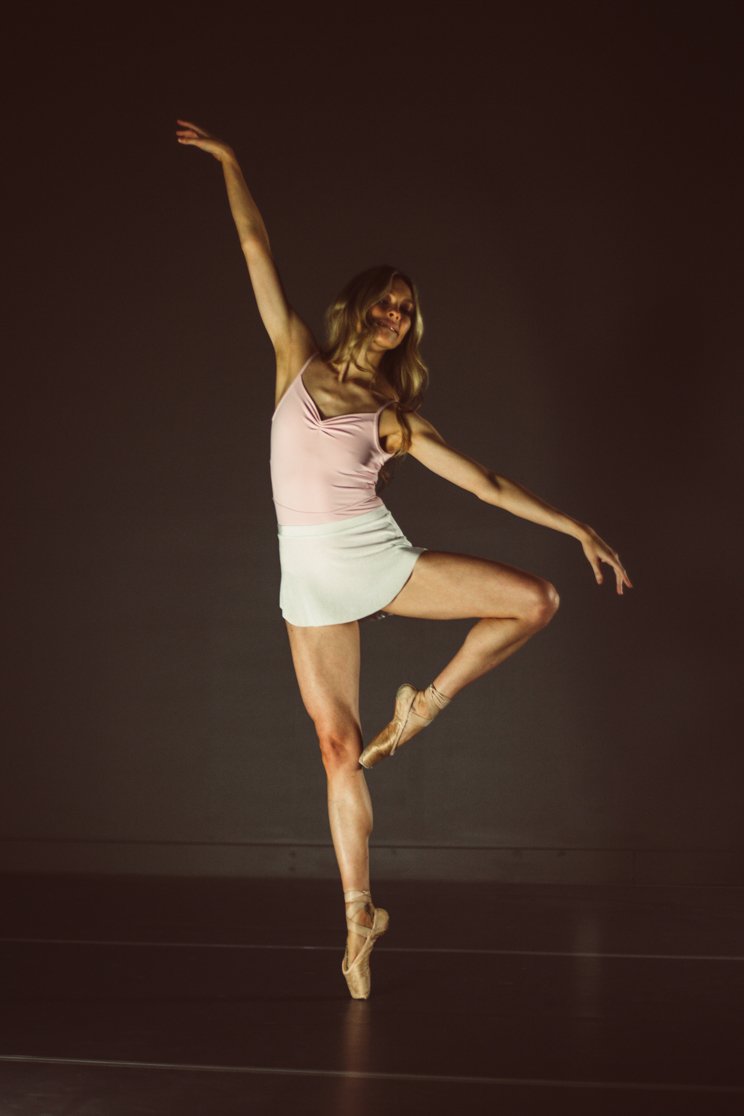
click below to shop the look:
Odette Leotard by Claudia Dean World | Bullet Pointe Skirt in White
I’m sure many of us have experienced some form of body shaming in the ballet world. As a student, my first ballet teacher placed a large emphasis on “perfect” ballet bodies. Students who occupied slender bodies with long legs and arms were given great roles in productions regardless of talent. She often praised those with beautifully arched feet, high extensions, and students who possessed good turnout. I was one of the students with “perfect” turnout and high extensions. In my naivety, these attributes are what lead me to believe that someday I was going to be a great ballet dancer.
In my early training days, I would spend ample time everyday stretching and improving my extensions to ensure that I always had the highest legs in the class. I started ballet at the age of 13, which for a long time was considered to be late. When I started taking ballet classes, I was unable to do the splits. As a child, I remember being hyper flexible, but at 13 my legs were already starting to stiffen. Because my teacher put such a large emphasis on flexibility, she had a star chart on the wall. The classes always began with static stretching. We moved through foot in hand stretches while sitting down in a circle, progressing to front and middle splits and the frog stretch. Students who were able to get their chests down to the floor in the middle splits were awarded a star sticker to place next to their name on the star chart. For many years I was not able to get my chest down, which made me feel inadequate to other students. Instead of getting to put a star sticker next to my name I had to go find my spot at the barre and wait for others to put their stickers on the chart.
My first experience with Vaganova training was when I watched the 2006 documentary Ballerina. I was amazed at how flexible the students in the movie were. Everyone had amazing extensions and their backs seemed to fold in half. All of the dancers stood in perfectly turned out positions at every moment. I was mesmerized by all the dancers I saw in this movie. This movie ignited in me a passion for ballet. I wanted to become as flexible and make lines as beautiful as the ballerinas in the documentary. I began extreme stretching every night after ballet class. The ways in which I tried to attain flexibility fast were dangerous and even caused me to pull my hamstring, which made dancing painful for a few months.
Even though my methods of attaining flexibility fast were not healthy, I started to gain the attention of my ballet teacher. She would often point out how high my arabesque was and how high my legs would go in developpes. This made me feel amazing. However, it wasn’t until many years later that I realized these praises I received were at the cost of others. I remember a moment when my teacher had me stand next to another student at the barre with all the other students gathered around us. She had us both do a grande plie. “See how Anna’s knees go directly out to the side?” She pointed to the other student. “See how her’s don’t go to the side as much at all?” At that moment, I felt great. I felt like the teacher was showing how I was better than the other student in the demonstration. Looking back, this was an abusive and toxic way to explain turnout to young dancers. Teachers should never compare other students to each other when it comes to physical attributes a dancer may or may not possess.
Years later, I found out that my “perfect” turnout was the culprit behind my intense hip pain that I was experiencing. I underwent a painful surgery that resulted in me losing all flexibility in my hips. The limited coverage that my acetabular was offering my femur gave me great mobility, but also made tears almost inevitable. These tears in my labrum made me unable to dance. After my hip surgery and rehab, I was able to work on recovering flexibility. It was disheartening at first. In my early dancing years, I had put so much emphasis on how high my legs could go, and how flexible I was. After 1.5 years, I was able to do all my splits again, but I had lost a bit of the turnout I was previously used to having and I wasn’t able to get my legs as high as I was used to. I knew that I still wanted to dance at a high calibur, and it took a ton of soul searching to hone into the other parts of dance that I had put on the backburner at the expense of high extensions and wacking my legs as high as they could go. I began to focus more on musicality and my port de bras. Funnily enough, when I stopped putting emphasis on how high my legs were going or how turned out I was at the barre, my dancing improved tremendously. I actually began to enjoy dancing for the sake of dancing, not on making the most “perfect” lines at all times. In a way, I learned how to let go and just dance. This is something that I had not been doing for the near entirety of my early ballet career.
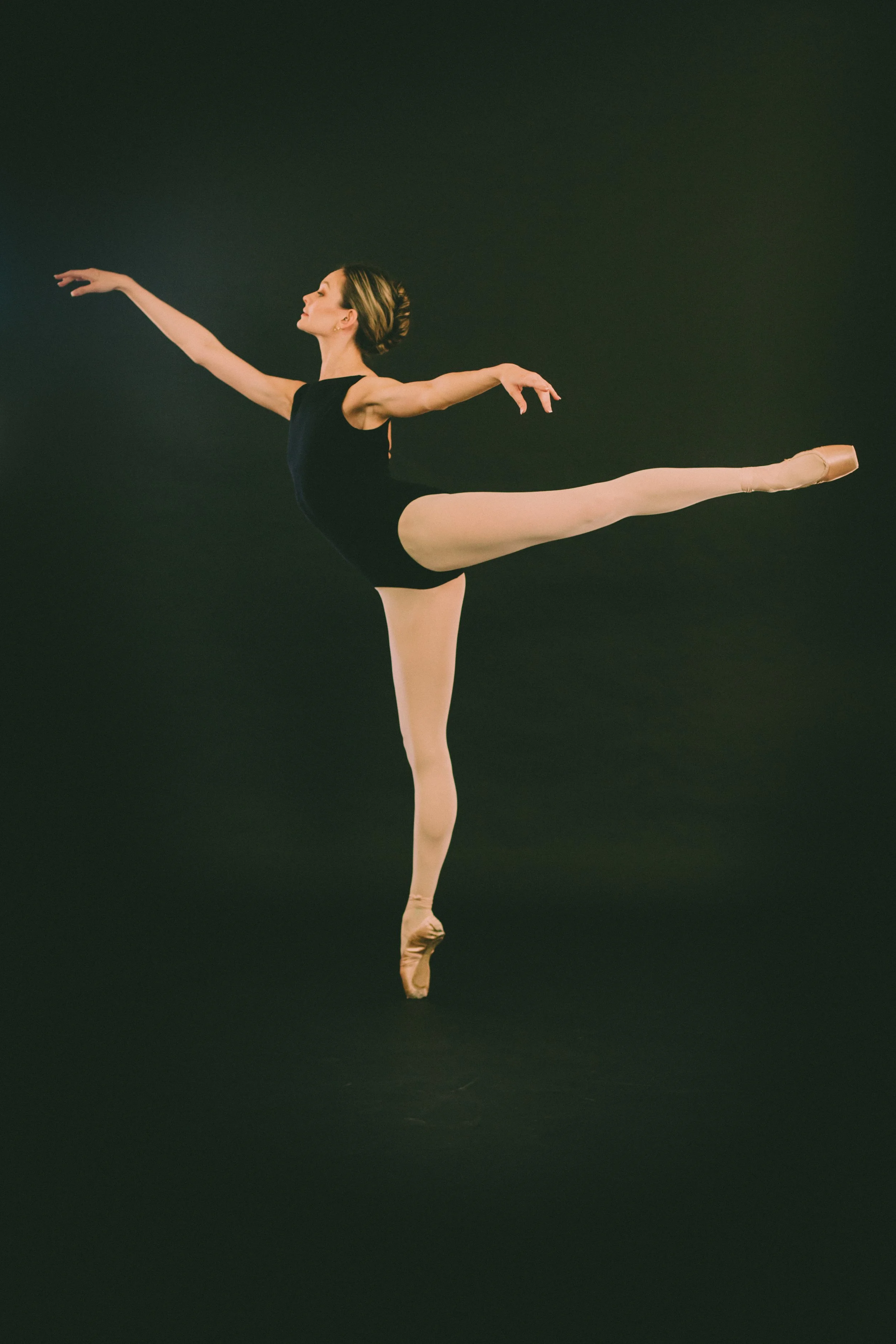
In retrospect, my childhood self was impressed by the beautiful lines the ballerinas created in the documentary, but these dancers also possessed beautiful quality of movement and musicality. These qualities are just as impressive, if not more impressive than just how high your legs can go. It takes years to develop artistry and musicality. These attributes are what makes ballet an art and not a sport. There is no right or wrong way to move to a certain phrase of music. These are all things I had been told in my years of training, but were not something that I fully understood until after my surgery.
There is a saying that always rang true for me in my early career: “there will always be someone better than you.” When I moved on to professional training schools, I found out that I was not always going to be the most flexible. I wasn’t always going to have the best extensions. In fact, I found that depending on where I was, my extensions were just average. Once I began to place an emphasis on the other qualities a dancer possesses, ballet became so much more enjoyable to me. Musicality, port de bras, and dynamics of movement are all things that anyone can make beautiful and exciting regardless of ability, age, or gender. This is what makes ballet a beautiful art form. If you're struggling with technical perfectionism in dance, I encourage you to focus on these other attributes of dance that can help elevate your artistry without pushing your body to extreme limits.
Disclaimer
All content found on the Dancewear Center Website, Instagram, Facebook, Pinterest, and all other relevant social media platforms including: text, images, audio, or other formats were created for informational purposes only. Offerings for continuing education credits are clearly identified and the appropriate target audience is identified. The Content is not intended to be a substitute for professional medical advice, diagnosis, or treatment. Always seek the advice of your physician or other qualified health provider with any questions you may have regarding a medical condition. Never disregard professional medical advice or delay in seeking it because of something you have read on this Website.
If you think you may have a medical emergency, call your doctor, go to the emergency department, or call 911 immediately. Dancewear Center does not recommend or endorse any specific tests, physicians, products, procedures, opinions, or other information that may be mentioned on dancewearcenter.net. Reliance on any information provided by dancewearcenter.net, Dancewear Center employees, contracted writers, or medical professionals presenting content for publication to Dancewear Center is solely at your own risk.
Links to educational content not created by Dancewear Center are taken at your own risk. Dancewear Center is not responsible for the claims of external websites and education companies.
Whim W’Him’s Olivier Wevers on Equitable Treatment in Dance
One of Whim W’Him’s most important values is putting “people first always,” something that is not always upheld in the dance world. That’s why Olivier shares that ensuring his dancers are well-paid has always been a priority of his. “They are artists…They are highly skilled professionals and they should be paid for that,” he stresses. He started Whim W’Him with the intention of “changing the landscape of how dancers are often abused and exploited,” particularly when it comes to being under-compensated for their work.
A Seattle-Based Director on Eliminating Exploitation in the Dance Scene
Name pronunciation: Ol-i-vee-eh W-eh-vers | Pronouns: he/him
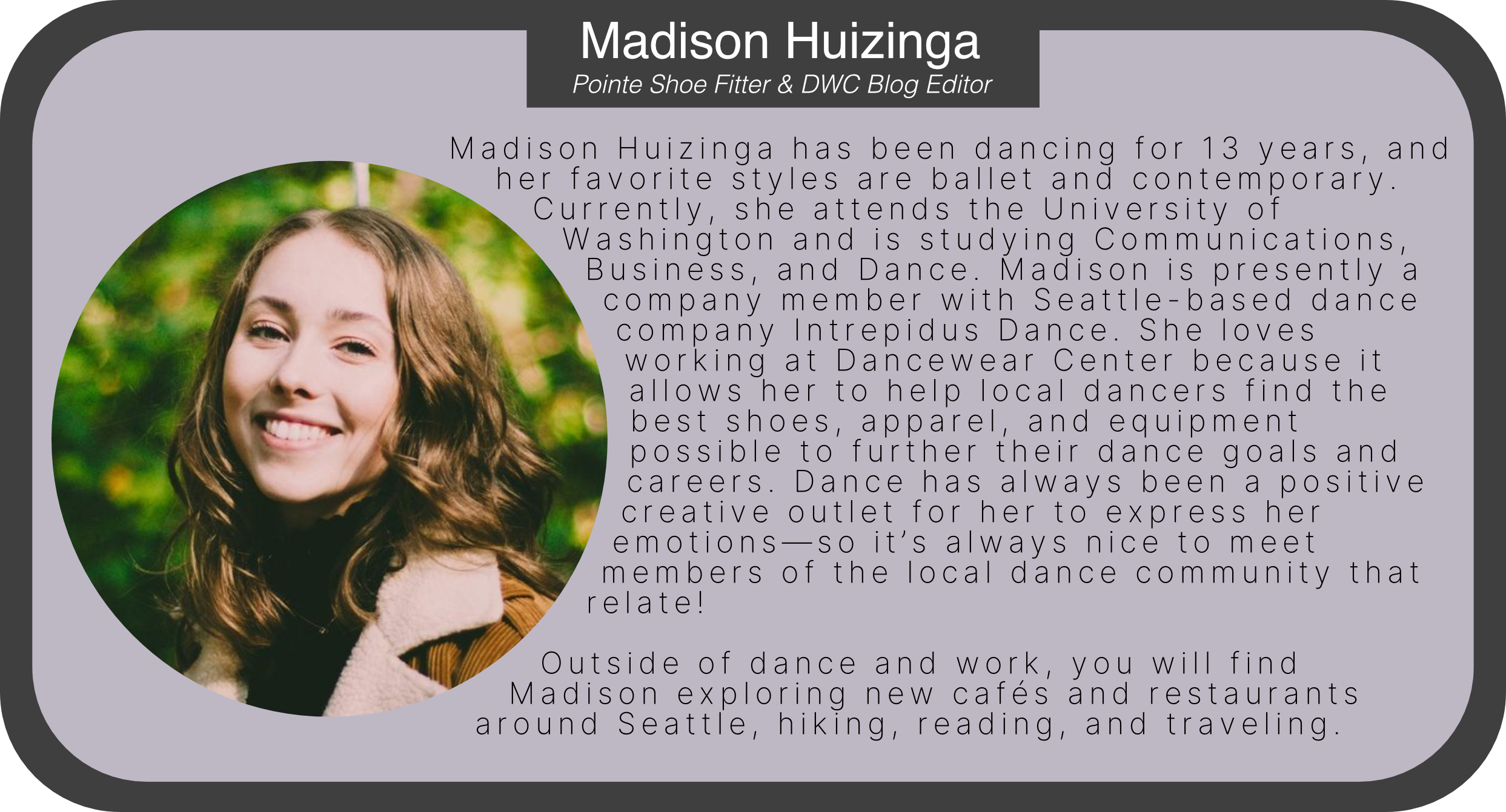
By Madison Huizinga, DWC Blog Editor

Photo by Stefano Altamura
Artists are often left out of larger conversations about equitable treatment and fair pay for workers. Even so, artists are skilled professionals as other laborers are, deserving of comprehensive treatment from companies that are able to secure the funds they need to operate effectively. Whim W’Him Founder and Artistic Director Olivier Wevers is a strong advocate for eliminating exploitative practices in the dance scene, principles he is practicing at the Seattle-based dance company itself. Read on to learn more about Olivier’s dance journey and about Whim W’Him’s mission and plans for its 2022-2023 season. And when purchasing tickets for one of Whim W’Him’s 22-23 shows, use code DWC20 for 20% off your ticket purchase!
Olivier expressed interest in dancing around age six. He can recall arriving at his first dance class wearing thick red wool tights, and immediately feeling out of place. “I actually cried and sat on the piano,” Olivier recalls, laughing. His parents told him that if he cried again, he wouldn’t be coming back to dance class. “I guess I didn’t,” Olivier says.
Around age fourteen, Olivier transferred from a recreational studio to a more professionally-focused one in his hometown of Brussels, Belgium. When he reached about nineteen years old, he began looking for work, moving to the United States for a summer program in Pittsburgh, Pennsylvania. Olivier landed his first job dancing with Columbia City Ballet in South Carolina for a year. He later danced at Royal Winnipeg Ballet for five years, touring around the world for six months out of the year. Olivier finished his dancing career at Pacific Northwest Ballet, where he worked for fourteen years.

Photo by Stefano Altamura
It took a while for Olivier to realize that starting a dance company is what he wanted to do. He had been gaining more choreography opportunities, diving deeper into the creation side of dance. He knew that running a dance company required a lot of hustle - administrative work, fundraising, and more - and he also realized the life of touring and traveling so often became lonely. Olivier desired to not only work with his own dancers but begin developing a vocabulary of dance that was unique. After mulling it over and having some encouragement from friends, Olivier incorporated Whim W’Him in 2009.
Today, Olivier says that Whim W’Him is all about the “creation process,” sharing that the company doesn’t like to place limits on itself by fixating on one topic or genre of focus. “There are so many types of choreographies and ways of working with bodies and I think that’s what we want to embrace,” Olivier says. “It’s really about exploring our human condition.”
One of Whim W’Him’s most important values is putting “people first always,” something that is not always upheld in the dance world. That’s why Olivier shares that ensuring his dancers are well-paid has always been a priority of his. “They are artists…They are highly skilled professionals and they should be paid for that,” he stresses. He started Whim W’Him with the intention of “changing the landscape of how dancers are abused and exploited,” particularly when it comes to being under-compensated for their work.
“The idea behind the company is to re-create a culture that is fighting the [outdated system] that is now widely adopted in this country for contemporary dancers and re-build an environment that is safe, welcoming, and supportive for everyone,” Olivier says.
Fittingly, Whim W’Him dancers are also offered opportunities to exercise creative control when it comes to the work they perform. For example, choreographers featured in Whim W’Him’s upcoming fall program were selected by dancers of the company itself, as a part of the 8th Choreographic Shindig. In a longstanding tradition, after reviewing applications, the dancers themselves have the opportunity to curate the evening performance, exercising their own creative opinions as artists.
In its 2022-2023 season, Whim W’Him is excited to showcase about ten original works across its three live programs in fall, winter, and spring. In addition, in February 2023, Whim W’Him will be collaborating with Early Music Seattle to create a brand new piece.

Photo by Stefano Altamura
In the fall, audiences can expect new creations from Keerati Jinakunwiphat, Dolly Sfeir, and Nicole von Arx on September 9-17, 2022 at Erikson Theater and on September 14, 2022 at Vashon Center for the Arts. In the winter, Whim W’Him will show work by Mike Esperanza, Annabelle Lopez Ochoa, and Olivier Wevers from January 20-31, 2023 at the Cornish Playhouse, January 25, 2023 at Vashon Center for the Arts, and January 31, 2022 at Whidbey Island Center for the Arts. Finally, in the spring, audiences will see work by Emilie Leriche, Olivier Wevers, and Rauf Yasit on May 12-20, 2023 at the Cornish Playhouse, May 17, 2023 at Vashon Center for the Arts, and May 24, 2023 at Whidbey Island Center for the Arts.
All in all, in the next year, Olivier looks forward to seeing Whim W’Him continue to grow as a company and help create an environment for dancers that is “safe, diverse, [and] welcoming.” “We have a lot of change that needs to happen,” Olivier insists, citing more accessible dance education, greater support for BIPOC artists, comprehensive dance media and journalism, and of course, fair pay and eradicated exploitation as changes the dance industry needs to see. He also hopes to see more arts funding on a governmental level, particularly for smaller dance companies, where he believes much of the innovation in dance is occurring.
Become a member with Whim W’Him today or use code DWC20 for 20% off your tickets for one of Whim W’Him’s Season 22-23 shows.

Sources:
Disclaimer
All content found on the Dancewear Center Website, Instagram, Facebook, Pinterest, and all other relevant social media platforms including: text, images, audio, or other formats were created for informational purposes only. Offerings for continuing education credits are clearly identified and the appropriate target audience is identified. The Content is not intended to be a substitute for professional medical advice, diagnosis, or treatment. Always seek the advice of your physician or other qualified health provider with any questions you may have regarding a medical condition. Never disregard professional medical advice or delay in seeking it because of something you have read on this Website.
If you think you may have a medical emergency, call your doctor, go to the emergency department, or call 911 immediately. Dancewear Center does not recommend or endorse any specific tests, physicians, products, procedures, opinions, or other information that may be mentioned on dancewearcenter.net. Reliance on any information provided by dancewearcenter.net, Dancewear Center employees, contracted writers, or medical professionals presenting content for publication to Dancewear Center is solely at your own risk.
Links to educational content not created by Dancewear Center are taken at your own risk. Dancewear Center is not responsible for the claims of external websites and education companies.
Dr. Amanda Rixey on Collaboration in Dance Medicine
Taking on a lot of dancing, whether in a pre-professional or professional capacity, takes grit. Dancers are encouraged to push their mental and physical boundaries to create art that moves people. Nonetheless, this boundary-pushing can place strain on dancers’ minds and bodies. Without proper care, pushing oneself too far for too long simply isn’t sustainable. That’s why local physical therapist Amanda Rixey is passionate about fostering communication and collaboration among dancers, instructors, and dance medicine specialists. Read on to learn about Amanda’s own dance journey, as well as her practice, Newfound Physical Therapy PLLC.
A Discussion With a Local PT
Pronouns: she/her | Pronunciation: Rix-ee
By Madison Huizinga, DWC Blog Editor

Photo by Mackenzie Eveland Smith
Taking on a lot of dancing, whether in a pre-professional or professional capacity, takes grit. Dancers are encouraged to push their mental and physical boundaries to create art that moves people. Nonetheless, this boundary-pushing can place strain on dancers’ minds and bodies. Without proper care, pushing oneself too far for too long simply isn’t sustainable. That’s why local physical therapist Amanda Rixey is passionate about fostering communication and collaboration among dancers, instructors, and dance medicine specialists. Read on to learn about Amanda’s own dance journey, as well as her practice, Newfound Physical Therapy PLLC.
Amanda shares that she was inspired to start dancing after watching her older sisters dance growing up. She started out at a studio geared toward dance competitions in the Kansas City area. Enduring several arm injuries as a child, Amanda was also exposed to the world of physical therapy early in her life and was quickly fascinated by it. As early as elementary school she bookmarked “PT” in her brain as a potential career option.
As Amanda entered middle school and high school, she focused more seriously on her ballet training. She continued to experience injuries, sharing that she is particularly injury-prone due to her joint laxity and hypermobility. This put her in more frequent contact with physical therapists, few of which had a deep understanding of dancers and the specialized PT needs they require.
She attended the University of Kansas on a dance scholarship, participating in a small department with four other dancers in her graduating class. While her major was dance, she also fulfilled the prerequisites for physical therapy school and worked as a physiology teaching assistant. Following her college graduation, Amanda got her Pilates certification and worked as a rehab aide before starting PT school at Regis University. She later worked with Kansas City Ballet, conducting weekly backstage screenings with dancers and local studios, and provided services for numerous touring theatre shows like Love Never Dies, Beautiful, and Dear Evan Hansen.

Photo by Mackenzie Eveland Smith
In May 2020, Amanda relocated to Seattle and since then, she’s been working on building out her own practice, Newfound Physical Therapy PLLC, in the Seattle area, in which she provides specialized treatment in dance medicine, and Pilates-based rehabilitation, and helps treat chronic pain conditions. Amanda also offers fitness-related services like individual and group classes for body conditioning and Pilates, as well as pointe readiness assessments. She stresses that her services are geared towards anything and anyone across the board, whether it’s dancers seeking preventative services, performers trying to figure out what is biomechanically off in their bodies, or those seeking recovery after facing a major injury. It’s important that dancers know that they don’t just have to be injured to visit a PT, in fact undergoing physical therapy before an injury occurs can reap major benefits.
Part of what inspired Amanda to start her own practice and go into PT altogether was the fact that offering treatment for dance medicine is an incredibly individualized and specific service. It can be challenging for dancers to find physical therapists that have a deep understanding of the activities they engage with on a day-to-day basis and to find specialists that will be covered by their insurance. Amanda is hoping to be that resource that dancers need in the community. “If you’ve never done it yourself…you’re not going to be able to relate to the patient,” Amanda says of providing PT services to dancers. “I want to share my knowledge with this community.”

Photo by Mackenzie Eveland Smith
Amanda shares that a big misconception she’s witnessed in the dance world regarding physical therapy is that people should just push through the pain they’re experiencing. While she’s grateful to see many dance companies working to change this school of thought, there are deep-rooted systems in genres like ballet that often encourage dancers to hide injuries while performing or simply not come to class. “That is tough to work around,” Amanda admits. “How do you work with that as a PT?” She emphasizes the importance of communication between physical therapists and dance instructors to ensure all involved are on the same page and not making assumptions about each other. Amanda describes her efforts as largely collaborative, with dancers, instructors, and herself all working to see each other eye-to-eye.
Ultimately, a change that Amanda hopes to see made in the dance world is more communication among individuals in different industry positions and an intentional effort made to learn from one another. “We can all learn from each other. We don’t need to keep secrets from each other,” Amanda says of the competitive nature of the dance industry. “It’s all about the dancer in the end.”
Disclaimer
All content found on the Dancewear Center Website, Instagram, Facebook, Pinterest, and all other relevant social media platforms including: text, images, audio, or other formats were created for informational purposes only. Offerings for continuing education credits are clearly identified and the appropriate target audience is identified. The Content is not intended to be a substitute for professional medical advice, diagnosis, or treatment. Always seek the advice of your physician or other qualified health provider with any questions you may have regarding a medical condition. Never disregard professional medical advice or delay in seeking it because of something you have read on this Website.
If you think you may have a medical emergency, call your doctor, go to the emergency department, or call 911 immediately. Dancewear Center does not recommend or endorse any specific tests, physicians, products, procedures, opinions, or other information that may be mentioned on dancewearcenter.net. Reliance on any information provided by dancewearcenter.net, Dancewear Center employees, contracted writers, or medical professionals presenting content for publication to Dancewear Center is solely at your own risk.
Links to educational content not created by Dancewear Center are taken at your own risk. Dancewear Center is not responsible for the claims of external websites and education companies.
Getting to Know DWC Ambassador Emmy Fansler
Today, Emmy has carved spaces for herself and others that have been long overdue in the dance industry, specifically through the creation of the Best of My Abilities (BOMA) program. The BOMA program, offered at Issaquah Dance Theater and The Dance School, introduces students with disabilities to dance and provides a space for dancers of all abilities to learn and build relationships. “I know that there are lots of people who are afraid to step into a dance studio because they feel like you have to be a certain way...My entire dance life has been [dedicated to] figuring out ways to use dance to show people how loved they are,” she shares.
On the Difference Between Accepting and Embracing
Name pronunciation: Em-me Fan-s-ler | Pronouns: she/her
**Trigger Warning: Trauma, Sexual Assault
By Madison Huizinga, DWC Blog Editor
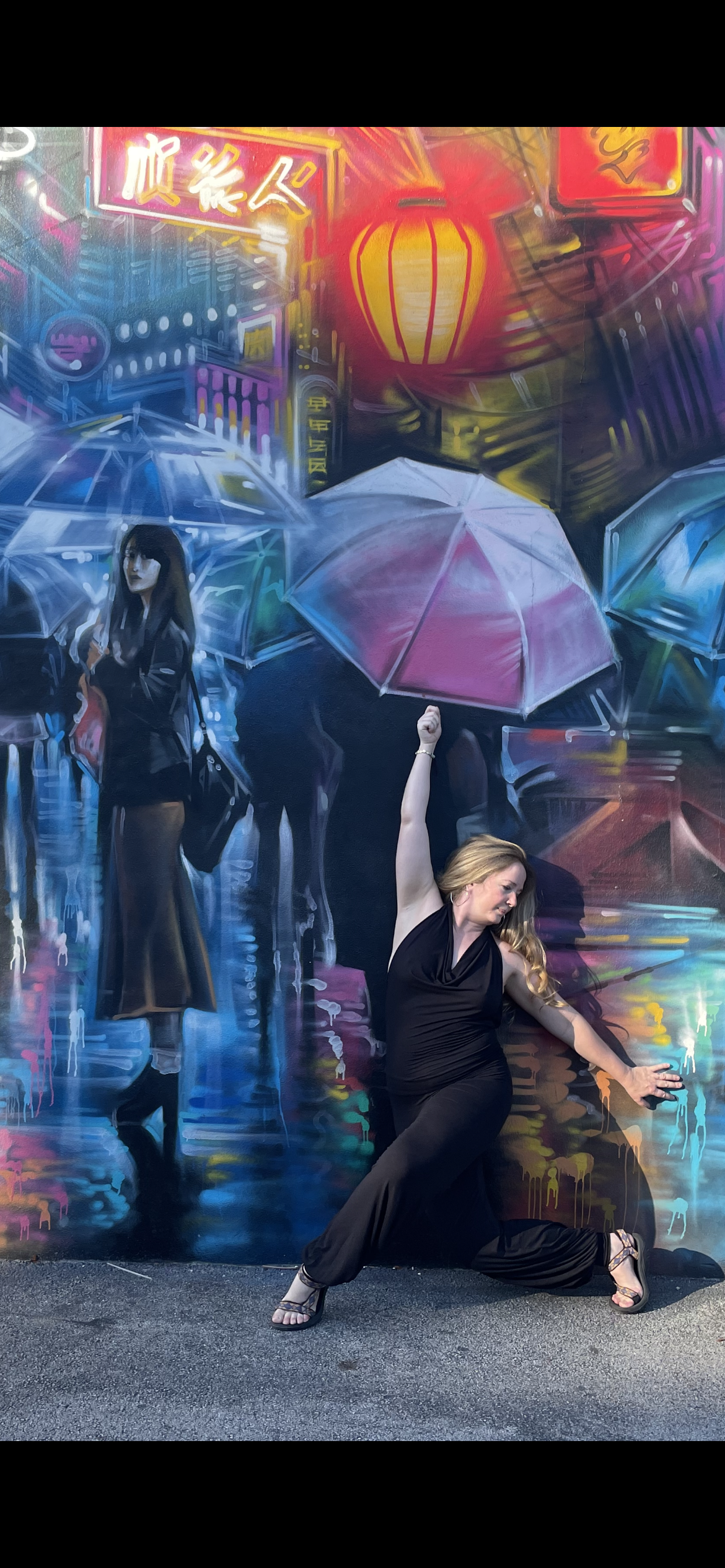
Emmy largely fell in love with dance because of its healing qualities. “I had quite a bit of trauma in my middle school and high school life,” Emmy says. Due to these experiences, she went from being “somebody that cared about everything” to being “somebody that really didn’t care.” “I just didn’t care about myself anymore [and] didn’t feel like I was worthy of love or praise or attention,” Emmy says. When someone invited her to audition to be a ball guest for Midwest Regional Ballet’s Cinderella, these feelings of unworthiness began to shift.
“I just fell in love with the sense of community,” Emmy says of being a part of Cinderella. She shares that it wasn’t that she was particularly interested in dancing ballet choreography—rather, she was touched that somebody wanted her to be a part of something. In addition, after experiencing sexual trauma, dance helped show Emmy that physical touch could be anticipated, safe, and choreographed. “That was really healing to me,” she says. Since that first day of rehearsal, Emmy says that she hasn’t gone less than dancing twenty hours a week.
She ended up getting a scholarship to study dance at the University of Central Oklahoma after dancing for just three years. Nonetheless, over time, it became clear to Emmy that becoming a professional dancer wasn’t in her future, particularly after experiencing a hip injury and being diagnosed with a thyroid disorder.
“It felt natural that I would be a teacher and choreographer because I didn’t start dance with the idea of wanting to be a professional ballerina necessarily. I started dance because somebody invited me,” Emmy says, and she continued because of the way it made her feel. Today, she’s carved spaces for herself and others that have been long overdue in the dance industry, specifically through the creation of the Best of My Abilities (BOMA) program. The BOMA program, offered at Issaquah Dance Theater and The Dance School, introduces students with disabilities to dance and provides a space for dancers of all abilities to learn and build relationships. “I know that there are lots of people who are afraid to step into a dance studio because they feel like you have to be a certain way...My entire dance life has been [dedicated to] figuring out ways to use dance to show people how loved they are,” she shares.
Emmy loves that dance allows her to take huge feelings she experiences and stories that are challenging to tell and express them on a stage where people can witness her experiences as beautiful. Dancing reminds Emmy that her body is capable of amazing things. And after undergoing a procedure that left her without the ability to conceive children, having a life passion that allows her to connect with children is one of the most important things to her.

While she acknowledges the many challenges she’s experienced in the dance industry, Emmy says that a big one is “imposter syndrome,” or feeling like she doesn’t belong. She points out that there are so many dancers, and people in general, in the Seattle area who have extensive accolades to justify their qualifications. “I don’t have that,” she admits. “Part of me has felt like I have to jump into every situation and prove that I’m capable.” For those who have similarly felt like they don’t belong in certain dance spaces, Emmy says that they undoubtedly do. “Your experience is different than anybody else’s in the world. And there are things that you can contribute that other people cannot. And it’s also okay if they contribute things that you cannot,” she says.
Emmy was inspired to become a DWC ambassador because she strongly aligns with the values of the business. “I feel like this is a space and a platform that’s very authentic,” she says, sharing that she appreciates that DWC strives to help make all dancers feel welcomed and safe in the industry. As an Ambassador, Emmy looks forward to helping affirm this message to dancers and sharing her multiplicity of experiences as a teacher. In addition to her BOMA classes, Emmy teaches classes of all levels and works with the competition team at Issaquah Dance Theater. At The Dance School, Emmy also teaches classes relating to storytelling, partnering, embodied ballet, and more. And she’s the program director for the dance program at Si View Metro Parks. Emmy is excited to show people what it’s like to participate in all of these different spheres of dance.
In the future, Emmy strives to find ways to integrate more student-driven storytelling and choreography classes into her schedule. At Si View Metro Parks, she’s planning on hosting an expressive movement workshop once a month open to dancers of all experience levels. The workshop will be centered on a theme, featuring a discussion portion, a creation workshop, and a small performance that is open to the community. “I have a vision for it. I feel very excited about the possibilit[ies] for it,” Emmy shares of the workshop.
Emmy strongly believes that dance creates a platform for building relationships and in the larger dance industry, she hopes to see more people embracing the differences dancers have and the contributions they can make. “There’s a difference between accepting and embracing,” she points out, sharing her wish for all dancers to not only feel tolerated but cared for and even invited.

“It doesn’t have to be an exclusive space. It can be radically inclusive,” Emmy says of the dance world.
Stay tuned for more from Emmy Fansler in the coming weeks!
If you or someone you know has been sexually assaulted, help is available. The National Sexual Assault Hotline is available 24/7 and is completely confidential: 800-656-4673
Disclaimer
All content found on the Dancewear Center Website, Instagram, Facebook, Pinterest, and all other relevant social media platforms including: text, images, audio, or other formats were created for informational purposes only. Offerings for continuing education credits are clearly identified and the appropriate target audience is identified. The Content is not intended to be a substitute for professional medical advice, diagnosis, or treatment. Always seek the advice of your physician or other qualified health provider with any questions you may have regarding a medical condition. Never disregard professional medical advice or delay in seeking it because of something you have read on this Website.
If you think you may have a medical emergency, call your doctor, go to the emergency department, or call 911 immediately. Dancewear Center does not recommend or endorse any specific tests, physicians, products, procedures, opinions, or other information that may be mentioned on dancewearcenter.net. Reliance on any information provided by dancewearcenter.net, Dancewear Center employees, contracted writers, or medical professionals presenting content for publication to Dancewear Center is solely at your own risk.
Links to educational content not created by Dancewear Center are taken at your own risk. Dancewear Center is not responsible for the claims of external websites and education companies.
Getting to Know DWC Ambassador Grace Pilo
While there is still so much social progress that needs to be made in the dance world, it’s exciting to see studios and companies taking steps to celebrate inclusivity and diversity in ways that didn’t exist years ago. Celebrating inclusivity in the dance world involves inviting dancers with all kinds of backgrounds and identities into the industry, and making them feel welcomed as they are. This also includes celebrating dancers with autoimmune diseases. DWC Ambassador Grace Pilo is passionate about advocating for dancers with autoimmune diseases, particularly those with type 1 diabetes, like herself. Read on to learn more about Grace’s dance journey and advocation efforts!
A Local Dancer on Dancing with Type 1 Diabetes
Name pronunciation: Grace Pie-lo | Pronouns: she/her
By Madison Huizinga, DWC Blog Editor

While there is still so much social progress that needs to be made in the dance world, it’s exciting to see studios and companies taking steps to celebrate inclusivity and diversity in ways that didn’t exist years ago. Celebrating inclusivity in the dance world involves inviting dancers with all kinds of backgrounds and identities into the industry, and making them feel welcomed as they are. This also includes celebrating dancers with autoimmune diseases. DWC Ambassador Grace Pilo is passionate about advocating for dancers with autoimmune diseases, particularly those with type 1 diabetes, like herself. Read on to learn more about Grace’s dance journey and advocation efforts!
“I’ve always been such a wiggly kid,” Grace says, sharing that as a youngster, her mom sought to involve her in an activity where she could release some of her restless energy. She says her mom signed her up for dance and she instantly fell in love with it. Today, Grace dances with Momentum Dance Academy & Ensemble in Burien, Washington.
“In 2015, I was diagnosed with a life-threatening autoimmune disease: type 1 diabetes,” Grace shares. “When I was in the hospital, all I wanted to do was go back to dance.” Before her diagnosis, Grace’s involvement with dance was largely recreational. But after she learned she had diabetes, she shares that her passion for the art form deepened. “I realized why I love to dance,” Grace says. Dance is an opportunity for Grace to be herself and not think about anything else, particularly when she’s performing on stage.
According to the organization JDRF, type 1 diabetes is an autoimmune disease that results from the pancreas ceasing to produce insulin. Insulin is a hormone that the human body needs to get energy from food. Type 1 diabetes strikes both children and adults differently and has nothing to do with diet or lifestyle. To help manage her own diabetes, Grace wears an insulin pump, which delivers constant doses of insulin on a pre-programmed schedule, and allows her to input carbohydrate information for everything she eats or drinks into the pump to calculate and dose insulin. She also wears a continuous glucose monitor or CGM, which measures her body’s glucose levels every five minutes. This information is sent via Bluetooth to her pump and phone and is also shared with her mom to help monitor. She wears both of these devices constantly and they are often visible, including to audience members when she performs on stage.
A challenge that Grace has faced as a dancer with diabetes is dancing with her medical gear, due to the way it’s perceived by others in the industry. “I feel like some doors have been closed for me since my diagnosis,” she says. “I think that people worry about it too much or think I am limited by my medical needs.” Grace says that her medical gear doesn’t stop her from being a talented dancer. “I’m still doing what I love, I just have to work harder than some at times to help manage my condition, but in the end, I’m no different than any of the other [dancers] in my class. I can still be me,” she says.
For other dancers facing similar challenges in the dance world, Grace says to not let anything stop them from doing what they love. For her, communicating transparently with her dance teacher allowed her to realize that there is nothing holding her back from being successful in the studio and on stage. “There’s always people to talk to,” Grace says. “And if you’re feeling like there’s something not right or maybe you’re not having the same opportunities [as others], just bring it up. Talk to someone, let them know how you’re feeling.”
Grace applied to be a DWC Ambassador because of the opportunity the position allows for her to advocate for type 1 diabetics and other dancers like her. She also says that Dancewear Center’s message “every body is a dancing body” greatly resonates with her, which also inspired her to apply for the program. Grace looks forward to being able to utilize Dancewear Center’s platform to reach large groups of people with her messages, particularly through Instagram takeovers.
Outside of the DWC Ambassadorship, Grace advocates for type 1 diabetics on her personal Instagram and with the Pacific Northwest chapter of JDRF, a global organization funding type 1 diabetes research. As a youth ambassador for JDRF, Grace has been a part of public outreach programs, including speaking in front of crowds at events to share her own story.
In the larger dance world, Grace hopes to see a larger cultural shift towards inclusivity and celebrating diversity, especially when it comes to dancers with medical devices or gear. She also hopes to share her story of dancing with type 1 diabetes with others to show that people with medical needs can dance proudly. “I have to wear these medical devices. I’m still a dancer and I still love to dance,” Grace declares.
Sources:
https://www.cdc.gov/diabetes/basics/what-is-type-1-diabetes.html
https://my.clevelandclinic.org/health/articles/9811-insulin-pumps
https://my.clevelandclinic.org/health/drugs/11444-glucose-continuous-glucose-monitoring
Disclaimer
All content found on the Dancewear Center Website, Instagram, Facebook, Pinterest, and all other relevant social media platforms including: text, images, audio, or other formats were created for informational purposes only. Offerings for continuing education credits are clearly identified and the appropriate target audience is identified. The Content is not intended to be a substitute for professional medical advice, diagnosis, or treatment. Always seek the advice of your physician or other qualified health provider with any questions you may have regarding a medical condition. Never disregard professional medical advice or delay in seeking it because of something you have read on this Website.
If you think you may have a medical emergency, call your doctor, go to the emergency department, or call 911 immediately. Dancewear Center does not recommend or endorse any specific tests, physicians, products, procedures, opinions, or other information that may be mentioned on dancewearcenter.net. Reliance on any information provided by dancewearcenter.net, Dancewear Center employees, contracted writers, or medical professionals presenting content for publication to Dancewear Center is solely at your own risk.
Links to educational content not created by Dancewear Center are taken at your own risk. Dancewear Center is not responsible for the claims of external websites and education companies.
Interested in writing for the DWC Blog? Click below to fill out the DWC Contributor application!