
Getting to Know Assistant Store Manager and Senior Pointe Shoe Fitter Anna Peters
From studying and teaching dance to fitting pointe shoes and helping customers as a Senior Pointe Shoe Fitter and Assistant Store Manager at Dancewear Center, dance consumes Anna Peters’ life. And she wouldn’t want it any other way! Read on to learn more about DWC Staff Member Anna Peters’ personal dance journey, goals for the future, and the changes she hopes to see made in the larger dance industry.
Name pronunciation: Anna Pee-ters | Pronouns: she/her
By Madison Huizinga, DWC Blog Editor

From studying and teaching dance to fitting pointe shoes and helping customers as a Senior Pointe Shoe Fitter and Assistant Store Manager at Dancewear Center, dance consumes Anna Peters’ life. And she wouldn’t want it any other way! Read on to learn more about DWC Staff Member Anna Peters’ personal dance journey, goals for the future, and the changes she hopes to see made in the larger dance industry.
Anna was inspired to begin dancing around age seven when her father took her to see The Nutcracker at Pacific Northwest Ballet. She started taking ballet classes at Body Language Studio, formerly known as Cornerstone Studio. In middle school, she started to branch out and took on classes in contemporary, lyrical, and jazz styles. “But I’m definitely a bunhead at heart,” Anna laughs, speaking about her love of ballet. In high school, Anna danced on the performing arts team at her studio and also took part in its pre-professional program. Today, she teaches ballet to students ages three through eighteen. “I’m also currently a dance major at the University of Washington,” Anna shares.
Anna began working at Dancewear Center in February of 2019 as a retail associate and since then she’s been promoted to a senior pointe shoe fitter and an assistant manager. Most of Anna’s time at Dancewear Center is spent helping dancers find the best pointe shoes for them and helping them learn more about the pointe shoe fitting process so they can be more informed about what they’re doing. She also has experience working on inventory and managing customers’ orders and information. Anna also takes pride in participating in the continuing education programs DWC employees do, particularly those related to pointe shoe fitting.
Anna enjoys being able to help dancers on their journeys by helping them find the exact products they need. Especially when it comes to helping people with pointe shoes, Anna gets a lot of satisfaction from helping people find the best pair of shoes for them.
Another aspect of fitting pointe shoes that Anna loves is being able to work in a space that occupies the “intersection of art and science.” She likes seeing how the anatomical knowledge of pointe shoe fitting supports the poetic, artistic side of dance.
When Anna isn’t at work or school, she enjoys dancing herself, as well as creating other forms of visual art. She especially likes to draw, particularly in a comic book style, and enjoys creating fan art. Anna is also an avid reader and writer, she’s even written a novel that she’s looking into publishing!

In addition to majoring in dance at the University of Washington, Anna is also studying physiology and plans to attend PT school to become a physical therapist who specializes in working with dancers, dance educators, and pointe shoe fitters. “I really want to be able to work with other[s]...to create an environment that’s a little more friendly to dancers,” Anna shares, acknowledging that dancers have specific needs that cannot always be adequately met by meeting with a general physical therapist. “I think that it’s really important that a dancer gets what they actually need,” she says, also stressing the importance of dancers being educated on injury prevention. Anna is excited to be working with Velocity Physiotherapy this summer to learn more about physical therapy in the dance and performing arts industry.
A change that Anna hopes to see made in the dance world is dancewear companies offering a wider range of size options across leotard styles. Anna points out that the leotard sizes available to the public are reflective of the types of bodies that people have been conditioned to associate with dancers. She stresses that leotards need to have support for all body types. “What’s super important to me is that everyone feels comfortable dancing,” Anna says. “I think part of that is having clothes that they can actually feel comfortable dancing in.” She’s proud of the strides that have been made within many companies but shares that more work still needs to be done.
About the Author

Disclaimer
All content found on the Dancewear Center Website, Instagram, Facebook, Pinterest, and all other relevant social media platforms including: text, images, audio, or other formats were created for informational purposes only. Offerings for continuing education credits are clearly identified and the appropriate target audience is identified. The Content is not intended to be a substitute for professional medical advice, diagnosis, or treatment. Always seek the advice of your physician or other qualified health provider with any questions you may have regarding a medical condition. Never disregard professional medical advice or delay in seeking it because of something you have read on this Website.
If you think you may have a medical emergency, call your doctor, go to the emergency department, or call 911 immediately. Dancewear Center does not recommend or endorse any specific tests, physicians, products, procedures, opinions, or other information that may be mentioned on dancewearcenter.net. Reliance on any information provided by dancewearcenter.net, Dancewear Center employees, contracted writers, or medical professionals presenting content for publication to Dancewear Center is solely at your own risk.
Links to educational content not created by Dancewear Center are taken at your own risk. Dancewear Center is not responsible for the claims of external websites and education companies.
Getting to Know DWC Blog Editor Nicole Barrett
Nicole enjoys writing for the DWC Blog because she gets to learn about other peoples’ stories and relationships with dance. She points out that in everyday dance training, it’s rare that dancers discuss how dance has helped shape their lives. Hearing the stories of others has opened Nicole’s eyes to what dance can do for people and the capacity that it has to transform lives. Through conducting and transcribing interviews, she also feels a stronger attachment to the local dance community in Seattle and a greater understanding of its interconnectedness.
A Conversation About Writing and Dancing in the Greater Seattle Area
Name pronunciation: Nick-ole Bear-et | Pronouns: she/her
By Madison Huizinga, DWC Blog Editor

Since its conception, the DWC Blog has been an outlet for local artists and business owners to share their stories with the dance community of greater Seattle. For those on the DWC Blog team, the blog has also become a site of learning and connection. DWC staff member Nicole Barrett shares what she loves about writing for the DWC Blog, what she hopes to see change in the dance world, as well as her plans for the future. Nicole will soon be the new editor for the DWC Blog, so keep an eye out for her upcoming posts!
Growing up, Nicole trained at several different dance studios across the greater Seattle area. She began taking dance classes at age three at the Renton Community Center. “I fell in love with it,” Nicole shares. She later took classes at Rainier Ballet Academy and participated in the performing company. After the dance school got bought out by another business, Nicole began taking classes from the studio director out of her house multiple times a week to continue dancing. She later took classes at Body Language Studio (formerly Cornerstone Studio) and then took some time off following an injury. Nicole eventually landed at Spotlight Dance Center, where she has danced in the performing company and participates in annual shows.
“Dance is my way of expressing without having to use words,” Nicole says. She enjoys that dance allows her the ability to share her emotions without having to speak, as verbal communication is admittedly not her favorite mode of expression. Nicole feels like dancing has allowed her to be more emotionally intelligent, as she’s able to explore nuanced feelings through movements that are challenging to verbalize.
Something Nicole hopes to see change in the dance world is the unrealistic physical expectations for dancers, as well as the antiquated ideas about gender roles in dance. “Everyone can dance, no matter what their body type is,” Nicole says. “Dance is for every person, it doesn’t have to be just for one specific set of people.” She believes that more dance studios should promote the idea that anyone can dance and have open conversations about tough topics like physical insecurities. She appreciates that Spotlight Dance Center celebrates “Love Your Body Week,” an annual event in which a week is dedicated to promoting self-care and self-love.
Nicole learned about Dancewear Center last summer when her studio director informed her and her fellow dancers that a new dance store was opening in Renton, Washington and that they were looking for staff. Nicole thought she would make an excellent member of the DWC team, as she had experience dancing which would lend itself well as a retail associate at a dancewear store. She and her friend and fellow dancer Mia Behnke applied and both got the jobs! In August 2021, Nicole began working as a retail associate. Months later, Nicole was recruited by DWC Owner and General Manager Samantha Weissbach to work on the DWC marketing team. Since then, Nicole has been devoting most of her work time to training to be the next DWC Blog Editor, as well as helping out with photography efforts.
“Dance is for every person, it doesn’t have to be just for one specific set of people”

Nicole enjoys writing for the DWC Blog because she gets to learn about other peoples’ stories and relationships with dance. She points out that in everyday dance training, it’s rare that dancers discuss how dance has helped shape their lives. Hearing the stories of others has opened Nicole’s eyes to what dance can do for people and the capacity that it has to transform lives. Through conducting and transcribing interviews, she also feels a stronger attachment to the local dance community in Seattle and a greater understanding of its interconnectedness.
Outside of working and dancing, one of Nicole’s greatest passions is film. She enjoys watching movies in her free time, but she is unsure of what she would like to pursue in college. Growing up, she loved watching the movie Monsters, Inc., and today she’s a huge fan of Knives Out, Once Upon a Time in Hollywood, and Marvel movies. She’s also fond of taking photographs, spending time with her friends and family, and engaging in self-care when she can.
This summer, Nicole is attending a summer film program at UCLA and plans to start preparing her college applications and touring universities. She is still unsure about where she wants to land for college, but she is excited for the future. Nicole also shares that she has some dance performances coming up that she’s preparing for with her dance studio.
We’re thrilled to have Nicole as our new DWC blog editor! Stay tuned for more posts from her in the upcoming months.
About the Author
Disclaimer
All content found on the Dancewear Center Website, Instagram, Facebook, Pinterest, and all other relevant social media platforms including: text, images, audio, or other formats were created for informational purposes only. Offerings for continuing education credits are clearly identified and the appropriate target audience is identified. The Content is not intended to be a substitute for professional medical advice, diagnosis, or treatment. Always seek the advice of your physician or other qualified health provider with any questions you may have regarding a medical condition. Never disregard professional medical advice or delay in seeking it because of something you have read on this Website.
If you think you may have a medical emergency, call your doctor, go to the emergency department, or call 911 immediately. Dancewear Center does not recommend or endorse any specific tests, physicians, products, procedures, opinions, or other information that may be mentioned on dancewearcenter.net. Reliance on any information provided by dancewearcenter.net, Dancewear Center employees, contracted writers, or medical professionals presenting content for publication to Dancewear Center is solely at your own risk.
Links to educational content not created by Dancewear Center are taken at your own risk. Dancewear Center is not responsible for the claims of external websites and education companies.
What It’s Like Being a DWC Ambassador
At Dancewear Center, the fundamental mission that underpins all of our work is “to support and empower our dance community through quality, integrity, and education.” A large part of how Dancewear Center strives to support local dancers is by finding unique ways to connect dance artists and forge community. The DWC Ambassador program is one of the ways we’re creating those connections and conceiving that community. As ambassadors, individuals get the chance to create original content for the DWC Blog, take over the DWC Instagram, receive free products, get professional photos taken, and much more.
By Madison Huizinga, DWC Blog Editor

Click below to shop the look:
At Dancewear Center, the fundamental mission that underpins all of our work is “to support and empower our dance community through quality, integrity, and education.” A large part of how Dancewear Center strives to support local dancers is by finding unique ways to connect dance artists and forge community. The DWC Ambassador program is one of the ways we’re creating those connections and conceiving that community. As ambassadors, individuals get the chance to create original content for the DWC Blog, take over the DWC Instagram, receive free products, get professional photos taken, and much more.
The program offers dancers opportunities to share their messages with the local dance community through a variety of modes. “I think my favorite part has been the blogs we do. Not only reading everyone else’s blogs and seeing how dance is affecting them… but also bringing your own voice and awareness to the project,” says former DWC Ambassador Heather Smith.
DWC Ambassador Emma Spencer appreciates getting to share information about topics that are important to her in the dance world, like mental health and epilepsy awareness in the studio. “Writing for the blog has been really awesome because I always wanted to do something like that,” she says. “It’s been a good experience to have something I care about be posted very publicly.”

Click below to shop the look:
Former DWC Ambassador Niyah Pratt points out that there is value in getting to share your ideas through Dancewear Center’s platform. “You get to speak on things that you love and what you’re passionate about...It’s such a huge platform that you can use your voice and get anything across that you want.”
Along with the chance to speak your mind on the DWC Blog and social media, being an ambassador comes with numerous perks, like complimentary photoshoots and free products. “There are some really fun things you get to do as an ambassador, like photoshoots. You’re hung up on the wall!” Emma says of the ambassador photos being displayed in the store.
“You get a gift every single month with amazing things inside,” gushes Heather. The ambassadors get a chance to own some of the highest quality products the store has to offer. DWC Ambassador Kelsey Wickman shares that many of the gifts she’s received are products she wouldn’t have purchased for herself but have thoroughly changed her dancing experience, such as the Apolla Shocks.
“I now own more leotards than I do pants!” adds former DWC Ambassador Isabel Reck.
A particularly fun part about being an ambassador is getting to do an “Instagram takeover,” in which the ambassador runs the DWC Instagram account for a day. “I’m not a very social person, I’m actually really introverted. But I think that was a really fun way to interact with Dancewear Center’s audience and their customers,” Emma says of the Instagram takeovers. She also says that it’s been enjoyable to post sponsored Instagram posts and feel like she’s playing a role in spreading the word about Dancewear Center’s products.
“You get to speak on things that you love and what you’re passionate about...It’s such a huge platform that you can use your voice and get anything across that you want”

Click below to shop the look:
Mirella Leo by BLO | Delia Skirt by WM | Always There For You Necklace by Covet Dance | Pointe Paint by Pointe People
The DWC Ambassador role offers dancers opportunities to overcome challenges and learn new things about themselves, whether that be nudging them to be more social, improving upon their writing skills, and more. For example, Emma says that being a DWC Ambassador has encouraged her to “get out of [her] shell socially.” She describes feeling nervous when she learned she had to do an Instagram takeover, but that it ultimately helped her gain confidence and connect with others in the DWC community.
Kelsey shares that it’s been empowering to realize she has a “unique perspective” to bring to Dancewear Center. Being able to reflect on her dance experiences, particularly through writing blog posts, has enabled her to explore new areas of her life. She also appreciates how her experiences are respected within the DWC community. “Being able to have a more personal connection with everyone at Dancewear Center has been really awesome,” Kelsey says. “Because they just know their stuff and it’s so cool to see how much emphasis Sam puts on continuing education.”
Emma says that part of the reason she signed up to be an ambassador was that Dancewear Center often discusses serious subjects in the dance world, like body image, race, sexual orientation, gender, and more. Emma appreciates how solution-oriented the staff at Dancewear Center is, especially in the way it discusses issues relating to these topics.

Click below to shop the look:
In a similar vein, Kelsey shares how helpful it is to collaborate with a small business that cares about creating positive change on micro and macro levels. “[Dancewear Center] is so aware of those pockets of room for improvement,” she says.
And the DWC Ambassadors get a chance to be a part of filling those pockets for improvement with the changes they want to see made. Whether it’s through providing representation for underrepresented groups of dancers, sharing unique perspectives through writing, and more, the DWC Ambassadors are true change-makers that are invaluable to the DWC team. “You have the chance to make some real change in your community,” Isabel Reck says proudly.
To become a DWC Ambassador for 2022-2023 click here!
Whim W’Him’s Olivier Wevers on Equitable Treatment in Dance
One of Whim W’Him’s most important values is putting “people first always,” something that is not always upheld in the dance world. That’s why Olivier shares that ensuring his dancers are well-paid has always been a priority of his. “They are artists…They are highly skilled professionals and they should be paid for that,” he stresses. He started Whim W’Him with the intention of “changing the landscape of how dancers are often abused and exploited,” particularly when it comes to being under-compensated for their work.
A Seattle-Based Director on Eliminating Exploitation in the Dance Scene
Name pronunciation: Ol-i-vee-eh W-eh-vers | Pronouns: he/him
By Madison Huizinga, DWC Blog Editor

Photo by Stefano Altamura
Artists are often left out of larger conversations about equitable treatment and fair pay for workers. Even so, artists are skilled professionals as other laborers are, deserving of comprehensive treatment from companies that are able to secure the funds they need to operate effectively. Whim W’Him Founder and Artistic Director Olivier Wevers is a strong advocate for eliminating exploitative practices in the dance scene, principles he is practicing at the Seattle-based dance company itself. Read on to learn more about Olivier’s dance journey and about Whim W’Him’s mission and plans for its 2022-2023 season. And when purchasing tickets for one of Whim W’Him’s 22-23 shows, use code DWC20 for 20% off your ticket purchase!
Olivier expressed interest in dancing around age six. He can recall arriving at his first dance class wearing thick red wool tights, and immediately feeling out of place. “I actually cried and sat on the piano,” Olivier recalls, laughing. His parents told him that if he cried again, he wouldn’t be coming back to dance class. “I guess I didn’t,” Olivier says.
Around age fourteen, Olivier transferred from a recreational studio to a more professionally-focused one in his hometown of Brussels, Belgium. When he reached about nineteen years old, he began looking for work, moving to the United States for a summer program in Pittsburgh, Pennsylvania. Olivier landed his first job dancing with Columbia City Ballet in South Carolina for a year. He later danced at Royal Winnipeg Ballet for five years, touring around the world for six months out of the year. Olivier finished his dancing career at Pacific Northwest Ballet, where he worked for fourteen years.

Photo by Stefano Altamura
It took a while for Olivier to realize that starting a dance company is what he wanted to do. He had been gaining more choreography opportunities, diving deeper into the creation side of dance. He knew that running a dance company required a lot of hustle - administrative work, fundraising, and more - and he also realized the life of touring and traveling so often became lonely. Olivier desired to not only work with his own dancers but begin developing a vocabulary of dance that was unique. After mulling it over and having some encouragement from friends, Olivier incorporated Whim W’Him in 2009.
Today, Olivier says that Whim W’Him is all about the “creation process,” sharing that the company doesn’t like to place limits on itself by fixating on one topic or genre of focus. “There are so many types of choreographies and ways of working with bodies and I think that’s what we want to embrace,” Olivier says. “It’s really about exploring our human condition.”
One of Whim W’Him’s most important values is putting “people first always,” something that is not always upheld in the dance world. That’s why Olivier shares that ensuring his dancers are well-paid has always been a priority of his. “They are artists…They are highly skilled professionals and they should be paid for that,” he stresses. He started Whim W’Him with the intention of “changing the landscape of how dancers are abused and exploited,” particularly when it comes to being under-compensated for their work.
“The idea behind the company is to re-create a culture that is fighting the [outdated system] that is now widely adopted in this country for contemporary dancers and re-build an environment that is safe, welcoming, and supportive for everyone,” Olivier says.
Fittingly, Whim W’Him dancers are also offered opportunities to exercise creative control when it comes to the work they perform. For example, choreographers featured in Whim W’Him’s upcoming fall program were selected by dancers of the company itself, as a part of the 8th Choreographic Shindig. In a longstanding tradition, after reviewing applications, the dancers themselves have the opportunity to curate the evening performance, exercising their own creative opinions as artists.
In its 2022-2023 season, Whim W’Him is excited to showcase about ten original works across its three live programs in fall, winter, and spring. In addition, in February 2023, Whim W’Him will be collaborating with Early Music Seattle to create a brand new piece.

Photo by Stefano Altamura
In the fall, audiences can expect new creations from Keerati Jinakunwiphat, Dolly Sfeir, and Nicole von Arx on September 9-17, 2022 at Erikson Theater and on September 14, 2022 at Vashon Center for the Arts. In the winter, Whim W’Him will show work by Mike Esperanza, Annabelle Lopez Ochoa, and Olivier Wevers from January 20-31, 2023 at the Cornish Playhouse, January 25, 2023 at Vashon Center for the Arts, and January 31, 2022 at Whidbey Island Center for the Arts. Finally, in the spring, audiences will see work by Emilie Leriche, Olivier Wevers, and Rauf Yasit on May 12-20, 2023 at the Cornish Playhouse, May 17, 2023 at Vashon Center for the Arts, and May 24, 2023 at Whidbey Island Center for the Arts.
All in all, in the next year, Olivier looks forward to seeing Whim W’Him continue to grow as a company and help create an environment for dancers that is “safe, diverse, [and] welcoming.” “We have a lot of change that needs to happen,” Olivier insists, citing more accessible dance education, greater support for BIPOC artists, comprehensive dance media and journalism, and of course, fair pay and eradicated exploitation as changes the dance industry needs to see. He also hopes to see more arts funding on a governmental level, particularly for smaller dance companies, where he believes much of the innovation in dance is occurring.
Become a member with Whim W’Him today or use code DWC20 for 20% off your tickets for one of Whim W’Him’s Season 22-23 shows.

Sources:
Disclaimer
All content found on the Dancewear Center Website, Instagram, Facebook, Pinterest, and all other relevant social media platforms including: text, images, audio, or other formats were created for informational purposes only. Offerings for continuing education credits are clearly identified and the appropriate target audience is identified. The Content is not intended to be a substitute for professional medical advice, diagnosis, or treatment. Always seek the advice of your physician or other qualified health provider with any questions you may have regarding a medical condition. Never disregard professional medical advice or delay in seeking it because of something you have read on this Website.
If you think you may have a medical emergency, call your doctor, go to the emergency department, or call 911 immediately. Dancewear Center does not recommend or endorse any specific tests, physicians, products, procedures, opinions, or other information that may be mentioned on dancewearcenter.net. Reliance on any information provided by dancewearcenter.net, Dancewear Center employees, contracted writers, or medical professionals presenting content for publication to Dancewear Center is solely at your own risk.
Links to educational content not created by Dancewear Center are taken at your own risk. Dancewear Center is not responsible for the claims of external websites and education companies.
How to Make a Ballet Bun
As dancers, we tirelessly strive to improve our technique and artistry in each class. A big part of putting in this work is focusing on the task at hand without distractions. And as any dancer with long locks knows, hair can often be a big distraction! We’ve all been there - constantly tucking falling strands behind our ears, jamming bobby pins into our scalp, trying to re-do our ballet bun in between combinations, the list goes on. Knowing how to do a proper ballet bun can significantly benefit a dancer, as it can keep them focused on their training and performance and not on whether their updo will stay put. Read on to learn DWC’s tips for achieving the perfect ballet bun.
A Guide to the Essential Ballerina Updo
By Madison Huizinga, DWC Blog Editor

Ballet bun at the crown of the head. Photo by Colin Hutton from danceadvantage.net
As dancers, we tirelessly strive to improve our technique and artistry in each class. A big part of putting in this work is focusing on the task at hand without distractions. And as any dancer with long locks knows, hair can often be a big distraction! We’ve all been there - constantly tucking falling strands behind our ears, jamming bobby pins into our scalp, trying to re-do our ballet bun in between combinations, the list goes on. Knowing how to do a proper ballet bun can significantly benefit a dancer, as it can keep them focused on their training and performance and not on whether their updo will stay put.
Let’s run through the basic steps.
Brush or comb your hair free of tangles
Run a hairbrush or comb through your hair several times until it is free of any tangles. Eliminating any knots or tangles in your hair will ensure that your hair looks smooth in the final ballet bun without any large “bumps.” Many dancers choose to use a spray bottle filled with water to achieve an extra smooth look.
Secure your hair in a ponytail at the crown of your head
Gather your hair into a ponytail that sits at the crown of your head (see photo). It’s worth noting that some dancers prefer to part their hair and secure it into a low ponytail at the nape of their neck. This creates what’s referred to as a “low bun.” For those with finer hair, using a hairbrush or comb to help gather your hair into a ponytail can help smooth out any bumps. Secure the ponytail with a hair tie, preferably one that’s a similar color to your hair. Dancers, specifically ones with finer hair, can optionally smooth their hair back with hair gel before this step to help smooth away bumps and flyaways. Many dancers also choose to use a bristle or “smoothing brush” during this step to help with any bumps or flyaways. Using mousse, “hair mascara,” or gel applied with a toothbrush can further enhance this smoothed back ponytail.
Twist the ponytail into a coil and wrap it around the hair tie

Photo of a ponytail at the crown of the head. Photo by Pius Martin from Unsplash.
Twist the hair in your ponytail until it starts coiling in on itself. Wrap it around your hair tie so it forms a spiral-like shape, pinning it with hair pins as you go. The tighter you coil your hair, the better! For dancers with thicker hair, it can be useful to divide the ponytail into two separate sections, twist each section, and coil each one in opposing directions around the hair tie. Twisting your hair into a firm coil will help ensure that the bun stays tightly secure and in place.
Fasten the bun with hair pins and a hairnet
Secure the ballet bun by sticking hair pins into its center, along the bottom base of the bun on the scalp. Angle the pin towards your scalp before shifting the angle upwards into the center of the bun. The more hair you gather in the pin before angling it upwards, into the bun, the flatter the bun will be. At Dancewear Center, we offer two-inch, two-and-a-half-inch, and three-inch hair pins for buns of varying sizes. The hair pin size that a dancer should use depends on the thickness and length of their hair. Also, wrapping a hairnet around the bun helps keep fine, flyaway hair at bay. Before securing the bun with hair pins, simply wrap the hairnet around the bun, making sure that its elasticized edge is tucked towards the bottom of the bun out of view. The hairnet may be wrapped around the dancer’s bun once, twice, or three times depending on the texture of the dancer’s hair and the size of their bun.
Pin back and hairspray any stray hairs
For those with layered and/or fine hair, use bobby pins or snap clips to secure any stray hairs or bangs. As a finishing touch, spray the bun and your scalp with a light coating of hairspray to ensure that the updo is smooth with a clean, finished look.
Bonus tips!
Use a “Bun Builder”
For those struggling to achieve a tall, rounded bun look, use the Bun “Donut” Builder by Bloch. Simply gather your hair into a ponytail, pull the ponytail through the center of the builder, slide the builder to the base of the ponytail, arrange your hair around it, and secure it with a hairnet and hair pins. The Bloch Bun Builder creates a taller, more spherical bun than the classic method, so we suggest using it if you are hoping to achieve that style in particular.
Keep a “hair kit” in your dance bag
It’s always helpful to have extra hair supplies on hand in the case of a hair tie snapping, a hair net snagging, or a bobby pin disappearing out of thin air (it’s crazy how they seem to do that!). The Bloch Hair Kit contains all of a dancer’s hair essentials including two hair nets, fifteen three-inch hair pins, ten two-inch hair pins, six bobby pins, four hair elastics, and a “how-to” guide for the best bun. Plus, it comes in an elegantly packaged pink tin that will be sure to stand out in your dance bag when you’re doing your hair in a hurry. The “Holding It Together” Bun Box from Covet Dance similarly contains hair pins and hair ties, as well as bobby pins, corkscrew spin pins, a bun-making “flower,” and a cute decorative wool bow to offer dancers more hair options.

Photo by Iiona Virgin on Unsplash
Accessorize!
When given permission from your dance instructor, let your personality shine with some fun hair accessories. The dreamy Cloud Scrunchie from Cloud & Victory wraps your bun in a colorful, luminous garment that looks great on your hair and on your wrist. Handmade by local Seattle artist Hayley Maddox, the scrunchies from Lasso Leos come with intricately detailed lace patterns and stitching, sure to stand out in any class. The Fluffy BUNnies Scrunchies from Covet Dance are as fuzzy and adorable as can be, particularly cute on younger dancers. Or adorn your ballerina updo with a classic crochet bun cover from American Dance Supply, offered in a variety of soft colors and with rhinestones.
By following these tips along with a little practice, your ballet bun will be fit for the studio and stage in no time!
Disclaimer
All content found on the Dancewear Center Website, Instagram, Facebook, Pinterest, and all other relevant social media platforms including: text, images, audio, or other formats were created for informational purposes only. Offerings for continuing education credits are clearly identified and the appropriate target audience is identified. The Content is not intended to be a substitute for professional medical advice, diagnosis, or treatment. Always seek the advice of your physician or other qualified health provider with any questions you may have regarding a medical condition. Never disregard professional medical advice or delay in seeking it because of something you have read on this Website.
If you think you may have a medical emergency, call your doctor, go to the emergency department, or call 911 immediately. Dancewear Center does not recommend or endorse any specific tests, physicians, products, procedures, opinions, or other information that may be mentioned on dancewearcenter.net. Reliance on any information provided by dancewearcenter.net, Dancewear Center employees, contracted writers, or medical professionals presenting content for publication to Dancewear Center is solely at your own risk.
Links to educational content not created by Dancewear Center are taken at your own risk. Dancewear Center is not responsible for the claims of external websites and education companies.
Happenings at the Yaw and New Pitch & Roll Studios
Aside from the Yaw, Stella has recently opened several new rehearsal spaces called Pitch and Roll. These spaces are there as rehearsal studios that choreographers and artists can book and use without excess hassle. Stella wanted to put on more programming for the artists and choreographers in the area, so she created these rehearsal spaces for people to use that have the proper resources. “I don’t think there can be too much performance art,” Stella said about getting more space for dancers around the area.
Stella Kutz on Providing Spaces for Artistry
Name pronunciation: Stella Kuh-Ts | Pronouns: she/her
By Nicole Barrett, DWC Blog Editor

Having a space where dancers can come together and create something beautiful is something that Stella Kutz strives for in the Seattle area. From starting dance early on in her life to creating the Yaw Theater, Stella has much experience navigating the tough dance world and striving for creativity. Read on to learn more about Stella’s hopes for the dance community and new events happening at the Yaw and new Pitch & Roll Studios!
Stella started dancing when she was five when her grandmother bought her classes. “I wanted to jump high and I always wanted to be pretty,” Stella shares about wanting to join dance classes. Stella started dancing at Spectrum Dance Theater under the direction of Dale Merrill. “It was perfect for me because Spectrum at the time was just there, if you want to dance you are going to dance and that is how I got through,” she says. Stella danced at Spectrum for 13 years and took every opportunity that she could to volunteer and help out as much as she could.
After many years of dance, Stella went off to the University of Nevada, Las Vegas to receive a BFA in Performance Choreography. Once her degree was completed, she moved back to Seattle, but was faced with the difficulty of figuring out what to do after college. “Once you graduate college, they don’t tell you what to do at all. They’re like, `Well, just go audition,’” Stella shares. She began to dance for numerous companies around the city and eventually as she got more involved in the dance world in Seattle, noticed that there were no places nearby to dance.
One day she got to meet the owner of Equinox Studios, where Yaw Theater is now located, and expressed to him that she wanted a dance space and he agreed. Ideas kept sprouting and more opportunities arose for this new space and the Yaw Theater was eventually born. “Everything kind of fell into place,” Stella says.
When asked what her favorite thing about dance is, she shares this: “it’s the only art form where you can be ‘not good at it’ but be captivating.” Stella also expressed the energy of being in a dance class and the joy felt when you know you did a good job as a large part of dance’s appeal to her.
Moving forward in the dance world, Stella would like to see more community and an increase in inclusivity with everyone no matter who they are. “I want people to be more supportive of everyone else in general and in dance,” Stella shares. She would also like to see more intimate performances that allow the audience to be up close to the dancers and feel their emotions rather than being far away and feeling detached from the art.
When it comes to the production of the Yaw Theater, Stella wanted a place that was easy and affordable for anyone that wanted to use it. “I really enjoy watching people achieve their goals,” Stella shares. “Just a place where people can try things and it’s not a huge financial risk.” She also mentioned that she wants a place where it is easier to make art and that working with artists of different mediums is very important to her, so the location of the Yaw Theater, in Equinox Studios among other artists, was perfect.
Aside from the Yaw, Stella has recently opened several new rehearsal spaces called Pitch and Roll. These spaces are rehearsal studios that choreographers and artists can book and use without excess hassle. Stella wanted to put on more programming for the artists and choreographers in the area, so she created these rehearsal spaces for people to use that have the proper resources. “I don’t think there can be too much performance art,” Stella said about getting more space for dancers around the area.

Stella plans to create more festivals and events for artists and dancers around the area to come create and watch art. In terms of what is in the works right now, Stella is planning on bringing together a group of like-minded individuals from different artistic backgrounds to showcase their works in “Launchpoint,” a “conglomeration” of art. Stella plans to work with Sophia Wheelright, a Seattle-based artist who specializes in aluminum mesh installations, to create a sculpture for groups of dance artists to perform with in the space. Each group of dancers will be given the same performance parameters in terms of time and space, allowing audiences to help see and appreciate the diversity of artists’ creative processes. The tactile art itself is also something that Stella is interested in when it comes to making sure that every dancing body is given the same source to inspire their creations. This can allow the audience to interpret the creativity in their own way and find the message in the story. “That will help people understand or at least appreciate the diversity of our thoughts and our creative process,” Stella shared.
Keep a lookout at yawtheater.com for more information about “Launchpoint” and book your space at the Yaw and Pitch & Roll today!

Sources:
Disclaimer
All content found on the Dancewear Center Website, Instagram, Facebook, Pinterest, and all other relevant social media platforms including: text, images, audio, or other formats were created for informational purposes only. Offerings for continuing education credits are clearly identified and the appropriate target audience is identified. The Content is not intended to be a substitute for professional medical advice, diagnosis, or treatment. Always seek the advice of your physician or other qualified health provider with any questions you may have regarding a medical condition. Never disregard professional medical advice or delay in seeking it because of something you have read on this Website.
If you think you may have a medical emergency, call your doctor, go to the emergency department, or call 911 immediately. Dancewear Center does not recommend or endorse any specific tests, physicians, products, procedures, opinions, or other information that may be mentioned on dancewearcenter.net. Reliance on any information provided by dancewearcenter.net, Dancewear Center employees, contracted writers, or medical professionals presenting content for publication to Dancewear Center is solely at your own risk.
Links to educational content not created by Dancewear Center are taken at your own risk. Dancewear Center is not responsible for the claims of external websites and education companies.
Celebrating Vintage Jazz at Sister Kate Dance Company
Sister Kate Dance Company teaches its SKDC Boot Camps in October, January, and April. The Boot Camps offer a chance for anyone to experience what it’s like to be a vintage chorus line dancer. Over the course of four weeks, participants learn original choreography from a Sister Kate dancer, work on their stage presence, connect with other eager and enthusiastic dancers, and even have the chance to perform in front of a live audience. This year’s October boot camp theme is “A Coven of Witches,” so dancers can expect a spooky, Halloween-themed performance opportunity. Tickets for the October 2022 boot camp open on September 1st, and Robin recommends grabbing yours early! Check out Sister Kate’s website and social media for more information.
Robin Nunnally on Promoting Jazz Across Seattle
Name pronunciation: Robin Noon-aul-ee | Pronouns: she/her
By Madison Huizinga, DWC Blog Editor

Photo By Priya Alahan Photography
Jazz is among the many history-rich dance genres widely celebrated throughout the world today. Organizations like Sister Kate Dance Company (SKDC) are making an effort to keep styles like vintage-jazz alive and teach jazz history through SKDC Boot Camps and performances throughout the Seattle area. Read on to learn more about Sister Kate’s mission and the dance journey of Robin Nunnally who is a manager, head choreographer, and original founding member of the company. Be sure to register for Sister Kate’s SKDC Boot Camp for October 2022 on September 1st and keep an eye out for upcoming performances on its social media!
Growing up in a family that enjoyed dancing and theatrics likely primed Robin for the path she’s on now. As a kid, Robin shares that she was obsessed with the dances in musicals like Hairspray, A Chorus Line, and Victor Victoria, explaining she could often be found dancing in front of the television copying the performances. Around age 13, Robin attended a summer theatrics class at a local theater on Bainbridge Island, Washington, where she was first exposed to solo jazz. About a year and a half later, she was introduced to the world of Lindy Hop and swing dance through a friend. “I just kind of dove into it head first and have been obsessed ever since,” Robin says.
The Sister Kate Dance Company was founded in 2006, largely as a result of some female swing dancers feeling like their artistic voices were overshadowed by their male counterparts during choreography sessions. Robin and four of her female peers met together and asked what it might look like if they put together their own solo jazz choreography. The dancers performed their piece at a local event and had an amazing time, prompting them to continue creating for the years to come.
16 years since its founding, Sister Kate now has 26 dancers as core company members and teaches classes to the public several times a year out of the Russian Community Center of Seattle, a community hall ballroom in Seattle, Washington. To date, some of the company’s biggest dance inspirations are Josephine Baker, Debbie Reynolds, Cyd Charisse, The Sepia Steppers, The Rockettes, Ziegfeld Follies, and Busby Berkeley.

Photo By Priya Alahan Photography
Sister Kate Dance Company teaches its SKDC Boot Camps in October, January, and April. The Boot Camps offer a chance for anyone to experience what it’s like to be a vintage chorus line dancer. Over the course of four weeks, participants learn original choreography from a Sister Kate dancer, work on their stage presence, connect with other eager and enthusiastic dancers, and even have the chance to perform in front of a live audience. This year’s October boot camp theme is “A Coven of Witches,” so dancers can expect a spooky, 1930s/1940s Halloween-themed performance opportunity. Tickets for the October 2022 boot camp open on September 1st, and Robin recommends grabbing yours early! Check out Sister Kate’s website and social media for more information.
In addition to its upcoming Boot Camp, Sister Kate is hoping to debut a new routine in November 2022, specifically spotlighting seven new members of the dance company. Before the COVID-19 pandemic, Sister Kate produced an annual jazz cabaret at The Rendezvous and Jewelbox Theater, a venue established in 1932 and one of the few remaining jazz-era stages in Seattle. Unfortunately, the pandemic hit Seattle as Sister Kate was in the process of finalizing work for its annual show. While the show has been on hold for the last couple of years, the company plans to bring it back in spring 2023.
“Our biggest mission is really to inspire women to get up and dance,” Robin shares. One of her favorite things about Sister Kate is the inclusivity of all body sizes, shapes, heights, and ages that participate as company dancers and in their Boot Camp classes. Robin jokes that she often refers to the company as “if The Rockettes didn’t have rules,” pointing out that many members have brightly colored hair and tattoos.
“It’s really cool to have this diverse group of people come together…who all have this interest in celebrating and performing vintage jazz dance,” Robin says. “We kind of break that traditional ‘chorus girl’ mold.” While Sister Kate has traditionally catered towards cisgender women dancers, they prefer to lean into the word “femme” now, offering dancing opportunities to dancers with a wider range of gender identities. She shares that some male-identifying dancers have attended the company’s Boot Camps, which she and the rest of the company welcome and “absolutely love to see.”
“Our biggest mission is really to inspire women to get up and dance.”
Sister Kate Dance Company makes an effort to educate the public and one another about the history of jazz dance, which has roots in Black communities in the early 20th century. “We want to try to honor those creators by continuing to spread the history and our passion for the dance as much as we can,” Robin says, sharing that the company often shares historical footage and knowledge through its social media and blog, as well as through its classes and choreography.
“One of the things that I like about Sister Kate is that as an artistic group, we’ve really evolved and grown over the years,” Robin says, sharing that the company has learned that it’s okay to evolve as it learns more about the dance genre, their audience, and more.
A change that Robin hopes to see in the world of solo jazz and swing dance is more folks looking to the roots of the genre for artistic inspiration, specifically clips of original dancers on YouTube. In the age of the Internet, when everyone has the ability to post just about anything at any time they want, Robin sees value in returning to the original source in history-rich genres like jazz.

Photo By Priya Alahan Photography
As the country enters a new stage of the pandemic, Robin also hopes to see more folks supporting the arts again through ticket purchasing, sharing show information via social media, or donating to local nonprofits. During the pandemic, Sister Kate Dance Company started donating to a handful of local BIPOC arts-focused organizations in the Seattle area, and plans to continue to donate a portion of cabaret ticket sales to local nonprofits, as well.
“I’m really proud of where we are now and I’m really excited for where we’re heading in the future,” Robin says of Sister Kate Dance Company.
Disclaimer
All content found on the Dancewear Center Website, Instagram, Facebook, Pinterest, and all other relevant social media platforms including: text, images, audio, or other formats were created for informational purposes only. Offerings for continuing education credits are clearly identified and the appropriate target audience is identified. The Content is not intended to be a substitute for professional medical advice, diagnosis, or treatment. Always seek the advice of your physician or other qualified health provider with any questions you may have regarding a medical condition. Never disregard professional medical advice or delay in seeking it because of something you have read on this Website.
If you think you may have a medical emergency, call your doctor, go to the emergency department, or call 911 immediately. Dancewear Center does not recommend or endorse any specific tests, physicians, products, procedures, opinions, or other information that may be mentioned on dancewearcenter.net. Reliance on any information provided by dancewearcenter.net, Dancewear Center employees, contracted writers, or medical professionals presenting content for publication to Dancewear Center is solely at your own risk.
Links to educational content not created by Dancewear Center are taken at your own risk. Dancewear Center is not responsible for the claims of external websites and education companies.
What Is a Pointe Shoe?: A Guide to the Advanced Dance Footwear
Dancers often try on many pairs of pointe shoes in their first fitting to ensure that the best fit possible is selected. At DWC, we strive to make out fittings both a fun and educational experience, so dancers can expect to be informed about the different properties of the different shoes they try. Once the best shoe for the dancer is selected, it’s important that students have their teacher approve of them before they begin sewing them.
By Madison Huizinga, DWC Blog Editor
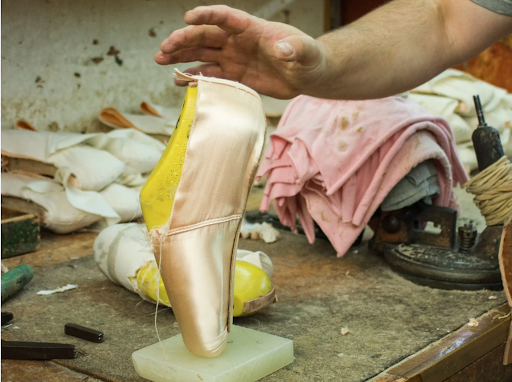
Pointe shoe from Freed of London being made on a last from Business Insider
Dancing “en pointe” is a common phrase in the dance industry. We often hear about prima ballerinas at large companies wearing “pointe shoes” or adolescent dancers working to earn their “pointe shoes.” But what exactly is a pointe shoe?
Pointe shoes are footwear specially designed for experienced dancers to wear to dance on the tips of their toes. In most classical ballets, like The Nutcracker, Swan Lake, and The Sleeping Beauty, you’ll see professional dancers donning pointe shoes onstage. While these dancers appear to glide across the stage in these shoes with ease, it takes years of training to be qualified to dance in them. Importantly, pointe shoes are not meant for beginning dancers who haven’t been cleared to wear them by a professional.
There are many different parts to a pointe shoe:
The Box
The “box” of a shoe is the hard, rectangular area that the toes and top of the feet are inserted into. This part of the shoe is made by applying layers of paper/cardboard and paste to a “last”: the mold that a pointe shoe is made on.
The Shank
The “shank” of the pointe shoe is the section that runs lengthwise across the bottom of the foot that helps support the foot’s arch. The shank is made out of leather and other composite materials. Added after the box is made, the shank is attached to the pointe shoe through a nailing and gluing process. Before the pointe shoe is sent to retailers and consumers, the maker will hammer and smooth out the box and finalize it by sewing on a drawstring and, in some cases, adding pleats.
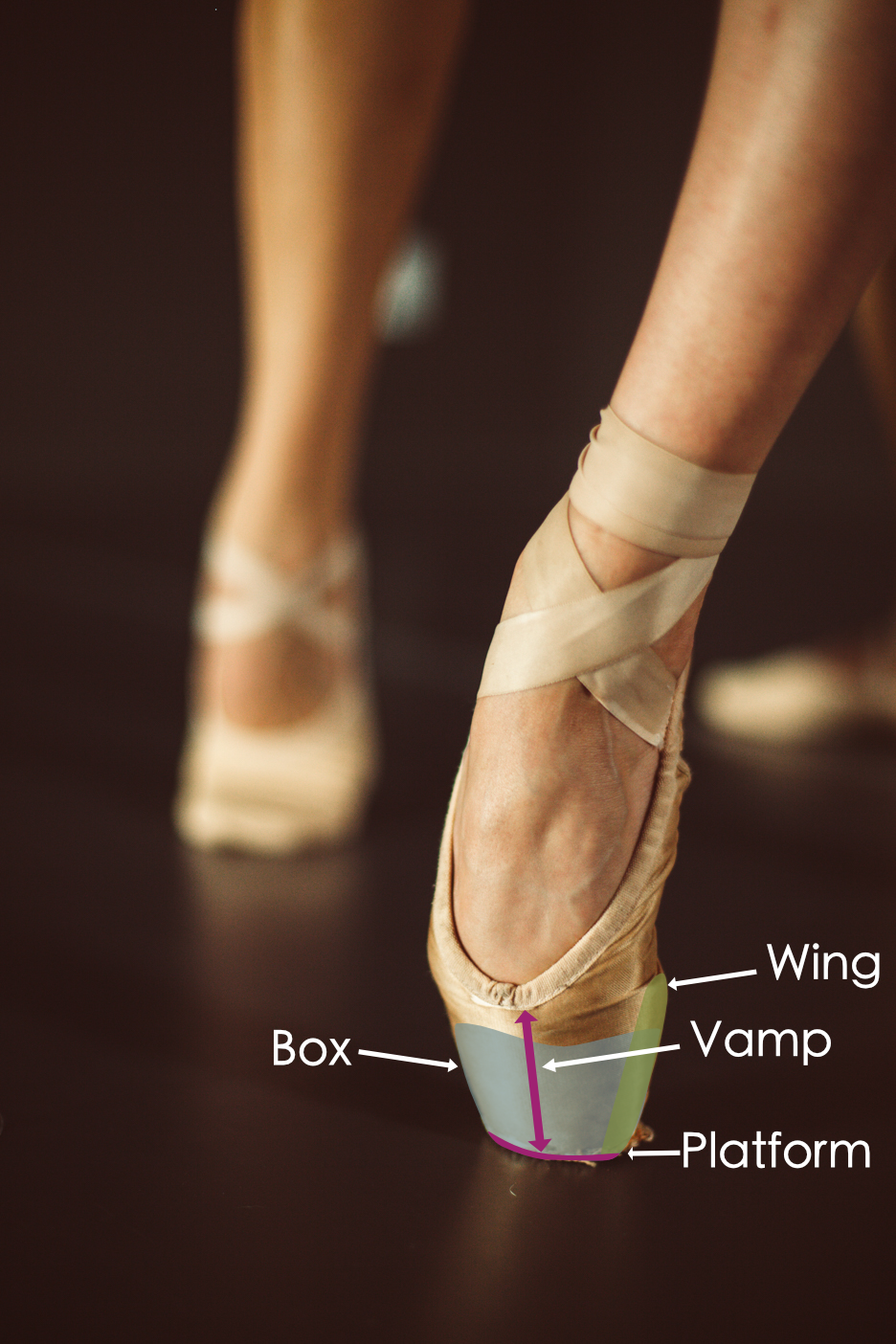
The Crown
The “crown” of the shoe, otherwise known as the shoe’s “profile” or height when viewed from the side. Some pointe shoe profiles are graded, flat, or round, all of which impact how the dancer uses the shoe en pointe.
The Platform
The “platform” of the pointe shoe refers to the hard, flat surface at the tip of the shoe upon which the dancer balances.
The Vamp
The “vamp” of the pointe shoe refers to the length from the platform to the opening or “throat” of the shoe. Vamps can be “high” meaning there is a longer length from the platform to the throat of the shoe, and others can be “low” meaning there is a shorter length. Some vamps are U-shaped and others are V-shaped, and some have elasticized satin while others don’t.
The Wings
The “wings” of a pointe shoe are an extension of the vamp that provide support along the sides of the dancers’ feet. Some wings are high, meaning they extend further along the sides of dancers’ feet, and others are lower, meaning they don’t extend as far. Some wings are more collapsible and some are harder, some are rounded and some are straight.
The Drawstring & Casing
The drawstring, often made of either cotton or elastic, passes through the binding around the pointe shoe and ties at the top of the vamp. The drawstring casing is a piece of material stitched around the edge of the pointe shoe containing the drawstring. Pointe shoes with a drawstring and casing often have a U-cut style. Other pointe shoes may have no drawstring and instead, have an elasticized casing that fits snug around the foot. And other pointe shoes may have a V-cut style vamp and have no drawstring at all.
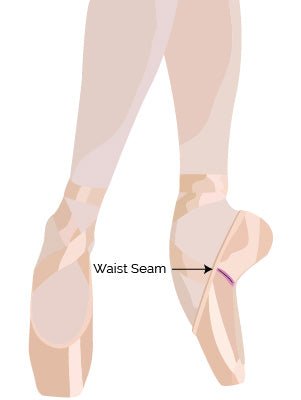
Photo from Inspirations Dancewear
The Waist Seam & Heel
The waist seam of a pointe shoe is a seam that joins the front and the back of the pointe shoe together. The heel of a pointe shoe can be structured or loose, wide or tapered, made of special stretch satin, made with structured, double-backed satin, and sometimes feature a “heel cup” designed to provide structure and create a seamless look.
Getting Fitted for Pointe Shoes
Getting fitted for pointe shoes is not like getting fitted for street shoes. Across the vast amount of pointe shoe brands available, there are a variety of styles that have different qualities. In addition, when fitting pointe shoes, fitters don’t just account for the length of a dancer’s foot, but also the width of their feet, the strength and flexibility of their feet, their toe shape and length, their heel shape, their foot profile, training experience, current dance goals, previous and current injuries, medical conditions, and more! All of these factors will influence what shoe the dancer ultimately ends up with.
In addition, getting properly fitted for pointe shoes requires the expertise of pointe shoe fitters. Pointe shoe fitters at Dancewear Center participate in required continuing education on a weekly, monthly, and quarterly basis, and have been trained in an array of professional fitting methods, including those from Bloch, Russian Pointe, So Danca, and most recently, the Progressive Pointe Method from ThePointeShop. There are a variety of factors our fitters consider when fitting dancers for pointe shoes, like making sure the dancer is over the shoe’s box, making sure the shank is providing adequate support, making sure they aren’t “sinking” or sitting in the shoe, and much more.
How To Prepare for your First Pointe Shoe Fitting with DWC
Get Assessed for Pointe Readiness
If you’re a student, you should be approved by your dance teacher to get fitted for pointe shoes or demi-pointe shoes before coming to Dancewear Center. If not trained under the guidance of a professional, dancing in pointe shoes can be a dangerous experience. Here at DWC, we also love fitting adults who wish to train en pointe or those returning to dancing en pointe. Many studios in the Seattle area offer classes for adults, including Dance Conservatory Seattle, Dance Fremont, American Dance Institute, Second Act Dance, ARC Dance, Westlake Dance Center, and more. We recommend that adults interested in dancing en pointe get assessed by a physical therapist for pointe readiness. Check out our dance medicine specialist page for information about dance specialists in the Seattle area.
Book a Pointe Shoe Fitting
Expert pointe shoe fitting teams require dancers to make an appointment. If a dancer arrives without an appointment, they will be assisted in scheduling one for a later date. Appointments can be booked through DWC’s website for our Kirkland or Renton locations, and group or mobile fittings can be requested by emailing info@dancewearcenter.net. It’s important that dancers allot around 45 minutes for their first appointment with DWC to allow for a thorough assessment and fitting process. Pointe shoe fittings are subject to a $25 service fee that is waived with the purchase of pointe shoes, and late arrivals will be charged the $25 fitting fee and asked to reschedule at a later time.
Prior to Your Fitting
Prior to their appointment, dancers will be sent information about what to expect and how to prepare for their appointment. Dancers should make sure their feet are clean and toenails are trimmed - we recommend trimming toenails two days before their appointment. Dancers should also wear transition/convertible tights to their fitting and bring the most recent pair of pointe shoes and the padding they normally wear with them. For more information, dancers and parents can also check out this pointe shoe fitting informational page on DWC’s website and this informational video on our YouTube page.
During the Fitting
At the beginning of a dancer’s first fitting, dancers will be greeted by one of our knowledgable pointe shoe fitters who will give dancers an overview of the fitting process. The fitter will ask questions and take notes about previous pointe shoes, injuries, current training, and much more, as well as take a visual assessment of the dancer’s bare feet. This will allow the fitter to have a better understanding of what types of pointe shoes they should pull for dancers to try on and the padding they suggest. For example, for dancers who have bunions and experience bunion pain, our fitters may advise them to use a silicone gel spacer and to see a physical therapist who specializes in dance medicine. Also, dancers will often be advised to wear padding like “Ouch Pouches,” made from gel and polyester upon their first fitting.
After the feet are assessed and additional equipment is administered, it’s time for the fun part: trying on the shoes! Notably, pointe shoes fresh out of the package have no elastic or ribbon attached. Elastics and ribbons will need to be purchased separately, as well as a sewing kit for dancers to sew them on themselves.
Dancers often try on many pairs of pointe shoes in their first fitting to ensure that the best fit possible is selected. After trying on many pairs, the fitter and dancer will narrow down the best final options. The dancer will be asked a lot of questions to ensure that the best possible shoe is selected. At DWC, we strive to make our fittings both a fun and educational experience, so dancers can expect to be informed about the different properties of the various shoes they try. Once the best shoe for the dancer is selected, it’s important that students have their teacher approve of them before they begin sewing them.
Following their appointment, dancers will receive a follow-up email reminding them that the DWC fitters are available at any time after the fitting to answer questions about their shoes. The DWC staff also keeps records of dancers' preferred pointe shoes and sizes to provide more information for future refittings.
Important Reminders
Pointe shoes only last 10-20 dancing hours on average. To help prolong the life of pointe shoes, it’s important to give them the opportunity to dry out in between wears, which takes up to 48-72 hours. Storing and transporting pointe shoes in mesh bags can aid with the drying process as well as help alleviate their sweaty smell. It’s also important to remember to keep pointe shoes out of the reach of pets!
We recommend that dancers schedule refitting appointments for their first 2-3 pairs of shoes and every six months after that or if they’re experiencing issues with their shoes. Refittings are important, as dancers’ feet can change drastically after dancing en pointe. At pointe shoe refittings, fitters will take a look at the dancer’s old pair of pointe shoes to analyze how they’re breaking down to figure out how the dancer’s needs have changed since their first fitting. The fitters will have a conversation with the dancer about their shoes, asking what they liked and disliked about them and what their typical experience in the shoe was like.
Working consistently with a professional fitter throughout a dancer’s journey is essential for ensuring that dancers are performing their best and are in the shoes that fit their needs best at that time. The pointe shoe industry is rapidly innovating and DWC fitters are constantly working to improve their skillset by involving themselves in continuing education, learning about the latest medical research and technology, and more. Dancers can feel confident that they are in good hands with DWC fitters.
This is just the tip of the iceberg when it comes to pointe shoes! But we hope it provides you with a solid baseline of knowledge about the complex and exciting world of pointe shoes. Book your pointe shoe fittings with Dancewear Center today here!
Sources:
https://www.pbt.org/learn-and-engage/resources-audience-members/ballet-101/pointe-pointe-shoes/
https://www.businessinsider.com/what-its-like-ballet-pointe-shoe-maker-freed-of-london-2021-6
https://dancewear-center.myshopify.com/products/super-spacers-cap?_pos=3&_sid=f912ccba0&_ss=r
https://dancewear-center.myshopify.com/products/ouch-pouch-jr-large-cap?_pos=6&_sid=61d304c77&_ss=r
https://www.rpcollection.com/perfect-fit/finding-your-perfect-fit/pointe-shoe-drawstring/
https://creativeartsacademyutah.wordpress.com/for-dancers/learn-reflect/pointe-shoe-anatomy/
Disclaimer
All content found on the Dancewear Center Website, Instagram, Facebook, Pinterest, and all other relevant social media platforms including: text, images, audio, or other formats were created for informational purposes only. Offerings for continuing education credits are clearly identified and the appropriate target audience is identified. The Content is not intended to be a substitute for professional medical advice, diagnosis, or treatment. Always seek the advice of your physician or other qualified health provider with any questions you may have regarding a medical condition. Never disregard professional medical advice or delay in seeking it because of something you have read on this Website.
If you think you may have a medical emergency, call your doctor, go to the emergency department, or call 911 immediately. Dancewear Center does not recommend or endorse any specific tests, physicians, products, procedures, opinions, or other information that may be mentioned on dancewearcenter.net. Reliance on any information provided by dancewearcenter.net, Dancewear Center employees, contracted writers, or medical professionals presenting content for publication to Dancewear Center is solely at your own risk.
Links to educational content not created by Dancewear Center are taken at your own risk. Dancewear Center is not responsible for the claims of external websites and education companies.
Dr. Amanda Rixey on Collaboration in Dance Medicine
Taking on a lot of dancing, whether in a pre-professional or professional capacity, takes grit. Dancers are encouraged to push their mental and physical boundaries to create art that moves people. Nonetheless, this boundary-pushing can place strain on dancers’ minds and bodies. Without proper care, pushing oneself too far for too long simply isn’t sustainable. That’s why local physical therapist Amanda Rixey is passionate about fostering communication and collaboration among dancers, instructors, and dance medicine specialists. Read on to learn about Amanda’s own dance journey, as well as her practice, Newfound Physical Therapy PLLC.
A Discussion With a Local PT
Pronouns: she/her | Pronunciation: Rix-ee
By Madison Huizinga, DWC Blog Editor

Photo by Mackenzie Eveland Smith
Taking on a lot of dancing, whether in a pre-professional or professional capacity, takes grit. Dancers are encouraged to push their mental and physical boundaries to create art that moves people. Nonetheless, this boundary-pushing can place strain on dancers’ minds and bodies. Without proper care, pushing oneself too far for too long simply isn’t sustainable. That’s why local physical therapist Amanda Rixey is passionate about fostering communication and collaboration among dancers, instructors, and dance medicine specialists. Read on to learn about Amanda’s own dance journey, as well as her practice, Newfound Physical Therapy PLLC.
Amanda shares that she was inspired to start dancing after watching her older sisters dance growing up. She started out at a studio geared toward dance competitions in the Kansas City area. Enduring several arm injuries as a child, Amanda was also exposed to the world of physical therapy early in her life and was quickly fascinated by it. As early as elementary school she bookmarked “PT” in her brain as a potential career option.
As Amanda entered middle school and high school, she focused more seriously on her ballet training. She continued to experience injuries, sharing that she is particularly injury-prone due to her joint laxity and hypermobility. This put her in more frequent contact with physical therapists, few of which had a deep understanding of dancers and the specialized PT needs they require.
She attended the University of Kansas on a dance scholarship, participating in a small department with four other dancers in her graduating class. While her major was dance, she also fulfilled the prerequisites for physical therapy school and worked as a physiology teaching assistant. Following her college graduation, Amanda got her Pilates certification and worked as a rehab aide before starting PT school at Regis University. She later worked with Kansas City Ballet, conducting weekly backstage screenings with dancers and local studios, and provided services for numerous touring theatre shows like Love Never Dies, Beautiful, and Dear Evan Hansen.

Photo by Mackenzie Eveland Smith
In May 2020, Amanda relocated to Seattle and since then, she’s been working on building out her own practice, Newfound Physical Therapy PLLC, in the Seattle area, in which she provides specialized treatment in dance medicine, and Pilates-based rehabilitation, and helps treat chronic pain conditions. Amanda also offers fitness-related services like individual and group classes for body conditioning and Pilates, as well as pointe readiness assessments. She stresses that her services are geared towards anything and anyone across the board, whether it’s dancers seeking preventative services, performers trying to figure out what is biomechanically off in their bodies, or those seeking recovery after facing a major injury. It’s important that dancers know that they don’t just have to be injured to visit a PT, in fact undergoing physical therapy before an injury occurs can reap major benefits.
Part of what inspired Amanda to start her own practice and go into PT altogether was the fact that offering treatment for dance medicine is an incredibly individualized and specific service. It can be challenging for dancers to find physical therapists that have a deep understanding of the activities they engage with on a day-to-day basis and to find specialists that will be covered by their insurance. Amanda is hoping to be that resource that dancers need in the community. “If you’ve never done it yourself…you’re not going to be able to relate to the patient,” Amanda says of providing PT services to dancers. “I want to share my knowledge with this community.”

Photo by Mackenzie Eveland Smith
Amanda shares that a big misconception she’s witnessed in the dance world regarding physical therapy is that people should just push through the pain they’re experiencing. While she’s grateful to see many dance companies working to change this school of thought, there are deep-rooted systems in genres like ballet that often encourage dancers to hide injuries while performing or simply not come to class. “That is tough to work around,” Amanda admits. “How do you work with that as a PT?” She emphasizes the importance of communication between physical therapists and dance instructors to ensure all involved are on the same page and not making assumptions about each other. Amanda describes her efforts as largely collaborative, with dancers, instructors, and herself all working to see each other eye-to-eye.
Ultimately, a change that Amanda hopes to see made in the dance world is more communication among individuals in different industry positions and an intentional effort made to learn from one another. “We can all learn from each other. We don’t need to keep secrets from each other,” Amanda says of the competitive nature of the dance industry. “It’s all about the dancer in the end.”
Disclaimer
All content found on the Dancewear Center Website, Instagram, Facebook, Pinterest, and all other relevant social media platforms including: text, images, audio, or other formats were created for informational purposes only. Offerings for continuing education credits are clearly identified and the appropriate target audience is identified. The Content is not intended to be a substitute for professional medical advice, diagnosis, or treatment. Always seek the advice of your physician or other qualified health provider with any questions you may have regarding a medical condition. Never disregard professional medical advice or delay in seeking it because of something you have read on this Website.
If you think you may have a medical emergency, call your doctor, go to the emergency department, or call 911 immediately. Dancewear Center does not recommend or endorse any specific tests, physicians, products, procedures, opinions, or other information that may be mentioned on dancewearcenter.net. Reliance on any information provided by dancewearcenter.net, Dancewear Center employees, contracted writers, or medical professionals presenting content for publication to Dancewear Center is solely at your own risk.
Links to educational content not created by Dancewear Center are taken at your own risk. Dancewear Center is not responsible for the claims of external websites and education companies.
An Inside Look at Dancewear Center Mobile
Dancewear Center Mobile provides private pointe shoe fittings that individualize and streamline the fitting process for dancers, allowing them to receive professional, one on one attention in the comfort of their home studio. At private pointe shoe fittings, fitters appreciate getting the knowledge and input of dance teachers and providing ease and convenience for community members. Our mobile service also arranges pop-up shops that help alleviate back-to-school dance shopping stress and allow studios to build their brand and bring their community together in a fun way. Dancewear Center Mobile will bring dress code apparel, shoes, and the latest seasonal items for dancers in the form of a private shopping experience.
A Glance At DWC’s Mobile Service
By Madison Huizinga, DWC Blog Editor

Dancewear Center is known for offering high-quality pointe shoe fittings and products via its brick and mortar in Renton, Washington. Dancers have traveled to DWC from all over the Pacific Northwest to receive fittings and explore our large pointe shoe inventory, but through Dancewear Center Mobile, we bring our fitters and merchandise to the dancers themselves!
Dancewear Center Mobile provides private pointe shoe fittings that individualize and streamline the fitting process for dancers, allowing them to receive professional, one on one attention in the comfort of their home studio. At private pointe shoe fittings, fitters appreciate getting the knowledge and input of dance teachers and providing ease and convenience for community members. Our mobile service also arranges pop-up shops that help alleviate back-to-school dance shopping stress and allow studios to build their brand and bring their community together in a fun way. Dancewear Center Mobile will bring dress code apparel, shoes, and the latest seasonal items for dancers in the form of a private shopping experience.
Maluhia Vander Griend is the artistic director and co-owner of Dancing For Joy in Bellingham and Lynden, Washington. Dancing For Joy had two Dancewear Center Mobile visits, both of which occurred in early 2022. “I was there the whole time and it was lovely,” Maluhia shares. She says that due to the expertise and convenience of the service she would love to have four to six mobile fittings a year to keep dancers dancing in pointe shoes that safely fit them. Maluhia also shares that she was adamant about having other community members take part in the mobile fitting service, so she invited other studios in the area to join at their last event.
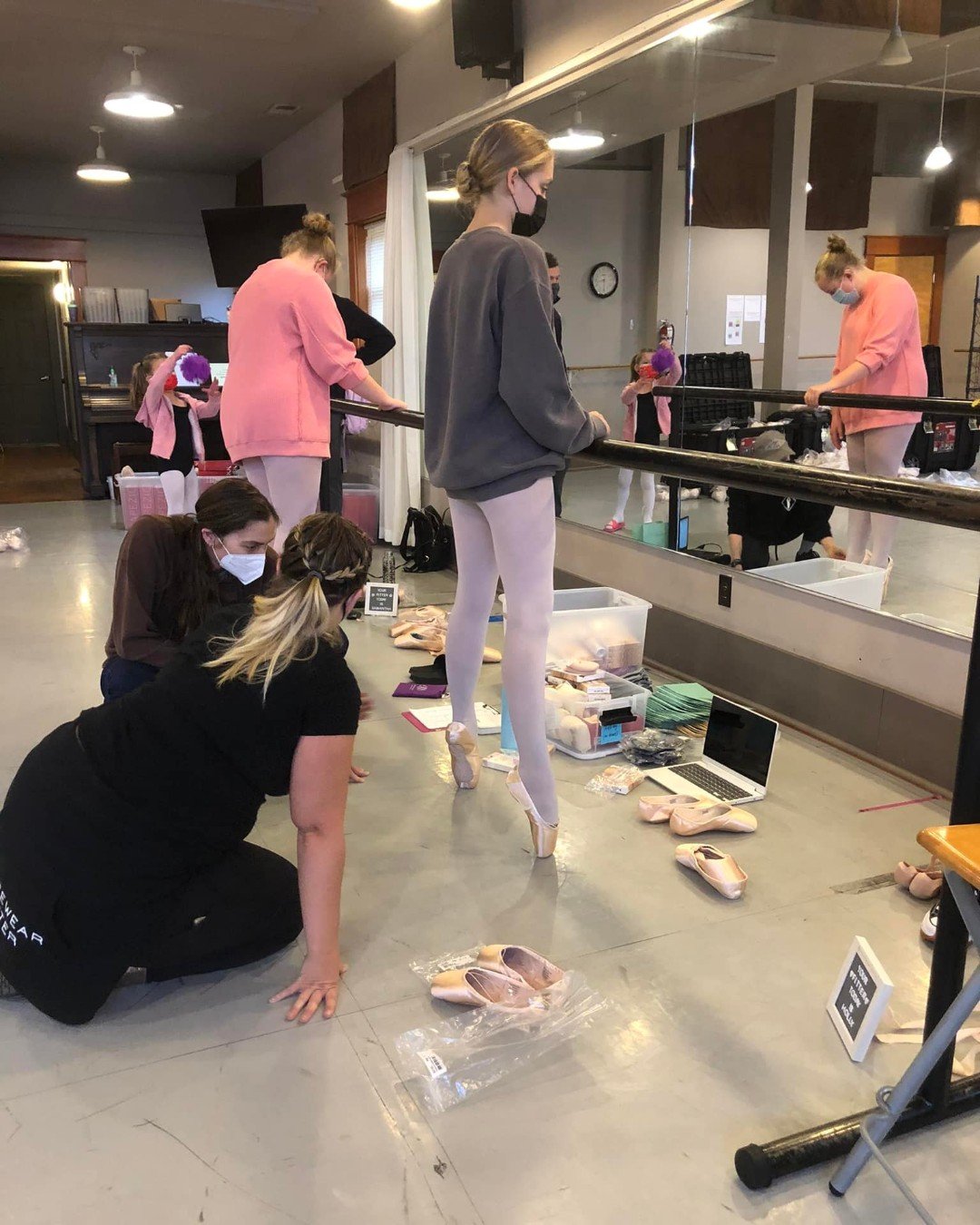
“What you can expect is amazing, one-on-one service customized to each individual dancer,” Maluhia says of the Dancewear Center Mobile private pointe shoe fittings. She shares that there was nothing hurried about the fitting process and that the staff took the time and care needed to evaluate each dancer. At fittings, dancers are asked questions about their previous injuries, what their current pointe shoes are like, what their dancing load is like, how their pointe shoes typically break-in, and more. DWC Owner & General Manager Samantha Weissbach often provides advice and informed strategies for students experiencing different issues dancing en pointe.
“As a studio owner, I was like ‘this is awesome!’” Maluhia says, of the individualized care DWC fitters offer during mobile fittings. She also appreciates how the DWC fitters take detailed notes about the dancers’ conditions and pointe shoe history for future fittings, commenting that the customer service is “outstanding.” Maluhia also says that Samantha made the experience fun and entertaining for all involved, sharing that the last session was full of laughter. The DWC fitters make an effort to make the pointe shoe fitting experience a memorable one, particularly for dancers receiving their first pairs, as it can be a huge milestone in a dancer’s career.
“The mobile unit comes in, they take over one of your studios and they turn it into a retail shop,” says Linda Johnston, school director and dance instructor at Fidalgo DanceWorks. Linda shares that the mobile fitting process was incredibly convenient for her studio based in Anacortes, Washington. “We’re kind of remote up here in Anacortes, so it’s fabulous that [Dancewear Center] came to bring all of their shoes,” Linda says. At Fidalgo DanceWorks’ second mobile fitting with DWC in November 2021, about fourteen dancers received fittings and Linda shares that the experience was an excellent time for bonding among students.
“What you can expect is amazing, one-on-one service customized to each individual dancer.”
“For us, just having the convenience of having someone bring all their stock and know what they’re talking about…[is] just a huge blessing,” Linda says, also pointing to the value of having students try on pointe shoes in the comfort of their own studio. Linda says that rehearsals could continue running at the studio during the mobile fitting session, causing little interruption in the flow of the usual work day.

Linda recommends the Dancewear Center Mobile service to other studios, particularly those that are located in more remote areas. “I’ve just been really grateful for the service, it’s amazing. I would absolutely recommend it to anybody,” she says.
Karlenn Smith owns and teaches at High Desert Dance in Prineville, Oregon, located far from many dancewear stores. When she learned about Dancewear Center Mobile, her interest was immediately piqued, as it meant her students could save time and money on traveling to get fitted for pointe shoes. Like Maluhia, Karlenn also invited other dance studios in the community to join their mobile fitting session in March 2022 and has discussed having quarterly mobile fittings. She shares that Samantha traveled down to the studio the night before the mobile fitting and set up the fitting room. Karlenn also shares that scheduling the fitting appointments was extremely easy, as Samantha simply passed along her digital calendar and allowed dancers to sign up for slots that worked for them.
“I was so impressed with her knowledge,” Karlenn says, also pointing out how effective it was to have an outside voice share pointe shoe care information with her students. She says that Samantha even sent along websites and videos after the fitting for students to get more information about foot exercises and injury prevention. Samantha even conducted a virtual fitting with one of Karlenn’s students a couple of months after the mobile fitting and mailed pointe shoes down to High Desert Dance. “She got it right on without even being here!” Karlenn exclaims about the virtual fitting.
Be sure to book your Dancewear Center Mobile visit for an unforgettable pointe shoe fitting and shopping experience! Click here to get more information and book today.
Interviewee name pronunciations and pronouns:
Maluhia Vander Griend (Mah-loo-hee-ah Van-der Gree-end), she/her, Artistic Director and Co-Owner of Dancing For Joy in Bellingham and Lynden, WA
Linda Johnston (Linn-da Jons-ton), she/her, School Director and Dance Instructor at Fidalgo DanceWorks in Anacortes, WA
Karlenn Smith (Car-len Smith), she/her, Owner and Teacher at High Desert Dance in Prineville, OR
Sources:
Disclaimer
All content found on the Dancewear Center Website, Instagram, Facebook, Pinterest, and all other relevant social media platforms including: text, images, audio, or other formats were created for informational purposes only. Offerings for continuing education credits are clearly identified and the appropriate target audience is identified. The Content is not intended to be a substitute for professional medical advice, diagnosis, or treatment. Always seek the advice of your physician or other qualified health provider with any questions you may have regarding a medical condition. Never disregard professional medical advice or delay in seeking it because of something you have read on this Website.
If you think you may have a medical emergency, call your doctor, go to the emergency department, or call 911 immediately. Dancewear Center does not recommend or endorse any specific tests, physicians, products, procedures, opinions, or other information that may be mentioned on dancewearcenter.net. Reliance on any information provided by dancewearcenter.net, Dancewear Center employees, contracted writers, or medical professionals presenting content for publication to Dancewear Center is solely at your own risk.
Links to educational content not created by Dancewear Center are taken at your own risk. Dancewear Center is not responsible for the claims of external websites and education companies.
Interested in writing for the DWC Blog? Click below to fill out the DWC Contributor application!