
The Inclusive Eye: The Importance of Representation, Mentorship, and Comprehensive Education
For the longest time at the beginning of my dance career, I didn’t see many dancers that looked like me. I did ballet, jazz, tap, and modern growing up in my little Kent, Washington studio--and I thought this was normal. My dance classes didn’t look any different from my school classes, I was one of the only people of color in my classes there too. For years and years I went without knowing anything about the success of dancers like me in the dance industry and simply thought they didn’t exist.

by niyah pratt
Niyah Pratt was born in raised in Renton, Washington. She began dancing at age six, at the British Dancing Academy where she trained in ballet, jazz, tap, and modern. She is currently attending the University of Nevada Las Vegas where she is double majoring in Dance Performance and Urban Affairs. She hopes to continue her dance career for as long as she possibly can, and make an impact not only in the dance community, but on the youth as well. She wants to be the role model she never had when she started dancing for someone else, and “thinks it is important to start implementing this in dance.”
click to shop the look: Holly Leo with Mod Dot by Ainsley Wear
By Niyah Pratt
For the longest time at the beginning of my dance career, I didn’t see many dancers that looked like me. I did ballet, jazz, tap, and modern growing up in my little Kent, Washington studio--and I thought this was normal. My dance classes didn’t look any different from my school classes, I was one of the only people of color in my classes there too. For years and years I went without knowing anything about the success of dancers like me in the dance industry and simply thought they didn’t exist.
When I was very little, there was one dancer older than me at my studio who looked like just me and I absolutely loved watching her dance. When I saw her I was mesmerized! I thought she was the most beautiful dancer in the world because I saw myself in her. Just seeing her made me feel like I could do it; and I know there are a lot of young dancers of color who have felt this way before in the dance world. Because of this, I want to reach as many young people as I can by teaching technique and giving them someone to look up to.
When I was 16 years old, I was accepted into the Debbie Allen Dance Academy summer intensive. Before this, I honestly did not know there were dance establishments built by African Americans. That summer, I experienced a profound transformation. I was surrounded by dancers and teachers that shared the same passion as I did--and looked just like me. I had never experienced this before. This not only changed how I danced but also expanded my view of the dance world.

click below to shop the look:
Debbie Allen started her own school to give her daughter a higher caliber of dance that she needed in order to succeed. Places like Debbie Allen Dance Academy and The Ailey School aren’t just dance institutions for black dancers. This was a large misconception held by the general populace--especially in the early years of their establishment. These institutions are sanctuaries for dancers of color where we can finally dance somewhere we feel acknowledged and celebrated.
My experience at Debbie Allen Dance Academy then led me to attend the Ailey Experience in New York the summer after where I had the greatest week of dancing in my life. I have never felt so seen and accepted dancing somewhere in such a short amount of time. Each teacher was beyond thrilled to teach us and share their knowledge of the dance world. Many of them were previous and current company members while others came from different parts of the dance world. It was exhilarating dancing with the staff and not having our strong technique be met with shock and surprise.
I say this because I feel like in certain situations when a dancer of color has good technique it's met by the community with shock. There is this preconceived notion of what a ballerina looks like and I think many don't expect us to be interested in ballet. It’s definitely not been viewed within my family as typical, and when I was super young my cousins and extended family were surprised when I started ballet. They were always very excited for me, but I wasn't playing basketball or running track like all the rest of my family members and that was surprising to them.
One summer, I auditioned for Joffrey Chicago just for exposure. Ballet is not my strong suit, and it has definitely been a journey to get my technique where it is today, but I wanted to try. Every girl who auditioned with me looked exactly the same, and I found myself the sole person of color in the building that day auditioning. This made me question at the beginning of the audition what I was doing there, but I also remember looking in the mirror by the end and getting choked up at just how proud of myself I was for choosing to be there and for fighting through being so uncomfortable.
I am forever grateful for the experiences I’ve had; I know that I am blessed to have parents that support me and to have had access to these opportunities. However, without being able to travel and fund these experiences, I don’t know that I would have become the dancer I am today.
So how can we make an impact on young people of color who want to become dancers but don’t have the resources and mentorship to fulfill their dreams? The answer: prioritizing our young dancers of color and their dance education.
Teaching dance from a more inclusive eye and making sure young dancers of color are well supported and seen makes all the difference in their training. If you are teaching students of color, guide them in learning about proper attire, their history of dance, finding a supportive community, and seeking out mentors.

click below to shop the look:
Educate dancers of color on proper attire for their complexion: this helps set dancers up for success. Personally, I didn’t know that ballerinas of color should (or could) wear skin color tights for ballet until I was 18. I was performing in a ballet piece in my first faculty show at UNLV (University of Nevada, Las Vegas) and the teacher pulled me aside baffled that I didn’t know I was technically wearing improper tights for the performance. It was an experience that left me feeling embarrassed and a little sad that I had never been taught this.
Encourage dancers and support them in the application and audition process for institutions such as Alvin Ailey, Debbie Allen Dance Academy, and Alonzo King LINES Ballet: where they will feel seen in a business that often does not.
Teach dancers of color their history. Dancers like Lauren Anderson, Syncopated Ladies, Katherine Dunham, and Robert Battle (to name a few) have all made large impacts on the dance world and students should know early on about these pioneers so that they can look up to successful dancers that look just like them.
We all know that having representation and someone to look up to reinforces the idea that you can do it too! It's motivating to see people like us in a profession that historically has not catered to our skin tone. If dancers don’t have a role model in dance, help support them in finding one.
We must set dancers of color up for success and teach them to their individual needs. I feel the largest job I can do to support my community is share how I've overcome these challenges and guide as many as I can to achieving their goals. I want all young dancers of color to feel inspired and prepared to conquer and succeed in the dance world!
RESOURCES
Brown Girls Do Ballet: Scholarships
LINES Vermont: Diversity in Dance Scholarship Fund
The Ballet Clinic’s Scholarship Fund
Memoirs of Blacks in Ballet (MoBBallet): An Ever Expanding and Historic Timeline of Blacks in Ballet
Staying Active During Dance Breaks or Off-Seasons
It is easy to spend dance breaks curled up on the couch or binging Netflix shows; these activities are definitely needed when you have a little more free time but it is also important to keep your training going. Flexibility, strength and endurance decline quickly when you have time off from a rigorous dance routine, so here are a few tips for “staying in shape” during dance breaks or off-seasons!
Pronouns: she/her
By Emily Borders, DWC Ambassador

It is easy to spend dance breaks curled up on the couch or binging Netflix shows; these activities are definitely needed when you have a little more free time but it is also important to keep your training going. Flexibility, strength and endurance decline quickly when you have time off from a rigorous dance routine, so here are a few tips for “staying in shape” during dance breaks or off-seasons!
Training during break will allow you to maintain your current level of strength, endurance and flexibility. It is also a great opportunity to focus on areas of your training that you don’t have time for when rehearsing for a recital or getting ready for competition. Strength training is a great thing to focus on during the off seasons. Since dance is mostly an endurance sport;, it is important to strength train when you can to build up your muscle fibers that provide strength and power as well. Strength training increases your power, meaning that you will be able to do things like jump higher. It also helps increase bone and connective tissue density, meaning that your ligaments, muscles, tendons and bones will be stronger and more resistant to injury. So grab some dumbbells, barbells, kettlebells or anything you can find and start working those muscles!
For dancers, it is really important to have strong calves, glutes and core muscles. Off-seasons and breaks can be the time where you focus on exercises specific to these muscles, other than typical dance drills. While also spending time strengthening muscles that are not worked as much with dance, like back, arms, hamstrings, etc. Ultimately, take advantage of this extra time to focus on the parts of your body that are weaker and build those areas up to develop yourself into a more well-rounded artist.
Strength training should be done at least 2-3x/week with a rest day between each day. You want to strive for 8-10 repetitions of an exercise before muscular fatigue in order to build strength. If you can do more than 8-10 repetitions then the weight is too light. In that case, you are working endurance muscle fibers. Another thing to note is that strengthening your muscles without stretching them will decrease your flexibility, so make sure you are stretching after strength training and on rest days.
I personally enjoy group fitness classes or workout videos. I feel like I am more motivated to get a good workout when I have someone guiding me and workout buddies to encourage me. I know group fitness isn’t for everyone so it’s important to try a few different exercise strategies and find what works for you. Furthermore, many people find that lack of equipment can be a barrier to strength training for them. Remember that you can use any sort of heavy object around your house to use as weights. You do not need a gym membership or all the “proper” equipment to build up strength. I hear gallon jugs work great.
I do want to emphasize the importance of rest as well during breaks or off-season. It is important to stay active but it is also important to incorporate rest when you can. Rest does not mean lying on the couch all day; resting should involve low impact/intensity activities. You want to do what I like to call “active rest.” Some examples include going on a nice walk, doing gentle yoga, doing some nice, easy “feel-good” improv in your living room; anything that moves your body in a way that doesn’t feel strenuous.

All in all, use your breaks effectively! You do not have to do as much physical activity as you do during the dance season. But staying active during breaks will lead you to be more prepared, reduce your risk of injury and you will probably realize that you don’t have to work as hard to get back into shape when the season starts. Our muscles were designed to do many different functions. Since you already spend plenty of time training your muscular endurance, take the time while you have it to train your muscular strength. You will likely see the results of your strength training in your dancing! Don’t lose everything you worked so hard for during your training. You got this!

Emily Borders
Emily currently attends the University of Washington as a Doctor of Physical Therapy student. She began dancing at a young age and trained in all sorts of styles. She attended Western Washington University majoring in Kinesiology and Minoring in Dance.
Disclaimer
All content found on the Dancewear Center Website, Instagram, Facebook, Pinterest, and all other relevant social media platforms including: text, images, audio, or other formats were created for informational purposes only. Offerings for continuing education credits are clearly identified and the appropriate target audience is identified. The Content is not intended to be a substitute for professional medical advice, diagnosis, or treatment. Always seek the advice of your physician or other qualified health provider with any questions you may have regarding a medical condition. Never disregard professional medical advice or delay in seeking it because of something you have read on this Website.
If you think you may have a medical emergency, call your doctor, go to the emergency department, or call 911 immediately. Dancewear Center does not recommend or endorse any specific tests, physicians, products, procedures, opinions, or other information that may be mentioned on dancewearcenter.net. Reliance on any information provided by dancewearcenter.net, Dancewear Center employees, contracted writers, or medical professionals presenting content for publication to Dancewear Center is solely at your own risk.
Links to educational content not created by Dancewear Center are taken at your own risk. Dancewear Center is not responsible for the claims of external websites and education companies.
Getting To Know DWC Ambassador Laurie Balise
Becoming a DWC Ambassador was something that Laurie Balise knew she wanted to do. She saw an opportunity to positively impact the dance community by participating in the program especially because she shares the company’s ideals of integrity, laughter and tenacity. Additionally, her impetus was because she believes in the importance of positive support and collaboration in our industry in order to more greatly empower all dancers. We got the chance to speak with one of our new Ambassadors and hear about her dancing journey and what motivated her the most in the dance world! Read on to learn more about Laurie’s experience with dance and what she’s looking forward to most about becoming an Ambassador!
Pronunciation: La-Ree Ba-Lees | Pronouns: she/her
By Nicole Barrett, DWC Blog Editor

Becoming a DWC Ambassador was something that Laurie Balise knew she wanted to do. She saw an opportunity to positively impact the dance community by participating in the program especially because she shares the company’s ideals of integrity, laughter and tenacity. Additionally, her impetus was because she believes in the importance of positive support and collaboration in our industry in order to more greatly empower all dancers. We got the chance to speak with one of our new Ambassadors and hear about her dancing journey and what motivated her the most in the dance world! Read on to learn more about Laurie’s experience with dance and what she’s looking forward to most about becoming an Ambassador!
Laurie started dancing when she was just 3 years old. Ever since she has loved the world of performing arts. She was one of the founding senior dancers at Olympic Ballet Theater in the 1980’s and originally trained with Dorothy Fisher dancers. Her family has always been a big supporter of the arts, so growing up she knew her life would always involve her passion in some way. She’s had positions in the arts in several of Seattle’s largest arts organizations, as well as taught dance and fitness for many organizations, and currently teaches ballet, pilates, and mindfulness and meditation at Vibe Dance Studio and primarily pilates and yoga at Columbia Athletic Club. Her teaching career has spanned 22 years in the greater Everett/Seattle area.
One thing that Laurie is most excited about when it comes to her new ambassadorship is the community that is around Dancewear Center and the connection and education it provides. She loves the message that DWC has put out that “every body is a dancing body” and she is excited to offer her unique perspectives with the dance community especially as an older dancer and teacher. After nearly 50 years of dance experience, she has many personal stories and teaching wisdom she is looking forward to passing along during her ambassadorship, as well as she is hoping to be an inspiration in longevity to other dancers.
We are so happy to have Laurie as one of our new DWC Ambassadors! Be sure to check out her interview on our YouTube channel to hear more about Laurie’s dancing journey!
About the Author

Disclaimer
All content found on the Dancewear Center Website, Instagram, Facebook, Pinterest, and all other relevant social media platforms including: text, images, audio, or other formats were created for informational purposes only. Offerings for continuing education credits are clearly identified and the appropriate target audience is identified. The Content is not intended to be a substitute for professional medical advice, diagnosis, or treatment. Always seek the advice of your physician or other qualified health provider with any questions you may have regarding a medical condition. Never disregard professional medical advice or delay in seeking it because of something you have read on this Website.
If you think you may have a medical emergency, call your doctor, go to the emergency department, or call 911 immediately. Dancewear Center does not recommend or endorse any specific tests, physicians, products, procedures, opinions, or other information that may be mentioned on dancewearcenter.net. Reliance on any information provided by dancewearcenter.net, Dancewear Center employees, contracted writers, or medical professionals presenting content for publication to Dancewear Center is solely at your own risk.
Links to educational content not created by Dancewear Center are taken at your own risk. Dancewear Center is not responsible for the claims of external websites and education companies.
Responsive Teaching
On the first day of a theater camp for homeless and abused teens, I walked down the line of 40 campers and tried to teach what I had naively considered a “basic” ripple of movement. I stood next to a kid I would later learn was named Bruno, demonstrating and loudly explaining to the room how they should reach and hold each other and told the camper behind him, “now put your hand up on her shoulder like this.”
Bruno flinched at the sudden touch, and then his head snapped around, big brown eyes flitting from straight at me to the ground and back again.
Part 1: Bruno
Name pronunciation: Em-me Fan-s-ler | Pronouns: she/her
By Emmy Fansler, DWC Ambassador

On the first day of a theater camp for homeless and abused teens, I walked down the line of 40 campers and tried to teach what I had naively considered a “basic” ripple of movement. I stood next to a kid I would later learn was named Bruno, demonstrating and loudly explaining to the room how they should reach and hold each other and told the camper behind him, “now put your hand up on her shoulder like this.”
Bruno flinched at the sudden touch, and then his head snapped around, big brown eyes flitting from straight at me to the ground and back again.
“I’m a boy.”
Dead quiet. But soon after, a snicker came from across the room. And then a, “Say what?!” from somewhere down the line.
After that, the whole room laughed, aside from the 10-12 counselors and volunteers who tried to calm everyone down, a demoralized and humiliated Bruno, and me. The horror struck teaching artist that just publicly misgendered this kid whose trauma had already made it difficult to trust anyone or feel like he belonged anywhere. The activity was over and no one was willing to pick it back up, even before I’d finished teaching the entire ripple.
Talk about a humbling moment. This was not the place for the choreography I had dreamed up. I hadn’t even met these kids or considered their stories. I just assumed they’d be excited to learn what I had to teach them.
From this large group activity, the campers were split into groups and brought through my dance and movement class in 45-minute rotations. I don’t remember how many groups I worked with before Bruno’s, but I remember feeling the palpable anxiety when he came into the room— some of it (or perhaps most of it) being my own.
The goal for that day was to get to know the campers and start generating ideas for the piece they would perform at the end of two weeks. The morning had proven to me that throwing them into my preconceived routines and patterns was not going to work, so I had them stand in a circle and tell me some random things— maybe their name, pronouns, something they wanted me to know about them, something they were good at, a time they felt brave… something like that— so I could determine my next move.
Truth be told, I don’t remember any of their answers— at all. What I remember is the way Bruno nervously moved as he answered the questions— shuffling forward a few steps, then backward, over and over. His eyes everywhere but at me, hands fidgeting first in his pockets, then in his long hair, then with each other. And then when his turn was over, he stopped. I had been mesmerized, and his abrupt stop disarmed me and the “cool” I’d been trying to keep.
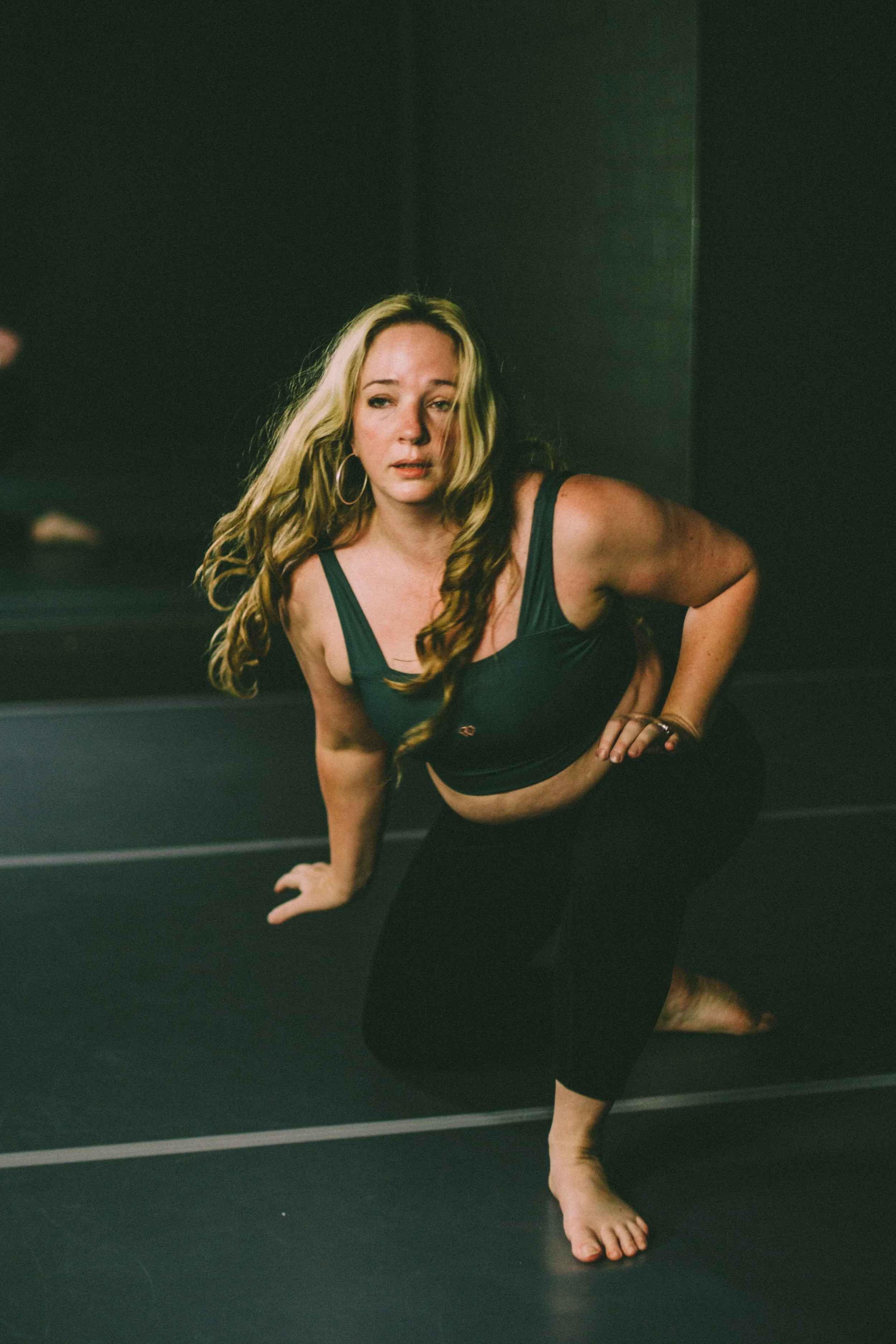
He noticed my staring, and I blurted out that the way he moved had sort of hypnotized me. He blushed and people stood around awkwardly, but I was inspired and his nervous movement had given me an inkling of an idea I wanted to play with. I asked him if he realized that he’d been moving, and then showed him with my body what he’d been doing. I asked the entire circle to try the forward and backward steps with me, and reluctantly they did. I added a look over the shoulder when they stepped backward, and then after a few more sets added a sigh and a single fidgeting gesture. They fell into a rhythm and suddenly I realized they were doing it without needing my continuous prompting. They listened to each other’s footfalls and coordinated their breaths organically. Watching it all come together in my head, I asked them to face the same direction instead of into the circle. The whole group trudged forward two steps, stumbled back one, brushed their hands on their pant legs, looked back, and sighed. Starting the process over and over and over.
With Bruno at the front of the formation, I asked him to make it travel, and lead it all the way across the floor. I asked a couple of them if they’d be comfortable trying it while carrying someone on their backs. I asked two more if they’d be willing to be carried. This, it seemed, was the moment they knew there was magic in the making.
The teens were engaged, excited, and enthusiastic at the way the sequence progressed from Bruno’s organic movement into the soul-stirring piece they performed for a packed house the following Friday. They partnered. They rippled. They rolled and reached and leapt and lifted Bruno up to the sky with a blue cyc and remnants of broken furniture hanging from the flies. They started with diagonal trudging and ended with eyes up, chests open, backs arched, hands on shoulders, showing support and care for each other in front of hundreds of strangers. Not one of them having taken a dance class before camp, but all of them KNOWING they had just moved the hearts of every single person witnessing them. There were no pirouettes, no high kicks, no tricks of any kind… maybe four pointed feet, total. Just a bunch of beautiful teens with a story to tell— one that began unfolding out of the anxious movement and emotional responses of one brave and vulnerable student named Bruno.
This was a formative experience, not only for the kids who found a platform to share their stories of resilience, but for me as a teacher and choreographer. It forever shifted the way I choreograph and opened my eyes to the beauty of teaching the non-traditional dancer. You don’t need years of training, the perfect body, or endless financial resources to be a dancer and tell your story through movement. You need a body and space. And… you don’t need dancers with a life of devoted ballet technique, marley floor, and perfectly performed etiquette to choreograph and create a life-changing piece— you need the willingness to see the humans in front of you, an openness to what they’re sharing with you just by existing, curiosity, creativity, and love for the incredible work you get to do.

Disclaimer
All content found on the Dancewear Center Website, Instagram, Facebook, Pinterest, and all other relevant social media platforms including: text, images, audio, or other formats were created for informational purposes only. Offerings for continuing education credits are clearly identified and the appropriate target audience is identified. The Content is not intended to be a substitute for professional medical advice, diagnosis, or treatment. Always seek the advice of your physician or other qualified health provider with any questions you may have regarding a medical condition. Never disregard professional medical advice or delay in seeking it because of something you have read on this Website.
If you think you may have a medical emergency, call your doctor, go to the emergency department, or call 911 immediately. Dancewear Center does not recommend or endorse any specific tests, physicians, products, procedures, opinions, or other information that may be mentioned on dancewearcenter.net. Reliance on any information provided by dancewearcenter.net, Dancewear Center employees, contracted writers, or medical professionals presenting content for publication to Dancewear Center is solely at your own risk.
Links to educational content not created by Dancewear Center are taken at your own risk. Dancewear Center is not responsible for the claims of external websites and education companies.
Have you heard of Relative Energy Deficiency Syndrome AKA Female Athlete Triad?
Over 80% of athletes, including dancers and figure skaters are unaware of a highly prevalent condition known as Female Athlete Triad or sometimes, more recently termed Relative Energy Deficiency Syndrome (RED-S)(Tosi & Dodson, 2019). You may find that you are in this category. It was many years until I got a first-hand experience of the manifestations of RED-S. Three weeks before my dance company’s spring recital I broke my arm in multiple places while mat tumbling in acro class. Since then, I have learned a lot about RED-S from my physical therapy education and my own desire to learn about and spread awareness of this condition.
Pronouns: she/her
By Emily Borders, DWC Ambassador

click below to shop the look:
Over 80% of athletes, including dancers and figure skaters are unaware of a highly prevalent condition known as Female Athlete Triad or sometimes, more recently termed Relative Energy Deficiency Syndrome (RED-S)(Tosi & Dodson, 2019). You may find that you are in this category. It was many years until I got a first-hand experience of the manifestations of RED-S. Three weeks before my dance company’s spring recital I broke my arm in multiple places while mat tumbling in acro class. Since then, I have learned a lot about RED-S from my physical therapy education and my own desire to learn about and spread awareness of this condition. This injury likely could have been prevented if I had been taking care of my body the way I should. RED-S is a form of energy deficiency that occurs due to excessive energy output or inadequate energy input. Basically, this occurs if someone is not putting enough fuel (energy) into their body to support their daily physical activity or they are doing so much rigorous physical activity that they are using up all their stored energy; both of these situations lead to an energy deficit and sometimes this can result as a combination of both. As you can imagine, these situations are common in dance training. Many hours of high-intensity dance training, a desire to maintain a certain body aesthetic and lack of proper nutrition, all contribute to RED-S being highly prevalent amongst dancers.
For me, proper nutrition and taking rest days was not strongly emphasized in my dance training. I developed a strong work ethic in dance, which I am grateful for and has shaped me into the person I am today. Due to this work ethic, I found myself extremely dedicated to my dance training. I would train for many hours a day 5-6 days a week, which would often turn into 7 days a week on a competition or convention weekend. I would sometimes even go to the gym after dance or on my day-off to get an extra workout in. If this sounds like you, or even if it doesn’t but you are still involved in dance or another form of physical activity at a high volume, I encourage you to read further and look at the following components to RED-S.

click below to shop the look:
GF Collective Paloma Racerback Bra | GF Collective Compressive Pocket Leggings
RED-S or Female Athlete Triad includes a triad of symptoms. These symptoms include low energy availability, menstrual disturbances including lack of menstrual cycle or irregular menstrual cycle and decreased bone mineral density. Low energy availability can cause increased fatigue, weakness, mood changes, and increased risk of injuries. Decreased bone mineral density increases one’s risk for fracture, which is what happened to me. Injuries and chronic fatigue can be detrimental to a dance career, but these things can often be prevented by fueling one’s body with a proper diet to support high-intensity dance training and incorporating rest days. Endurance athletes including dancers need about 1.4 g/kg of body weight of protein per day, which I can guarantee is a lot more protein than most young dancers are getting. Another way to decrease your risk of this condition is making sure to add rest days and strength training into your routine. Rest days are vital to restoring energy that has been depleted during physical activity and allowing bones and muscles to recover and adapt. Rest days don’t have to look like sitting on your couch. Going on a walk or doing another form of light activity can be a great way to “rest” but still move your body. Furthermore, bones become stronger through weight bearing activities; lifting weights can be a great way to increase bone mineral density and decrease injury risk. Keep in mind that if you are already dancing many hours, nearly every day of the week, I am not encouraging you to add a day of weight training, but having your instructors add some weight training into class or replacing some dance time with cross-training will be beneficial to dance and overall health. If this doesn’t seem possible, making sure to get some weight training in during dance breaks or off-season is another great idea!
Factors that may increase one’s risk for developing this condition include endurance athletes, female gender, having an eating disorder, ages 12-24, and people who feel pressured to maintain a certain body aesthetic for their sport. If any of these seem to apply to you or you think you may be experiencing some of the symptoms described above, I hope you look further into this condition and take steps to prevent it. Don’t wait until a major injury occurs to make a change for your health. Feel free to email emily.stadt@outlook.com if you have any questions or check out the resources below!
Sources:
https://dancenutrition.com/relative-energy-deficiency-in-sport-dancers/
Reference:
Tosi M, Maslyanskaya S, Dodson NA, Coupey SM. The Female Athlete Triad: A Comparison of Knowledge and Risk in Adolescent and Young Adult Figure Skaters, Dancers, and Runners. J Pediatr Adolesc Gynecol. 2019;32(2):165-169. doi:10.1016/j.jpag.2018.10.007
Disclaimer
All content found on the Dancewear Center Website, Instagram, Facebook, Pinterest, and all other relevant social media platforms including: text, images, audio, or other formats were created for informational purposes only. Offerings for continuing education credits are clearly identified and the appropriate target audience is identified. The Content is not intended to be a substitute for professional medical advice, diagnosis, or treatment. Always seek the advice of your physician or other qualified health provider with any questions you may have regarding a medical condition. Never disregard professional medical advice or delay in seeking it because of something you have read on this Website.
If you think you may have a medical emergency, call your doctor, go to the emergency department, or call 911 immediately. Dancewear Center does not recommend or endorse any specific tests, physicians, products, procedures, opinions, or other information that may be mentioned on dancewearcenter.net. Reliance on any information provided by dancewearcenter.net, Dancewear Center employees, contracted writers, or medical professionals presenting content for publication to Dancewear Center is solely at your own risk.
Links to educational content not created by Dancewear Center are taken at your own risk. Dancewear Center is not responsible for the claims of external websites and education companies.
Getting To Know DWC Ambassador EmmaRose DeSantis
At Dancewear Center, we always look for people that can help fulfill our message that “every body is a dancing body.” New DWC Ambassador Emma Rose DeSantis was perfect for that! We got the opportunity to speak with Emma Rose about her dancing journey! Read on to learn more about what dance means to Emma Rose and what inspired her to become an Ambassador!
Pronunciation: Em-ma Rose Dee-san-tis | Pronouns: she/her
By Nicole Barrett, DWC Blog Editor

At Dancewear Center, we always look for people that can help fulfill our message that “every body is a dancing body.” New DWC Ambassador Emma Rose DeSantis was perfect for that! We got the opportunity to speak with Emma Rose about her dancing journey! Read on to learn more about what dance means to Emma Rose and what inspired her to become an Ambassador!
Emma Rose has been dancing ever since she was 3 years old. She shares that she started with creative movement/ballet classes and then took some modern classes. Emma Rose grew up on Vashon Island, so she took classes and trained at Vashon Center for the Arts. As she entered high school, Vashon Center for the Arts introduced some other styles like jazz and hip hop to their studio, which allowed Emma Rose to explore those styles during her later dance years.
After high school, Emma Rose went to Western Washington University to get her BFA in Dance with two minors in Business Administration and Entrepreneurship and Innovation. During her time at Western, she was involved in some dance clubs around campus and she shares that she mainly was involved with those clubs during her junior and senior years at the university. Emma Rose currently focuses on contemporary and hip-hop styles and continues ballet to help with her technique and training for other styles.
At first, Emma Rose didn’t think that she could become a DWC Ambassador. She then received a message on social media from Dancewear Center saying that she should apply. As she was applying, Emma Rose was looking at the mission of DWC and loved the message that they wanted to uphold as a company and she knew that she wanted to apply. She loved how friendly the community was and is looking forward to being a part of the DWC community as an Ambassador.
We are so happy to have Emma Rose as one of our new DWC Ambassadors! Watch the full interview below to hear more about Emma Rose’s dancing journey!
About the Author
Disclaimer
All content found on the Dancewear Center Website, Instagram, Facebook, Pinterest, and all other relevant social media platforms including: text, images, audio, or other formats were created for informational purposes only. Offerings for continuing education credits are clearly identified and the appropriate target audience is identified. The Content is not intended to be a substitute for professional medical advice, diagnosis, or treatment. Always seek the advice of your physician or other qualified health provider with any questions you may have regarding a medical condition. Never disregard professional medical advice or delay in seeking it because of something you have read on this Website.
If you think you may have a medical emergency, call your doctor, go to the emergency department, or call 911 immediately. Dancewear Center does not recommend or endorse any specific tests, physicians, products, procedures, opinions, or other information that may be mentioned on dancewearcenter.net. Reliance on any information provided by dancewearcenter.net, Dancewear Center employees, contracted writers, or medical professionals presenting content for publication to Dancewear Center is solely at your own risk.
Links to educational content not created by Dancewear Center are taken at your own risk. Dancewear Center is not responsible for the claims of external websites and education companies.
Getting To Know DWC Ambassador Aubrey Zappen
Promoting body positivity is something very important to new DWC Ambassador Aubrey Zappen. When she heard about DWC, she instantly loved what the company stood for and new that she wanted to apply for the ambassadorship. We got the opportunity to speak with Aubrey about her dancing journey! Read on to learn more about what dance means to Aubrey and what inspired her to become an Ambassador!
Pronunciation: Aw-brie Zap-in | Pronouns: she/her
By Nicole Barrett, DWC Blog Editor

Promoting body positivity is something very important to new DWC Ambassador Aubrey Zappen. When she heard about DWC, she instantly loved what the company stood for and new that she wanted to apply for the ambassadorship. We got the opportunity to speak with Aubrey about her dancing journey! Read on to learn more about what dance means to Aubrey and what inspired her to become an Ambassador!
Starting at the age of 3, Aubrey knew that she always wanted to dance. She shares that there were very few times in her life that she ever doubted that she wanted to dance. She knew it was for her. Aubrey currently dances at the Academy of Dance in Port Orchard, Washington, and shares that she loves the community there. Within the past year, she realized that she wanted to dance as her career and go to school for it. As a senior in high school, she is preparing for auditions for various schools that she is wanting to go to.
One reason why Aubrey was inspired to become a DWC Ambassador was because of some of her peers at her studio. She had just heard about Dancewear Center and she shares that when she did she immediately fell in love with everything about it. Aubrey loves the importance of “every body is a dancing body” and appreciates that this business is promoting diversity and body positivity in every way. She shares the importance of this acceptance in the dance world and hopes to do that as a DWC Ambassador.
We are so happy to have Aubrey as one of our new DWC Ambassadors! Watch the full interview below to hear more about Aubrey’s dancing journey!
About the Author
Disclaimer
All content found on the Dancewear Center Website, Instagram, Facebook, Pinterest, and all other relevant social media platforms including: text, images, audio, or other formats were created for informational purposes only. Offerings for continuing education credits are clearly identified and the appropriate target audience is identified. The Content is not intended to be a substitute for professional medical advice, diagnosis, or treatment. Always seek the advice of your physician or other qualified health provider with any questions you may have regarding a medical condition. Never disregard professional medical advice or delay in seeking it because of something you have read on this Website.
If you think you may have a medical emergency, call your doctor, go to the emergency department, or call 911 immediately. Dancewear Center does not recommend or endorse any specific tests, physicians, products, procedures, opinions, or other information that may be mentioned on dancewearcenter.net. Reliance on any information provided by dancewearcenter.net, Dancewear Center employees, contracted writers, or medical professionals presenting content for publication to Dancewear Center is solely at your own risk.
Links to educational content not created by Dancewear Center are taken at your own risk. Dancewear Center is not responsible for the claims of external websites and education companies.
Exploring Dance in Academia as a Parent
“It’s my personal way of processing and understanding the world,” CarliAnn says of why she loves dancing. She describes herself as a kinesthetic person, using physicality as a way to connect with others and share experiences. CarliAnn also appreciates what a great medium dance is for storytelling, as communicating stories through the body can utilize a richness that simple text cannot, making it an accessible storytelling tool.
CarliAnn Bruner Recounts Her Dance Journey
Name pronunciation: Carlee-Ann B-run-er | Pronouns: she/her
By by Madison Huizinga, DWC Blog Contributor

Photo by 127th St.
The role dance plays in a person’s life can vary immensely, from taking community classes, to professionally performing, to becoming a trained educator in the practice. Dance artist and educator CarliAnn Bruner has experienced this wide range of dance roles throughout her journey and currently works as an adjunct professor of dance at Gonzaga University in Spokane, Washington. Read on to learn more about CarliAnn’s dance journey and experiences exploring dance in academia and as a parent.
Some of CarliAnn’s earliest movement memories are in gymnastics lessons, which her parents enrolled her in at age two. She loved gymnastics but felt especially drawn to the dance and style aspects of the balance beam and floor routines. After participating in competitive gymnastics until she was thirteen, CarliAnn dove head first into dancing and fell in love with it.
“At fifteen, I was like ‘Mom, I’m going to be a dancer when I grow up!’” CarliAnn recollects. At sixteen, she began regularly driving herself two hours from her hometown of Yakima, Washington to Seattle to take dance classes at Velocity Dance Center, Spectrum Dance Theater, and Westlake Dance Center. “My parents were so trusting,” she laughs about her younger self driving so far for dance.
CarliAnn attended Simon Fraser University in British Columbia, Canada, where she received her BFA, majoring in dance and minoring in kinesiology. While in the Vancouver area, a standout moment for her was getting to perform in the closing ceremonies at the 2010 Winter Olympics.
After college, CarliAnn auditioned for some dance companies in other cities, eventually landing a job with 127th St. Dance Company in Seattle. “That was my jumping-off point, my entry into the Seattle [dance] scene,” CarliAnn says of the job. “I met a lot of people who I’m still good friends with.”
CarliAnn later danced with Khambatta Dance Company, where she performed at venues around the world, including India, Brazil, Mexico, and Lithuania. She also danced in the inaugural season of Intrepidus Dance, with DWC Owner and General Manager Samantha Weissbach and former DWC staff member Holly Logan Livingston.
Through Khambatta Dance Company, CarliAnn was introduced to fellow dancer and DWC Director of Marketing Ethan Rome. The two artists were drawn to the art of choreography and desired to create their own dance company. So, they started Forthun + Rome Dance Theater in 2016, which created and showed work around Washington for about three years.
In 2018, CarliAnn and her husband found themselves itching to live in a new city. After some searching, they landed in Spokane. CarliAnn got connected with Gonzaga University Dance Director Suzanne Ostersmith and became a guest artist at the university, choreographing work for a production of theirs.

Photo by Audrey Parks
Teaching at Gonzaga prompted CarliAnn to think about getting her master’s degree. In 2021, she earned her MFA in dance at the University of Wisconsin, Milwaukee. Her thesis focused on indigenous contemporary dance, a subject personal to CarliAnn as a descendant of the Colville Tribe in Washington. “It was a nice way to use my art to reconnect to my heritage and my ancestry,” she says. Due to COVID-19, much of CarliAnn’s master’s program took place over Zoom in Washington, while she was pregnant with her second child. While this virtual format posed many challenges, she appreciated having the opportunity to interview family members for her thesis research, an opportunity she may not have had if she was living in a different state.
“It’s my personal way of processing and understanding the world,” CarliAnn says of why she loves dancing. She describes herself as a kinesthetic person, using physicality as a way to connect with others and share experiences. CarliAnn also appreciates what a great medium dance is for storytelling, as communicating stories through the body can utilize a richness that simple text cannot, making it an accessible storytelling tool.
Currently, CarliAnn is working as an adjunct professor of dance at Gonzaga University. She’s in the process of creating a curriculum for a course on arts leadership and administration with a specific focus on art management in the nonprofit sector. She’s passionate about making sure organizations are conscious of the voices that they are uplifting and hopes to bring attention to that through her teaching. CarliAnn also recently launched a course on dance improvisation, something that many of her students had been seeking more education about. She’s also planning on being the rehearsal director for the Gonzaga University Repertory Dance Company. This season, dance artist Ashley Menestrina will be setting work on the Gonzaga dancers, which CarliAnn is greatly excited to see.
In addition to her academic work, CarliAnn has been making a greater effort to slowly come back into the studio for herself for the first time in a while. She’s created a couple of pieces largely inspired by her thesis and personal research. She shares that being able to travel and tour her art around the world again is a long-time goal of hers.

Photo by Tabor Cote
“It’s interesting being an artist and a parent,” CarliAnn says. Not only has she had to re-acquaint herself with her body after having children, but she also says she’s learning where her place in the dance community is again. She says that in many ways, due to COVID-19, dance opportunities have been made more accessible to her as a parent due to the abundance of online options. At the same time, there are also many opportunities that aren’t as accessible due to time and distance limitations interfering with her important role as a parent. She shares that she sometimes feels like she has to hide her children away as an artist when in reality, they are an important part of her art-making. CarliAnn is excited to see discussions about being an artist and a parent beginning to happen more and hopes to see more holistic acceptance of artists and dancers as whole beings.
Disclaimer
All content found on the Dancewear Center Website, Instagram, Facebook, Pinterest, and all other relevant social media platforms including: text, images, audio, or other formats were created for informational purposes only. Offerings for continuing education credits are clearly identified and the appropriate target audience is identified. The Content is not intended to be a substitute for professional medical advice, diagnosis, or treatment. Always seek the advice of your physician or other qualified health provider with any questions you may have regarding a medical condition. Never disregard professional medical advice or delay in seeking it because of something you have read on this Website.
If you think you may have a medical emergency, call your doctor, go to the emergency department, or call 911 immediately. Dancewear Center does not recommend or endorse any specific tests, physicians, products, procedures, opinions, or other information that may be mentioned on dancewearcenter.net. Reliance on any information provided by dancewearcenter.net, Dancewear Center employees, contracted writers, or medical professionals presenting content for publication to Dancewear Center is solely at your own risk.
Links to educational content not created by Dancewear Center are taken at your own risk. Dancewear Center is not responsible for the claims of external websites and education companies.
Beyond the Artist: Exploring Identity Outside Dance
Dance is just one part of our identity, one culture that we belong to. It’s important for dancers to understand this, and it is important for them to feel affinity with other parts of their identity so that they understand they have other identities and other communities where they belong. It’s about finding balance. So, invite both your or your child’s dance and school friends to birthday parties, take a night off dance to spend time with your family, spend the summer trying a new sport or movement style— it is okay to take time off, it is okay to try out different interests, and it is important to make sure dancers understand this because the only constant in life is change and we need to prepare our young dancers to be flexible when change occurs so they can process it with strength and grace.
By Brittni Bryan, DWC Ambassador Alum

Click below to shop the look:
I was scrolling through TikTok today when I swept up to a video about finding your identity outside of dance. TikTok user gabimorando responded to the question “Do you ever miss ballet?”. Her answer brought me back to my senior year of high school when I too was trying to figure out who I was if I wasn’t going to continue dancing.
As I’ve written about in the past, dance and I have had a precarious journey, but what I want to talk about today is the familiar struggle I think all dancers have as they move through different phases of their lives and their relationships with dance change. In her video, gabimorando describes how she struggled with injuries for most of her career as a dancer, and when her injuries became chronic, it was clear that her body needed a break from dance. She said that while she doesn’t miss ballet physically, she does miss dance emotionally, explaining: “… I do miss the security and the identity dance gave me…”. When I tell you I felt that— WHOA. During my late teens and early twenties, I experienced an identity crisis. I wasn’t certain what my sexuality was, my mental health was turbulent at best, I was at war with my body, and I had no idea who I was or who I wanted to be. The one solid thing I had was dance. So, when it stopped bringing me the same joy it once had and I wasn’t sure if I wanted to keep dancing anymore, I was left facing the question: who was I if I wasn’t a dancer?
In her video, gabimorando explained that when she left dance to care for her body she had an identity crisis, and I understood perfectly what she felt. She described her journey saying, “… dance was my entire life for over a decade, and when that was gone, I had no idea how to define myself anymore”. Neither did I, which, I think, brings up an important but not often discussed mental health issue in dance: identity. Dancers usually start their careers early in life. At the studio where I teach, dancers can start class at the age of three. I started dancing when I was four years old. By the time a dancer is six or seven, they will often decide if they want to pursue dance more seriously or remain a recreational dancer. Whether at a ballet-focused studio or a commercial/competitive studio, choosing to pursue dance seriously requires taking class multiple days a week, performing seasonally, and training during the summer. It becomes your life. I started competing when I was seven years old. Between January and April, I spent most weekends competing at dance competitions or taking classes at conventions, in addition to my weekday classes. I trained Monday through Thursday for four or five hours a night. School ended at 3:25pm when I was in elementary school, and I would start class at 4:30pm. My mom would pick me up at 8:30 or 9:30pm. I trained like this from kindergarten through tenth grade. I had school friends and I had dance friends, but I always felt closer to my dance friends because I undeniably spent more time with them than I did with my friends from school. Birthday parties were always a social disaster because I had to decide if I wanted to invite school friends, dance friends, or both; what if they didn’t get along?

Click below to shop the look:
I was always introduced as a dancer. Tell us something about yourself. Well, I’m a dancer. What is your favorite sport? Dance. Dance conflicted with opportunities to spend time with friends from school. I can’t come to your birthday, I have a dance performance. I can’t go to softball camp with you, I have dance class. I wasn’t upset about this, I loved being a dancer. In fifth grade, we went on a cruise to Mexico because my studio performed on the ship. I went to Las Vegas annually in the summer to attend national dance competitions. I was constantly traveling for dance conventions and competitions, and what 9-12 year old doesn’t love swimming in hotel pools, eating room service, and playing in the sauna? I loved it. But… it became such a big part of my life that I didn’t know who I was without it. So, when I started struggling with depression in middle school and high school, an existential identity crisis took hold, and I know I am not alone in this experience.

Click below to shop the look:
Be it mental health, injury, age, location, lifestyle, etc. there comes a time in every dancer’s life when our relationship with the art changes. There is a grieving process we must move through when this occurs. I think a lot of dancers navigate this grief alone, but what if we didn’t have to? We live in a society that sees humans as what they do: she’s a lawyer, he’s a teacher, they’re an athlete. It’s understandable that our children adopt that same identification process. However, we are more than what we do. Our identity is made up of our biology, beliefs, abilities, language, national origin, culture, and personality. Dance is just one part of our identity, one culture that we belong to. It’s important for dancers to understand this, and it is important for them to feel affinity with other parts of their identity so that they understand they have other identities and other communities where they belong. It’s about finding balance. So, invite both your or your child’s dance and school friends to birthday parties, take a night off dance to spend time with your family, spend the summer trying a new sport or movement style— it is okay to take time off, it is okay to try out different interests, and it is important to make sure dancers understand this because the only constant in life is change and we need to prepare our young dancers to be flexible when change occurs so they can process it with strength and grace.

What It’s Like Being a DWC Ambassador
At Dancewear Center, the fundamental mission that underpins all of our work is “to support and empower our dance community through quality, integrity, and education.” A large part of how Dancewear Center strives to support local dancers is by finding unique ways to connect dance artists and forge community. The DWC Ambassador program is one of the ways we’re creating those connections and conceiving that community. As ambassadors, individuals get the chance to create original content for the DWC Blog, take over the DWC Instagram, receive free products, get professional photos taken, and much more.
By Madison Huizinga, DWC Blog Editor

Click below to shop the look:
At Dancewear Center, the fundamental mission that underpins all of our work is “to support and empower our dance community through quality, integrity, and education.” A large part of how Dancewear Center strives to support local dancers is by finding unique ways to connect dance artists and forge community. The DWC Ambassador program is one of the ways we’re creating those connections and conceiving that community. As ambassadors, individuals get the chance to create original content for the DWC Blog, take over the DWC Instagram, receive free products, get professional photos taken, and much more.
The program offers dancers opportunities to share their messages with the local dance community through a variety of modes. “I think my favorite part has been the blogs we do. Not only reading everyone else’s blogs and seeing how dance is affecting them… but also bringing your own voice and awareness to the project,” says former DWC Ambassador Heather Smith.
DWC Ambassador Emma Spencer appreciates getting to share information about topics that are important to her in the dance world, like mental health and epilepsy awareness in the studio. “Writing for the blog has been really awesome because I always wanted to do something like that,” she says. “It’s been a good experience to have something I care about be posted very publicly.”

Click below to shop the look:
Former DWC Ambassador Niyah Pratt points out that there is value in getting to share your ideas through Dancewear Center’s platform. “You get to speak on things that you love and what you’re passionate about...It’s such a huge platform that you can use your voice and get anything across that you want.”
Along with the chance to speak your mind on the DWC Blog and social media, being an ambassador comes with numerous perks, like complimentary photoshoots and free products. “There are some really fun things you get to do as an ambassador, like photoshoots. You’re hung up on the wall!” Emma says of the ambassador photos being displayed in the store.
“You get a gift every single month with amazing things inside,” gushes Heather. The ambassadors get a chance to own some of the highest quality products the store has to offer. DWC Ambassador Kelsey Wickman shares that many of the gifts she’s received are products she wouldn’t have purchased for herself but have thoroughly changed her dancing experience, such as the Apolla Shocks.
“I now own more leotards than I do pants!” adds former DWC Ambassador Isabel Reck.
A particularly fun part about being an ambassador is getting to do an “Instagram takeover,” in which the ambassador runs the DWC Instagram account for a day. “I’m not a very social person, I’m actually really introverted. But I think that was a really fun way to interact with Dancewear Center’s audience and their customers,” Emma says of the Instagram takeovers. She also says that it’s been enjoyable to post sponsored Instagram posts and feel like she’s playing a role in spreading the word about Dancewear Center’s products.
“You get to speak on things that you love and what you’re passionate about...It’s such a huge platform that you can use your voice and get anything across that you want”

Click below to shop the look:
Mirella Leo by BLO | Delia Skirt by WM | Always There For You Necklace by Covet Dance | Pointe Paint by Pointe People
The DWC Ambassador role offers dancers opportunities to overcome challenges and learn new things about themselves, whether that be nudging them to be more social, improving upon their writing skills, and more. For example, Emma says that being a DWC Ambassador has encouraged her to “get out of [her] shell socially.” She describes feeling nervous when she learned she had to do an Instagram takeover, but that it ultimately helped her gain confidence and connect with others in the DWC community.
Kelsey shares that it’s been empowering to realize she has a “unique perspective” to bring to Dancewear Center. Being able to reflect on her dance experiences, particularly through writing blog posts, has enabled her to explore new areas of her life. She also appreciates how her experiences are respected within the DWC community. “Being able to have a more personal connection with everyone at Dancewear Center has been really awesome,” Kelsey says. “Because they just know their stuff and it’s so cool to see how much emphasis Sam puts on continuing education.”
Emma says that part of the reason she signed up to be an ambassador was that Dancewear Center often discusses serious subjects in the dance world, like body image, race, sexual orientation, gender, and more. Emma appreciates how solution-oriented the staff at Dancewear Center is, especially in the way it discusses issues relating to these topics.

Click below to shop the look:
In a similar vein, Kelsey shares how helpful it is to collaborate with a small business that cares about creating positive change on micro and macro levels. “[Dancewear Center] is so aware of those pockets of room for improvement,” she says.
And the DWC Ambassadors get a chance to be a part of filling those pockets for improvement with the changes they want to see made. Whether it’s through providing representation for underrepresented groups of dancers, sharing unique perspectives through writing, and more, the DWC Ambassadors are true change-makers that are invaluable to the DWC team. “You have the chance to make some real change in your community,” Isabel Reck says proudly.
To become a DWC Ambassador for 2022-2023 click here!

Interested in writing for the DWC Blog? Click below to fill out the DWC Contributor application!