
Elise Beers on Healing Community and Acknowledging Land Through Dance
In the age of commercialized dance, it can be easy for many to lose sight of the true origins of dance in many communities. Before the era of dance competitions, dance mainly served as a source of expression and community building. Whether it’s to express celebration or grief, movement has the power to unite and heal people in ways that other modes of communication can’t. Indigenous dance artist Elise Beers is harnessing this idea of using dance to connect to the land and community and alleviate pain in her latest project Earth Works Dance.
By Madison Huizinga, DWC Blog Editor

In the age of commercialized dance, it can be easy for many to lose sight of the true origins of dance in many communities. Before the era of dance competitions, dance mainly served as a source of expression and community building. Whether it’s to express celebration or grief, movement has the power to unite and heal people in ways that other modes of communication can’t. Indigenous dance artist Elise Beers is harnessing this idea of using dance to connect to the land and community and alleviate pain in her latest project Earth Works Dance.
Growing up with a father in the United States Air Force, Elise’s family moved around quite a bit. This prevented her from having a consistent routine for a while as a child. However, once her family landed in Washington, Elise began taking gymnastics classes at the YMCA in Tacoma and later branched out into ballet and jazz. As she began training at other studios, dance stuck with Elise tremendously and she was able to train under influential instructors, such as Miss Ally from Dance Ally in Gig Harbor, WA.
When she got older, Elise started dancing in Seattle more often, frequenting Westlake Dance Center and Velocity Dance Center. She ended up getting accepted into the dance program at Brigham Young University, where she studied contemporary dance, choreography, and performing. “While I was there, I was able to choreograph a lot and really just hone in on my skills and everything,” Elise says of her time studying dance in college. She ended up getting her BFA with a double major in filmmaking and dance. After graduating, Elise worked and danced in Utah for a while, before returning to Seattle around 2018.
Dance is an important art form for Elise because it has given her a means of expression, something she felt that she lacked as a child. “Growing up, I was a pretty shy kid, so I didn’t really have a voice,” Elise shares. “When I was able to dance, I could express myself.” Community is another major reason why she has stayed connected to dance for so long. Finding other dancers that Elise was able to mesh with was transformative.
Physically, the feeling of “building up momentum within [her] body” is a satisfying part of dancing to Elise. “Momentum building up in your body and feeling that almost ‘falling’ moment...that’s like an addicting feeling,” she stresses.
“Art is a spiritual and emotional provider that other people need to see the value in and then support...so their communities can grow and thrive, and in a sense, heal, mourn, and celebrate,”
Nevertheless, as with most dancers, Elise’s dance journey hasn’t been completely smooth sailing. “I feel like the biggest challenge I’ve had for a long time [is] my body type. I don’t have that skinny, tall, European body,” she says. She spent much of her training trying to show others that she could hold her own as a dancer, regardless of what she looks like. For others feeling overlooked because of their bodies, Elise advises them to find their niche as a dancer and lean into it. Finding what you’re good at and learning how to capitalize on it throughout your dancing can be incredibly useful.

Throughout the COVID-19 pandemic, Elise was deeply saddened by the hardships occurring around the world, especially within Indigenous communities. “It’s just really hard to [feel] like you’re on the sidelines,” Elise says in regards to her capacity to make positive change. Growing up, Elise’s family favored outdoor activities, constantly camping and “roughing it” in the wilderness, so nature has a special place in her heart. “Seeing all these pipelines and oil protests just really breaks my heart,” she shares. For Elise, the tipping point was the heightened news coverage about the Canadian government discovering hundreds of Indigenous children’s bodies buried beneath residential schools. This was information that Elise’s family had known about through passed down family stories, and knowledge that the public was no longer able to ignore. At this point, she knew she needed to contribute to activism in a way of her own.
“I want to do something. I want to create something in my own expression,” she states.
Earth Works Dance is primarily inspired by the concept of giving and receiving from the earth. “We give to the earth, the earth provides, and eventually we provide for the earth when we die,” Elise shares. In a similar vein, land acknowledgment is an act that Elise values greatly. Land acknowledgment doesn’t involve knowing who the “owner” of the land is or was, but who its keeper and caretaker was. This is ultimately what got the ball rolling on Elise’s project.
“With Earth Works Dance, I want to focus on the original land caretakers and be honest about land acknowledgment and focus on ceremonial healing in dance workshops,” Elise shares. Healing the “body, spirit, emotion, and mind” is a significant goal of the project. “That’s something that I feel like, as Indigenous people, we’ve held back from because of colonization and literal genocide. [There’s] a lot of healing that needs to happen,” she says. “Finding the expression from that and then taking it to a show or dance film” will be the ultimate progression from these workshops. “As an Indigenous person, I feel very drawn to this and feel like this is what I need to do,” Elise states.

While the specific details of its format are still in the works, utilizing dance as a means of healing, community building, and connection to the land will be a predominant focus of Earth Works Dance. In tandem with this objective, Elise hopes to see funding for the arts improve moving forward. “[Art] is a spiritual and emotional provider that other people need to see the value in and then support...so their communities can grow and thrive, and in a sense, heal, mourn, and celebrate,” Elise says.
You can learn more about Elise and her work on her website and Instagram. Look out for her choreography in the next Seattle International Dance Festival, Tint Dance Festival, and Full Tilt, and see her performance in EL SUEÑO’s upcoming dance film.
Celebrating Indigenous Dancers Past & Present
Many people in western culture generally feel comfortable with a binary kind of thinking because it's a way of processing information that we’ve grown up with. Things are either black or white, day or night, right or wrong. But when we make binary statements about people and art, we can create a rather limiting perspective for ourselves. I’ve found that such generalizations are often made about certain genres of dance or dance unique to specific cultural communities or regions.
A Look at the Contributions of Indigenous Performers Nationwide
By Madison Huizinga, DWC Blog Editor
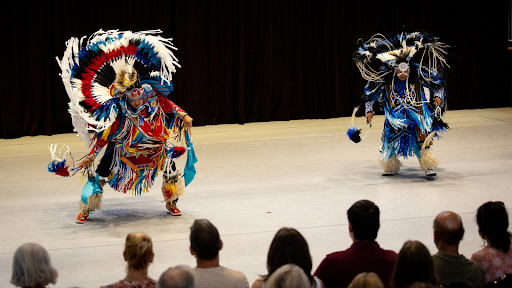
Photo of Indigenous Enterprise performers Kenneth Shirley and Dominic Pablo at Jacob’s Pillow in August 2022. Photo by Danica Paulos.
Many people in western culture generally feel comfortable with a binary kind of thinking because it's a way of processing information that we’ve grown up with. Things are either black or white, day or night, right or wrong. But when we make binary statements about people and art, we can create a rather limiting perspective for ourselves. I’ve found that such generalizations are often made about certain genres of dance or dance unique to specific cultural communities or regions.
For example, many are quick to assume that indigenous dancers and dance within indigenous communities must look a certain way. However, within indigenous communities across the globe, dance has played a variety of roles, including making cross-cultural connections in the case of “The Five Moons,” as well as telling stories, healing from trauma, and exercising imagination. Let’s take a look at just a few of the many talented former and active indigenous dancers contributing to the rich dance landscape across the country.
“The Five Moons”
Myra Yvonne Chouteau, Rosella Hightower, Moscelyne Larkin, Maria Tallchief, and Marjorie Tallchief, otherwise known as “The Five Moons,” are five Native American ballerinas from the U.S. state of Oklahoma known for achieving international recognition in ballet during the twentieth century.
“Of course, my parents were not about to let ballet take me away from my Indian dancing,” says Chouteau in American Indian Ballerinas. After touring globally with the Ballet Russe de Monte Carlo, Chouteau, a Shawnee-Cherokee, returned to Oklahoma and helped found the dance program at the University of Oklahoma in the early 1960s and the Oklahoma City Civic Ballet. On the other hand, Hightower, of the Choctaw Nation, found great success abroad, particularly in France where she earned the Chevalier de la Légion d’Honneur, a high marker of civil distinction in France, in 1975. Nonetheless, some jokingly argue that Hightower’s greatest accomplishment was famously learning the lead for Giselle in less than five hours!
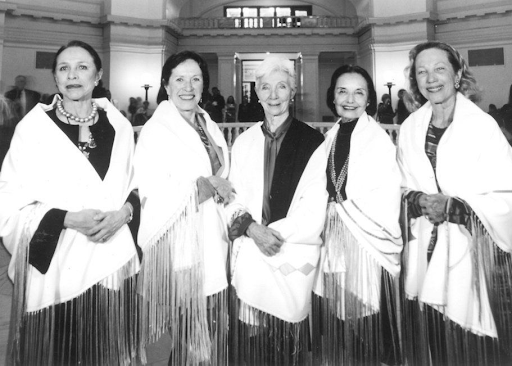
The Five Moons. From left: Maria Tallchief, Marjorie Tallchief, Rosella Hightower, Moscelyne Larkin and Yvonne Chouteau. Photo courtesy the University of Oklahoma School of Dance.
Among Larkin’s accomplishments, one particularly notable is helping found the renowned Tulsa Ballet. Larkin, an Eastern Shawnee-Peoria, was inducted into the Oklahoma Hall of Fame in 1979. A descendant of a Russian mother and a Native American father, Larkin famously said that ballet gave her the freedom to express all parts of her identity.
Marjorie Tallchief, of the Osage Nation, performed with the Paris Opéra Ballet from 1957 to 1962, as well as the Chicago Opera Ballet, Grand Ballet du Marquis de Cuevas, and many other large-scale companies. Her older sister Maria Tallchief was the first American dancer to achieve the title of “prima ballerina.” When George Balanchine co-founded what would become New York City Ballet in 1946, she was the company’s first major star. Tallchief showcased her talents across the globe, becoming the first American to perform in Moscow, Russia’s Bolshoi Theater.
“These are American Indian people that have made this impact on ballet,” says Russ Tall Chief, a relative of Marjorie and Maria, and a co-planner of the 2021 Five Moons Dance Festival at the University of Oklahoma. “And that they consider themselves American Indian before they consider themselves ballerinas, I think that’s important. That is part of their vocabulary as dancers. They bring that history of American Indian culture to their dance, and to their interpretation of the way that they see ballet.”
“The Five Moons” overcame preconceived, limiting notions of what a ballerina should look like, particularly during a time when American ballet was viewed as inferior to European ballet. Writer Meryl Cates points out that these women not only grappled with finding their place in the culture of their companies as Oklahomans but as Native women in a white-dominated field. These women have come to represent much of what people think of when they envision successful indigenous dancers of the twentieth century. But the story has certainly not stopped with them. Today, and for thousands of years before today, indigenous dancers have been using movement as a way to tell stories, heal, connect with their own culture and the world around them, and much more.
Dancing Earth
Dancing Earth is a company striving to create contemporary dance and related arts through global-Indigenous and intercultural relationships. The company is based in Ogaa Po Ogeh and Ohlone occupied territory, otherwise known as Santa Fe, New Mexico, and San Francisco, California. It specifically centers its mission on ecological and cultural diversity for creativity, health, and wellness. Founding Artistic Director Rulan Tangen descends, in part, from the Kampampangan people of Luzon in the Philippines. A cancer survivor and recipient of Kennedy Center’s 2018-19 Citizen Artist fellowship, her work interprets dance as a functional ritual for transformation and healing, using movement to foster a connection with all life forms on Earth.
Elise Beers of Earth Works Dance
Earth Works Dance
Formerly based in occupied Duwamish territory, otherwise known as Seattle, WA, Earth Works Dance is a nomadic dance company focused on earth healing and land acknowledgment. Using dance as a means to help heal the “body, spirit, emotion, and mind” is a driver of the company’s mission. “[Art] is a spiritual and emotional provider that other people need to see the value in and then support…so their communities can grow and thrive, and in a sense, heal, mourn, and celebrate,” says Earth Works Dance founder and artist Elise Beers. Click here to read more about Elise’s work with the company.
Indigenous Enterprise
Indigenous Enterprise centers its art on what it refers to as “the three Ps”: Preservation, Performance, and Progression. Through its teaching efforts, the company strives to help preserve a strong Native American identity while welcoming many different kinds of performances and continuing to “progress” amid cultural and global changes. The dance group has been featured at Lincoln Center’s Summer For the City, Jacob’s Pillow, and lauded in Dance Magazine for their imaginative fusion of hip hop and Native American dance on season four of World of Dance.
The Jingle Dress Project
The idea of the Jingle Dress Project came to Navajo photographer Eugene Tapahe in a dream. Amid one of the heights of the COVID-19 pandemic, Eugene dreamt of jingle dress dancers appearing as he sat, watching bison graze. Seeing the dancers perform the traditional Ojibwe healing dance gave Tapahe a sense of peace, a feeling he knew the world was craving during such a grave global crisis. Jingle dresses are traditionally adorned with beadwork, ribbon work, as well as triangular metal cones around the skirt that shake and create a distinctive sound with each movement. The Jingle Dress Project has traveled across the United States during the COVID-19 pandemic as a way to help uplift communities. “The jingle dress is really important for Native people, and the purposes of healing,” says Eugene, illustrating yet another way that dance can be used to heal in and out of indigenous communities.
While this article is certainly not exhaustive of all the Native American dancers creating art across the United States, it provides a peak into some of the exciting, multifaceted artists contributing to a long-standing, vibrant dance landscape. To explore some of these artists in greater depth, click the links below!
Resources:
American Indian Ballerinas (1997) by Lili Cockerille Livingston - https://www.goodreads.com/en/book/show/1654202.American_Indian_Ballerinas
“How Five American Indian Dancers Transformed Ballet in the 20th Century” by Allison Meier - https://hyperallergic.com/271205/how-five-american-indian-dancers-transformed-ballet-in-the-20th-century/
An entry on Rosella Hightower in The Encyclopedia of Oklahoma History and Culture - https://www.okhistory.org/publications/enc/entry.php?entry=HI003
“Moscelyne Larkin, a Founder of Tulsa Ballet, Is Dead at 87” by Jack Anderson - https://www.nytimes.com/2012/04/30/arts/dance/moscelyne-larkin-a-founder-of-tulsa-ballet-dies-at-87.html
An entry on Moscelyne Larkin in the Oklahoma Hall of Fame - https://oklahomahof.com/member-archives/j/jasinski-moscelyne-larkin-1979
“Marjorie Tallchief, Trailblazing Native American Ballerina, Dies at 95” by April Deocariza - https://www.dancemagazine.com/marjorie-tallchief/
An entry on Maria Tallchief in the National Women’s Hall of Fame - https://www.womenofthehall.org/inductee/maria-tallchief/#:~:text=At%20the%20ballet%2C%20Tallchief%20became,Swan%20Lake%20and%20The%20Nutcracker.
“Oklahoma’s Gift to Ballet: The Five Moons Ballerinas” by Meryl Cates - https://www.nytimes.com/2021/08/19/arts/dance/native-american-ballerinas-oklahoma.html
Dancing Earth - https://dancingearth.org/home/
Dancing Earth Founding Artistic Director and Choreographer Rulan Tangen - https://dancingearth.org/rulan
“Meet the Artists: Dancing Earth Indigenous Contemporary Dance Creations” from Kennedy Center Education Digital Learning - https://www.youtube.com/watch?v=Dv5cfgu49sQ
Earth Works Dance on Instagram - https://www.instagram.com/earthworksdance/
“Elise Beers on Healing Community and Acknowledging Land Through Dance” by Madison Huizinga - https://www.dancewearcenter.net/blog/2021/12/1/elise-beers
Indigenous Enterprise at Lincoln Center - https://www.lincolncenter.org/series/summer-for-the-city/indigenous-enterprise-564
Indigenous Enterprise at Jacobs Pillow - https://www.jacobspillow.org/events/indigenous-enterprise-2022/
“Evolving Tradition With the Fusion of Hip Hop and Native American Dance” by Bridgit Lujan - https://www.dancemagazine.com/hip-hop-and-native-american-dance/
Indigenous Enterprise on World of Dance - https://www.youtube.com/watch?v=uYa0tSXGIRs
The Jingle Dress Project on Instagram - https://www.instagram.com/jingledressproject/?hl=en
“How Jingle Dresses Are Being Used to Heal Communities” by Christian Allaire - https://www.vogue.com/article/jingle-dress-project-indigenous-design
Dance and Motherhood
Becoming a mother is a major life goal for many women in the world. But what does it look like when you’re a dancer? So much of the aesthetic of ballet relies on your body looking a certain way, so what happens when you no longer fit that mold? These were questions I started to ask myself when I saw those two VERY dark lines on my pregnancy test.
By Andrea Hines, DWC Ambassador
pronunciation: And-rea High-ns | pronouns: she/they

Becoming a mother is a major life goal for many women in the world. But what does it look like when you’re a dancer? So much of the aesthetic of ballet relies on your body looking a certain way, so what happens when you no longer fit that mold? These were questions I started to ask myself when I saw those two VERY dark lines on my pregnancy test.
I found out in August 2021 that I was pregnant after almost a year of trying. While I was obviously very excited, I couldn’t help but also have a wave of panic come over me once I realized that it meant my body was going to change drastically. As a ballet dancer, there is a certain aesthetic that comes with the art form, and unfortunately, with a former eating disorder and a massive case of body dysmorphia, I was anxious as to what was to come regarding my body changing. The uterus is a safe, warm and cozy place for baby, but for a lot of women, it is often a source of pain and anxiety.
I was determined to stay active throughout my pregnancy. Whether that was getting into the gym, going on walks, or taking ballet class, I promised myself I would keep myself as healthy as possible. I was able to keep with this, until I reached my third trimester. I was diagnosed with Symphysis Pubis Dysfunction, which meant anytime I walked or moved, I had extreme pain in my pelvis. This resulted in being put on bed rest for the last three months of my pregnancy. I would later learn that the reason for this diagnosis was because of my tenacity to stay active. I pushed myself too far, didn’t slow down, and as a result, my body was FORCING me to rest. While I knew logically this was the safest option for me and my baby, the little voice in my head said “Well, what now?”

From my first OB/GYN appointment to my 39-week appointment, I had gained a total of 50 pounds. While this is a totally normal amount of weight to gain while pregnant, my body dysmorphia told me otherwise. I was ready and determined to get back into shape after I gave birth. Cut to April 20th, 2022, my water broke at 11:30pm, and it was go time! 19 hours later, my son was here! I would later learn that the reason for my pelvic pain was also due to an 8 pound 3 ounce baby living inside me. But here we are, a new family of three! The next six weeks of recovery, healing and figuring out how to keep a tiny human alive swept by faster than I could have ever imagined. Once I got the go ahead to incorporate exercise back into my life, I thought to myself “How the F&!# am I supposed to find time to exercise when I have a tiny demon attached to me 90% of the day???” It started with small walks, while my son was napping, following a YouTube workout, and eventually, I got back into a ballet class…. But not right away.
I volunteer as one of the Rehearsal Assistants at Evergreen City Ballet, which means that I assist run rehearsals and teach choreography for whatever production we are getting ready for. In this instance, we were gearing up for Nutcracker. Running these rehearsals became another form of exercise, and one that I enjoyed. Rehearsals continued on, and we got to our final weekend of shows. I made a vow to myself that night, and promised myself that I would work my butt off, so I could get in shape enough to perform in Nutcracker 2023. And not just a character role; this meant I would strap on my pointe shoes and perform in a corps role.

January 2023
I looked into as many Open Adult classes as I could. I started the week on Mondays taking a beginner’s class at Northwest Ballet Center, so I could get back to basics and work on the fundamentals of ballet technique. Since this class went from 8pm-9pm, I was able to hand off any baby-duties to my amazing Husband. I won’t lie, this was a STRUGGLE, as I also work a regular 9am-5pm corporate job. I also recognize that I have the luxury of the support of a partner, so I am able to pursue the activities I want to pursue. Even if it meant bringing my son to the studio, my heart NEEDED to be in the studio.
After a few weeks, I started taking other open classes at Evergreen City Ballet & Dance Conservatory Seattle. Both these places have a special place on my heart for a few reasons:
ECB is where I got all my training. It is my comfort- my second home.
DCS is so incredibly inclusive, so I didn’t have to worry about my body looking a certain way to fit in. This place helped me rebuild my relationship with this new body of mine.
March 2023

I got fitted for pointe shoes from the ever so lovely Samantha from Dancewear Center!
June 2023

I performed a contemporary piece with DCS, and got back on stage for the first time in 12 years.
I continued to take classes, continued to get my strength and flexibility back, and then, we get to September 2023. Nutcracker casting is posted, and I see my name on the list: Andrea Hines, Snowflake & Flower. This was a momentous time for me. I have achieved my goal. I have the opportunity to perform the same choreography I performed as a student, 13 years later. As I’m writing this, I am in between Nutcracker rehearsals, and I am just happy.
As I mentioned, I am so incredibly lucky to have the support of my Husband, Maveryke, and a part-time nanny who allows me to get out of the house so I can take class and make it to rehearsal.
I just want to share that dance after giving birth is possible. It’s cliché, but it truly takes a village. My son is lucky to have so many people who are willing to watch him so I can achieve this goal of being able to dance again. I cannot thank them enough, from the bottom of my heart. And thank you Dancewear Center for taking a chance on me as your new Ambassador, and being able to share a new perspective.
Happy Dancing, and Happy Parenting!
Disclaimer
All content found on the Dancewear Center Website, Instagram, Facebook, Pinterest, and all other relevant social media platforms including: text, images, audio, or other formats were created for informational purposes only. Offerings for continuing education credits are clearly identified and the appropriate target audience is identified. The Content is not intended to be a substitute for professional medical advice, diagnosis, or treatment. Always seek the advice of your physician or other qualified health provider with any questions you may have regarding a medical condition. Never disregard professional medical advice or delay in seeking it because of something you have read on this Website.
If you think you may have a medical emergency, call your doctor, go to the emergency department, or call 911 immediately. Dancewear Center does not recommend or endorse any specific tests, physicians, products, procedures, opinions, or other information that may be mentioned on dancewearcenter.net. Reliance on any information provided by dancewearcenter.net, Dancewear Center employees, contracted writers, or medical professionals presenting content for publication to Dancewear Center is solely at your own risk.
Links to educational content not created by Dancewear Center are taken at your own risk. Dancewear Center is not responsible for the claims of external websites and education companies.
Get To Know DWC Ambassador Andrea Hines
Andrea Hines trained in dance at a high level from a young age in classical ballet. She started in Tacoma City Ballet and transitioned to Evergreen City Ballet and continued to train throughout high school. Since then she took some time off from dance, moved to California and back again, got married and had a baby! In 2019 she decided to come back into the dance world. Starting in the administrative side and then gradually back into ballet classes. Read on to learn more!
pronunciation: And-rea High-ns | pronouns: she/they
By Samantha Weissbach, DWC Owner & General Manager

Andrea Hines trained in dance at a high level from a young age in classical ballet. She started in Tacoma City Ballet and transitioned to Evergreen City Ballet and continued to train throughout high school. Since then she took some time off from dance, moved to California and back again, got married and had a baby! In 2019 she decided to come back into the dance world. Starting in the administrative side and then gradually back into ballet classes.
Andrea speaks to the difficulties and realities of getting back into dance after having a baby. She says it is fully possible, but it takes time. Social media skews many mothers’ expectations and can make them feel inadequate if they are unable to bounce back immediately. She wants to share her journey, and show other mothers a realistic approach to returning to activity after the baby.
This has become an overarching passion for Andrea. They want to teach others that what you see on social media is often improbable to achieve and at times, simply impossible. She feels the culture has shifted into nonstop comparisons. She says, “love that body that you have now, and work with what you have.”
Andrea teaches at BLS and ECB which holds open classes on Saturdays for adults. They will be performing in Auburn December 8-10th and Ikea Performing Arts center December 15-17th.
Disclaimer
All content found on the Dancewear Center Website, Instagram, Facebook, Pinterest, and all other relevant social media platforms including: text, images, audio, or other formats were created for informational purposes only. Offerings for continuing education credits are clearly identified and the appropriate target audience is identified. The Content is not intended to be a substitute for professional medical advice, diagnosis, or treatment. Always seek the advice of your physician or other qualified health provider with any questions you may have regarding a medical condition. Never disregard professional medical advice or delay in seeking it because of something you have read on this Website.
If you think you may have a medical emergency, call your doctor, go to the emergency department, or call 911 immediately. Dancewear Center does not recommend or endorse any specific tests, physicians, products, procedures, opinions, or other information that may be mentioned on dancewearcenter.net. Reliance on any information provided by dancewearcenter.net, Dancewear Center employees, contracted writers, or medical professionals presenting content for publication to Dancewear Center is solely at your own risk.
Links to educational content not created by Dancewear Center are taken at your own risk. Dancewear Center is not responsible for the claims of external websites and education companies.
Get To Know DWC Ambassador MiYoung Margolis
MiYoung Margolis is one of our newest ambassadors here at DWC! She has had a wonderful career in the arts both in South Korea and here in Seattle. An accomplished mixed media artist, fashion designer and choreographer, she brings a unique perspective to the arts and our ambassador program. Read on for more about this unique and interesting artist!
pronunciation: Me-young Mar-go-lis | pronouns: she/her
By Samantha Weissbach, DWC Owner & General Manager

MiYoung Margolis is one of our newest ambassadors here at DWC! She has had a wonderful career in the arts both in South Korea and here in Seattle. An accomplished mixed media artist, fashion designer and choreographer, she brings a unique perspective to the arts and our ambassador program. Read on for more about this unique and interesting artist!
MiYoung trained from a young age in classical western dance as well as traditional Korean dance and eventually received her degree in dance in South Korea. After moving to Seattle she worked in various artforms including visual art and fashion. Her gallery in Seattle displays her impressive range of art and creations and doubles as her company’s rehearsal space.
She is very passionate about getting every body into dance (something we can definitely agree on). She focuses her teachings and art on including all humans regardless of their background or training.
Her dance company, MMDC, is co-hosting the O-Jak Bridge Dance Festival with Adage Ballet on Dec 9th at the Erickson Theater in Seattle. They will be performing a non-traditional Swan Lake performance, as well as performances by multicultural artists and choreographers. You can click here to book tickets now!
We are thrilled to have MiYoung join the DWC family and you can look forward to seeing more from her on our Instagram and YouTube!
Disclaimer
All content found on the Dancewear Center Website, Instagram, Facebook, Pinterest, and all other relevant social media platforms including: text, images, audio, or other formats were created for informational purposes only. Offerings for continuing education credits are clearly identified and the appropriate target audience is identified. The Content is not intended to be a substitute for professional medical advice, diagnosis, or treatment. Always seek the advice of your physician or other qualified health provider with any questions you may have regarding a medical condition. Never disregard professional medical advice or delay in seeking it because of something you have read on this Website.
If you think you may have a medical emergency, call your doctor, go to the emergency department, or call 911 immediately. Dancewear Center does not recommend or endorse any specific tests, physicians, products, procedures, opinions, or other information that may be mentioned on dancewearcenter.net. Reliance on any information provided by dancewearcenter.net, Dancewear Center employees, contracted writers, or medical professionals presenting content for publication to Dancewear Center is solely at your own risk.
Links to educational content not created by Dancewear Center are taken at your own risk. Dancewear Center is not responsible for the claims of external websites and education companies.
Repurposing Your Dance Costumes into Halloween Costumes
As anyone who’s danced for an extended period knows, costumes can accumulate quickly. After various performances and recitals, the number seems to stack up exponentially. Before you know it, your closet is filled to the brim with tutus, bodices, leotards, jumpsuits, and hairpieces galore. Rather than allowing these sequined creations to collect dust in your bedroom or garage, why not sift through them to create this year’s Halloween costume? Read on to find out some of my top suggestions for turning dance costumes into Halloween costumes.
By Madison Huizinga, DWC Blog Editor

Wanda Maximoff and Vision from WandaVision, photo from www.thedirect.com
As anyone who’s danced for an extended period knows, costumes can accumulate quickly. After various performances and recitals, the number seems to stack up exponentially. Before you know it, your closet is filled to the brim with tutus, bodices, leotards, jumpsuits, and hairpieces galore. Rather than allowing these sequined creations to collect dust in your bedroom or garage, why not sift through them to create this year’s Halloween costume? Read on to find out some of my top suggestions for turning dance costumes into Halloween costumes.
Superhero
A colorful or sequined leotard paired with colorful tights or leggings and a cheap cape will transform you from zero to hero this Halloween season. You can even make your own superhero emblem out of paper to tape onto the cape or create your own headpiece out of cardboard to further the details. For me, the inspiration behind this idea was undoubtedly Wanda Maximoff’s Halloween costume in WandaVision. By wearing a red leotard, pink tights or leggings, a red cape, red gloves, and a cardboard Scarlet Witch crown, you can morph into an Avenger just like that!
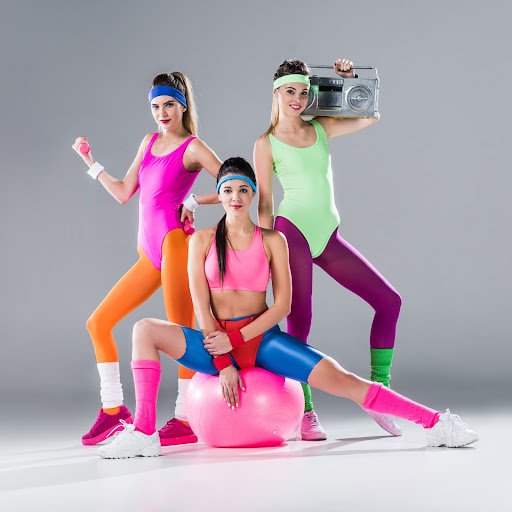
80s-inspired jazzercise outfits, from www.popsugar.com
80s Jazzercise
Similar to the superhero costume, the base of an 80s jazzercise costume is a colorful leotard and a colorful pair of tights. However, instead of accessorizing your ensemble with a cape, add some bright legwarmers around your ankles and sweatbands around your head and wrists. Throw on some chunky sneakers and show everyone your best jazzercise moves this Halloween. Extra points if you carry around a boom box!
Zombie ballerina
If you have the full ballerina get-up (leotard, tutu, tights, etc.) on hand, you can easily turn it into a costume with some eccentric makeup. Why not dress up as a ballerina turned into a zombie? By adding liquid latex to your face to look like peeling skin and some red, brown, and green eyeshadow to look like rotting flesh, you can become the scariest undead ballerina ever. Check out this zombie makeup tutorial to give you some assistance!
Angel
A simple white leotard can be transformed into an angel costume with just a few additions! Add a white tulle skirt or tutu to make it look like you’re sitting atop the clouds. Making your own wings and halo out of cardboard and feathers or pipe cleaners will complete this heavenly look.

Still of Natalie Portman in Black Swan, photo from Fountain Resource Group
Odile from “Black Swan”
If there’s any movie that encapsulates dance and horror the best, it has to be the 2010 thriller Black Swan. In the film, Nina Sayers, played by Natalie Portman, has her reality distorted as she prepares for the polarizing roles of Odette and Odile. Overcome by the demands of her choreographer and the role itself, Nina transforms into Odile, the “Black Swan,” growing black feathers out of her face and beady red eyes. If you have a black leotard or bodice, black tutu, and pink tights, all you need is some heavy black makeup, red contacts, and black feathers to complete this costume. It’ll be sure to give people a fright!
Catwoman
For this costume, black latex is your best friend. Pair some black latex pants or a black latex jumpsuit with a black (preferably latex) top or black leotard. Add some cat ears and some black whiskers to complete the look, or create your own Catwoman mask out of felt to complete the look!
Flapper Girl
Costumes for jazz dances often feature fringe details, making them a great base for a 1920s-inspired flapper costume! Pair a fringe dress or biketard with a homemade flapper headband and some character shoes to transport you back to the roaring 20s!
Instead of spending excess money and time searching for a Halloween costume this year, look no further than your own closet! With a little tweaking, accessorizing, and charm, you can turn your everyday dancewear and dance costumes into some remarkable Halloween creations. Happy haunting and happy creating!
About the Author

Disclaimer
All content found on the Dancewear Center Website, Instagram, Facebook, Pinterest, and all other relevant social media platforms including: text, images, audio, or other formats were created for informational purposes only. Offerings for continuing education credits are clearly identified and the appropriate target audience is identified. The Content is not intended to be a substitute for professional medical advice, diagnosis, or treatment. Always seek the advice of your physician or other qualified health provider with any questions you may have regarding a medical condition. Never disregard professional medical advice or delay in seeking it because of something you have read on this Website.
If you think you may have a medical emergency, call your doctor, go to the emergency department, or call 911 immediately. Dancewear Center does not recommend or endorse any specific tests, physicians, products, procedures, opinions, or other information that may be mentioned on dancewearcenter.net. Reliance on any information provided by dancewearcenter.net, Dancewear Center employees, contracted writers, or medical professionals presenting content for publication to Dancewear Center is solely at your own risk.
Links to educational content not created by Dancewear Center are taken at your own risk. Dancewear Center is not responsible for the claims of external websites and education companies.
Empowering Dancers in the Studio and On Stage - Local Choreographer Alicia Mullikin On Creating An Inclusive Space for all Marginalized Communities
Empowering dancers is something that is very important to local dance teacher and choreographer Alicia Mullikin. Being able to be your true self in the studio and on stage is one of the main goals she tries to pursue with her dance company El Sueño. We got the chance to speak with Alicia about her mission statement, her dance company, and her personal dance journey. Read on to learn more!
Pronunciation: Ah-lee-see-ah Mull-ih-kin | Pronouns: she/her
By Nicole Barrett, DWC Blog Editor
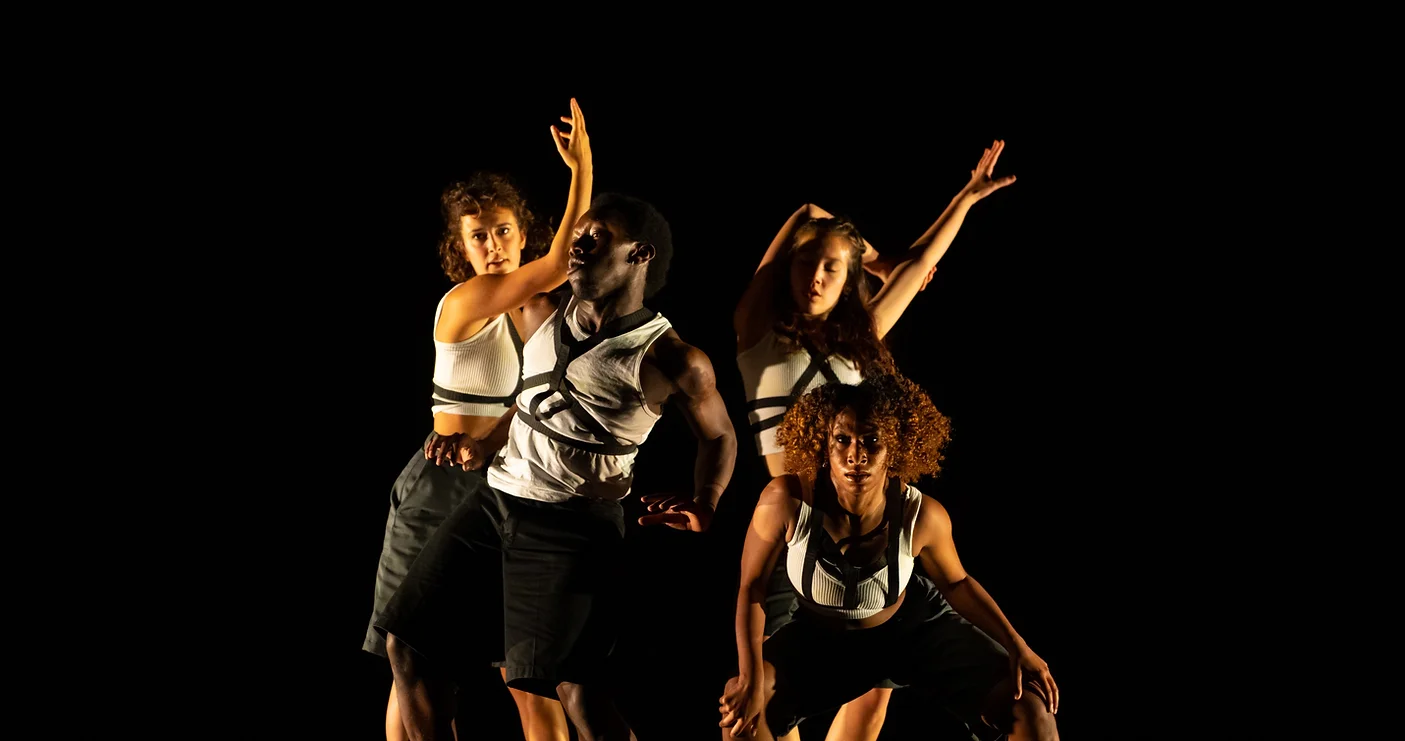
photo courtesy of https://www.aliciamullikin.com/works
Empowering dancers is something that is very important to local dance teacher and choreographer Alicia Mullikin. Being able to be your true self in the studio and on stage is one of the main goals she tries to pursue with her dance company El Sueño. We got the chance to speak with Alicia about her mission statement, her dance company, and her personal dance journey. Read on to learn more!
Alicia started dancing in the middle school show choir. While she was in the show choir, the choreographer quit which left the group without choreography. Alicia decided she wanted to help choreograph without taking any dance classes and fell in love with the creative process. She asked her parents to put her into dance classes at the local YMCA, where her love of dance and choreography bloomed.
After high school, Alicia went to Riverside City College where she continued to train in dance before transferring to Cornish College of the Arts. It was here that she encountered some struggle and came up against some rigid viewpoints about body shape and traditional expectations around size. However, it is also where she met some incredible teachers and lifelong friends. Alicia later went on to get her Masters in Dance from Cal State University of Long Beach and she was recently selected as an Arts Advocacy Leadership fellow by the National Association of Latino Arts and Cultures.
When asked about Alicia’s favorite thing about dance, she says, “Dance allowed a space for me to express myself in ways that I am unable to verbally. It allows me to be the person I want to be.” Folks often describe Alicia’s movement as expressive and powerful. She strives to bring this out of her students as well as guide them to stand in their full power and own their own story.

photo courtesy of https://www.aliciamullikin.com/works
El Sueño is an organization founded by Alicia. They use dance as a platform for community engagement, empowerment, and healing of marginalized communities. The phrase el sueño means “the dream” which is important to her as a first-generation American. Seeing her parents sacrifice and strive for the American dream has inspired her to continue pressing forward. Alicia’s family is descendant from the Indigenous people’s of North America and the genocide and struggle that they went through inspires her to be resilient. She shares, “I am the recipient of the American Dream, that is generations in the making.”
Alicia is currently working on a new work MESTIZO. It is an evening of collected stories of the Mexican-American experience. The description states As Mexican people, our histories are painfully entwined with both our Indigenous ancestors and our Spanish colonizers. So much of our Indigenous history was stripped from us through centuries of cultural erasure and genocide. What we have been able to hold onto has been strategically hidden within Catholic images and appropriated spiritual practices. Assimilation was the way we survived extinction, but defiance and resilience was threaded in the ways we stealthily passed our cultural practices through the colonial lens. MESTIZO bravely claims the pain and power of this history with each artist documenting their experiences. The event will include visual arts, film, music, dance, and ceremony that powerfully weave together our collective experiences.
You can find out more about Alicia and her new work at https://www.aliciamullikin.com/mestizo
And follow the El Sueño Instagram here!
If you’d like to support Alicia’s upcoming production of MESTIZO you can donate to their project fundraiser at https://www.gofundme.com/f/mestizo

Disclaimer
All content found on the Dancewear Center Website, Instagram, Facebook, Pinterest, and all other relevant social media platforms including: text, images, audio, or other formats were created for informational purposes only. Offerings for continuing education credits are clearly identified and the appropriate target audience is identified. The Content is not intended to be a substitute for professional medical advice, diagnosis, or treatment. Always seek the advice of your physician or other qualified health provider with any questions you may have regarding a medical condition. Never disregard professional medical advice or delay in seeking it because of something you have read on this Website.
If you think you may have a medical emergency, call your doctor, go to the emergency department, or call 911 immediately. Dancewear Center does not recommend or endorse any specific tests, physicians, products, procedures, opinions, or other information that may be mentioned on dancewearcenter.net. Reliance on any information provided by dancewearcenter.net, Dancewear Center employees, contracted writers, or medical professionals presenting content for publication to Dancewear Center is solely at your own risk.
Links to educational content not created by Dancewear Center are taken at your own risk. Dancewear Center is not responsible for the claims of external websites and education companies.
Get To Know DWC Ambassador Vania Bynum
Vania Bynum is one of our newest ambassadors with a unique dance story and very interesting perspective, read on to learn more about her and her organization, VCBynum Arts & Education!
Vania Bynum | van-ee-uh bye-num | pronouns: she/her
By Samantha Weissbach, DWC Owner & General Manager

Dance can be life-changing in many different ways. It can unleash a new identity inside and help express oneself for the whole world to see. We got the chance to speak with our very own DWC Ambassador Vania Bynum about what dance means to her! Read on to learn more about Vania’s dancing journey and what inspired her to become a DWC Ambassador!
Vania started dancing when she was in a club in school that allowed opportunities for underserved communities to be immersed in various forms of art. She was introduced to dance through this program and she shares she was in and out of this program for a couple of years. After going to college to become a software engineer, she came across Alvin Ailey for the first time in her late 20s and she realized that she needed to get back into dance.
While she was working at Microsoft, she would take classes in order to get back into dance and practice. Vania danced for Eastside Dance and Elizabeth’s Dance Dimensions in adult groups which made her want to further her artistry and take her dancing to the next level. Vania took a year off and studied dance which was her love and passion and auditioned for Cornish College of the Arts where she got in.
When asked about what inspired her to become a DWC Ambassador, Vania shares that her friend, former DWC Ambassador Robbi Moore, introduced her to the program. She was asking them about the things they were posting and they talked about it which led to Vania doing her own research. She believes that this will allow her to move forward in her dancing journey and be able to share her story with others. This can allow her to grow as not only a person and push herself but as an artist as well.
Vania is in a 50+ group that is called The Throwbacks that do performances so be sure to watch out for those performances! Vania also has VC Bynum Arts and Education which hosts classes in Bellevue, so look out for those flyers and sign up for classes!
We are so excited to have Vania as one of our DWC Ambassadors! Be sure to check out the full interview on YouTube!
Disclaimer
All content found on the Dancewear Center Website, Instagram, Facebook, Pinterest, and all other relevant social media platforms including: text, images, audio, or other formats were created for informational purposes only. Offerings for continuing education credits are clearly identified and the appropriate target audience is identified. The Content is not intended to be a substitute for professional medical advice, diagnosis, or treatment. Always seek the advice of your physician or other qualified health provider with any questions you may have regarding a medical condition. Never disregard professional medical advice or delay in seeking it because of something you have read on this Website.
If you think you may have a medical emergency, call your doctor, go to the emergency department, or call 911 immediately. Dancewear Center does not recommend or endorse any specific tests, physicians, products, procedures, opinions, or other information that may be mentioned on dancewearcenter.net. Reliance on any information provided by dancewearcenter.net, Dancewear Center employees, contracted writers, or medical professionals presenting content for publication to Dancewear Center is solely at your own risk.
Links to educational content not created by Dancewear Center are taken at your own risk. Dancewear Center is not responsible for the claims of external websites and education companies.

DWC Ambassador Kendall Hadley On The Mental Challenges Of Injury
Overcoming the physical and mental challenges of my injury was one of the hardest things I have gone through as a dancer.
In both 7th grade and my sophomore year of high school, I dislocated my knee during dance class. The first time I came out of a jump and landed poorly and sat out for four months. The second time my pointe shoe slid out from under me and I sat out for six months.
By Kendall Hadley, DWC Ambassador
Pronunciation: Can-doll Had-lee | Pronouns: she/her

Overcoming the physical and mental challenges of my injury was one of the hardest things I have gone through as a dancer.
In both 7th grade and my sophomore year of high school, I dislocated my knee during dance class. The first time I came out of a jump and landed poorly and sat out for four months. The second time my pointe shoe slid out from under me and I sat out for six months.
As a dancer I’ve become accustomed to relying on my body to perform as it needs to as long as I take care of it. My injuries were both sudden, unpredictable, and devastating. I could no longer count on my body the way I used to. I had to rely on crutches to walk, and others to be kind enough to help me with simple tasks such as opening the door. During this time I had to repair the physical and mental relationship of my body during the time of my injury, and long after my recovery.
While tedious, my physical recovery is essential to my healing, and it still benefits me today. Having back-to-back doctors and physical therapy appointments was time consuming, but I also learned more about my body in that time than I ever had before. Finding a physical therapist that was supportive as well as knowledgeable of my recovery process was extremely helpful in my recovery. It’s important that your physical therapist knows you are returning to dance, not just to recreational activity. Dance is a physically demanding sport that requires strength and endurance. I had to advocate for myself and explain the physical demands that were required for my sport were not simple. My physical therapist and I both worked to develop a routine that would help me return to my regular dance activity.
After months of hard work, rest, and truly listening to my body I was able to slowly return to taking class. After my second injury I encountered many more mental obstacles than physical. I no longer trusted my body. I was always psyching myself out from trying new movements, compared myself to others, and encountered anxiety within the classroom.
Anytime I was introduced to new movements I encountered anxiety. Fearing re-injury, I found I was holding myself back in dance and wasn’t pushing myself. This stunted my growth as a dancer. I had to learn to overcome these physical and mental obstacles overtime.
The things that really aided me on me journey to mental recovery:
-Go to your dance classes and take notes

I know it can be hard to watch your friends get to dance and not be able to join them, but this will help you learn by watching and remembering your terminology. It also shows that you genuinely want to be there and your instructors will see that.
-Know the difference between pain and discomfort
This requires an elevated awareness of your body that not many people possess. There is a difference between doing something your body isn’t used to and dancing through pain. Learn what is your body entering new territory and what is your body’s way of saying it needs a break.
-Take care of your body
Beyond the doctors appointments and dance classes, there is so much you can do to take care of your body. The little things like cold showers or warm baths make all the difference. Take time to ice your feet, warmup, roll out, stretch, meditate, and do everything your body needs to before hitting the dance floor.
-Be patient with yourself
Being a dancer you require a lot from your body. Understanding that your body needs the time to work up to what it once was is difficult. I have found that in some ways my injury has made me stronger as a dancer and I go into dance with an appreciation for my body and what it is allowing me to do. It may take some time before your body is dancing at the level it used to, but you may be a better dancer because of it.
Disclaimer
All content found on the Dancewear Center Website, Instagram, Facebook, Pinterest, and all other relevant social media platforms including: text, images, audio, or other formats were created for informational purposes only. Offerings for continuing education credits are clearly identified and the appropriate target audience is identified. The Content is not intended to be a substitute for professional medical advice, diagnosis, or treatment. Always seek the advice of your physician or other qualified health provider with any questions you may have regarding a medical condition. Never disregard professional medical advice or delay in seeking it because of something you have read on this Website.
If you think you may have a medical emergency, call your doctor, go to the emergency department, or call 911 immediately. Dancewear Center does not recommend or endorse any specific tests, physicians, products, procedures, opinions, or other information that may be mentioned on dancewearcenter.net. Reliance on any information provided by dancewearcenter.net, Dancewear Center employees, contracted writers, or medical professionals presenting content for publication to Dancewear Center is solely at your own risk.
Links to educational content not created by Dancewear Center are taken at your own risk. Dancewear Center is not responsible for the claims of external websites and education companies.

The Return of Seattle Dances
Seattle Dances is one of Seattle’s top dance journalism pages that features upcoming performances and various interviews with local dancers in the area. We got the chance to speak with Kaitlin McCarthy who is the current editor and director of operations of Seattle Dances! Read on the learn more about what Seattle Dances is all about and their mission for the Seattle Dances on the dance community!
A Conversation with Kaitlin McCarthy
By Samantha Weissbach, DWC Owner & General Manager and Nicole Barrett, DWC Blog Editor
Seattle Dances is one of Seattle’s top dance journalism pages that features upcoming performances and various interviews with local dancers in the area. We got the chance to speak with Kaitlin McCarthy who is the current editor and director of operations of Seattle Dances! Read on the learn more about what Seattle Dances is all about and their mission for the Seattle Dances on the dance community!
Seattle Dances was established in 2009 as a blog for Pacific Northwest Ballet. Later on, the organization expanded its converage and focused on including a wider range of dance performances in the area. Seattle Dances was passed around throughout the years to numerous different mangements and eventually landed on two local dancers Anna Waller and Mariko Nagashima from 2011-2016. Kaitlin became a writer for the organization in 2016 and then took over the managment position in 2016 with local dancer Megan Stevenson. At this stage, the orgianization was more of a formal jouranalistic entity with a staff of writers and more frequent posts on local shows in the area.
During the pandemic, many shows were cancelled so Seattle Dances decided to keep their site and staff to low capacity to adhere to the lack of movement from the Seattle dance community. The organization just had a large relaunch in January of this year that included a new look for their webpage and tried to continue focusing on local dance performances and supplying resources.
Kaitlin shares that what Seattle Dances wants most for the community to know is that everyone is open to submit anything dance related to the site! The organization was built to spread the word about local performances in the area and allow a common space for artists to share their work. There can be many misconceptions about journalism websites that only take a specifc range of content, but Seattle Dances is non-discriminating to the types of performances that they produce content about. Please use this resource to support local artists and spread the word about your upcoming performances!
We are so happy to be able to speak with Kaitlin abot Seattle Dances! This amazing webpage and resource is open for all dancers to use here! Be sure to check out the full interview with Kaitlin down below!
Disclaimer
All content found on the Dancewear Center Website, Instagram, Facebook, Pinterest, and all other relevant social media platforms including: text, images, audio, or other formats were created for informational purposes only. Offerings for continuing education credits are clearly identified and the appropriate target audience is identified. The Content is not intended to be a substitute for professional medical advice, diagnosis, or treatment. Always seek the advice of your physician or other qualified health provider with any questions you may have regarding a medical condition. Never disregard professional medical advice or delay in seeking it because of something you have read on this Website.
If you think you may have a medical emergency, call your doctor, go to the emergency department, or call 911 immediately. Dancewear Center does not recommend or endorse any specific tests, physicians, products, procedures, opinions, or other information that may be mentioned on dancewearcenter.net. Reliance on any information provided by dancewearcenter.net, Dancewear Center employees, contracted writers, or medical professionals presenting content for publication to Dancewear Center is solely at your own risk.
Links to educational content not created by Dancewear Center are taken at your own risk. Dancewear Center is not responsible for the claims of external websites and education companies.
Interested in writing for the DWC Blog? Click below to fill out the DWC Contributor application!