
How to Mentally Navigate Returning to Dance After a Summer Break
Returning to dance in the fall is always a challenge. Many of us spend the summer either taking a break from dancing or dancing significantly less than usual. Don’t get me wrong, rest is incredibly useful for dancers. It’s also important to spend time with friends and family and engage in other activities that bring dancers joy. Some may be fearful that they’ve lost a significant amount of their dance technique over the break or that their focus will be out of shape. No matter what type of nerves you’re feeling, there are small steps to take to ensure you’re mentally prepared to return to studio dancing.
Tips For Getting Into Dance After a Break
By Madison Huizinga, DWC Blog Editor

Returning to dance in the fall is always a challenge. Many of us spend the summer either taking a break from dancing or dancing significantly less than usual. Don’t get me wrong, rest is incredibly useful for dancers. It’s also important to spend time with friends and family and engage in other activities that bring dancers joy. Some may be fearful that they’ve lost a significant amount of their dance technique over the break or that their focus will be out of shape. No matter what type of nerves you’re feeling, there are small steps to take to ensure you’re mentally prepared to return to studio dancing.
Something that I find crucial when returning to dance is accepting the fact that my body will move differently after a break. It can be mentally challenging to reconcile with the fact that we’re not quite moving in the same way we were a few months ago. Our extensions might be a bit lower and our turn out may not be the same as it was before, and that’s okay! Accept the fact that your mobility is going to change slightly depending on your different levels of activity and inactivity. Feel free to cut yourself a little bit of slack for not quite meeting the expectations you set for yourself. Just because you find yourself in a different place than you were a few months ago, or even a year ago, doesn’t mean you won’t get back to where you were before. In fact, following a break from dance, I often find that my mind is more open and ready to absorb information. I can pick up choreography faster and learn how to do new moves more efficiently after my body and mind have taken time to heal and rest. Keeping this in mind can be helpful when transitioning back into dancing more regularly and rigorously.

Photo By Mathilde Langevin on Unsplash
A useful way I mentally adjust to getting back into dance, or starting any new routine, is journaling about my thoughts and feelings. According to the University of Rochester’s Medical Center, journaling is a helpful way to manage anxiety, reduce stress, and cope with depression. For me, journaling holds all of these benefits because it helps me understand the root causes of my fears, identify unhelpful thought patterns, and give myself positive affirmations about moving forward. When I notice that I’m not quite meeting my performance goals in dance, it can feel quite discouraging. I begin to feel like I’m being lazy, a slacker, or just downright losing my skills and won’t be able to get them back. When I journal about how I’m feeling, I’m able to realize that while I may be feeling these emotions in the moment, they aren’t necessarily true. Through writing, I can see that I’m feeling the way I’m feeling because I took a break from dancing and am getting into the rhythm of a new routine. By coming to this realization, I can reassure myself that I will be able to get back on track with some time and effort. Suddenly, my situation doesn’t seem like an utter catastrophe, but rather a natural symptom of taking time off.
Another helpful way to use journaling to prepare yourself for getting back into dance is to set realistic goals for yourself. A significant part of goal setting that people often neglect is setting attainable goals or those that you’re capable of achieving. For example, if I were to return to dance after a three-month break, setting a goal for myself to perfectly execute triple pirouettes my first week of class isn’t attainable. Instead, I need to be honest with myself about what I am capable of achieving.
“Finally, one of the most useful things to remember when getting back into dance is that you aren’t alone.”
To create some structure in my life, before I get started on my day, I like to set three goals about what I hope to accomplish, big or small. This is a simple practice that dancers can do before each dance class. These goals can be anything from paying more attention to your épaulement during barre exercises to asking questions about certain steps you want more assistance with. Setting these goals allows me to have a more systematic approach to getting back into dance, which can make me feel like I’m making more of an effort to progress back to where I once was.

Photo By Daria Nepriakhina on Unsplash
Finally, one of the most useful things to remember when getting back into dance is that you aren’t alone. Chances are most of your peers have also taken time off and may also be feeling insecure about getting back into dancing. The past year and a half of dancing through Zoom and/or taking time off is a universal experience for dancers, whether they’re beginners or professionals. Reach out to other dancers in your classes and connect with them about the challenges of returning to studio dancing. You can even create a plan to set goals together about what you hope to accomplish in the coming year and check in with each other regularly to see how you’re feeling.
Breaks are necessary for any field, they help us recharge and come back stronger. Regardless of how important they are, ending the break and returning to “regularly scheduled programming” can seem intimidating. But through journaling about your emotions, goal setting, and connecting with peers, getting back into dance can be a far less daunting feat than it seems on the surface.

Disclaimer
All content found on the Dancewear Center Website, Instagram, Facebook, Pinterest, and all other relevant social media platforms including: text, images, audio, or other formats were created for informational purposes only. Offerings for continuing education credits are clearly identified and the appropriate target audience is identified. The Content is not intended to be a substitute for professional medical advice, diagnosis, or treatment. Always seek the advice of your physician or other qualified health provider with any questions you may have regarding a medical condition. Never disregard professional medical advice or delay in seeking it because of something you have read on this Website.
If you think you may have a medical emergency, call your doctor, go to the emergency department, or call 911 immediately. Dancewear Center does not recommend or endorse any specific tests, physicians, products, procedures, opinions, or other information that may be mentioned on dancewearcenter.net. Reliance on any information provided by dancewearcenter.net, Dancewear Center employees, contracted writers, or medical professionals presenting content for publication to Dancewear Center is solely at your own risk.
Links to educational content not created by Dancewear Center are taken at your own risk. Dancewear Center is not responsible for the claims of external websites and education companies.
How to Make a Ballet Bun
As dancers, we tirelessly strive to improve our technique and artistry in each class. A big part of putting in this work is focusing on the task at hand without distractions. And as any dancer with long locks knows, hair can often be a big distraction! We’ve all been there - constantly tucking falling strands behind our ears, jamming bobby pins into our scalp, trying to re-do our ballet bun in between combinations, the list goes on. Knowing how to do a proper ballet bun can significantly benefit a dancer, as it can keep them focused on their training and performance and not on whether their updo will stay put. Read on to learn DWC’s tips for achieving the perfect ballet bun.
A Guide to the Essential Ballerina Updo
By Madison Huizinga, DWC Blog Editor

Ballet bun at the crown of the head. Photo by Colin Hutton from danceadvantage.net
As dancers, we tirelessly strive to improve our technique and artistry in each class. A big part of putting in this work is focusing on the task at hand without distractions. And as any dancer with long locks knows, hair can often be a big distraction! We’ve all been there - constantly tucking falling strands behind our ears, jamming bobby pins into our scalp, trying to re-do our ballet bun in between combinations, the list goes on. Knowing how to do a proper ballet bun can significantly benefit a dancer, as it can keep them focused on their training and performance and not on whether their updo will stay put.
Let’s run through the basic steps.
Brush or comb your hair free of tangles
Run a hairbrush or comb through your hair several times until it is free of any tangles. Eliminating any knots or tangles in your hair will ensure that your hair looks smooth in the final ballet bun without any large “bumps.” Many dancers choose to use a spray bottle filled with water to achieve an extra smooth look.
Secure your hair in a ponytail at the crown of your head
Gather your hair into a ponytail that sits at the crown of your head (see photo). It’s worth noting that some dancers prefer to part their hair and secure it into a low ponytail at the nape of their neck. This creates what’s referred to as a “low bun.” For those with finer hair, using a hairbrush or comb to help gather your hair into a ponytail can help smooth out any bumps. Secure the ponytail with a hair tie, preferably one that’s a similar color to your hair. Dancers, specifically ones with finer hair, can optionally smooth their hair back with hair gel before this step to help smooth away bumps and flyaways. Many dancers also choose to use a bristle or “smoothing brush” during this step to help with any bumps or flyaways. Using mousse, “hair mascara,” or gel applied with a toothbrush can further enhance this smoothed back ponytail.
Twist the ponytail into a coil and wrap it around the hair tie

Photo of a ponytail at the crown of the head. Photo by Pius Martin from Unsplash.
Twist the hair in your ponytail until it starts coiling in on itself. Wrap it around your hair tie so it forms a spiral-like shape, pinning it with hair pins as you go. The tighter you coil your hair, the better! For dancers with thicker hair, it can be useful to divide the ponytail into two separate sections, twist each section, and coil each one in opposing directions around the hair tie. Twisting your hair into a firm coil will help ensure that the bun stays tightly secure and in place.
Fasten the bun with hair pins and a hairnet
Secure the ballet bun by sticking hair pins into its center, along the bottom base of the bun on the scalp. Angle the pin towards your scalp before shifting the angle upwards into the center of the bun. The more hair you gather in the pin before angling it upwards, into the bun, the flatter the bun will be. At Dancewear Center, we offer two-inch, two-and-a-half-inch, and three-inch hair pins for buns of varying sizes. The hair pin size that a dancer should use depends on the thickness and length of their hair. Also, wrapping a hairnet around the bun helps keep fine, flyaway hair at bay. Before securing the bun with hair pins, simply wrap the hairnet around the bun, making sure that its elasticized edge is tucked towards the bottom of the bun out of view. The hairnet may be wrapped around the dancer’s bun once, twice, or three times depending on the texture of the dancer’s hair and the size of their bun.
Pin back and hairspray any stray hairs
For those with layered and/or fine hair, use bobby pins or snap clips to secure any stray hairs or bangs. As a finishing touch, spray the bun and your scalp with a light coating of hairspray to ensure that the updo is smooth with a clean, finished look.
Bonus tips!
Use a “Bun Builder”
For those struggling to achieve a tall, rounded bun look, use the Bun “Donut” Builder by Bloch. Simply gather your hair into a ponytail, pull the ponytail through the center of the builder, slide the builder to the base of the ponytail, arrange your hair around it, and secure it with a hairnet and hair pins. The Bloch Bun Builder creates a taller, more spherical bun than the classic method, so we suggest using it if you are hoping to achieve that style in particular.
Keep a “hair kit” in your dance bag
It’s always helpful to have extra hair supplies on hand in the case of a hair tie snapping, a hair net snagging, or a bobby pin disappearing out of thin air (it’s crazy how they seem to do that!). The Bloch Hair Kit contains all of a dancer’s hair essentials including two hair nets, fifteen three-inch hair pins, ten two-inch hair pins, six bobby pins, four hair elastics, and a “how-to” guide for the best bun. Plus, it comes in an elegantly packaged pink tin that will be sure to stand out in your dance bag when you’re doing your hair in a hurry. The “Holding It Together” Bun Box from Covet Dance similarly contains hair pins and hair ties, as well as bobby pins, corkscrew spin pins, a bun-making “flower,” and a cute decorative wool bow to offer dancers more hair options.

Photo by Iiona Virgin on Unsplash
Accessorize!
When given permission from your dance instructor, let your personality shine with some fun hair accessories. The dreamy Cloud Scrunchie from Cloud & Victory wraps your bun in a colorful, luminous garment that looks great on your hair and on your wrist. Handmade by local Seattle artist Hayley Maddox, the scrunchies from Lasso Leos come with intricately detailed lace patterns and stitching, sure to stand out in any class. The Fluffy BUNnies Scrunchies from Covet Dance are as fuzzy and adorable as can be, particularly cute on younger dancers. Or adorn your ballerina updo with a classic crochet bun cover from American Dance Supply, offered in a variety of soft colors and with rhinestones.
By following these tips along with a little practice, your ballet bun will be fit for the studio and stage in no time!
Disclaimer
All content found on the Dancewear Center Website, Instagram, Facebook, Pinterest, and all other relevant social media platforms including: text, images, audio, or other formats were created for informational purposes only. Offerings for continuing education credits are clearly identified and the appropriate target audience is identified. The Content is not intended to be a substitute for professional medical advice, diagnosis, or treatment. Always seek the advice of your physician or other qualified health provider with any questions you may have regarding a medical condition. Never disregard professional medical advice or delay in seeking it because of something you have read on this Website.
If you think you may have a medical emergency, call your doctor, go to the emergency department, or call 911 immediately. Dancewear Center does not recommend or endorse any specific tests, physicians, products, procedures, opinions, or other information that may be mentioned on dancewearcenter.net. Reliance on any information provided by dancewearcenter.net, Dancewear Center employees, contracted writers, or medical professionals presenting content for publication to Dancewear Center is solely at your own risk.
Links to educational content not created by Dancewear Center are taken at your own risk. Dancewear Center is not responsible for the claims of external websites and education companies.
What Is a Pointe Shoe?: A Guide to the Advanced Dance Footwear
Dancers often try on many pairs of pointe shoes in their first fitting to ensure that the best fit possible is selected. At DWC, we strive to make out fittings both a fun and educational experience, so dancers can expect to be informed about the different properties of the different shoes they try. Once the best shoe for the dancer is selected, it’s important that students have their teacher approve of them before they begin sewing them.
By Madison Huizinga, DWC Blog Editor
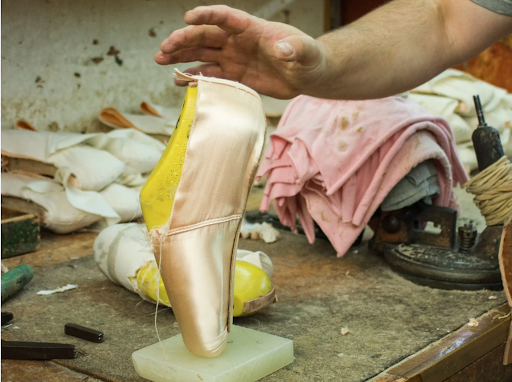
Pointe shoe from Freed of London being made on a last from Business Insider
Dancing “en pointe” is a common phrase in the dance industry. We often hear about prima ballerinas at large companies wearing “pointe shoes” or adolescent dancers working to earn their “pointe shoes.” But what exactly is a pointe shoe?
Pointe shoes are footwear specially designed for experienced dancers to wear to dance on the tips of their toes. In most classical ballets, like The Nutcracker, Swan Lake, and The Sleeping Beauty, you’ll see professional dancers donning pointe shoes onstage. While these dancers appear to glide across the stage in these shoes with ease, it takes years of training to be qualified to dance in them. Importantly, pointe shoes are not meant for beginning dancers who haven’t been cleared to wear them by a professional.
There are many different parts to a pointe shoe:
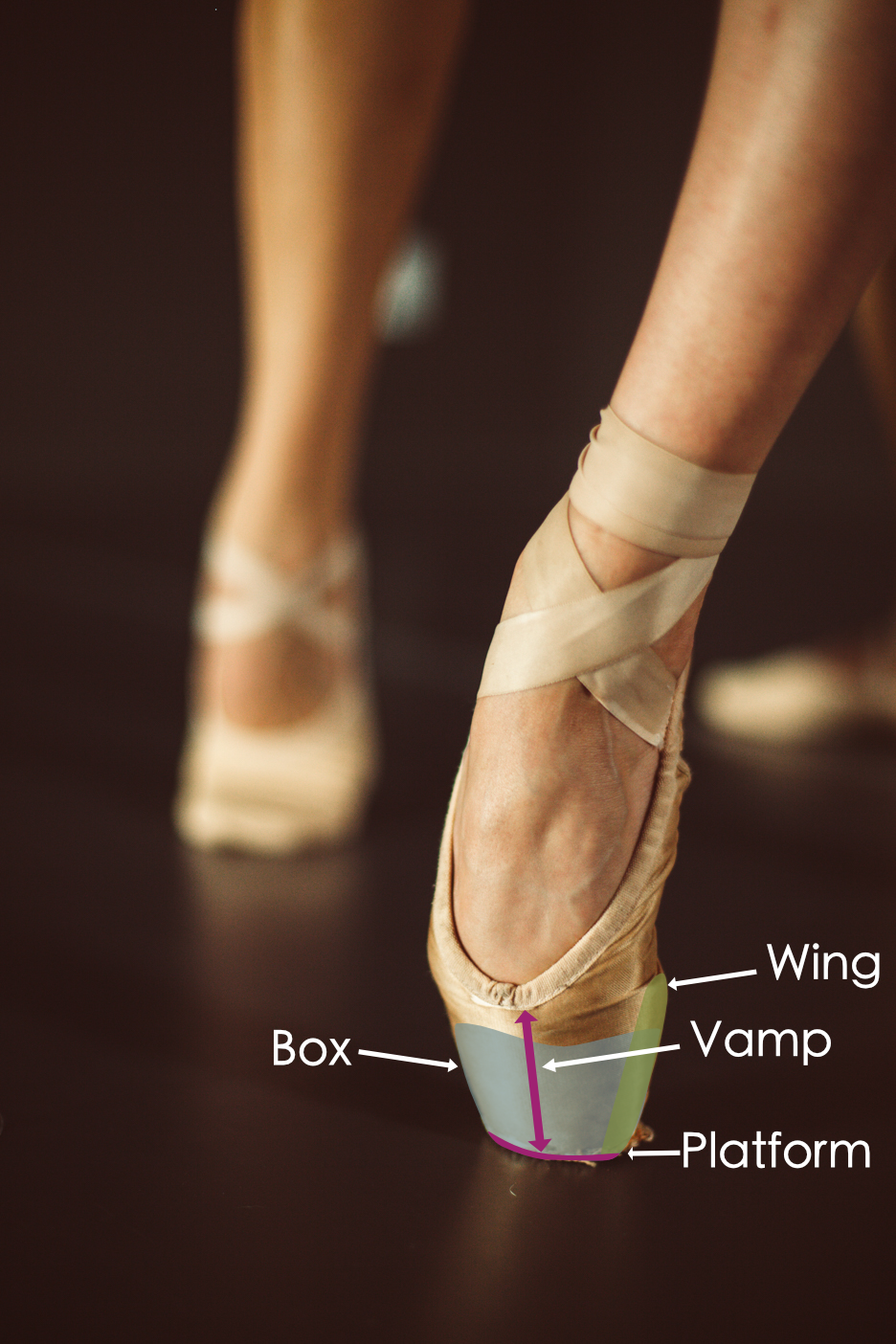
The Box
The “box” of a shoe is the hard, rectangular area that the toes and top of the feet are inserted into. This part of the shoe is made by applying layers of paper/cardboard and paste to a “last”: the mold that a pointe shoe is made on.
The Shank
The “shank” of the pointe shoe is the section that runs lengthwise across the bottom of the foot that helps support the foot’s arch. The shank is made out of leather and other composite materials. Added after the box is made, the shank is attached to the pointe shoe through a nailing and gluing process. Before the pointe shoe is sent to retailers and consumers, the maker will hammer and smooth out the box and finalize it by sewing on a drawstring and, in some cases, adding pleats.
The Crown
The “crown” of the shoe, otherwise known as the shoe’s “profile” or height when viewed from the side. Some pointe shoe profiles are graded, flat, or round, all of which impact how the dancer uses the shoe en pointe.
The Platform
The “platform” of the pointe shoe refers to the hard, flat surface at the tip of the shoe upon which the dancer balances.
The Vamp
The “vamp” of the pointe shoe refers to the length from the platform to the opening or “throat” of the shoe. Vamps can be “high” meaning there is a longer length from the platform to the throat of the shoe, and others can be “low” meaning there is a shorter length. Some vamps are U-shaped and others are V-shaped, and some have elasticized satin while others don’t.
The Wings
The “wings” of a pointe shoe are an extension of the vamp that provide support along the sides of the dancers’ feet. Some wings are high, meaning they extend further along the sides of dancers’ feet, and others are lower, meaning they don’t extend as far. Some wings are more collapsible and some are harder, some are rounded and some are straight.
The Drawstring & Casing
The drawstring, often made of either cotton or elastic, passes through the binding around the pointe shoe and ties at the top of the vamp. The drawstring casing is a piece of material stitched around the edge of the pointe shoe containing the drawstring. Pointe shoes with a drawstring and casing often have a U-cut style. Other pointe shoes may have no drawstring and instead, have an elasticized casing that fits snug around the foot. And other pointe shoes may have a V-cut style vamp and have no drawstring at all.
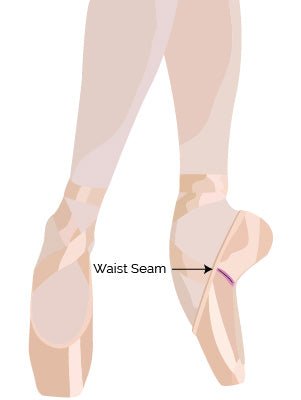
Photo from Inspirations Dancewear
The Waist Seam & Heel
The waist seam of a pointe shoe is a seam that joins the front and the back of the pointe shoe together. The heel of a pointe shoe can be structured or loose, wide or tapered, made of special stretch satin, made with structured, double-backed satin, and sometimes feature a “heel cup” designed to provide structure and create a seamless look.
Getting Fitted for Pointe Shoes
Getting fitted for pointe shoes is not like getting fitted for street shoes. Across the vast amount of pointe shoe brands available, there are a variety of styles that have different qualities. In addition, when fitting pointe shoes, fitters don’t just account for the length of a dancer’s foot, but also the width of their feet, the strength and flexibility of their feet, their toe shape and length, their heel shape, their foot profile, training experience, current dance goals, previous and current injuries, medical conditions, and more! All of these factors will influence what shoe the dancer ultimately ends up with.
In addition, getting properly fitted for pointe shoes requires the expertise of pointe shoe fitters. Pointe shoe fitters at Dancewear Center participate in required continuing education on a weekly, monthly, and quarterly basis, and have been trained in an array of professional fitting methods, including those from Bloch, Russian Pointe, So Danca, and most recently, the Progressive Pointe Method from ThePointeShop. There are a variety of factors our fitters consider when fitting dancers for pointe shoes, like making sure the dancer is over the shoe’s box, making sure the shank is providing adequate support, making sure they aren’t “sinking” or sitting in the shoe, and much more.
How To Prepare for your First Pointe Shoe Fitting with DWC
Get Assessed for Pointe Readiness
If you’re a student, you should be approved by your dance teacher to get fitted for pointe shoes or demi-pointe shoes before coming to Dancewear Center. If not trained under the guidance of a professional, dancing in pointe shoes can be a dangerous experience. Here at DWC, we also love fitting adults who wish to train en pointe or those returning to dancing en pointe. Many studios in the Seattle area offer classes for adults, including Dance Conservatory Seattle, Dance Fremont, American Dance Institute, Second Act Dance, ARC Dance, Westlake Dance Center, and more. We recommend that adults interested in dancing en pointe get assessed by a physical therapist for pointe readiness. Check out our dance medicine specialist page for information about dance specialists in the Seattle area.
Book a Pointe Shoe Fitting
Expert pointe shoe fitting teams require dancers to make an appointment. If a dancer arrives without an appointment, they will be assisted in scheduling one for a later date. Appointments can be booked through DWC’s website for our Kirkland or Renton locations, and group or mobile fittings can be requested by emailing info@dancewearcenter.net. It’s important that dancers allot around 45 minutes for their first appointment with DWC to allow for a thorough assessment and fitting process. Pointe shoe fittings are subject to a $25 service fee that is waived with the purchase of pointe shoes, and late arrivals will be charged the $25 fitting fee and asked to reschedule at a later time.
Prior to Your Fitting
Prior to their appointment, dancers will be sent information about what to expect and how to prepare for their appointment. Dancers should make sure their feet are clean and toenails are trimmed - we recommend trimming toenails two days before their appointment. Dancers should also wear transition/convertible tights to their fitting and bring the most recent pair of pointe shoes and the padding they normally wear with them. For more information, dancers and parents can also check out this pointe shoe fitting informational page on DWC’s website and this informational video on our YouTube page.
During the Fitting
At the beginning of a dancer’s first fitting, dancers will be greeted by one of our knowledgable pointe shoe fitters who will give dancers an overview of the fitting process. The fitter will ask questions and take notes about previous pointe shoes, injuries, current training, and much more, as well as take a visual assessment of the dancer’s bare feet. This will allow the fitter to have a better understanding of what types of pointe shoes they should pull for dancers to try on and the padding they suggest. For example, for dancers who have bunions and experience bunion pain, our fitters may advise them to use a silicone gel spacer and to see a physical therapist who specializes in dance medicine. Also, dancers will often be advised to wear padding like “Ouch Pouches,” made from gel and polyester upon their first fitting.
After the feet are assessed and additional equipment is administered, it’s time for the fun part: trying on the shoes! Notably, pointe shoes fresh out of the package have no elastic or ribbon attached. Elastics and ribbons will need to be purchased separately, as well as a sewing kit for dancers to sew them on themselves.
Dancers often try on many pairs of pointe shoes in their first fitting to ensure that the best fit possible is selected. After trying on many pairs, the fitter and dancer will narrow down the best final options. The dancer will be asked a lot of questions to ensure that the best possible shoe is selected. At DWC, we strive to make our fittings both a fun and educational experience, so dancers can expect to be informed about the different properties of the various shoes they try. Once the best shoe for the dancer is selected, it’s important that students have their teacher approve of them before they begin sewing them.
Following their appointment, dancers will receive a follow-up email reminding them that the DWC fitters are available at any time after the fitting to answer questions about their shoes. The DWC staff also keeps records of dancers' preferred pointe shoes and sizes to provide more information for future refittings.
Important Reminders
Pointe shoes only last 10-20 dancing hours on average. To help prolong the life of pointe shoes, it’s important to give them the opportunity to dry out in between wears, which takes up to 48-72 hours. Storing and transporting pointe shoes in mesh bags can aid with the drying process as well as help alleviate their sweaty smell. It’s also important to remember to keep pointe shoes out of the reach of pets!
We recommend that dancers schedule refitting appointments for their first 2-3 pairs of shoes and every six months after that or if they’re experiencing issues with their shoes. Refittings are important, as dancers’ feet can change drastically after dancing en pointe. At pointe shoe refittings, fitters will take a look at the dancer’s old pair of pointe shoes to analyze how they’re breaking down to figure out how the dancer’s needs have changed since their first fitting. The fitters will have a conversation with the dancer about their shoes, asking what they liked and disliked about them and what their typical experience in the shoe was like.
Working consistently with a professional fitter throughout a dancer’s journey is essential for ensuring that dancers are performing their best and are in the shoes that fit their needs best at that time. The pointe shoe industry is rapidly innovating and DWC fitters are constantly working to improve their skillset by involving themselves in continuing education, learning about the latest medical research and technology, and more. Dancers can feel confident that they are in good hands with DWC fitters.
This is just the tip of the iceberg when it comes to pointe shoes! But we hope it provides you with a solid baseline of knowledge about the complex and exciting world of pointe shoes. Book your pointe shoe fittings with Dancewear Center today here!
Sources:
https://www.pbt.org/learn-and-engage/resources-audience-members/ballet-101/pointe-pointe-shoes/
https://www.businessinsider.com/what-its-like-ballet-pointe-shoe-maker-freed-of-london-2021-6
https://dancewear-center.myshopify.com/products/super-spacers-cap?_pos=3&_sid=f912ccba0&_ss=r
https://dancewear-center.myshopify.com/products/ouch-pouch-jr-large-cap?_pos=6&_sid=61d304c77&_ss=r
https://www.rpcollection.com/perfect-fit/finding-your-perfect-fit/pointe-shoe-drawstring/
https://creativeartsacademyutah.wordpress.com/for-dancers/learn-reflect/pointe-shoe-anatomy/
Disclaimer
All content found on the Dancewear Center Website, Instagram, Facebook, Pinterest, and all other relevant social media platforms including: text, images, audio, or other formats were created for informational purposes only. Offerings for continuing education credits are clearly identified and the appropriate target audience is identified. The Content is not intended to be a substitute for professional medical advice, diagnosis, or treatment. Always seek the advice of your physician or other qualified health provider with any questions you may have regarding a medical condition. Never disregard professional medical advice or delay in seeking it because of something you have read on this Website.
If you think you may have a medical emergency, call your doctor, go to the emergency department, or call 911 immediately. Dancewear Center does not recommend or endorse any specific tests, physicians, products, procedures, opinions, or other information that may be mentioned on dancewearcenter.net. Reliance on any information provided by dancewearcenter.net, Dancewear Center employees, contracted writers, or medical professionals presenting content for publication to Dancewear Center is solely at your own risk.
Links to educational content not created by Dancewear Center are taken at your own risk. Dancewear Center is not responsible for the claims of external websites and education companies.
Interested in writing for the DWC Blog? Click below to fill out the DWC Contributor application!