
Local Dance Non-Profit on Prioritizing Dance Education for Adults
This new upcoming show will be held on November 18th and 19th at Broadway Performance Hall in Seattle at 8 pm. Dare to Dance’s shows started in 2010 with the first show simply called Dare to Dance. These shows aim to get people who don’t have a lot of dance training but want to start dancing on stage and perform. To include people who are dance enthusiasts and just want to dance. These dance pieces specifically are meant to showcase different dance styles and the utter joy that the people onstage have when performing.
A Conversation with the Directors of Dare to Dance Seattle
By Nicole Barrett, DWC Blog Editor
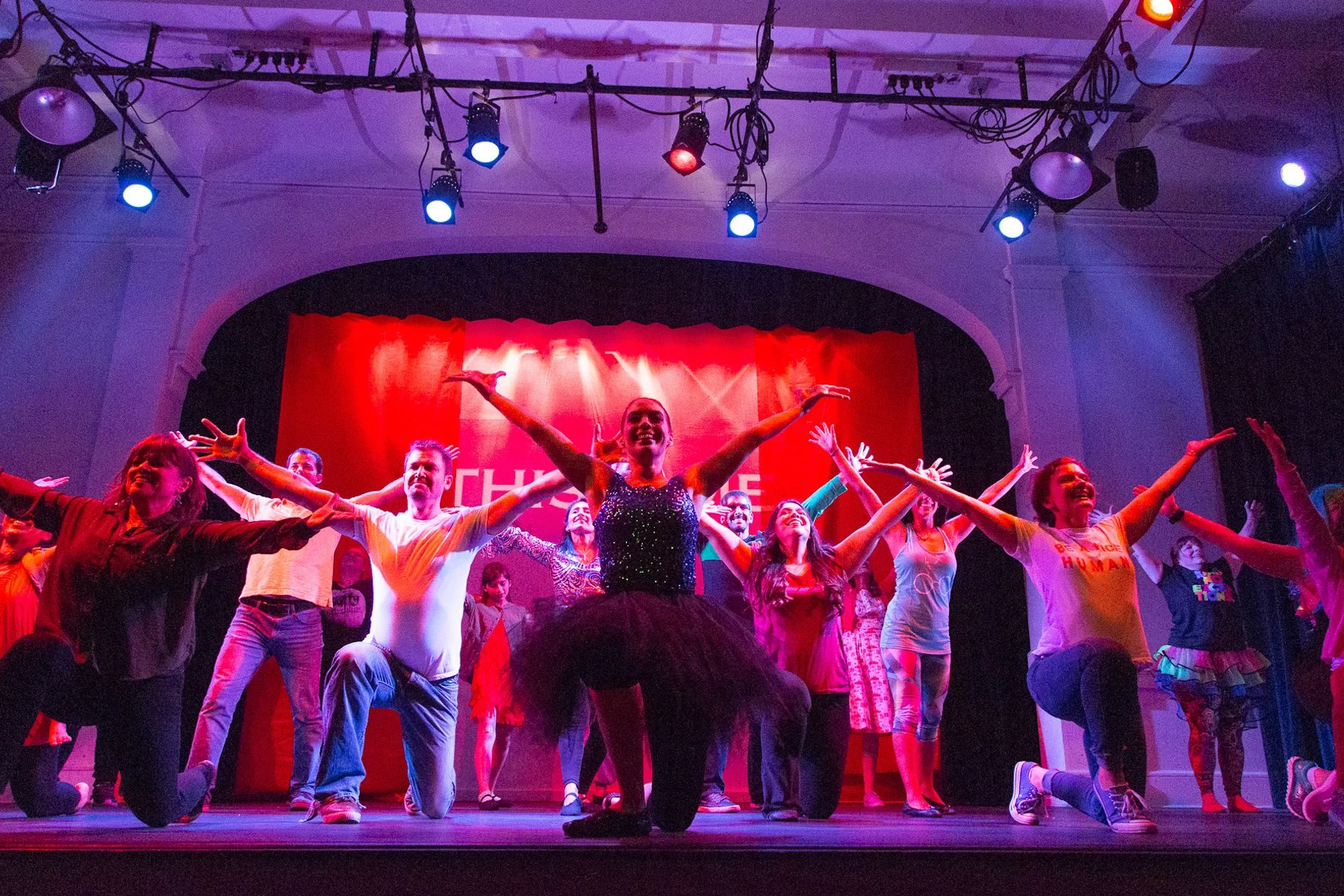
Photo by Zheng Wang
The dance world has come a long way in recent years for the acceptance of everyone. Gender norms are being broken and traditional ways of training are being pushed aside. One gap that is still working its way through the realm of dance is the gap for adults starting to dance at an older age. This is something that Dare to Dance Seattle is trying to tackle with their yearly performances. We got the opportunity to speak with Administrative Director Cindy Jacobs and Artistic Director Zheng Wang about their upcoming performance on November 18th and 19th! Read on to learn more about the mission of Dare to Dance and details for their upcoming show!
Zheng shares that he was not a dancer when he was growing up. He says that he never considered himself a dancer until he found a group that participated in flash mobs in 2010. The flash mob was performing at Westlake Center in Seattle and he says that he went with a friend and was a part of the big crowd dancing together. “That was just really fun, really exciting, so I just kept going back,” he recalls.
While participating in the flash mobs, he met a group of people that were very passionate about dance, but they weren’t “professionals.” He credits meeting this group of people as the true beginning of starting Dare to Dance and his reason for creating a show with the flash mob community.
Cindy started taking dance classes when she was five years old and shares that back when she was training, there were no performances or recitals. There were just strictly classes for technique. Her father was in the military so she says that she moved around a lot and learned different dance styles such as tap and hula. She continued to dance throughout high school and shares that she took a little break after graduating.
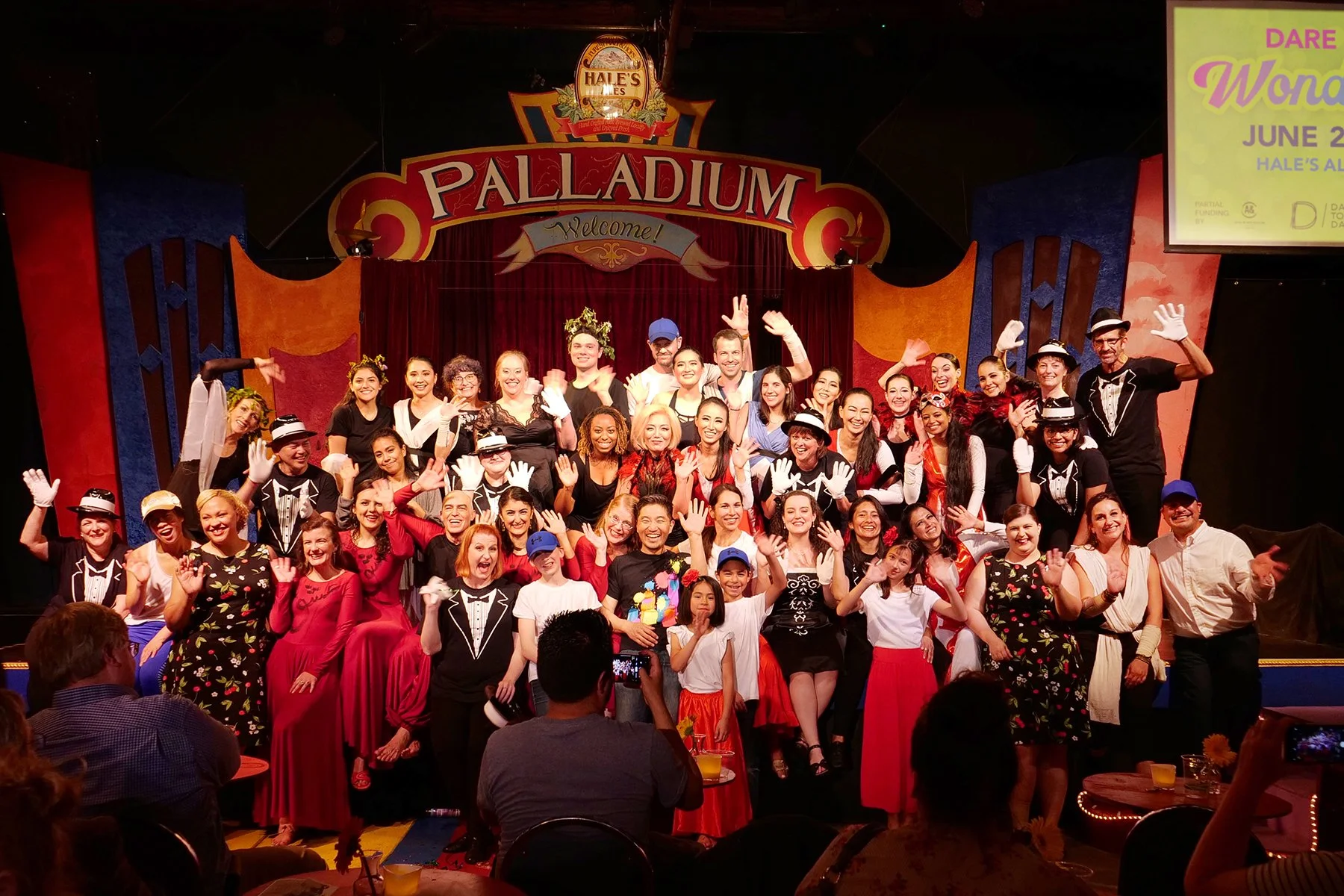
Photo by Zheng Wang
Later on, in her adult years, she started dancing again in some community-based performances and stage musicals. She then started dancing with a community show choir and later on choreographed for them. Cindy and her choreography partner Sue have worked together for many years and have choreographed numerous pieces in various locations. “I just love to dance,” she shares, smiling.
This new upcoming show will be held on November 18th and 19th at Broadway Performance Hall in Seattle at 8 pm. Dare to Dance’s shows started in 2010 with the first show simply called Dare to Dance. These shows aim to get people who don’t have a lot of dance training but want to start dancing on stage and perform. To include people who are dance enthusiasts and just want to dance. These dance pieces specifically are meant to showcase different dance styles and the utter joy that the people onstage have when performing.
Dare to Dance encourages group performances to share the joy of dancing together. Each specific piece showcases a dance style and choreographers from various locations bring these pieces for the dancers to perform. This organization just wants to share dance with everybody.
Cindy shares that when she joined the team in 2018 she was very impressed with the organization of the company and loved the mission. “It was extremely welcoming,” she shares. She says that something that surprised her was the amount of diversity between the dances and the dancers. “It’s really a fun show!” Cindy says.
The goal of Dare to Dance as a non-profit organization is to provide professional-quality opportunities for dance enthusiasts of all ages and skill levels to create, perform, connect and grow. “It’s really about providing that opportunity to people that don’t get it otherwise,” Zheng shares. He emphasizes the fact that “non-dancers” don’t get the opportunities to perform onstage like dancers that train at a studio do. Zheng believes that the audience can see themselves onstage when they are watching these performances that they might not with other shows.
When coming up with this idea, Zheng shares that he thought that this was a very out-of-the-box concept to create. He says that he disguised the first show as a big birthday celebration for his 35th birthday to ensure that people would turn out and want to celebrate. “I figured that if it was a total disaster, we could just write it off as having fun for my birthday!” Zheng shares, laughing. What surprised him the most was how successful it was and it allowed him to continue doing these shows from then on.
Something that makes Dare to Dance stand out amongst other organizations is the fact that every idea is open for discussion. “‘Hey, you have a good idea? Sure! Can you get some dancers?’” Cindy shares, smiling. She elaborates that there aren’t the boundaries that typical dance organizations have and they focus their time on allowing adult amateurs to have the opportunity to dance onstage. Cindy states that the most important thing about Dare to Dance is that there are no pre-existing rules for what kind of dance or dancers they need. “We are willing to look at everything,” she shares.
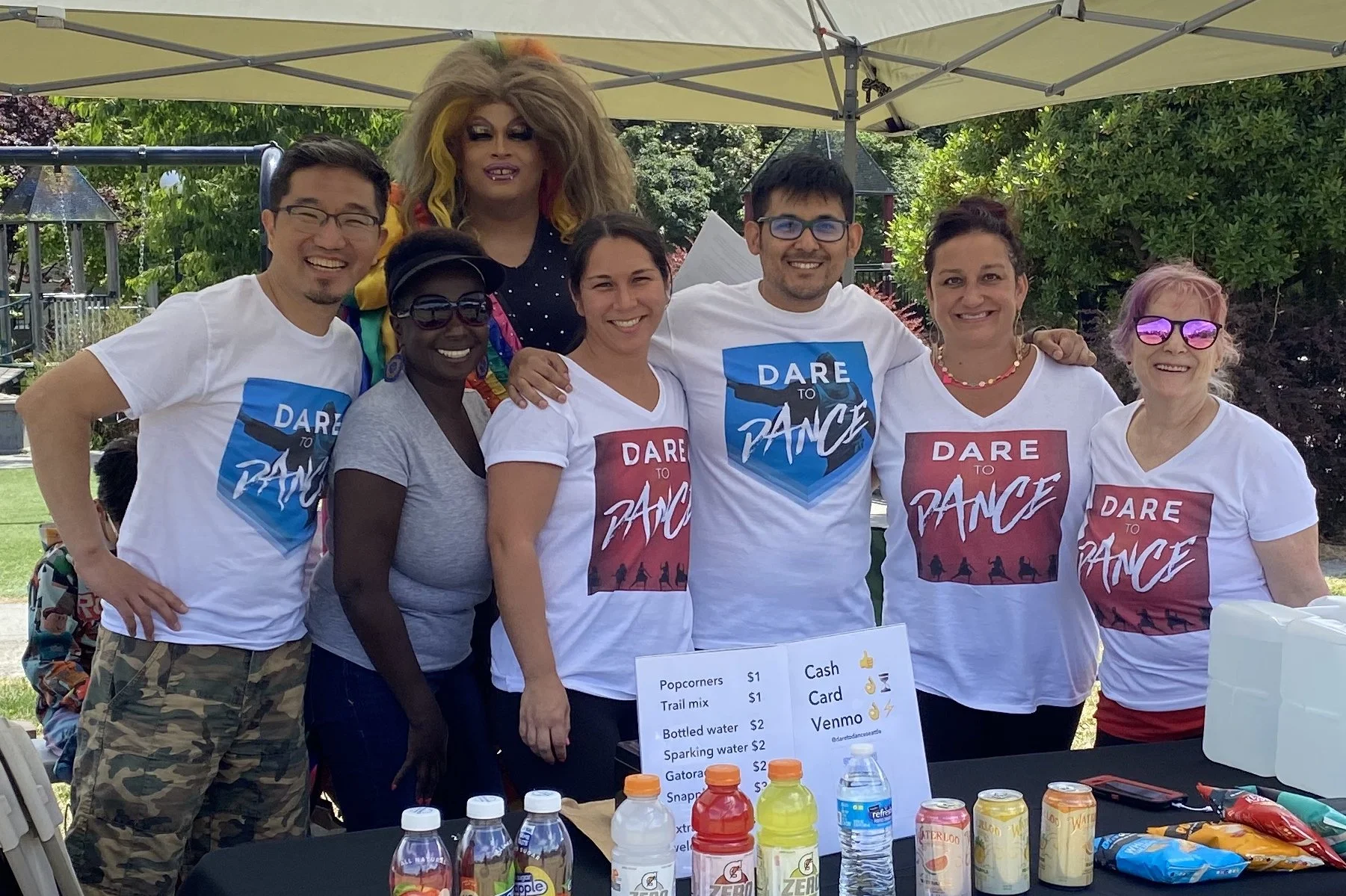
Photo by Zheng Wang
About the Author

Disclaimer
All content found on the Dancewear Center Website, Instagram, Facebook, Pinterest, and all other relevant social media platforms including: text, images, audio, or other formats were created for informational purposes only. Offerings for continuing education credits are clearly identified and the appropriate target audience is identified. The Content is not intended to be a substitute for professional medical advice, diagnosis, or treatment. Always seek the advice of your physician or other qualified health provider with any questions you may have regarding a medical condition. Never disregard professional medical advice or delay in seeking it because of something you have read on this Website.
If you think you may have a medical emergency, call your doctor, go to the emergency department, or call 911 immediately. Dancewear Center does not recommend or endorse any specific tests, physicians, products, procedures, opinions, or other information that may be mentioned on dancewearcenter.net. Reliance on any information provided by dancewearcenter.net, Dancewear Center employees, contracted writers, or medical professionals presenting content for publication to Dancewear Center is solely at your own risk.
Links to educational content not created by Dancewear Center are taken at your own risk. Dancewear Center is not responsible for the claims of external websites and education companies.
Evergreen City Ballet’s Bennyroyce Royon on Promoting Diverse and Comprehensive Training
For over 25 years, Evergreen City Ballet has provided high-quality dance education to the South King County community. Following “innovation, collaboration, and community building” as the pre-professional ballet school’s pillars, Artistic Director Bennyroyce Royon strives to redefine dance education in the PNW by centering a variety of cultural histories and promoting holistic training.
By Madison Huizinga, DWC Blog Editor

Photo Credit: Kuo-Heng Huang
For over 25 years, Evergreen City Ballet has provided high-quality dance education to the South King County community. Following “innovation, collaboration, and community building” as the pre-professional ballet school’s pillars, Artistic Director Bennyroyce Royon strives to redefine dance education in the PNW by centering a variety of cultural histories and promoting holistic training.
Bennyroyce’s true connection to movement began with learning folk dances as a young boy in the Philippines. “For a while, I was saying that I started with ballet, but I didn't,” Bennyroyce states. Moving to the United States at 12 years old, Bennyroyce describes the process of being “Americanized” and exposed to Western styles of dance. “I forgot about my actual beginning connection and… root in terms of movement,” he explains. Having this recognition of the true origins of his connection to dance is “informing the way he’s moving forward right now,” as an artist and teacher.
Growing up, Bennyroyce always had a knack for expressing himself through music and couldn’t find himself connecting to American sports. Around 16 years old, he stumbled across a piece in the Auburn Reporter saying that Evergreen City Ballet was auditioning teenage boys and offering scholarships. His interest was piqued. Bennyroyce remembers calling ECB to introduce himself and mildly exaggerating his dance experience and technique level. Upon being asked if he was flexible, Bennyroyce laughs, recalling placing his leg on the kitchen counter and thinking “yeah, I’m pretty flexible.”
After his audition, Bennyroyce was offered a scholarship from Evergreen City Ballet. His teachers, including Founding Artistic Director Wade Walthall, “instilled the love of ballet [in him].” His training became more rigorous as he dove deeper into the practice and attended summer programs. On one occasion, during a field trip in New York, Bennyroyce recalls standing in front of The Juilliard School and telling his friend “I’m going to go there next year.”
“I had a lot of work to do, it was very tough,” Bennyroyce emphasizes.
And he certainly put in the work. Bennyroyce was accepted at Juilliard, where he worked with major choreographers like Mark Morris with Paul Taylor, Ronald K. Brown, Elliot Feld, Jessica Lang, and many more. He danced with teachers who worked under some of the masters of American dance, such as Martha Graham and José Limón.
After graduating, Bennyroyce’s first job was at The Metropolitan Opera, and he later danced with companies such as Rasta Thomas’ Bad Boys of Dance, Carolyn Dorfman Dance, and Sidra Bell Dance New York. He danced in Montreal with Cas Public, and later with Armitage Gone! Dance Company, before beginning his choreographic journey. He began the project-based dance company Bennyroyce Dance in 2010 and has received choreographic commissions from Atlanta Ballet and Ballet Hispánico.
Following his time dancing on Broadway in the original cast of The King and I, Bennyroyce began “meditating on [his] impact and…[his] legacy as an artist.” An opportunity opened up at Evergreen City Ballet to become the artistic director. After advising and consulting for the ballet school, he applied and got the role.
“My goal is to bring the world of dance here [to ECB and the City of Renton] and really serve the South King County region because that’s where my heart is,” Bennyroyce says. Being able to provide “access to dance of the highest caliber is really important and transformative,” he stresses.
Bennyroyce shares the obstacles he has faced in the dance world, including anxiety, depression, and body dysmorphia. He describes himself as an “atypical” artistic director, in the traditional sense, pointing out that he has a “booty like J-Lo” and feet that aren’t as flexible as others. An encouraging message he strives to share through his work is that “whatever body type, color, size, or expression you [have], you can do it.”
A large part of Bennyroyce’s vision in dance is “provid[ing] opportunities to a diverse group of individuals.” He shares how much the American dance industry favors European aesthetics, which is why he decided to stay in the United States to “contribute to the American landscape of dance in [his] own little corner.”
Since its conception, Evergreen City Ballet has offered “rigorous, well-rounded, and holistic” dance education for toddlers at 20 months old, all the way up to adults. Live accompaniment and an expanded modern program are aspects of ECB that Bennyroyce particularly takes pride in. In the coming year at ECB, Bennyroyce hopes to expand the definition of a “pre-professional ballet school,” to show the community that “ballet is just one of the foundations of dance.”

Next year, Bennyroyce is excited to announce that Afro dance will be a part of Evergreen City Ballet’s curriculum. “The African diaspora has been a source of inspiration and foundation for some of the movement styles we have now,” Bennyroyce stresses. “I think it’s important for my students to access that.”
Evergreen City Ballet also plans to offer programming on wellness, including classes on nutrition, meditation, and cross-training. Bennyroyce believes it’s important for ECB students to harness a holistic approach when understanding self-development in dance.
The ballet school is also looking forward to continuing putting on its annual student-choreographed show, “Elevate.” Evergreen City Ballet also offers an annual production of The Nutcracker that tours locally to Bellevue, Renton, and Auburn, as well as a spring production and showcase.
It’s important to Bennyroyce that his students leave ECB being “intelligent, articulate, empathic, and compassionate” individuals, whether they become professional dancers or not. What he hopes to see in the local dance community is a “more connected network of artistic directors, educators, and artists.” He is “brimming with ideas” about how to provide more opportunities to Seattle artists, and is excited to reveal them in the future.

Interested in writing for the DWC Blog? Click below to fill out the DWC Contributor application!