
Promoting Versatility in the Studio and Community
In many professional industries, but particularly in dance, versatility can be a vital asset to an individual’s career. Having the ability to be light on your feet, expert across numerous genres, and adaptable to rapid changes can help elevate a dancer both on and off the stage. That is why versatility is an important part of Allegro Performing Arts Academy’s goal. By providing dancers with robust dance training in a variety of styles and offering programs to an assortment of ages and levels, Owner Tonya Goodwillie and the rest of Allegro’s staff strive to bring something to the table for everyone.
Allegro Performing Arts Academy’s Tonya Goodwillie
By Madison Huizinga, DWC Blog Editor

In many professional industries, but particularly in dance, versatility can be a vital asset to an individual’s career. Having the ability to be light on your feet, expert across numerous genres, and adaptable to rapid changes can help elevate a dancer both on and off the stage. That is why versatility is an important part of Allegro Performing Arts Academy’s goal. By providing dancers with robust dance training in a variety of styles and offering programs to an assortment of ages and levels, Owner Tonya Goodwillie and the rest of Allegro’s staff strive to bring something to the table for everyone.
Tonya was inspired to dance at age two after watching her uncle, a ballroom dancer, practice with his partner. “My mom just noticed me sitting for hours on end watching, being still. So she was like ‘I need to get this kid into dance!’” she recalls. “I [have been] involved in dance ever since.” Tonya initially had dreams of having a career as an architect. But one day in her high school ceramics class, she was looking through college brochures and Cornish College of the Arts stood out to her. It was at that moment that Tonya realized she wanted to pursue dance as a career. “It’s one of those moments you never forget,” she says.
While attending Cornish, Allegro opened. “I had an opportunity that I couldn’t say no to,” Tonya says, in regards to helping build the business. She ended up taking a hiatus from school to focus on her work with Allegro, before returning years later to complete her degree. The years Tonya took off of college were crucial to bolstering Allegro’s business.
Today, Allegro has grown to be a dynamic performing arts academy in the Pacific Northwest. Tonya shares that Allegro has always made an effort to be “pretty bold about offering something for everybody.” “I feel very strongly about versatility for dancers,” she says. Tonya firmly believes that those who want to be professional dancers benefit from being well versed in a variety of genres and having numerous experiences under their belts. Thus, Allegro offers classes in an array of styles, including lyrical, contemporary, ballet, jazz, hip hop, tap, tumbling, musical theatre, drama, and more.

In addition to the various genres offered, Allegro prides itself in providing classes and programs for dancers of all ages and levels. “It’s really important to me that we try to offer something for everybody,” Tonya shares. The Allegro Precision Dance Company offers dancers the ability to “commit extra time to training, performing, and competing” at local and national events and competitions. The P.U.R.E. Hip Hop program similarly provides rigorous training and competition opportunities with a focus on hip hop. And The Allegro Players consists of “young performers interested in training and performing in drama and musical theater.” Allegro also offers copious classes for young ones, including a “Tiny Tots” creative movement class and a “Me & My Shadow” class, intended for young dancers and their parents.
Allegro has a lot to look forward to in the coming school year. “Just like every other studio, we’re really hoping to have a holiday showcase,” Tonya says. The studio’s annual holiday showcase is set for December 17-19, 2021. In January, Allegro plans to put on its “Burnin’ the Floor” showcase in January of 2022, which acts as a fundraiser for Allegro’s performing arts team. “This past year [the dancers] didn’t get to do that, so to be able to be at a theater would be amazing,” Tonya says.
During the COVID-19 pandemic, Allegro was able to pivot its offerings to an online platform quite swiftly. “We were only closed for a week in March 2020,” Tonya shares. Within a week, the studio was able to create an entirely virtual class schedule on Zoom. Upon returning to in-person classes later into the pandemic, Allegro was fully prepared, equipping every room with cameras and microphones for dancers tuning in through Zoom and instating mask requirements and sanitation protocol for those dancing in the studio. “Technically we’re still doing hybrid,” Tonya says of Allegro’s fall classes. She gives kudos to all of Allegro’s teachers for their adaptability and constant compassion for their students.

Moving through the COVID-19 pandemic and beyond, Tonya hopes to see more “cohesiveness” among local dance studios. She believes that the community has already taken a step in that direction by being a part of the Washington State Dance Studio Owners Coalition. The coalition started as a weekly Zoom meeting of studio owners, listening to one another and exchanging ideas on how to better handle teaching during the pandemic. The group later became an official organization to better communicate their needs to the governor’s office. “The meetings are still focused around COVID and helping each other out, but we have a long wish list of how to improve our dance industry,” Tonya says. “We’re talking about best business practices, how to educate studios about injury prevention, [and more].”
Tonya says that the WSDSOC is helping boost camaraderie among studio owners. “It’s just a really great environment,” Tonya shares. “There’s room for all of us. Business is business, of course...but there is room for all of us to succeed. So I really hope that we can help to make the dance community better by educating more and getting more dance studio owners on board.” Whether it’s through diversifying Allegro’s class offerings or collaborating with other industry professionals in the greater Seattle area, it’s clear that Tonya values helping ensure that everyone in the dance community gets what they need.
Partnering as a Larger-Bodied Dancer
Partnering in dance is a beautiful thing. The agility, strength, and trust shown between two dancers is a breathtaking connection to watch. The grace of the dancer being lifted blended with the power of the dancer doing the lifting can make a piece mesmerizing. I love watching it, I love choreographing it, and I especially love exploring new ways to create unique, organic movement between two people.
By Austin Sexton, DWC Blog Contributor

Partnering in dance is a beautiful thing. The agility, strength, and trust shown between two dancers is a breathtaking connection to watch. The grace of the dancer being lifted blended with the power of the dancer doing the lifting can make a piece mesmerizing. I love watching it, I love choreographing it, and I especially love exploring new ways to create unique, organic movement between two people.
Partnering takes trust. Dancers need to be able to rely on each other to create a safe and meaningful connection. They need to be vulnerable enough to trust that the other one will catch them as they fly. As a larger-bodied dancer, I was never chosen to do any kind of partnering other than lifting the thin-bodied dancers. I am very good at it. I can lift, throw, catch, and guarantee that the person I’m lifting will look beautiful.
But I have never learned how to have the trust and vulnerability that dancers who get lifted get to have. In my adult life, I have worked with choreographers who have wanted me to be lifted by other dancers and I have never been able to break through the mental block that years of fat-shaming in dance programmed in my brain. I am not comfortable being lifted. I bail. I freeze. I do not have trust because I was never taught how to have it.
After I had a baby, I was cast in a piece with Continuum Dance Collective. The choreographer I was working with, Amber Jackson, asked us to do a partnering exercise where each person took a turn standing in the middle of a circle with dancers around them. The objective was for the person in the middle to fall in multiple directions, and it was the people on the outside's responsibility to catch them. That person was supposed to trust in giving the others their weight. When it was my turn to be in the middle, I could not do it. I would fall, and catch myself, right when it was time for someone to catch me. Every time I’ve tried to be lifted, my brain says “no, they can not catch you.” Even if I know that they are capable of catching me, I do not have the trust in myself to give them my weight.

My brain just freezes and won’t let me give myself to another person when I dance with them unless I am the person doing the lifting. I think that I have conditioned myself to not trust others unless I am the one in control. I was never taught to be vulnerable with another person unless I was the one maintaining the safety of the situation, so I think that I missed out on an integral part of dance training. It’s so important to learn how to trust others, in the dance setting, but also outside of the studio. I think that to an extent, I took some of that lack of trust into my relationships with people. I think that I have built many walls to protect myself because being vulnerable was too difficult to face. I also think that I developed a sort of “do it myself” attitude with things, which can lead to resentment and being overwhelmed.
It’s important to note that I understand that historically, it makes sense to have a larger-bodied person lift a smaller-bodied person. But I think that partnering can be so much more than just impressive tricks and lifts. I think that teaching dancers how to weight share and counter each other’s weight can be a beautiful thing too. I would love to see the dance world start to explore new ways of partnering that don’t further the idea that only small-bodied people can ever be lifted.

Now, as an educator, I teach every dancer that important part of training. Every student in my class gets a chance to learn how to be lifted by another person. I teach trust and the proper way to weight share and counterbalance.
Counterbalance is an incredible way to teach dancers to trust each other because they’re not only responsible for holding the other person's weight, but their own as well. An exercise that I’ve done with my students is to pair them up and have them begin by just looking into each other's eyes. It opens them up to being vulnerable with their partner from the start. I have them start breathing together and try to match breaths. Then, I have them link wrists and begin exploring giving each other their weight. I have them lean away from each other and see how far they can hold each other. We build on that once they’re comfortable, by trying it with only one hand, or different parts of the body, like their backs, thighs, or feet.
At first, many students are skeptical and I see them reacting the same way I’ve seen myself react, with fear, doubt, and embarrassment. But I always reassure them that no matter their size or shape, everyone is capable of being partnered, as long as a foundation of trust is built with their partner. And usually, by the end of the exercise, I see beautiful demonstrations of weight sharing and counterbalance.
Lastly, in my classes and choreography, nobody is chosen to be lifted solely based on size, but rather what works best for the choreography and dancers. I never want to instill the mindset in my students that only the smaller-bodied dancers get to be lifted, and only the larger dancers get to lift. I want to create a space in my class that allows everyone to learn what I deeply feel I missed out on: equal trust and vulnerability.
I hope that the dance community can continue to grow to be more body-positive and allow all dancers to learn all elements of training and partnering.

Capturing Art in Action: Getting to Know Devin Muñoz of Muñoz Motions
Despite the COVID-related challenges the dance industry has faced in 2020, dancers and choreographers have found unique ways to pivot to continue creating and sharing art. One of the predominant ways the industry has adapted is translating live shows to dance films for virtual audiences to view. By merging the arts of film, photography, and dance, Devin Muñoz’s Muñoz Motions captures the vibrancy and dynamism of live dance performances in an accessible and enduring manner. Being a dancer herself, Devin’s practice adds new layers of creativity, allows artists to hone in on their messages, and potentially reach larger audiences than imaginable.
By Madison Huizinga, DWC Blog Contributor

Photo Credit: Devin Marie Muñoz
Despite the COVID-related challenges the dance industry has faced in 2020, dancers and choreographers have found unique ways to pivot to continue creating and sharing art. One of the predominant ways the industry has adapted is translating live shows to dance films for virtual audiences to view. By merging the arts of film, photography, and dance, Devin Muñoz’s Muñoz Motions captures the vibrancy and dynamism of live dance performances in an accessible and enduring manner. Being a dancer herself, Devin’s practice adds new layers of creativity, allows artists to hone in on their messages, and potentially reach larger audiences than imaginable.
As a Mexican American, Devin grew up watching and participating in “ballet folklórico,” a traditional Mexican style of dance that values local folk culture and includes characteristics of ballet. As a toddler, surrounded by this style of dance, is when Devin’s love for the art form emerged. Devin officially began taking classes around age seven at a local community center. At first, these classes weren’t the most appealing to young Devin, due to the lack of control she felt in them. However, once Devin realized she had control over her body, she wanted to get even more involved. Originally from San Diego, Devin later took classes at a beautiful, small theater in Balboa Park, where she “felt like a princess.”

Photo credit: Devin Marie Muñoz
Devin’s interest in photography came about during her high school years. She recalls constantly hanging out in the dark studio in the photography department of Mercer Island High School, where she was a student. She used her mom’s old camera as a teenager to practice taking photos of stationary objects and printing them out at school. Later on, as a student at Cornish College of the Arts, Devin took an elective about “screen dance,” and from there began to realize that dance on film was an avenue she wanted to pursue. Knowing she wasn’t particularly interested in being a “star soloist” or making work for the stage, she desired to work with a medium that would grant her more control of what the audience sees in the work she creates. Devin describes the rest of her time in college as full of “trial and error,” as she refined her skills by photographing her friends and filming their rehearsals. In her senior year of college, Devin created three dance films, which helped her realize that creating and capturing dance on film was truly the career she wanted to follow.
While there is an undoubtedly strong, visceral connection audience members make with live dance performances, live dance lacks durability. A live show happens and then it’s over just like that. Thus, part of what drew Devin to dance on film is that filming shows allow them to live on perpetually. Devin strives to obtain the same vitality and intensity of live shows in her photographs by getting up close and personal with her subjects. Her works possess incredibly energetic and lively qualities that capture each of the dancers’ movements (hence the name “Muñoz Motions”).
Among her favorite projects is her work with Chicana artist Alicia Mullikin on the dance film collaboration EL SUEÑO, which centers on the experiences of women of color, particularly first-generation Americans. The project explores the experiences of pain and joy endured by women of color and what it means to control their own narratives. Devin appreciates being able to work with a cast that largely shares her cultural heritage, as it makes the work much more relatable.

Photo Credit: Devin Marie Muñoz
Following college, it struck Devin that there were only a couple of dancers of color in each piece she was performing in, and she was one of them. As a person of color, she describes the implicit competitive edge she experiences to get noticed in the dance world due to there being so few dancers of color cast in pieces. Devin explains it’s exhausting to search for people she can relate to and avoid “assimilating her dancing body” to fit in with others. Thus, in the dance world, she wants to see and hear more stories similar to her own.
Moving forward, Devin aims to channel all of her energy into Muñoz Motions and bolster her business. She strives to take more creative and professional risks to follow her true passion for film and dance. Listening, attending workshops, asking for help, and keeping people close that support and believe in her is what Devin is doing to continuously improve herself and Muñoz Motions.
Devin’s work is currently on display and available for purchase at Dancewear Center. To connect with Devin, check out https://www.munozmotions.com/ to view her work, as well as contact her for business inquiries. You can follow and contact Devin on Instagram @munoz_motions to view more projects and inquire about future ones.

Getting to Know DWC Staff Member Ethan Rome
If you would have told Ethan Rome before college that he would have a career in dance, he likely would have been a bit confused. What started as dabbling in his college’s breakdancing club has become an integral part of the dancer, choreographer, and DWC Director of Marketing’s life. From performing around the world to co-founding his own dance companies to overseeing Dancewear Center’s image, Ethan has acquired rich experience in the dance industry and plays a crucial role on the DWC team. Read on to learn more about how he got here.

Photo by Catlyn Griswell
Ethan Rome is a dancer, teacher, and choreographer in Seattle, Washington. He graduated from the University of Iowa with degrees in Dance, Psychology, and Entrepreneurial Management. From there he trained at Jacob’s Pillow Dance Festival and then relocated to Seattle.
He has danced professionally for the Khambatta Dance Company, the Seattle Opera, and his own companies: Forthun+Rome Dance Theater and Trillium Dance Collective. Ethan has performed and taught around the world including in Puerto Rico, Lithuania, India, Mexico, and Brazil.
Ethan has choreographed original works for the Seattle International Dance Festival, the University of Iowa, Gonzaga University, Ballet Chelsea, the Khambatta Dance Company, Price Arts N.E.W., Intrepidus Dance, and multiple pieces for his own companies. He has also received the Bridge Project residency and the James Ray Residency.
His choreography often explores psychological and philosophical concepts, as well as his Korean heritage. Ethan uses his background in hip-hop and martial arts to influence his contemporary movement.
If you would have told Ethan Rome before college that he would have a career in dance, he likely would have been a bit confused. What started as dabbling in his college’s breakdancing club has become an integral part of the dancer, choreographer, and DWC Director of Marketing’s life. From performing around the world to co-founding his own dance companies to overseeing Dancewear Center’s image, Ethan has acquired rich experience in the dance industry and plays a crucial role on the DWC team. Read on to learn more about how he got here.
When Ethan first began college in Iowa, he was intending on studying psychology to become a therapist. Nevertheless, he decided to explore some other areas of interest and ended up walking into his school’s breakdancing club. He started dancing with the club members and made some friends. During his second semester, some of Ethan’s breaking friends wanted to take a modern class for fun and Ethan decided to join them. “I thought, ‘Oh wow, this is pretty cool’ and so I decided to take the next class, and the next class after that…” he recalls, until finally he decided to pursue a double major in psychology and dance. He also achieved a Certificate in Entrepreneurial Management during his time in school.
After college, Ethan went to Jacob’s Pillow, home of one of the most prestigious dance festivals in the nation, for the summer in Massachusetts. “It was really awesome to be able to see all of the different professional companies that came in,” Ethan says. Attending the festival helped him redefine what he considered “contemporary dance” to be.
During his time at The Pillow, Ethan began sending out dance reels, which is how he got connected with Cyrus Khambatta of Khambatta Dance Company in Seattle, WA. Ethan moved to Seattle to dance with Cyrus and got the opportunity to tour all around the world, including India, Lithuania, Mexico, and Brazil. “It was really amazing to be able to travel to different places and see the differences in dance as well as the similarities,” Ethan reminisces.
Ethan eventually left Khambatta Dance Company to begin his own company with CarliAnn Forthun known as Forthun+Rome Dance Theater. The company performed throughout Seattle at various festivals and even traveled to Gonzaga University for a choreographic and performance residency.
Before the pandemic, Forthun+Rome Dance Theater disbanded and the chaos of COVID-19 quickly followed. However, through the pandemic, Ethan joined local dancers Catlyn Griswell and Melissa Krienke to dance together and make videos for fun. Soon, they realized that not only were they enjoying dancing together, but what they were producing was interesting to all of them. Trillium Dance Collective, a dance organization founded by the three dancers, was born. Trillium Dance Collective has performed at the Seattle International Dance Festival, makes various videos and films, and focuses on bringing unique outside elements into its dance and art creations, such as stainless steel cubes made by artist De Carbón Azul.

Photo by Catlyn Griswell
Ethan first began doing graphic design projects for Dancewear Center, such as creating the store logo, but recently he’s become the store’s director of marketing. “Essentially, that means that I am in charge of the image overall and how we can connect with people. I look at marketing as a tool for us to bring positivity to the people that want our stuff, our connection, our services, [and] our products,” he shares.
Ethan enjoys the flexibility that his role offers, as it allows him to pursue a lot of different avenues within the art world. He loves working on graphic design projects, planning out the big picture of the store, and getting to work in a positive environment. “The store, everything about Dancewear Center, [is] true to its values,” says Ethan. “It’s really good knowing that this is a place with integrity.”
As a dancer and choreographer, a change that Ethan hopes to see happen in the larger dance world is more funding for smaller companies. He believes that the insufficient funds allocated to the arts can “hinder a lot of people” and “stop a lot of dancers from even the thought of pursuing dance [professionally].” “If you are someone that likes to donate and has the capacity to do that, consider donating to smaller local companies and dancers...and if you are someone who just enjoys the art or enjoys dance, go and see a show,” he encourages.
From the wealth of knowledge he’s obtained from his dance experiences to his commitment to creating sincere art in various forms, Dancewear Center is thrilled to have the dynamic Ethan Rome as a part of the DWC staff!

Filling the Connection Gap: How Dancer for Dancer is Linking “Pals Around the World”
The COVID-19 pandemic isn’t the only phenomenon that’s caused the dance community to be a bit disjointed. A culture of competition and perfectionism has permeated the dance world, causing many dancers to see others as rivals rather than peers. To help alleviate the challenges that this type of environment can bring about, 17-year-old Samantha Parr has created the organization Dancer for Dancer to unite the dance community through open discussions, mental health support, and mentorship. Through Dancer for Dancer’s Pal Program and with the help of Pal Program coordinators like DWC staff member Emma Neilson, the organization is providing connection and support to dancers worldwide.
By Madison Huizinga, DWC Blog Editor

Samantha Parr, founder of Dancer for Dancer
The COVID-19 pandemic isn’t the only phenomenon that’s caused the dance community to be a bit disjointed. A culture of competition and perfectionism has permeated the dance world, causing many dancers to see others as rivals rather than peers. To help alleviate the challenges that this type of environment can bring about, 17-year-old Samantha Parr has created the organization Dancer for Dancer to unite the dance community through open discussions, mental health support, and mentorship. Through Dancer for Dancer’s Pal Program and with the help of Pal Program coordinators like DWC staff member Emma Neilson, the organization is providing connection and support to dancers worldwide.
Samantha began dancing when she was three years old and started to get involved more seriously with intensives and competitions around age 12. She’s attended intensives with Joffrey Ballet School, Pacific Northwest Ballet, and Ballet West and competed at the Youth America Grand Prix several times. At her studio in the Bay Area, Samantha has performed several lead roles in original ballets, as well as Clara in The Nutcracker. “I think the thing that keeps me dancing is my ability to express myself. At the end of long days, it’s nice to have something that I can work hard at. It keeps me grounded in a way and helps me focus a little bit,” Samantha shares. “I hope to continue to dance throughout college and beyond because I love it so much.”
The idea for Dancer for Dancer first came to Samantha in May of 2020, months into the COVID-19 pandemic. “I felt very disconnected from my ballet community in my studio,” she recalls. She remembers struggling to stay mentally healthy and falling out of love with dance a bit, due to the difficulty of learning at home. Samantha figured she must not be alone in these hardships she was facing, so she decided to schedule a Zoom call to connect with some dancers.
Samantha’s first Zoom call, with around 14 dancers, was towards the end of June. During the first several meetings, the dancers held discussions about racial inequality in the dance industry and later began talking about mental health among dancers. The Zoom calls began with dancers in Samantha’s area, but soon grew as others heard about them and as she informed friends from dance intensives she had attended. Little did she know one upcoming Zoom call would make her idea take extreme flight.

Samantha Parr, founder of Dancer for Dancer
Around January 2021, Samantha’s friend and Dancer for Dancer Ambassador Eleanor Green reached out to Casimere Jollette of the Netflix series “Tiny Pretty Things” to attend one of the Zoom calls. She said yes! Samantha and her cohorts organized a giant Q&A with Casimere and about 300 dancers from all over the world attended. “That’s kind of where it began to take off,” Samantha says.
Currently, Dancer for Dancer is extending its programming beyond Zoom calls through the Pal Program. “In ballet, there’s this unhealthy competition that I had experienced a lot when I was younger and it always left me feeling weird,” Samantha says. “I could have benefited from having an older dancer being my support system...That’s the inspiration for the Pal Program.”
Dancer for Dancer’s Pal Program contains two subsets: the D4D Mentorship Program and Pals Around the World. The D4D Mentorship Program consists of seven mentors from around the world aged 16-19. The mentors have been trained in giving mental health support by a professional and connect with younger dancers to give advice and provide guidance for wherever they are in their dance journey. The D4D Mentorship Program is open to younger dancers of all backgrounds who are interested in connecting with an older dancer, click here to sign up.
The Pals Around the World program is a global, virtual program in which any dancer of any age and from any dance background is paired with another dancer to correspond virtually for four weeks. Dancers can connect through Zoom, FaceTime, social media, texting, or any other medium they see fit. People are welcome to reapply for the program once the four weeks are up to connect with a new dancer. Samantha shares that Pals Around the World is a “chill” and “laid back” program where dancers have the opportunity to make friends with other dancers around the world. Participants also get “special access to D4D Pal Program workshops on mental health, self-improvement, and peer support.”
Pointe Shoe Fitter and DWC Blog Contributor Emma Neilson has recently gotten involved with Dancer for Dancer as a Pal Program Coordinator. Emma began dancing around age 13 to supplement her figure skating training. After training in ballet, jazz, modern, lyrical, and contemporary throughout high school, Emma graduated with her AA in Psychology from Shoreline Community College and then decided to take a gap year. Starting in 2019, she began training year-round at the International Ballet Academy in Bellevue, Washington where she is today.

Samantha Parr, founder of Dancer for Dancer
Emma came across Dancer for Dancer while scrolling through her Instagram feed. The organization’s account popped up as a recommended account for her to follow. After looking more into Dancer for Dancer and its offerings, Emma was amazed by its mission. She noticed that Dancer for Dancer was looking for coordinators and decided to apply. Shortly after that, Emma was interviewed and joined the team. As one of the Pal Program Coordinators, Emma’s role with Dancer for Dancer involves her collaborating with local studios in the greater Seattle area to see if they’re interested in participating in the Pal Program. There are numerous positions open at Dancer for Dancer, such as a Tik Tok Coordinator, Discord Moderator, and more, click here for more information.
Moving forward, the biggest change Samantha hopes to see in the dance world is for all body types to be accepted. She hopes that the “ballet body” ideal is eliminated and that companies start catering to dancers of all body sizes. “How your body looks doesn’t determine how your body dances and I feel like if the dance community is accepting of all body types, it would put less pressure on girls and boys to feel as if they have to fit into a certain mold that maybe they weren’t born like,” Samantha shares.
Additionally, Emma says that she hopes to see dance become more accessible to a wider range of people in the near future, specifically people of all ages, abilities, and socioeconomic classes. “Your age and what you think your physical capabilities are shouldn’t impact your ability to participate in something that gives you joy,” Emma states.
Dancer for Dancer was born to fill a gap that Samantha was witnessing in the dance realm. She was able to create a vessel to connect dancers in meaningful ways, something that was sorely missing and needed in the dance industry. For others who are interested in creating their own organizations, Samantha’s biggest piece of advice is for people to give themselves time to let their ideas sit with them. “Think about what the people are wanting or what you feel like they need more of,” she says. Once you figure out what your community is lacking, you can start finding ways to provide what is needed and build from there.

Sources:
https://www.dancerfordancer.com/
https://www.dancewearcenter.net/e-neilson
https://www.dancerfordancer.com/mentorship
https://www.dancerfordancer.com/pals-around-the-world
https://www.dancerfordancer.com/pal-meetings
https://www.dancerfordancer.com/team-1
https://docs.google.com/forms/d/e/1FAIpQLSehUadFIwLc4-suEWfAwVkgDUuXsgqD6BYKsMW1fYjQv_7GYw/viewform
Cultivating Community: A Spotlight on Syncopation Dance Project’s Elbert Lubas
It’s no secret that dance is a costly and demanding practice, often completely inaccessible to families and communities lacking sufficient funds and resources. For many aspirational youngsters, obtaining proficient dance instruction is merely a far-fetched dream. But thanks to the nonprofit organization Syncopation Dance Project, this dream of dance training and performing has become a reality for many. Under the dynamic and skillful leadership of Artistic Director Elbert Lubas, Syncopation Dance Project strives to bring dance education and performance opportunities to everyone, particularly to underserved members of the greater Seattle community.
By Madison Huizinga, DWC Blog Editor

It’s no secret that dance is a costly and demanding practice, often completely inaccessible to families and communities lacking sufficient funds and resources. For many aspirational youngsters, obtaining proficient dance instruction is merely a far-fetched dream. But thanks to the nonprofit organization Syncopation Dance Project, this dream of dance training and performing has become a reality for many. Under the dynamic and skillful leadership of Artistic Director Elbert Lubas, Syncopation Dance Project strives to bring dance education and performance opportunities to everyone, particularly to underserved members of the greater Seattle community.
Elbert Lubas began dancing around age 10, performing in musicals, competing, and training in tap, jazz, ballet, and more. “Growing up, we didn’t have a lot of money so he had to work and pay for dance himself,” Elbert’s cousin and Syncopation Dance Company member Carlin Leyble shares. Elbert cultivated his passion for dance deeply, even performing alongside Janet Jackson as a backup dancer in his early teens. Elbert graduated high school early at age 16 and moved from his home in Guam to the United States to attend Stanford University where he studied marketing and communications. Elbert later went on to work in computer science. “It’s crazy to see how his brain works,” Carlin says. “As far as in [the tech] realm and then...the dance world and being able to choreograph and find the right music.”
In his early twenties, Elbert began teaching different styles of dance, including hip hop, jazz, and ballet. “He is a very well-rounded dancer and a fast learner,” Carlin emphasizes. He takes care to choreograph based on each dancer’s technique level and puts the right movement on each individual. Elbert also enjoys bringing his students and fellow instructors to dance conventions where they can learn from dancers around the nation.
Carlin shares that Elbert’s whole world revolves around dance and family. “Elbert is the type of person who does everything with a purpose,” she shares. “No matter where he goes, what he does, something is always inspiring him to create more. And I find that amazing.”
Elbert began Syncopation Dance Project in 2014 and since then he has collaborated with an abundance of outreach programs and local organizations to give children and young adults the opportunity to dance. Syncopation has worked with local Boys & Girls Clubs in Bellevue, Kirkland, and Redmond. The nonprofit has also collaborated with Sixth Day Dance to work with performers with physical disabilities, and students in SOAR Academy formerly located in Tacoma, WA. Syncopation even hosts free classes in a variety of styles open to anyone in the community eager to dance.

In addition to Syncopation’s community outreach, the organization also has a select group of well-versed dancers known as the Syncopation Dance Company. The Company works on originally choreographed routines and “serves to demonstrate the breadth of movement and storytelling in dance.” Amid the COVID-19 pandemic, Syncopation Dance Company has created several video projects, including concept videos for Josh Pineda’s songs “One in a Million Love” and “Manila.”
This July, Elbert set off to visit his family in Guam for a vacation. However, a few days into the trip, Elbert was admitted to the hospital for a stroke, which has greatly impacted his physical mobility. Even though Guam is a U.S. territory, they don’t accept stateside insurance, meaning Elbert’s medical bills have been extremely high and it’s uncertain how long his recovery process will take. His family can use all the help they can get to defer the cost of medical expenses. A GoFundMe is currently running to help cover Elbert’s medical recovery. People are encouraged to donate anything they’re able to, as any contribution helps.
“Seeing someone so intelligent and so talented lose [their movement] is really heartbreaking,” Carlin shares. “Having your outlet of expression not be fully accessible is heartbreaking.” The members of the Syncopation Dance Company are currently arranging fundraisers and training on their own, but are eager for their fearless leader to recover and return to the States. In addition to donating to the GoFundMe for Elbert’s recovery, any resources (such as advice, dance instruction, rehearsal space, etc.) to assist Syncopation Dance Company with its training are welcome. “Coming together as a dance community will really help,” Carlin says.

“Speaking from someone who is very close to Elbert, I know he would want me to tell others to continue dancing and don’t ever stop doing what you love and training to be the best dancer or athlete or artist you can be,” Carlin shares.
Elbert’s passion for dance shines through in every area of his life, from his inspired choreographic creations to his outreach with organizations in the greater Seattle area. While he is currently “recovering and showing amazing progress every day,” any support for Elbert and Syncopation Dance Project is appreciated.
To support Elbert’s medical recovery, donate to the GoFundMe set up by his family. People can also donate and reach out to Syncopation Dance Project to support the nonprofit and find out more ways to assist.
New Beginnings in the Midst of COVID-19 2 of 2
The past year and a half has been undoubtedly replete with hurdles, as much of the local dance community was left jobless due to COVID-19. Yet, through the hardships that unfolded throughout the pandemic, many were able to find unique ways to fill the gaps they were witnessing in the dance world. Dwelling in isolation served as a time for reflection and deep contemplation about how to emerge back into the dance realm. From private coaching to cross-training, from rebranding to expanding, and bridging the divide between dance and theatre, these organizations and individuals have created new beginnings for themselves amid adversity, leaving the local dance community better than they found it. Read on to learn more about these local artists and their latest endeavors.
By Madison Huizinga, DWC Blog Editor
The past year and a half has been undoubtedly replete with hurdles, as much of the local dance community was left jobless due to COVID-19. Yet, through the hardships that unfolded throughout the pandemic, many were able to find unique ways to fill the gaps they were witnessing in the dance world. Dwelling in isolation served as a time for reflection and deep contemplation about how to emerge back into the dance realm. From private coaching to cross-training, from rebranding to expanding, and bridging the divide between dance and theatre, these organizations and individuals have created new beginnings for themselves amid adversity, leaving the local dance community better than they found it. Read on to learn more about these local artists and their latest endeavors. We are continuing our feature of three more studios!
Creation Dance Studio

In April 2021, Creation Dance Studio moved to a new location with two new studio spaces. Additionally, the studio is expanding its adult/teen program to include classes like tap and hip hop and is now offering a complete youth program too. The youth program will offer jazz, hip hop, tap, lyrical fusion, ballet, and conditioning classes, as well as cheer and tumbling classes. “So much has led up to this brand new chapter for Creation Dance Studio and I am deeply grateful for the opportunity to provide classes for dancers of all ages on Mercer Island,” Owner Stevie Hagen shares.
For the past five years, Creation Dance Studio has offered adult ballet and pointe classes to dancers of all ages and backgrounds. The dancers have performed at retirement communities in Mercer Island and fundraisers, “with the goal of giving back and spreading the joy of dance to everyone around [them].” “We all have one huge thing in common - we absolutely love to dance,” Stevie says.

“If you had asked me if I wanted to be a dance teacher at the start of my senior year of college, I would have said no,” Stevie admits. She assumed that she would audition to join a ballet company after graduating from Cornish College of the Arts with a BFA in dance. She had no clue that a life of teaching and studio owning was in store for her. Stevie remembers the moment she figured it out. “I was taking [Cornish’s] required teaching methods class and began teaching a mock class in front of my peers and in that moment I knew that I wanted to be a dance teacher,” she recalls.
Deena Dunning was one of Stevie’s biggest teaching inspirations, as she assisted with Deena’s adult ballet program “Ballet With Deena.” Deena had stage 4 breast cancer at the time and would show up to teach dance regardless of how she was feeling. “Subbing for her was the greatest honor and getting to know the adult dancers that had followed her from location to location was truly special,” Stevie says. She recalls meeting with Deena at a Starbucks one afternoon and her passing the program onto Stevie. Deena passed away a week later. “I embraced the opportunity to continue Deena’s beautiful legacy and soon after Creation Dance Studio was founded in 2016,” Stevie shares.
Throughout the COVID-19 pandemic, safety was a top priority for Stevie when teaching dancers at CDS. The CDS adult program and many of Stevie’s private lessons were able to meet over Zoom for 15 months before returning to Creation’s brand new studio space in person. “We will continue to do everything that we can to be creative and flexible as we keep our dance community healthy and strong.”
Stevie expresses that she knows she has succeeded as a teacher when each student leaves her classes feeling “encouraged, capable, and knowing that they are enough exactly as they are.” She shares that it breaks her heart to see passionate dancers slowly beginning to believe that they aren’t enough because they don’t fit a certain mold. Excessive criticism and pressure can diminish a dancer’s true love for the art form. “Dance is so much more than a body type or reaching perfection,” Stevie stresses. Thus, she channels her energy into encouraging her students, focusing on movement rather than physique, and instilling confidence in each dancer she teaches. “If we, as a dance community, could return to that foundation of why we dance, that moment when we stepped into a class for the very first time and fell in love, I truly believe that the dance world would be a better place,” Stevie says.
Elevated Forms dance+fitness

Elevated Forms Dance + Fitness provides dance and fitness programs that teach dancers valuable cross-training exercises and techniques to prepare them for the professional realm. Founder Alexandra Roumanis offers in-studio or in-home classes designed to help build strong pre-professional dancers. These classes feature Progressing Ballet Technique (PBT) exercises, ballet technique training, as well as “contemporary, jazz, and acrobatic movements.” Alexandra stresses that her programs are designed to be adaptable and attainable for dancers to meet their “individual needs and goals.” She provides a variety of different class formats, including “weekly technique training,” “weekly cross-training for injury prevention, strength and flexibility,” and even one-week intensives. There are one-on-one or private group sessions available, in addition to in-studio or virtual workshops. Alexandra also offers more general personal training with an emphasis on pilates and barre-style exercises, and Elevated Barre classes, which are “dance-inspired” and designed for movers of all levels. Free workouts are even available on the Elevated Forms YouTube channel.

Photo by: Nicole Firestone
Alexandra began dancing around age three and began pursuing it more seriously around age 10. Throughout her teenage years, she focused more specifically on ballet. However, throughout high school, she also developed a deeper interest in contemporary dance, attending summer programs at Alonzo King LINES Ballet and the San Francisco Conservatory of Dance. While pursuing her BFA in Dance Performance and Choreography at Texas State University, she further cultivated her love for modern and contemporary ballet styles. After graduating college, Alexandra moved to Seattle and began interning with Velocity Dance Center and dancing with Khambatta Dance Company. She also worked as the operations and marketing manager of SQUID MGMT, an artist management company. Later realizing she was more interested in being in the studio, Alexandra took on more teaching, something she had always done throughout college.
Amid dance studios closing in 2020 due to COVID-19, Alexandra had several students ask her if she would teach private lessons, which she agreed to do. Unsure of what the landscape of dance would look like in the following year, Alexandra created Elevated Forms as a way to formalize the lessons she was providing. She specifically works with students who are serious about dance, wish to pursue it professionally, and are interested in improving their technique. Certified in a variety of dance teaching and cross-training methods, such as Progressing Ballet Technique and Sugarfoot Therapy, Alexandra’s everchanging vision is to provide her clients with a program that they can eventually practice independently to supplement their dance training. “Ideally...I want to let them go and fly on their own,” she says.
Alexandra stresses the importance of cross-training in dance as a way to make dancers stronger and prevent injuries. It upsets her to see such young dancers suffering through horrible injuries that stick with them for life. Thus, her practice is aimed at finding ways to implement cross-training into dancers’ routines and finding unique ways to make it interesting and enjoyable.
Glass House Dance

Glass House Dance is excited to announce its partnership with the City of Maple Valley’s Parks & Recreation Department. Starting this September, Glass House Dance will be expanding into the Maple Valley, Covington & Black Diamond communities by offering a variety of dance classes at Lake Wilderness Lodge. Registration for these classes begins this August through the City of Maple Valley’s Parks & Recreation registration page. In addition, Glass House is expanding its Sammamish location by adding a fifth dance room. Coming out of the COVID-19 pandemic, Glass House has secured the suite next to its usual studio space in light of growing classes & programming
Glass House Dance is going on its sixth year of offering the Sammamish, Issaquah, and Redmond communities year-round classes in ballet, hip hop, jazz, acro, lyrical, and contemporary. The studio also possesses a plethora of competitive and performance teams.
Co-Owner Larisa Eronemo grew up training as a competitive studio dancer and later earned her BFA in Dance from Arizona State University and MFA in Dance Choreography from the University of Arizona on a full-ride scholarship. After working at a university, she returned to studio life as a dance teacher. She has choreographed for the concerts of artists like Brett Michaels, George Thorogood, Third Eye Blind, Joan Jett & The Blackhearts, and many others. Larisa is also a nationally and internationally recognized judge and “guest master teacher”.
Co-Owner Ryan Eronemo’s dance journey began in high school. After breaking his hand left him unable to continue playing football, Ryan took a girl’s PE dance class, and his dance career built from there. He has performed, taught, and judged across the country and around the world, including venues in Asia and Europe. Ryan has appeared in music videos that have premiered on SkyTv in Canada and MTV Europe and is an “international master teacher” that’s taught across three continents.

Throughout the COVID-19 pandemic, Glass House Dance was able to meet state occupancy requirements and keep its classes running outdoors and by renting out spaces next to the studio. Glass House Dance is actively searching for a permanent location in the Maple Valley/Black Diamond community, but in the meantime, the studio is partnering with the City of Maple Valley to offer weekly classes with Glass House instructors & pedagogies. Glass House is beginning with 10 weekly classes through this partnership, but is looking forward to offering more classes as they fill up.
Larisa and Ryan live near Maple Valley and decided to spread their operations south when they were searching for dance classes for their daughter in the area. “There are not very many [dance] providers in this area and [South King County is] one of the fastest growing areas in King County,” Ryan says. “We thought we could have a unique voice and offer something valuable to the community.”
Glass House Dance’s programs are centered around inclusion. “If you want to dance, no matter what your body type is, what your skill level is, what you're able to commit in terms of time: we have a place for you no matter where you’re at in your dance journey,” Ryan says about Glass House Dance’s offerings.
From the rubble of the COVID-19 pandemic, the dance community of the greater Seattle area is coming together in inspired ways. These private coaching sessions, cross training endeavors, rebranding and expansion efforts, and more signal that the dance realm in our little corner of the world is only getting stronger following adversity.

New Beginnings in the Midst of COVID-19
The past year and a half has been undoubtedly replete with hurdles, as much of the local dance community was left jobless due to COVID-19. Yet, through the hardships that unfolded throughout the pandemic, many were able to find unique ways to fill the gaps they were witnessing in the dance world. Dwelling in isolation served as a time for reflection and deep contemplation about how to emerge back into the dance realm. From private coaching to cross-training, from rebranding to expanding, and bridging the divide between dance and theatre, these organizations and individuals have created new beginnings for themselves amid adversity, leaving the local dance community better than they found it. Read on to learn more about these local artists and their latest endeavors.
By Madison Huizinga, DWC Blog Editor
The past year and a half has been undoubtedly replete with hurdles, as much of the local dance community was left jobless due to COVID-19. Yet, through the hardships that unfolded throughout the pandemic, many were able to find unique ways to fill the gaps they were witnessing in the dance world. Dwelling in isolation served as a time for reflection and deep contemplation about how to emerge back into the dance realm. From private coaching to cross-training, from rebranding to expanding, and bridging the divide between dance and theatre, these organizations and individuals have created new beginnings for themselves amid adversity, leaving the local dance community better than they found it. Read on to learn more about these local artists and their latest endeavors. We will feature three more next week!
Adage Ballet Studio

Adage Ballet Studio offers private ballet coaching to students of all ages and abilities. ABS’s offerings are designed to supplement the training that students receive at their studios. Rather than dividing its lessons into age-defined levels, Adage Ballet Studio divides its classes into three tiers based on “technical achievement and the nature of individual needs observed.” The Preparatory tier is for pre-pointe dancers with at least two years of ballet training. The Primary tier, split into three sub-tiers, trains dancers in pointe shoes and educates them on “ballet theory and injury prevention.” Finally, the Adagio tier is designed for dancers with at least five years of ballet training who are working towards mastering the “highest levels of classical ballet.” Students may sign up for solo, duo, or trio sessions with coaches Abby Jayne DeAngelo and Guillaume Basso.
Abby Jayne, both a coach and owner of ABS, began dancing at a young age under the esteemed Marcia Dale Weary at Central Pennsylvania Youth Ballet (CPYB) in Carlisle, PA. She trained at CPYB throughout her childhood, attending numerous summer programs and performing frequently. Around age 16, she attended a program at the School of American Ballet. Upon returning home, she suffered a major injury: three stress fractures in her left metatarsals. She was out for almost a year and left to reflect on the rigorous dance training she had experienced leading up to that point. Eager to continue dancing, she ended up joining Pacific Northwest Ballet as a Professional Division student in 2016 and was promoted to an apprentice position and the corps de ballet in 2019.

What led Abby Jayne to create ABS was witnessing the “many gaps in the dance world and how people’s bodies are treated...mentally and physically.” In particular, she stresses the importance of providing dancers with education on how to prevent and treat injuries so they can dance in a sustainable manner. She had begun working privately with a few students who desired extra assistance outside of their routine classes. She would teach classes out of her apartment or in the students’ homes. When the pandemic hit Seattle, more and more students began asking for private lessons virtually and in person. During this time of teaching, Abby Jayne thought about how many students had been turned away from ballet because they were told they didn’t have the “right body” or didn’t “learn fast enough.” She realized that “everyone is on their own timeline” when it comes to training in ballet.
Adage Ballet Studio is designed to “foster each individual” and help people get to “the highest level of ballet technique for themselves.” Abby Jayne hopes to create a ballet environment that encourages “compassion” and is “nurturing” of its dancers holistically. Her mission is to “instill joy and love and inspire growth” in her students, not just as dancers, but as human beings.
Aspire Kinetic Arts

Aspire Kinetic Arts offers unique programming in both dance and theatre. In the fall, the studio will offer semester classes for “littles” (ages 3-6), pre-teens (ages 7-12), and teens (ages 13-19). The genres Aspire Kinetic Arts will focus on include creative movement, pre-ballet, ballet, pointe, jazz, and tap of varying levels. Aspire also plans to have drop-in classes in ballet, jazz, tap, and fitness, as well as master classes that are open to the public. Aspire Kinetic Arts will also feature workshops on dance and theatre, as well as additional art-related realms, such as costuming, lighting, and self-care as an artist. This summer, Aspire Kinetic Arts will also have a variety of summer programs, including “littles camp,” “performing camp,” a ballet intensive, and a “musical theatre intensive.” The facility itself will consist of three studios which can be easily reconfigured to create a black box performance space.
Director and Co-Founder Erin Crall Scott began dancing at age five, focusing more seriously on ballet around age 11. She has experience training around the country and globe, dancing at the Pacific Northwest Ballet School, Colorado Ballet, and the Hungarian National Dance Academy’s summer intensive. Erin has performed professionally with Cincinnati Ballet, ARC Dance, as a guest artist, and at the Hungarian National Ballet. She has trained in a variety of ballet styles, including Cecchetti, Balanchine, and Vaganova, and has abundant experience with jazz and tap styles as well.
Theatre Program Director and Co-Founder John Crall Scott began dancing around age eight, inspired to tap after watching Gregory Hines perform. He was encouraged to take up ballet training around the age of nine or ten. In high school, John’s love for theatre blossomed and has continued on throughout his life. Being able to learn while working in theatre with various choreographers and directors was the “best education” for him. He has experience performing with a variety of local organizations, such as Village Theatre, Seattle Repertory Theatre, Seattle Opera, and more.

Erin and John have a love for teaching, so opening up a studio had always been a shared dream. They believe that having a place where people can receive excellent training in both dance and theatre will be incredibly useful for performers, as the two art forms overlap quite a bit. Their vision is to provide comprehensive arts education that covers the wide range of roles that go into dance and theatre production, whether it’s being a performer, a costume designer, or a stage manager. Erin and John want Aspire Kinetic Arts to become a community hub for artists, envisioning their black box theater being a space for local artists to put on performances and events.
Aspire Kinetic Arts strives to provide an equitable education to all students, in part by hiring a diverse staff and being respectful to students of all social identities and backgrounds. Erin stresses the significance of educating students on the histories of art forms like ballet, so we can all “appreciate [their] beauty” while understanding their “troublesome legacies.” The pair also plans to launch a nonprofit that will go hand-in-hand with Aspire Kinetic Arts. They will conduct outreach and host performances that will donate portions of proceeds to communities that have less access to live performances. “We’re committed to building an environment that is healthy and supportive,” Erin says.
Body Language Studio

Formerly known as Cornerstone Studio, Body Language Studio has recently opened in the Renton Highlands and offering an abundance of programs. In addition to weekly technique classes for children in ballet, pointe, contemporary/lyrical, hip hop, breaking, and more, the new BLS Select Team and Breaking Crew will compete at local competitions and partake in community performances. BLS is also thrilled to offer teen/adult classes for dancers of all skill levels in a variety of styles, including ballet, hip hop foundations & funk styles, social dancing, and hula.
A unique aspect of Body Language Studio’s offerings will be its breaking program. BLS will host breaking “battles” and frequent dance cyphers, where people can dance freely, socialize, and enjoy music played by a DJ. Body Language is also looking forward to implementing skill-based assessments to provide structure for students as they move up in dance levels and to encourage students to “work towards short-term goals on a regular basis.”
In terms of performances, an annual production of The Nutcracker, a spring recital, and a winter showcase of the BLS Select Team will be staples at Body Language Studio.
Executive Director Lea Aparis has danced since age 3 and has competed nationally in ballet, jazz, tap, hip hop, lyrical, musical theatre, and more. She danced for the Seattle Supersonics Dance Team for three seasons and graduated from the University of Washington with a major in Economics and a minor in Dance. She also has experience judging for local dance competitions and guest performing in local productions. Lea has been teaching for over two decades and has been running Cornerstone Studio for 11 years.

Co-Director Jerome Aparis is a member and co-founder of the renowned breaking crew Massive Monkees. The Massive Monkees have won the 2004 B-Boy World Championship in London, England, and the 2012 R-16 World Championship in Seoul, Korea. The group also finished third overall in MTV’s America’s Best Dance Crew in 2009. Jerome has judged and won awards at numerous b-boy events around the world. He has also performed on the Seattle Supersonics Boom Squad, which is where he and Lea first met.
When Lea took ownership of Cornerstone Studio 11 years ago, she aimed to diversify the studio’s offerings to reach more students, offer representation across the staff, and provide well-rounded training. This desire led her to reach out to Jerome to teach breaking over the summer and it was a hit with the students. Since then, breaking has been a huge part of Cornerstone’s business.
From the moment Jerome and Lea connected, they envisioned how they would merge their passions and “take what they both do so well to the next level.” Having their own studio together is something the couple had always talked about, but the timing had never been completely right. It wasn’t until COVID-19 hit that Lea and Jerome began doing some deep reflection about Cornerstone Studio and analyzing their options moving forward through the challenges of the pandemic. When a space in the Renton Highlands became available, it was as though the stars had finally aligned. Lea and Jerome decided to take a leap to rebrand their business and relocate to a new and improved location.
Body Language Studio looks forward to continuing offering programs that promote diversity, inclusion, and safety in a fresh environment. “We know that the new space will give us the energy, the momentum, the inspiration, the creative spark, and the joy that... everybody else needs,” Lea says. “It’s something that’s even bigger for everyone to look forward to.”
Spreading Epilepsy Awareness in the Studio
If you are a friend of mine or have even been following me on social media, you'll know that epilepsy is a topic I care very passionately about. It's something that has affected my family for a little over seven years now. More specifically, my sibling, Hanna was diagnosed with epilepsy when they were seven years old, and I like to think that I’m well educated on the topic. I'm a major advocate for spreading awareness about different types of seizures and seizure first aid and debunking misinformation. I find great importance in educating others on seizures and epilepsy.
By Emma Spencer, DWC Ambassador

Click below to shop the look:
If you are a friend of mine or have even been following me on social media, you'll know that epilepsy is a topic I care very passionately about. It's something that has affected my family for a little over seven years now. More specifically, my sibling, Hanna was diagnosed with epilepsy when they were seven years old, and I like to think that I’m well educated on the topic. I'm a major advocate for spreading awareness about different types of seizures and seizure first aid and debunking misinformation. I find great importance in educating others on seizures and epilepsy.
Epilepsy is one of the most common neurological disorders in the world. It affects all ages and a seizure can happen to anyone at any time. Some seizures are triggered by certain actions, stress, strobing lights, dehydration, hitting your head, and even certain sounds. Some seizures don’t have a specific trigger, such as Hanna’s seizures. An estimated five million people around the world are diagnosed with epilepsy each year according to the World Health Organization. Epilepsy is not contagious in any way. You cannot swallow or choke on your tongue if you’re having a seizure. It’s also important to note that having a seizure does not necessarily mean that you have epilepsy. Your seizure may have been situational or caused by another underlying medical condition. There are different types of seizures and not all of them involve falling to the ground and violently contracting. Hanna, for example, has partial focal seizures in their left temporal lobe. They are completely lucid and can go about their day normally while having a seizure. They actually did a whole petit allegro combination while having a seizure one time!
Something I appreciate that my studio has done is provide our dance instructors with seizure first aid instructions in the back of our attendance books, as well as require any newly registered dancers to list if they have any seizure disorders upon registration. After a former dance instructor at my studio was diagnosed with epilepsy about a year ago, she had a conversation with my competition group on what to do if she had a seizure, since hers were “grand mal seizures” (a type of seizure that includes a loss of consciousness and violent muscle contractions. They are also known as tonic-clonic seizures). She even had Hanna share some of their experiences with epilepsy. Myself and our office manager are even certified to perform seizure first aid!
I’m so grateful that I attend a studio where staff members educate themselves based on the needs of their dancers. However, we have to raise awareness that seizures can happen to anyone at any time, and that training staff on epilepsy first aid only when you know you have a student or teacher with epilepsy can be very dangerous. Last year in November, I was doing a combination in my contemporary class, and I hit my head really hard on the floor when transitioning to the ground. I ended up with a concussion, but if I had hit my head just right, I could have had a seizure. I do not have a history of seizures. My point is, some seizures are situational. There could be an incident where a student hits their head in the right spot while doing a combination, or someone could have their first seizure during class. If you don’t have the proper training or education on seizures, you might not know what to do, and that could lead to some very dangerous consequences.
Studio owners, please take the time to have a conversation with your staff and students about epilepsy and seizure first aid. I’m including students in the mix because they will need to know what to do if a teacher has a seizure or if a fellow student has a seizure and a teacher is not present. Having epilepsy first aid sheets or posters hung up in your studio can spread awareness to parents as well! It would even be a good idea to have your staff complete CPR training as well. The safety of your staff and students is incredibly important.

On the topic of seizure first aid, I would like to go over some information on performing first aid on someone who is having a seizure:
Despite how scary a seizure can be, they actually only need emergency medical attention under certain circumstances, such as:
The person has never had a seizure before
They have difficulty breathing or walking after a seizure
The seizure lasts more than 5 minutes
The person hits their head or is overall injured
The seizure happens in water
The person is pregnant, had diabetes, heart disease, or another health condition
The person has another seizure soon after the first one
There are many different types of seizures: Absent, Focal Aware, and Grand Mal are the most commonly identified. The steps you’ll want to take for general seizure first aid are as follows:
Stay with the person until the seizure ends and when they completely regain consciousness.
Direct them to a safe area, or move any objects that may cause harm to the person out of the way if they’re having a grand mal seizure
After regaining consciousness, communicate calmly to the person what happened and comfort them
Grand Mal/Tonic-Clonic Seizure First Aid
Grand Mal or Tonic-Clonic Seizures come with a slightly different and more detailed protocol since there are a lot of parts to a grand mal. Here are the steps you should follow:
If you can, ease the person gently to the ground
Move the person to their side. This position actually allows the person having a seizure to breathe much easier!
Make sure any hard or sharp objects are out of the way
Check for a medical ID or bracelet and time the seizure. !f it lasts longer than 5 minutes, call 911
Do not stick any objects or your fingers in their mouth, do not give any water, pills, or food until the person is completely conscious and the seizure is over
Do not hold the person down or restrain them
Put something soft and flat under their head (a folded jacket or blanket will work)
Remove their glasses if they are wearing any
Make sure clothing is loosened around the neck and remove any ties or necklaces if they are present
Stay with the person until the seizure is over and they regain consciousness
For more information on seizures and what you can do to spread awareness, I have listed multiple sources I used to write this blog and even a couple of articles on dancers who have epilepsy and their experiences. I highly recommend checking out these sources, as they contain multitudes of information that I didn’t even graze upon in this blog post that is super important to know. I also recommend browsing around the Epilepsy Foundation’s website. The majority of their staff and volunteers have epilepsy themselves and the website contains a plethora of useful and fascinating information. You can also become seizure first aid certified after taking a webinar and test with them!
Sources and Information
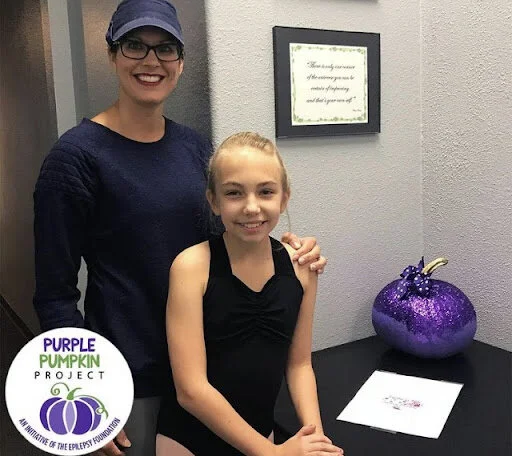
Photo of 11 year old Hanna and my studio’s administrator Alicia Peerson. Hanna had participated in the Epilepsy Foundation Kids Club’s “Purple Pumpkin Project” to spread awareness about epilepsy.

From Individual Coaching to Global Reach: Claudia Dean on Bolstering Positivity Worldwide
If you’ve ever searched “how to get a higher extension,” “how to break in pointe shoes,” or any other ballet-related question on YouTube, chances are you’ve come across a video by the incomparable Claudia Dean. Claudia Dean is undeniably a household name in the realm of online dance content. From private coaching to luxury dancewear to viral video tutorials, there seems to be nothing that the founder of Claudia Dean World can’t tackle. Claudia Dean World strives to “welcome dancers at any stage of their journey” and foster a positive community through global connection. But how exactly did the former Royal Ballet company member get here?
Claudia began dancing at age four because her best friend wanted her to join her class. She decided to stick with it and continue her training, eventually getting accepted into the Australian Ballet School’s Intra/Interstate & International Training Programme (ITP). After getting accepted into such a rigorous program, it occurred to Claudia that she might have a shot at making a career for herself in classical ballet. She continued dancing at her local studio, but around 14-15 years old she started training full-time on the Gold Coast of Australia, about two hours away from her home in Brisbane. “I was actually living away from home, which is a really good experience,” Claudia explains, as she learned how to cook, do laundry, and more all by herself at a young age.
By Madison Huizinga, DWC Blog Editor

Click below to shop the look:
Tracksuit Pants by Claudia Dean World | Cropped Hoodie by Claudia Dean World
If you’ve ever searched “how to get a higher extension,” “how to break in pointe shoes,” or any other ballet-related question on YouTube, chances are you’ve come across a video by the incomparable Claudia Dean. Claudia Dean is undeniably a household name in the realm of online dance content. From private coaching to luxury dancewear to viral video tutorials, there seems to be nothing that the founder of Claudia Dean World can’t tackle. Claudia Dean World strives to “welcome dancers at any stage of their journey” and foster a positive community through global connection. But how exactly did the former Royal Ballet company member get here?
Claudia began dancing at age four because her best friend wanted her to join her class. She decided to stick with it and continue her training, eventually getting accepted into the Australian Ballet School’s Intra/Interstate & International Training Programme (ITP). After getting accepted into such a rigorous program, it occurred to Claudia that she might have a shot at making a career for herself in classical ballet. She continued dancing at her local studio, but around 14-15 years old she started training full-time on the Gold Coast of Australia, about two hours away from her home in Brisbane. “I was actually living away from home, which is a really good experience,” Claudia explains, as she learned how to cook, do laundry, and more all by herself at a young age.
After a year and a half of training and competing at competitions like the Prix de Lausanne and the Alana Haines Australasian Awards, Claudia was accepted into the Royal Ballet School in London. She ended up graduating a year early and joining the Royal Ballet Company at age 17, where she got the opportunity to dance in coveted roles on the Royal Opera House stage. “It was sort of like a dream come true,” Claudia describes.

Click below to shop the look:
Sports Bra by Claudia Dean World | Bike Shorts by Claudia Dean World
And then Claudia had what she describes as a “light bulb moment.” “I’d been away for about six and a half years at this point,” she recalls. “I was missing home a fair bit and I found, as I was getting older, that homesickness for me was actually getting worse.” When she first joined the Royal Ballet School, she thought it was “the most exciting thing ever,” but later began contemplating what she was missing back home in Australia.
“I worked so hard and I’d done so many amazing roles at the Royal Ballet, I think I got to a point where I was a little bit burned out,” Claudia admits. “I got to this point where I was like ‘you know what, I feel like I’m destined to do something else now.’” Claudia retired from the Royal Ballet in 2014 and moved back to Australia.
Upon returning home, Claudia began working with her dad and brother in their real estate business where she got the opportunity to learn a lot about the inner workings of a company. “I kind of had a chance to get on my feet and be with my family,” she remembers. Then one day, an old ballet teacher called her up and asked if she was interested in teaching some of her students. Claudia was reluctant to accept, as she didn’t know if she would enjoy teaching, but decided to give it a try. After working with her first student, Claudia was hooked.
“I love passing on my knowledge and experience from the Royal Ballet but also…[providing] exercises and improving dancers,” Claudia says. “I didn’t have a natural facility for ballet so I was really passionate about dancers that also didn’t have a natural facility [and] making sure they know how to get better feet, get higher extensions, and all that stuff.”
Eager to add more personal coaching into her life, Claudia threw together a website and posted it on her Facebook page to see if anyone was interested in her coaching services. “My emails just blew up,” Claudia says. Eventually, she transitioned out of real estate work and shifted into personal coaching full-time in 2015, which is when Claudia Dean World launched.
“I’m really passionate about trying to help as many people as possible,” Claudia says. “Although I was coaching people one-on-one in the studio, I was like ‘how can I help other people that are in America or South Africa or Brazil.’” She recalls one of her coaching students, Talia Fidra, suggesting she make a YouTube channel to showcase dance tutorials and give tips that she gives in her one-on-one lessons. Claudia thought that this was a great idea, as she hadn’t seen many YouTube videos like that before.
Claudia’s first YouTube video was about how to master triple pirouettes. After 48 hours, the video amassed nearly 200,000 views. Claudia quickly realized that the information she could offer in these videos was incredibly valuable to so many people around the globe who were lacking it. She began posting weekly YouTube videos on a wide variety of technical topics and since then has gained over 250,000 subscribers and 133,000 followers on Instagram.

Click below to shop the look:
Tracksuit Pants by Claudia Dean World | Cropped Hoodie by Claudia Dean World
In addition to her coaching and video content on social media, Claudia Dean has lines of dancewear and activewear. A few years ago, Claudia was asking her followers what more they wanted to see from Claudia Dean World and many dancers said they would love for Claudia to try to make the “perfect leotard.” Intrigued, Claudia approached a bigger dancewear brand and inquired about a collaboration, but was rejected. “But I was still really passionate about doing it,” she shares. “So I went and sourced all my own fabrics, I found manufacturers, I found all the little silicon logos,” and more. Her first dancewear products came out in November 2017 and immediately took off. “They literally sold out in four minutes!” Claudia recalls. Today, Claudia Dean World’s dancewear is bigger than ever, selling thousands and thousands of garments each year. Keep an eye out for new releases coming soon, such as a new bag and four or five additional collections this year.
Through all the work Claudia does, but particularly through her coaching and video tutorials, she hopes to cultivate “a more positive approach to how children and even professionals are treated in the studio.” “I feel like there’s so many different ways you can say things to a child and [they] can be received so well [but can be] so damaging if they hear it in the wrong context,” Claudia says. She wants dancers to walk out of their studios feeling inspired and empowered, rather than discouraged.
Having access to the educational resources that Claudia Dean provides isn’t just useful; it has the potential to be transformative. Since its conception, Claudia Dean World has been geared towards helping individual dancers be the best they can be. Today, that sentiment still comes through, just on a global scale.
About the Author:
Interested in writing for the DWC Blog? Click below to fill out the DWC Contributor application!