
Envisioning Intersectional Feminism in the Dance Industry
What do you think of when you heard the word “feminism”? Perhaps you envision women protesting in the streets and outside government buildings. Maybe you picture historic milestones, like women…

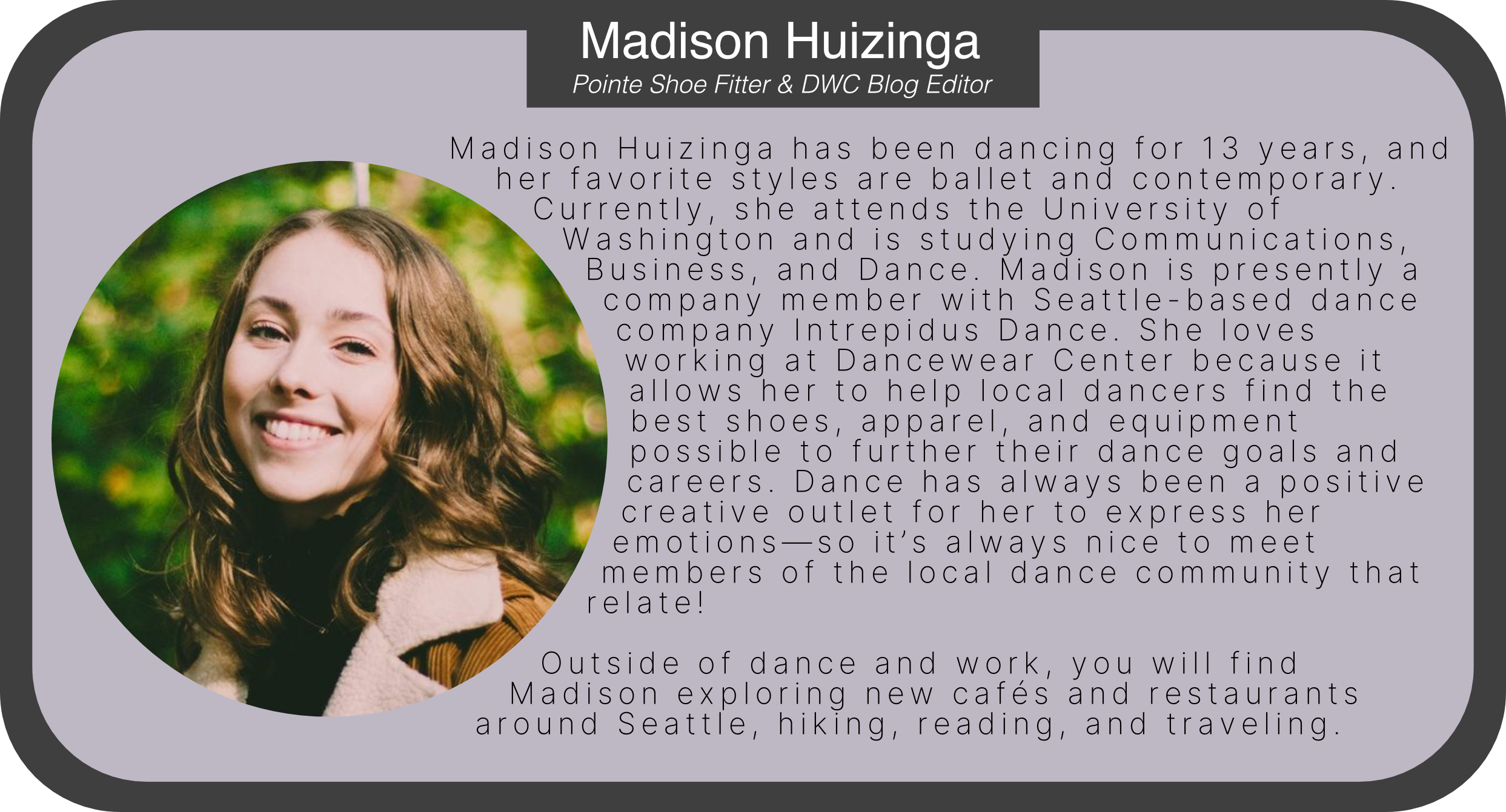
Madison Huizinga has been dancing for 13 years, and her favorite styles are ballet and contemporary. Currently, she attends the University of Washington and is studying Communications, Business, and Dance. Madison is presently a company member with Seattle-based dance company Intrepidus Dance. Dance has always been a positive creative outlet for her to express her emotions—so it’s always nice to meet members of the local dance community that relate!
Outside of dance and work, you will find Madison exploring new cafés and restaurants around Seattle, hiking, reading, and traveling.
By Madison Huizinga
What do you think of when you heard the word “feminism”? Perhaps you envision women protesting in the streets and outside government buildings. Maybe you picture historic milestones, like women receiving the right to vote with the ratification of the 19th amendment or Kamala Harris becoming the first female vice president of the United States. Some of you may even think of all of those promotional products companies produce for Women’s History Month, like form-fitting t-shirts that say “this is what a feminist looks like” in rhinestone letters. These different pictures of feminism proliferate throughout our culture and serve as models for what feminists should look like and stand for.
That being said, our general view of feminism in the U.S. tends to be pretty unitary. Most people assume that “doing feminism” requires breaking the “glass ceiling,” increasing female participation in male-dominated workspaces, and making women feel safer walking home at night. These are all admirable goals that feminists should strive to achieve. But while we work to achieve these aspirations, it’s important to consider whether all women’s lives are being advanced. For example, a major goal of the mainstream Western feminist movement is closing the gender pay gap. As of 2019, senior executive women earn approximately 84.6 cents for every dollar a man earns. However, this gap isn’t the same for all women. While white women earn around 82 cents for every dollar earned by a white man, Black women only earn about 65 cents for every dollar earned by a white man. For Latina women, the gap is even wider, as they on average earn about 58 cents for every dollar earned by a white man. In addition to considering what must be done to bring about gender equality, we should also ask if our efforts are serving all women.
These disparities are not just visible when analyzing the gender pay gap. When looking at nearly every industry, in every sector, there are disparities in discrimination based on women’s race, sexual orientation, ability, and every other facet of their social identities. While it can be useful to view the feminist movement as a completely unified campaign against sexist oppression, it can also cause disillusionment. When embarking on the journey to end patriarchal injustice, not all women are starting at the same place. Assuming that all women experience the same maltreatment is misguided. Rather, we must re-envision how we view and enact feminism in every space in our lives so that all women’s lives are progressed, not just a select, privileged few. To accomplish this, we must adopt intersectional feminism.
Intersectional feminism was coined by lawyer and civil rights advocate Kimberlé Crenshaw in 1989. Crenshaw introduced this term as a way to examine “overlapping, concurrent forms of oppression” to better understand the depths of inequalities in given contexts. Intersectional feminism acknowledges that the impact of various crises or inequities isn’t always the same, as our different marginalized identities interlock with one another to create unique challenges. In this way, “all inequality is not created equal,” according to Crenshaw. The impact of hardships like sexism won’t be the same for women of all ethnicities, ages, sexual orientations, religions, and nationalities.
Using an intersectional lens does not just apply to specific social justice movements. Such a framework can and should be applied to all areas of our lives, especially the dance industry. Many people assume that the dance industry is a female-dominated space, which is fairly accurate. However, while about 65.9% of ballerinas in the U.S. are white females, only about 2.27% of ballerinas are African American females. In professional companies around the world, white females dominate, while women of color hold far fewer spots. When women of color are depicted on stage, they are often presented in roles that are extremely racialized and stereotyped, such as the “Chinese Tea” or “Arabian Coffee” roles in The Nutcracker. Sometimes white women will even pretend to play women of color on stage, such as in the more extreme case of blackface in Bolshoi Ballet’s 2019 production of La Bayadère. Also, when women portray lead roles in ballets like The Sleeping Beauty and Swan Lake, their characters tend to be involved in romantic relationships with heterosexual men. Same-sex pairings are absent in nearly every popular ballet. And when we look at the body types that are presented on stage, they are almost always tall, thin bodies, as those are the only types of bodies that have been historically celebrated in the dance industry.
Sure, large strides have been made for diversity in the dance industry. Misty Copeland becoming the first female African American principal dancer at American Ballet Theatre is a huge milestone, as well as Charlotte Nebres becoming the first Black dancer to be cast as Marie in NYC Ballet’s The Nutcracker. Across the country, choreographers are re-imagining the traditional depictions of women in ballets and creating new works that uplift a wider array of girls and women. But the work can’t stop now. It’s not enough to look at a women-dominated industry and think that it’s somehow “achieved feminism” by simply having female participants. For this Women’s History Month and onwards, consider the ways your studio is depicting women of all races, sexual orientations, ages, and body types and hold your instructors accountable. We won’t truly eradicate sexist oppression until all women are treated with respect.
Here are some ways we can all practice intersectional feminism in the dance world:
Educate yourself and others
Conduct research on the ballets and other dance works you’re participating in. Consider who created the original choreography and how their biases may impact how different groups of women are portrayed on stage. Communicate the information you learn with those around you, whether that be through face-to-face communication or social media posts.
Be a good listener
Listen to the stories of those around you, particularly groups of dancers that possess social identities that are marginalized in American society. Do not dismiss or minimize their experiences and understand that you shouldn’t always do all of the talking.
Make a deliberate effort to not be isolated
Actively seek out the perspectives of dancers who possess different social identities than you and who dance in different communities than you. Find ways to interact and collaborate with them, either through viewing their dance works, co-choreographing a dance, or simply exchanging contact information and discussing your experiences in the dance world.
Be critical of the dances you view
When watching various dances, think critically about what you are watching and how it may be perceived by different individuals. Consider the changes you would make if you were a choreographer and how you will avoid reifying negative representations in your creations.
Provide constructive criticism to people in your dance community
If you are a dancer, talk with your studio owners and dance instructors about changes you would like to see in the curriculum, studio policies, and choreography. Point out the ways in which certain groups of women may be hurt by certain aspects of your studio’s culture and co-create solutions. If you are a studio owner or dance instructor, be open to feedback from your dancers on how to make your studio an equitable environment for all individuals.
Create your own work!
If there are stories out there that aren’t being told, find ways to tell them through dance! This could involve choreographing a new work on your own, revising an older production in a more appropriate way, or collaborating with other members of the dance community to bring important, untold stories to light.
The Khambatta Dance Company Director Shares Desires for Cross-Cultural Connectivity
Cyrus shares that the experience of two cultures coming together is important to him, as his father is Indian and his mother is white, making him a product of cross-cultural connection himself. Throughout their personal lives and careers, Cyrus’ parents have experienced and fought against racial discrimination. From witnessing his parents’ own experiences, as well as navigating the societal challenges of having a biracial identity, Cyrus has been inspired to elevate and celebrate diversity through dance as a means to heal the damages that injustices like racism have caused. “[It] inspires me when I see different cultures coming together,” Cyrus expresses, sharing that his primary desire is to bring unity through understanding in his work at Khambatta Dance Company and beyond.
Cyrus Khambatta On His Vision for a Networked Future
Name pronunciation: Sai-russ Kahm-baht-ta | Pronouns: he/him
By Madison Huizinga, DWC Blog Contributor

When encapsulated in their communities, with their noses to the grindstone, it can be easy for artists to silo themselves off. While bolstering artistry in one’s community is beneficial, many benefits can also be reaped from looking outside oneself and forming cross-cultural connections. This inclusivity- and community-oriented mindset is one that Cyrus Khambatta carries with him in his work as Executive Artistic Director of Khambatta Dance Company and the Seattle International Dance Festival.
Cyrus was introduced to art and movement at a young age, as his mother worked in theatre education. He took classes at Capitol Hill Arts Workshop in Washington, DC, where he trained early on in acrobatics, tap, and creative movement, among other styles. Cyrus developed a deep interest in physical theatre, specifically the intersection of dance and theatre, which he fostered while attending an alternative school. During his time at New York University, he participated in the Experimental Theater Wing, specifically the dance track, which featured a curriculum largely focused on physicality and self-creation.
With fellow students and peers on the dance track at NYU, Cyrus formed Phffft! Dance Theatre Company, which would later become Khambatta Dance Company. Having participated in largely self-directed educational programs throughout his schooling, Cyrus was confident that starting a company right after college was something he wanted to do. After graduating, the company mainly toured and performed around Europe and the east coast of the United States, including Spoleto Festival USA in Charleston, South Carolina. KDC also took part in a long-term residency in Venezuela for about three years.
After KDC moved to Seattle in 2001, Cyrus realized that dance was not being presented in a lot of venues like it was on the east coast and across Europe. “If [KDC] was going to be here, we would have to create our own environment,” he shares. Cyrus felt deeply inspired by the cross-cultural and cross-organizational connections made at the dance and arts festivals he participated in across different regions; this type of connection is ultimately what inspired the creation of the Seattle International Dance Festival.
Seattle International Dance Festival is a program born out of Khambatta Dance Company, aimed at hosting and inviting domestic and international dance companies to Seattle to present work. Cyrus is a board member and the main curator for SIDF but invites curators for various portions of the festival, such as Gonzaga University Dance Director Suzanne Ostersmith for the Spotlight on Seattle program of SIDF in 2022.
“As an artist, artist presenter, administrator, and company that oversees the festival, we have a great interest in seeing that dance is served in our community,” Cyrus says, speaking on the value of providing the geographically isolated Seattle dance community with a view into different dance scenes around the world.
Cyrus shares that the experience of two cultures coming together is important to him, as his father is Asian Indian and his mother is white, making him a product of cross-cultural connection himself. Throughout their personal lives and careers, Cyrus’ parents have experienced and fought against racial discrimination. From witnessing his parents’ own experiences, as well as navigating the societal challenges of having a biracial identity, Cyrus has been inspired to elevate and celebrate diversity through dance as a means to heal the damage racism has caused. “[It] inspires me when I see different cultures coming together,” Cyrus expresses, sharing that his primary desire is to bring unity through understanding in his work at Khambatta Dance Company and beyond.
Cyrus describes the leadership and creation process within Khambatta Dance Company as “collaborative” across the organization, including its artistic and administrative positions. The dancers all work together to create an abundance of material in a short period of time and the administrative staff comes together to identify areas of need to improve KDC and SIDF. This horizontal leadership format falls in tandem with the values the organization was founded on.
In addition, Cyrus takes pride in KDC’s presentation of split bill performances, as the organization finds value in presenting “a pluralistic view of art” as a way for creators and audiences to reflect on their life experiences and see broader worldviews.
Over the summer, Khambatta Dance Company performed at Blois Dance Festival in Blois, France, and did a two-week residency at Newport Dance Festival with Island Moving Company in Newport, Rhode Island. Along with Khambatta performing its own independent pieces, dancers from KDC and Island Moving Company got the opportunity to dance together in a piece choreographed by Cyrus for both companies.
In October 2022, Khambatta Dance Company is headed to Busan and Iksan, South Korea to perform. KDC has a partnership with a dance festival in South Korea and plans on working to bring artists back and forth between South Korea and the United States.

“We are looking at creating an international and national network where Seattle artists could tour some of the places that we have created relationships,” Cyrus says of the future of SIDF. He’s greatly interested in creating mechanisms that encourage the global exchange of dancers to better support Seattle artists’ touring funds, allow artists opportunities to expand their own audiences, as well as see art presented across different cultures. In his work, Cyrus appreciates utilizing a model that doesn’t just consider what will benefit one’s own community, but also neighboring communities.
“I’d like to see that artists become the ambassadors for culture, particularly in the United States,” Cyrus says. In addition, he encourages artists to foster their own community-oriented curiosity and turn their eyes toward art that they may think is pushing the envelope. In addition, he believes dancers should embolden themselves to “think a little bigger,” pushing themselves to stop considering how they must fit a pre-existing mold, in spite of the challenges that come along with that.
“I think dance artists really need to think about changing the mold,” Cyrus says.
Preparing Mentally, Emotionally & Physically for Aging in Dance and Transitioning Stages
As a young company dancer at Olympic Ballet Theater in the 1980’s, one of my favorite pieces I performed was “Fall” as a part of the Ballet Seasons. Now in my 50’s, I’m in a very different season of my life as a dancer. I’ve always loved fall–the season that teaches us that change can be beautiful.
What I’ve Learned from 50+ Years of Dance!
Pronunciation: La-Ree Ba-Lees | Pronouns: she/her
By Laurie Balise, DWC Ambassador

click to shop the look: girlfriend | GF Biketard
As a young company dancer at Olympic Ballet Theater in the 1980’s, one of my favorite pieces I performed was “Fall” as a part of the Ballet Seasons. Now in my 50’s, I’m in a very different season of my life as a dancer. I’ve always loved fall–the season that teaches us that change can be beautiful.
My life story thus far includes many different seasons, in both dance and otherwise, all of which I’ve tried to embrace. Each season has taught me something different that at now 53 has created wisdom. While there have been many successes and much happiness, I’ve also learned to deal with mistakes and disappointment, handling regrets, and practicing forgiveness. Often the greatest shifts and growth have come from re-addressing previous truths that came after life tragedies. My wisdom has taught me that everything in life, whether positive or negative, or significant or seemingly not, has value. Personal reflection is so important, and implementing new ideas or goals, yet still allowing yourself to dream. I likewise believe in teaching my dancers to be adaptable, disciplined, hard working, resilient and tenacious in all they do. Dance teaches us SO much more on our life path at times than just dance, and I’m grateful for all the lessons along the way.
Something I’ve also considered as I’ve aged is wanting to assure I’ve created a positive impact on the world. Whereas in my youth I was primarily a performer, transitioning to teaching gave me even greater purpose. Before teaching I incorporated the arts and dance into my academics in college with an internship at Pacific NW Ballet in their Public Relations Department and later was the Publicist for the Seattle Symphony. I have more avenues to explore, but I’ve also found peace and felt pride and satisfaction with what I’ve accomplished thus far. I think positive self validation is really important always, but especially as we get older-we don’t have to continually prove ourselves as dancers, or otherwise. What I hope to have passed along as a teacher and be remembered for is that I truly cared; that I challenged myself and others both creatively and in physical abilities and technique; that I showed my students how to have fun even when working hard; and that believing in themselves is always most important. I love connecting with others in our shared humanity which has been a big part of my purpose. I think it’s important to identify the why? as well and once we have, better align ourselves with our purpose. Progress and growth is always important, but sometimes it also includes rest or reinvention. There’s no particular ‘standard’ we have to meet to be dancers either- no right or wrong. Nor do we have to be doing certain things like performing or even teaching to still be viable in our art form and make a contribution. There are so many options for how we can incorporate dance into our lives that are meaningful and joyous. I love just dancing around the world or taking classes whenever I’m traveling. For many years I’ve also helped in volunteer positions judging the dance category in art competitions, assisting with high school dance team tryouts, producing and choreographing school musicals, and representing the arts at student career fairs.

click to shop the look:
Jule meshie crop top | CD World grey/black sports bra | SoDanca Black Shorts
Sometimes rest or change is something we resist though until life throws us a prominent “stoplight!’ There are always indicators around us if we are present enough to pay attention, and sometimes an opportunity we hadn’t considered becomes a wonderful transition to a new chapter. The Universe sent me a message recently to listen to my gut, literally. It led me to health tests that revealed a gut disorder most likely brought on from years of cumulative stressors and past traumas. As dancers and artists, we of course are quite empathic and feel everything deeply. Additionally, we hold ourselves to high standards and push ourselves in all ways. And after so many years of being in front of people, no matter what level of confidence or mastery we have, we can still get anxiety and butterflies in our stomach. Practicing greater self care and managing stress including both physical and mental health has been a big priority for me especially in this latest season of my life. The gift in awareness was that I was able to bring its importance into my professional life as well by offering mindfulness and meditation classes for my dancers, as well as teaching yoga to both kids and adults.
In more recent years, I’ve really tried to start leaning more into my wisdom and intuition, giving myself more permission to say “no” when necessary to find greater balance in my life. I think this is such a great practice for dancers or anyone. Sometimes things are just too much at times, and when we ease off and take a few steps back we can actually proceed forward with greater care. We don’t always have to be “on'' and available to everyone either. We’re already so exposed as performers and teachers, and it’s okay to not have to always be front and center. Using this skill, I try to step back when I teach for instance so my dancers can let themselves be their own focus.
I may be getting older- everyone is! But I’ve found acceptance in that and all the undeniable things my body has gone through as a mother and otherwise. In this way I practice non-resistance to the things I can’t change. That said, I still don’t need to be limited by or defined by my body or age in my strengths or abilities throughout any of the seasons of my life either. In many ways I know my body has been stronger the older I’ve gotten. When we truly love ourselves, our body responds positively in a homeostasis in our mind, body, and soul. As a dancer and most importantly a human being, I am always viable in what I have to offer and in any capacity that I may find myself in. This is what keeps me going and growing, always, and staying positive and allows the freedom and ease of transformation to occur, in dance or otherwise.
If we think of ourselves as being in constant creation then we are in a revolutionary process of reinventing ourselves throughout life. Growth is a choice we can make over stagnation. The more we move in all ways,, the more we find opportunities to stimulate our brains and bodies in new exploratory ways. This can help us defy the aging process just by the natural occurrence of our choices and actions. You are confined only by the walls you build yourself; the opposite of courage is not cowardice, it’s conformity.
Just like there are several positions in dance that we flow through from first to fifth, we move through different points in our relationship with dance in each new season. Each is beautifully unique for what it offers us in experiences and memories and grows us in different ways. When holding a pose in dance, we still remain alive and breathing before transitioning into the next step, just like through the stages of our lives. So may we all Temps lié, Chassé or Pas de Bourrée into our next position in life and embrace whatever it may be! Ultimately as we know, life itself is truly a dance!

“You can have as much ballet or dance as you want in your life. You can have a lot or a little bit, or somewhere in-between,” said Miko Fogarty, the star of the 2012 dance documentary First Position who herself has found different directions in life beyond dance.
About the Author

Disclaimer
All content found on the Dancewear Center Website, Instagram, Facebook, Pinterest, and all other relevant social media platforms including: text, images, audio, or other formats were created for informational purposes only. Offerings for continuing education credits are clearly identified and the appropriate target audience is identified. The Content is not intended to be a substitute for professional medical advice, diagnosis, or treatment. Always seek the advice of your physician or other qualified health provider with any questions you may have regarding a medical condition. Never disregard professional medical advice or delay in seeking it because of something you have read on this Website.
If you think you may have a medical emergency, call your doctor, go to the emergency department, or call 911 immediately. Dancewear Center does not recommend or endorse any specific tests, physicians, products, procedures, opinions, or other information that may be mentioned on dancewearcenter.net. Reliance on any information provided by dancewearcenter.net, Dancewear Center employees, contracted writers, or medical professionals presenting content for publication to Dancewear Center is solely at your own risk.
Links to educational content not created by Dancewear Center are taken at your own risk. Dancewear Center is not responsible for the claims of external websites and education companies.
Interested in writing for the DWC Blog? Click below to fill out the DWC Contributor application!