
Korean Folktales in Contemporary Dance
Asian American and Pacific Islander Heritage month is in full swing. This month is here to celebrate and recognize the contributions and influence that Asian Americans and Pacific Islander Americans have on the culture in our society. We got the chance to have blog contributor MiYoung Margolis share a story about a Korean folktale that influenced her choreography for her dance company. Read on to learn more about MiYoung’s piece and to learn more about Korean culture!
By Nicole Barrett, DWC Blog Editor & MiYoung Margolis
Asian American and Pacific Islander Heritage month is in full swing. This month is here to celebrate and recognize the contributions and influence that Asian Americans and Pacific Islander Americans have on the culture in our society. We got the chance to have blog contributor MiYoung Margolis share a story about a Korean folktale that influenced her choreography for her dance company. Read on to learn more about MiYoung’s piece and to learn more about Korean culture!
MiYoung Margolis: “I have presented the original Contemporary Korean Fusion pieces inspired by Korean folktales.
Once again, I would love to talk about “One World” through the Korean Contemporary fusion dance piece since I deeply feel that is what we all need especially after the pandemic.
To me, living in this one world together means ‘Love’. And as we all know, love is all you need.
Embracing our unique heritage, while celebrating our common life journey. Though we all come from different backgrounds, We can come together to create a beautiful performance.
In my choreography, I enjoy blending Eastern to Western and Western to Eastern. To create a fusion of cultures and a performance we can all connect to.I am proud to present an original Contemporary Korean Fusion piece that once again draws from my Korean Heritage
and borrows from another Korean folktale:

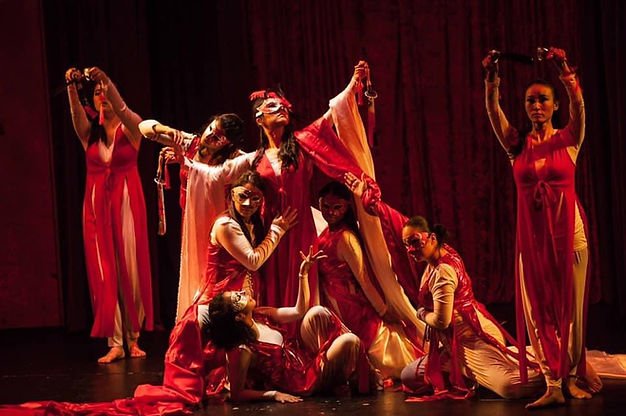
Photo courtesy of www.miyoungmargolis.com
The tragic love story of So-Hwa, A Court Lady, who’s unreturned love for the king, left her waiting forever and dying alone. Her remains transformed into the imaginary flower, the “Trumpet Creeper” which to this day, still waits for the king’s return. This story is told by a diverse cast of extremely talented dancers for the screen dance film version. Kang-He and Christie are professional Korean dancers. Parmida is a professional dancer from Iran, with incredible upper-body movement and control. And the amazing Tatiana with her legendary High Kick and professional ballet and contemporary dance background.
I am so glad to be able to bring these dancers together to tell So-Hwa’s story.”
MiYoung performed this piece on May 21st at ACES: Artists of Color Expo & Symposium. We are so happy to have MiYoung share the wonderful story behind her amazing performance! Keep an eye out for more information on future performances on her instagram here! MMDC performs again May 28th at PRIDEASIA.
Sources:

The Division of Self, the Division of Identity
How we are defined is important. It helps tell the world our values, our morals, and our interests. But who makes that definition? Do we set the parameters ourselves by means that we dictate? Or is it determined by our background, heritage, and childhood?
As with most things in life, I suspect it’s a little of everything. There are factors we cannot control that play insurmountably in how we are viewed, including skin color, eye shape, and our parent’s socio-economic status. But there are other things that ebb and flow with our own desires like our morals, our interests, and the places we go. And then there are things that just happen, random events that you may not even realize are significant until ten years later when you look back at your life and realize that one seemingly meaningless decision, event, or person, changes the trajectory of your whole life.
Trigger Warning: Racial Slurs Used in Context, Mental Health
By Ethan Rome, DWC Director of Marketing

How we are defined is important. It helps tell the world our values, our morals, and our interests. But who makes that definition? Do we set the parameters ourselves by means that we dictate? Or is it determined by our background, heritage, and childhood?
As with most things in life, I suspect it’s a little of everything. There are factors we cannot control that play insurmountably in how we are viewed, including skin color, eye shape, and our parent’s socio-economic status. But there are other things that ebb and flow with our own desires like our morals, our interests, and the places we go. And then there are things that just happen, random events that you may not even realize are significant until ten years later when you look back at your life and realize that one seemingly meaningless decision, event, or person, changes the trajectory of your whole life.
Looking back at these things in my own life, it’s easy to point out why I made certain decisions. However, in those moments, there is no way I could have known why. As most people do, I make decisions in the present based on factors that I think I have set. But ten years from now, I’m certain I will realize that it could not have been any other way. We could go on for days dissecting every detail, but today I want to focus on a particular one. In light of Asian American and Pacific Islander Heritage Month, I want to speak about one of the most prominent factors that has created a division in my own self.
I am half Korean and half Scandinavian. Which in my life has meant I am not enough of anything to anyone. Everyone sees me as an “other.” I cannot count the number of times a White person has asked me, “so are you Chinese or something?” Or the number of times an Asian person simply won’t speak to me until I’m able to gently assert my own Asian-ness (by somehow slipping it into the dead conversation, or saying “thank you” in Korean). Or the number of times someone of any race has said “so what are you?” I have been called both “chink-eyes” and “the white boy.” Growing up, I can only remember having one mixed-race friend and recall often wishing I could “just be normal.” There was a period of my life when I tried to pass (as singularly White). People would ask me, “So what are you?” I would reply “I’m normal, you know White.” I can confidently say now that White does not equal “normal.” There is nothing wrong with being White, but we can’t allow it to be the standard to which all other races must be compared. You are not irregular or weird because of your skin tone, culture, or ethnicity.
Everywhere I go, I feel left out or pushed aside by the people that I feel look like me or think like me. Feelings of dismissal and ostracization can lead to serious disorders. Studies have shown that people of mixed race “were the most likely to screen positive or at-risk for alcohol/substance use disorders, anxiety, depression, eating disorders, and psychosis” (Imposter Syndrome in Multiracial Individuals). Because of this, I have always longed for a community that I felt I belonged to, but that also one that wanted me.

Due to this longing for community I have always tried new clubs, sports and activities. When I went to college, I was still searching for that sense of belonging. Therefore, I searched through the college club directory and decided to try breaking (or breakdancing). The intensity and uniqueness of breaking was reminiscent of watching Bruce Lee, one of the few male Asian icons in American culture. I saw something of myself in those bboys. Thus began my dance journey.
The breakers, and breaking in general, were very welcoming. They themselves came from all kinds of backgrounds, some grew up breaking, some only started a year ago, most were self-taught, all of them were glad to teach what they knew and have a conversation. This was likely aided by the fact that they were all so different from each other, dancers were Asian, Pacific Islander, Middle Eastern, White, Black, and Hispanic. It was possibly the most diverse group on campus in terms of race/ethnicity. During this time, my feelings of unease or dismissal subsided, it does not matter what you look like when everyone looks different from the person standing next to them. However, being mixed raced is a unique beast that may slumber, but never dies.
During my time as a bboy, I also started to take classes in the Dance Department, ballet and modern specifically. Entering into the Dance Department came with the shock of the technical details of classical dance, as well as the fact that I was pretty much the only Asian person in the department, and one of the few people of color. I was suddenly back to being an “other.” Dancers are largely open-minded and accepting people. But even well-intentioned people might not notice their microaggressions, or don’t understand why calling me a “ninja” is maybe not the compliment they think it is (ninja are Japanese, I’m Korean, ninja were also often viewed as individuals without honor, assassins sent to do the dirty work and were shunned for completing the tasks given to them). My newfound passion in modern created the next division of my identity. Was I a breaker, or was I a modern dancer? For many reasons I chose to finish my degree in dance, and attempt a career as a “modern dancer.”
Moving to Seattle was a significant change in many ways, and it too was just a random event that happened to happen. Living in Seattle opened the door of contemporary dance. Contemporary has its own confusing and mixed background. Did it come from the lyrical/contemporary world? Did it come from the contemporary ballet world? Is it neither? Is it both? Perhaps it's because of this ambiguity that I became so enamored with it. It is almost a blank canvas, to be determined and designed by me. It is a place where I can express myself fully. I can utilize my classical training, I can incorporate my breaking origin. There is no one to tell me what I am or can do as a contemporary artist. I can use my art to express any idea I want such as my Korean heritage.
This piece was created in response to the recent outbreak of anti-Asian hatred
After moving here I also started to feel that I wasn’t quite as much of an outsider. They are still relatively few, but I have met more Hapa (a Hawaiian word meaning “half,” it has been co-opted by the half/mixed-Asian community and has its own controversy behind it) here than in the rest of my life combined. It has been wonderful to connect with others like me and to learn that I was not alone. I do not think the answer to solving this problem is simply to have more mixed raced babies, in fact, that too can be problematic; “We could have such beautiful babies'' is a terrible thing to say, reduces someone to their race, a singular part of their identity, and tokenizes certain races. It’s another example of a micro-aggression and how people often don’t understand that their “compliment” is actually quite demeaning.
So what can we do?
You can help by taking a moment to put yourself in someone else’s shoes. Your compliment may be an insult to someone else (one man’s trash…). Do they understand that you meant to compliment them? Do you understand the cultural context you might be implying? Allow others to be themselves, accept them for who they are and let them demonstrate to you how they wish to be treated. Authentic representation also tells people they matter and shows them they are not alone. If you are multi-racial, then be yourself! If it is a part of you, don’t try to hide it, it very likely won’t work anyway.
If you feel you are an “other” I encourage you to take a deep breath, you are not alone. It may take time, it may be painful, but you can find ways to connect if you keep pushing yourself. Remove yourself from your ego, from notions of who you or other people think you need to be or should accomplish. Do not be afraid to enjoy something simply because other people look down on you for it, they probably just don’t understand it well enough. Your community might not look the way you envision it now, in fact, it is very likely to look entirely different, but it is out there. Alan Watts once said, “So don't worry too much, somebody's interested in everything. And anything you can be interested in, you'll find others will.”

Looking back at it now I see that there was really no other way, I was never going to fully be a bboy, I was never going to fully be a modern dancer; I will never be fully Asian nor fully White, I always have and always will be split. But that is not necessarily a bad thing. I am more empathic, more understanding, and more accepting because of it. And I am a significantly more unique artist because of it. I learned to see the strengths of my divisions. My only regret was how long I tried to hide and failed to see how my uniqueness can define my positive attributes as well as the negatives.
Looking back at it now I am grateful for my own confusing and mixed background.
Fostering Creative Collaboration Across Genres
The COVID-19 pandemic has posed more challenges than benefits for most peoples’ lives. However, in unique and unexpected ways, this time of isolation and solace has allowed people to re-connect with creative parts of themselves and explore ventures they’ve always wanted to. For MiYoung Margolis, MiYoung Margolis Dance Collective or MMDC was born out of the rubbles of the COVID-19 pandemic as a way to foster creativity and collaboration across genres.
MiYoung Margolis on the Origins of MMDC
By Madison Huizinga, DWC Blog Editor

Photo courtesy of www.miyoungmargolis.com
The COVID-19 pandemic has posed more challenges than benefits for most peoples’ lives. However, in unique and unexpected ways, this time of isolation and solace has allowed people to re-connect with creative parts of themselves and explore ventures they’ve always wanted to. For MiYoung Margolis, MiYoung Margolis Dance Collective or MMDC was born out of the rubbles of the COVID-19 pandemic as a way to foster creativity and collaboration across genres.
MiYoung shares that for her entire life, dance has been a core part of who she is. She has experience mostly training in ballet and Martha Graham’s modern technique. She also trained in traditional Korean dance styles when studying for her undergraduate degree from Korea National Sport University in Seoul, South Korea. As a student, MiYoung got the opportunity to travel abroad and perform internationally. Dance also had a big influence on her outside of the classroom, as she sought out other styles like salsa. Education is another one of MiYoung’s passions, as she has a master’s degree in the subject.
In 2005, MiYoung relocated to Seattle where she worked with local cultural organizations, organizing festivals and events. She threw herself into her work and greatly enjoyed it, confessing that she became a bit of a “workoholic.” “It was an awesome experience,” she says. MiYoung also taught ballet and salsa in the community. Her husband, Jeffrey Margolis, introduced her to tango, which the two danced at their wedding.
After 12 years of living, working, and teaching in Seattle, MiYoung realized that she missed dancing on stage in group pieces. “I missed that type of group dance [where you] breathe together, practice together, and torture each other,” MiYoung laughs.
Recently, MiYoung and her husband have opened up a Seattle art gallery known as B612 that also holds a dance studio space, as well as a Korean language and culture learning center. The gallery also contains a photo studio and an event space that is available to rent. MiYoung says she feels “extremely fortunate” to be able to open up this space with her husband and have it as a space for her company to rehearse. The rehearsal space itself was a jumping off point for MiYoung to begin MMDC.
MMDC was born out of a desire to create during the pandemic. MiYoung says that in addition to the challenges 2020 presented, the difficult year also allowed her the chance to re-awaken a creative side of herself that had been dormant. In addition, MiYoung’s gallery granted her the space to “gather and organize a team of strong, willing dancers who were open-minded enough to take a chance on her choreography and unique style.” She feels grateful to have a “large collection of extremely talented dancers, each with their own unique capabilities” within MMDC. In her choreography, MiYoung seeks to express her creative vision, but also collaborate with performers based on their strengths.
Within the company, there are about 12 dancers and counting. The dancers within the collective come from different backgrounds and regions of the country and globe, making it a dynamic group that is constantly learning from one another.
Rather than channeling all of her energy into one dance piece, MiYoung desires to create various dance projects containing different stories. So far, the dance collective has created nine dance works. “My dance style is not usual, because I try to [include] a fusion [of styles],” MiYoung shares. She also expresses her infatuation with choreographing specific storylines, similar to operas. MiYoung greatly connects to song lyrics throughout her choreography and particularly enjoys choreographing love stories.
During the pandemic, MMDC has filmed its dance works outside in light of social distancing protocol. MiYoung commends her dancers for persevering during the filming sessions, sharing that many had to endure cold winter conditions and “pouring down rain.” MiYoung laughs that the less favorable Seattle weather simply added to the drama of the dances.
MiYoung shares that MMDC has turned its attention back towards choreographing for the stage. Last summer, the company had a chance to perform on an outdoor stage at the Asia Pacific Cultural Center in Tacoma, WA. “It was a celebration of the Korean harvest festival, so it was well-connected to my background,” MiYoung shares.
In 2022, MMDC has a full schedule of live performances scheduled, in secure venues that will check for COVID vaccinations and/or negative COVID tests. On January 9, 2022, MMDC kicked off its first performance of the year at the Federal Way Performing Arts and Events Center that is a celebration of Korean American culture. The performance documented a timeline of Korean music trends through the decades in collaboration with other dance artists, from showcasing disco styles in the 70s to honoring the popular Korean girl group Wonder Girls in the 2000s.
On February 19th, MMDC celebrated the Lunar New Year through dance with a community celebration. In May, MMDC is planning to dance in the Seattle Center Armory alongside various Asian American and Pacific Islander organizations. In June, MiYoung plans to showcase a piece at the Seattle International Dance Festival. She was planning to show her work at the SIDF in 2020; however, it was postponed due to the COVID-19 pandemic. Needless to say, MiYoung is eager to share her dance creations with the public after a long wait. Througout the summer, MMDC will likely participate in other festivals, so keep an eye out for those announcements.
In November 2022, MMDC will put on its own company show at Broadway Performance Hall in Capitol Hill, Seattle. In addition to showcasing MMDC’s work, MiYoung is also interested in involving child dancers in the showcase. “I love to give some of our young dancers in Seattle some opportunities,” she says. She is currently looking for studios that are interested in participating.
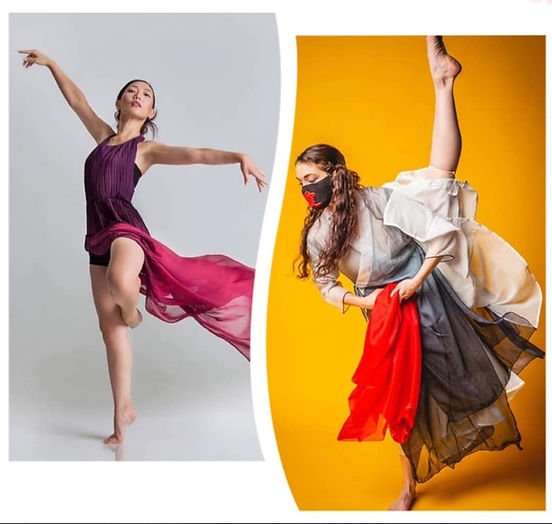
Moving forward, MiYoung looks forward to bringing in different instructors to teach different dance genres to MMDC. In the local dance community, she hopes to see more collaboration across dance genres and among dance artists. She believes that there are more similarities than people often recognize throughout different dance genres. “I just don’t want [us] to be against each other,” MiYoung says. Dancers learning to step out of their comfort zones and learn more about each other have the potential to create waves of creative impact.
Check out MMDC in action at the 2021 Duo Dance Festival in Seoul here.
Interested in writing for the DWC Blog? Click below to fill out the DWC Contributor application!