
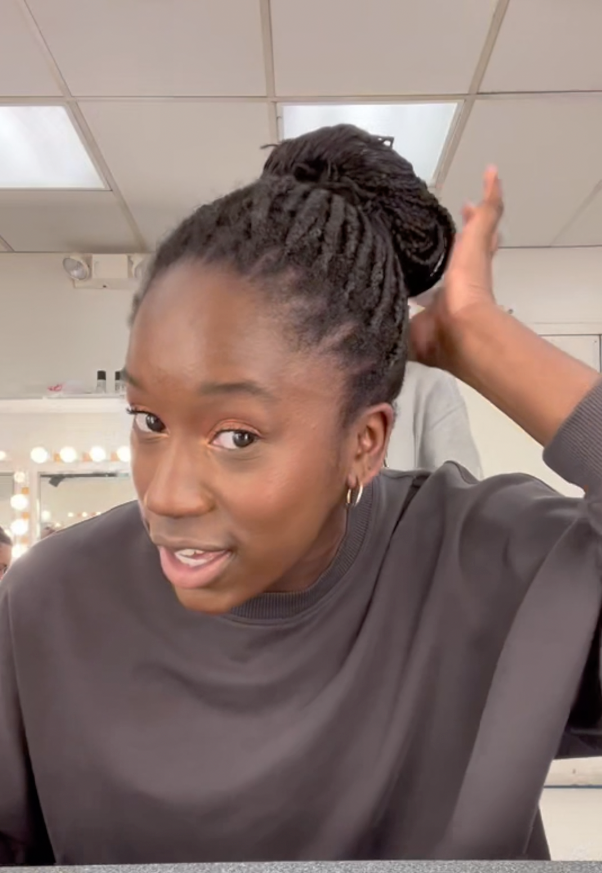
How to do a Ballet Bun with Braids
Dancers come in all different shapes and sizes, and hair is no exception. All different types of hair from textured to straight are thrown into ballet buns every single day, but sometimes it can be a struggle to find the right way to put up your hair. Former DWC Ambassador Niyah Pratt is here to show you just how you can do it! Here is how to do a ballet bun with braids:
By Niyah Pratt, Former DWC Ambassador
Dancers come in all different shapes and sizes, and hair is no exception. All different types of hair from textured to straight are thrown into ballet buns every single day, but sometimes it can be a struggle to find the right way to put up your hair. Former DWC Ambassador Niyah Pratt is here to show you just how you can do it! Here is how to do a ballet bun with braids:
First, flip your head over and gather all of your hair to the top of your head.
Secure it up into a ponytail with a hair tie.
After you have the ponytail in, you are going to start a twisting motion to gather all of the hair and begin to wrap the hair around the top of the ponytail.
Once all of the hair is gently wrapped around the top of the ponytail, use another hair tie to wrap it all into place.
Lastly, secure any loose pieces with bobby pins and then you have a gorgeous ballet bun!
We hope that this quick how-to helped you learn to do a ballet bun with braids! Be sure to check out the video below for a more in-depth description!
About the author:

by niyah pratt
Niyah Pratt was born in raised in Renton, Washington. She began dancing at age six, at the British Dancing Academy where she trained in ballet, jazz, tap, and modern. She is currently attending the University of Nevada Las Vegas where she is double majoring in Dance Performance and Urban Affairs. She hopes to continue her dance career for as long as she possibly can, and make an impact not only in the dance community, but on the youth as well. She wants to be the role model she never had when she started dancing for someone else, and “thinks it is important to start implementing this in dance.”
click to shop the look: Holly Leo with Mod Dot by Ainsley Wear
Disclaimer
All content found on the Dancewear Center Website, Instagram, Facebook, Pinterest, and all other relevant social media platforms including: text, images, audio, or other formats were created for informational purposes only. Offerings for continuing education credits are clearly identified and the appropriate target audience is identified. The Content is not intended to be a substitute for professional medical advice, diagnosis, or treatment. Always seek the advice of your physician or other qualified health provider with any questions you may have regarding a medical condition. Never disregard professional medical advice or delay in seeking it because of something you have read on this Website.
If you think you may have a medical emergency, call your doctor, go to the emergency department, or call 911 immediately. Dancewear Center does not recommend or endorse any specific tests, physicians, products, procedures, opinions, or other information that may be mentioned on dancewearcenter.net. Reliance on any information provided by dancewearcenter.net, Dancewear Center employees, contracted writers, or medical professionals presenting content for publication to Dancewear Center is solely at your own risk.
Links to educational content not created by Dancewear Center are taken at your own risk. Dancewear Center is not responsible for the claims of external websites and education companies.
Seeing Color in the Dance Industry
It’s safe to say that most of us didn’t anticipate the first half of 2020 to go the way it has. Our lives have changed drastically in the past few months, some more than others. Not only has the COVID-19 pandemic modified nearly all aspects of our daily routines, but a national movement supporting black lives and opposing police brutality has ignited. The heartbreaking murder of George Floyd in Minneapolis has stirred global attention towards police brutality and racial inequity in America. There have been protests in solidarity with George Floyd in all 50 states and at least 40 additional countries on nearly every continent. Anger towards this grueling act of police brutality has transformed into a larger revolution against systemic racism that’s gone on for too long in the United States.
This piece was originally written in 2020 and has been reposted in February 2023.
By Madison Huizinga, DWC Blog Editor
It’s safe to say that most of us didn’t anticipate the first half of 2020 to go the way it has. Our lives have changed drastically in the past few months, some more than others. Not only has the COVID-19 pandemic modified nearly all aspects of our daily routines, but a national movement supporting black lives and opposing police brutality has ignited. The heartbreaking murder of George Floyd in Minneapolis has stirred global attention towards police brutality and racial inequity in America. There have been protests in solidarity with George Floyd in all 50 states and at least 40 additional countries on nearly every continent. Anger towards this grueling act of police brutality has transformed into a larger revolution against systemic racism that’s gone on for too long in the United States.
As we partake in protests, sign petitions, and watch riots unfold on television, many of us are contemplative of our position in this movement and greater society. And in light of social distancing, many of us are in close quarters with family members and roommates who may disagree with the demonstrations developing throughout the country. This can result in some uncomfortable conversations that some people may have never had before, especially among white people.
As a white person who grew up in a white family, race is an aspect of my identity I have never needed to consciously consider. I expect to see people who look like me on my favorite TV shows. I expect to purchase a foundation that matches my skin tone at the mall. I expect to learn how historical figures with my racial identity founded America in history class. I can walk around my community confidently knowing that nothing adverse will happen to me solely because of my race. I feel seen and heard wherever I go because I have learned that being white means being the default. And I have been taught to think that this is valid.
When it comes to discussions about race at my family dinner table and within the walls of my classrooms, I am often told that all people are the same regardless of their skin color. I am told that to push for justice, we must simply view all people equally to achieve equality within social systems and institutions. Throughout my education and upbringing, I have been taught to be “color blind,” which may sound beneficial in theory. But being blind to racial difference means ignoring white privilege and the disadvantages others have because of it. Choosing to be “color blind,” means choosing to ignore the flawed systems that white people benefit from at the expense of people of color’s rights. It means choosing to be blind to systemic oppression, and thus indifferent and complacent to the suffering of black people. It’s time that I, and white people everywhere, open their eyes.

Niyah Pratt, DWC Ambassador
Now is a more important time than ever to listen and learn about the systemic racism that’s embedded in the world we live in. It’s time that we identify how racism not only withholds power from people of color but actively contributes to white people’s success. This does not mean denying the existence of white privilege but utilizing privilege to amplify anti-racist sentiment. This does not just involve taking a stand during a moment of tragedy but constantly analyzing the systems we are a part of and understanding how prejudice is woven into their fabrics. For many of us, this means turning to the dance industry.
As a white woman, I see dancers who look like me strewn throughout the dance community. I constantly see my identity presented through the types of stories told on stage, as well as through the types of dancers telling those stories. In the United States, about 67% of dancers and choreographers are white, while only 16.6% are black. Like all art, dance is meant to express emotions, transport audiences to different worlds, and explore unique narratives. However, when the majority of these narratives are choreographed and performed by white people, it can be difficult for people of color to feel as represented on stage. When white people make up two-thirds of the American dance industry, we cannot expect dance to be a comprehensive art form that communicates widely shared anecdotes. We cannot expect people of color to feel as accepted in the dance community if they aren’t represented across every area of the industry.
Niyah Pratt is a black dancer who has trained in the greater Seattle area since she was six years old. She’s performed at numerous showcases, attended conventions across the west coast, and has even spent a summer dancing at Debbie Allen Dance Academy. Today she studies dance at the University of Nevada, Las Vegas. While dance currently plays a paramount role in Niyah’s life, she hasn’t always felt embraced by the dance community throughout her childhood. Niyah says that “it has always been hard being an African American pursuing dance,” largely because she rarely saw people within her classes and acclaimed companies that looked like her. Niyah recalls that she “didn’t fully know that there were companies other than Alvin Ailey that were started and ran by African Americans until [she] was sixteen.” It wasn’t until she attended a summer intensive at the Debbie Allen Dance Academy that she began learning about the history of African Americans in dance. Before that, her view of the dance world was skewed towards white dancers and their contributions.
Niyah notes that growing up she was “one of four African American dancers” at her studio, and often felt singled out as a result. She has attended ballet auditions in which she is the “only person of color in the whole building.” Niyah “never forgets walking into a room and every girl looking exactly the same except for [her].” She says that from her own experiences “having a darker complexion while dancing is mentally challenging.” Being surrounded by solely white dancers can instill imposter syndrome in many black dancers, otherwise known as a lack of belonging. Not feeling seen, accepted, and represented within the dance industry can easily deter many people of color from pursuing a career in dance, as they may feel that they aren’t talented or qualified enough to belong in the industry because of their race.
According to Niyah, being a black dancer is not only mentally challenging but “it’s physical as well” due to the lack of costuming options for black dancers. Niyah says that “anything skin-toned or with mesh” often makes black dancers “feel uncomfortable” because “they are made for someone ‘fair toned.’” Especially when it comes to shopping for tights, black dancers often struggle to find anything close to matching their skin tone. Niyah recounts a vivid memory of a faculty show in college, in which her ballet teacher requested to speak with her in the hallway and asked “why [she] didn’t have skin-colored tights or pointe shoes.” Niyah was extremely confused because she was wearing tights and shoes that were marketed and labeled as “skin tone,” even though they were much lighter than her complexion. Niyah’s teacher told her that “when you have darker skin, you are supposed to wear your tone of tights and shoes when you perform.” Niyah was surprised that no one had ever told her that. This a conversation that a white dancer would never need to have. As a white dancer myself, I can purchase “skin toned” tights and shoes at any store and expect them to resemble my skin tone. But for black dancers, this simply isn’t the case because “skin tone” is synonymous with “white” across the dance industry and society.
Despite the challenges Niyah has faced in the dance industry, she notes that there “has been significant progress” and she is “ecstatic seeing [the industry] evolve.” She has noticed that in recent years more dancers of color and dancers of different shapes and sizes have gained attention. While it’s certainly inspiring to see individual performers like Misty Copeland gain recognition for their talents, a large-level change is needed so that seeing black dancers in the spotlight becomes a standard and not an anomaly. What Niyah wishes to see across dance communities is “inclusion” and dance that “is taught for anyone and everyone.” This means telling stories through dance that are relevant to people of color. This means seeing black dancers in lead roles that are complex and powerful, rather than vilified, racialized, or minimized. This means creating nude leotards, tights, and pointe shoes that don’t just match a pale skin tone, but compliment dancers of all races. It’s about a complete metamorphosis of the dance industry on every level. In the words of Niyah Pratt, dance “is already so beautiful, diversity is the only thing keeping it from being stunning.”
The past few months have presented challenges that many of us may have never foreseen. But we have the opportunity to move forward with a more compassionate and critical outlook on the world. We have the chance to not let this movement be a moment in time, but a catalyst for change. It is never too late to break the silence to provide support for black lives today and forever. Here are some ways to get started:
Educate yourself:
Learn more about the history of racism in America, and more about how black identity is widely perceived in institutions. This is an essential way to understand the meaning behind the large injustices that take place throughout the United States.
Here are some books to read to learn more about the experiences of black people and how to have productive conversations about racial identity:
The New Jim Crowe: Mass Incarceration in the Age of Colorblindness by Michelle Alexander
We Were Eight Years in Power: An American Tragedy by Ta-Nehisi Coates
Here are some documentaries, films, and series that incapsulate the experiences of black people in the United States:
13th on Netflix and YouTube
When They See Us on Netflix
Moonlight
Dear White People on Netflix
The African Americans: Many Rivers to Cross
Consume and support art from black artists
There is a plethora of beautiful art produced and performed by black artists across the Internet. Here are some that are dance-related:
“SHOT” by Donald Byrd
DTH On Demand Presents: VESSELS by Dance Theatre of Harlem
“ink” by Camille A. Brown and dancers
Alvin Ailey American Dance Theater: Chroma, Grace, Takademe, Revelations (2015)
Sign petitions
On change.org, there are a variety of petitions relating to racial justice for people to sign. Learn about different causes that need support and share them with your friends and family.
Donate
A donation of any size is welcome to nearly every cause. If you are capable of donating, consider doing so. Here are some organizations to consider:
The Inclusive Eye: The Importance of Representation, Mentorship, and Comprehensive Education
For the longest time at the beginning of my dance career, I didn’t see many dancers that looked like me. I did ballet, jazz, tap, and modern growing up in my little Kent, Washington studio--and I thought this was normal. My dance classes didn’t look any different from my school classes, I was one of the only people of color in my classes there too. For years and years I went without knowing anything about the success of dancers like me in the dance industry and simply thought they didn’t exist.
by niyah pratt
Niyah Pratt was born in raised in Renton, Washington. She began dancing at age six, at the British Dancing Academy where she trained in ballet, jazz, tap, and modern. She is currently attending the University of Nevada Las Vegas where she is double majoring in Dance Performance and Urban Affairs. She hopes to continue her dance career for as long as she possibly can, and make an impact not only in the dance community, but on the youth as well. She wants to be the role model she never had when she started dancing for someone else, and “thinks it is important to start implementing this in dance.”
click to shop the look: Holly Leo with Mod Dot by Ainsley Wear
By Niyah Pratt
For the longest time at the beginning of my dance career, I didn’t see many dancers that looked like me. I did ballet, jazz, tap, and modern growing up in my little Kent, Washington studio--and I thought this was normal. My dance classes didn’t look any different from my school classes, I was one of the only people of color in my classes there too. For years and years I went without knowing anything about the success of dancers like me in the dance industry and simply thought they didn’t exist.
When I was very little, there was one dancer older than me at my studio who looked like just me and I absolutely loved watching her dance. When I saw her I was mesmerized! I thought she was the most beautiful dancer in the world because I saw myself in her. Just seeing her made me feel like I could do it; and I know there are a lot of young dancers of color who have felt this way before in the dance world. Because of this, I want to reach as many young people as I can by teaching technique and giving them someone to look up to.
When I was 16 years old, I was accepted into the Debbie Allen Dance Academy summer intensive. Before this, I honestly did not know there were dance establishments built by African Americans. That summer, I experienced a profound transformation. I was surrounded by dancers and teachers that shared the same passion as I did--and looked just like me. I had never experienced this before. This not only changed how I danced but also expanded my view of the dance world.

click below to shop the look:
Debbie Allen started her own school to give her daughter a higher caliber of dance that she needed in order to succeed. Places like Debbie Allen Dance Academy and The Ailey School aren’t just dance institutions for black dancers. This was a large misconception held by the general populace--especially in the early years of their establishment. These institutions are sanctuaries for dancers of color where we can finally dance somewhere we feel acknowledged and celebrated.
My experience at Debbie Allen Dance Academy then led me to attend the Ailey Experience in New York the summer after where I had the greatest week of dancing in my life. I have never felt so seen and accepted dancing somewhere in such a short amount of time. Each teacher was beyond thrilled to teach us and share their knowledge of the dance world. Many of them were previous and current company members while others came from different parts of the dance world. It was exhilarating dancing with the staff and not having our strong technique be met with shock and surprise.
I say this because I feel like in certain situations when a dancer of color has good technique it's met by the community with shock. There is this preconceived notion of what a ballerina looks like and I think many don't expect us to be interested in ballet. It’s definitely not been viewed within my family as typical, and when I was super young my cousins and extended family were surprised when I started ballet. They were always very excited for me, but I wasn't playing basketball or running track like all the rest of my family members and that was surprising to them.
One summer, I auditioned for Joffrey Chicago just for exposure. Ballet is not my strong suit, and it has definitely been a journey to get my technique where it is today, but I wanted to try. Every girl who auditioned with me looked exactly the same, and I found myself the sole person of color in the building that day auditioning. This made me question at the beginning of the audition what I was doing there, but I also remember looking in the mirror by the end and getting choked up at just how proud of myself I was for choosing to be there and for fighting through being so uncomfortable.
I am forever grateful for the experiences I’ve had; I know that I am blessed to have parents that support me and to have had access to these opportunities. However, without being able to travel and fund these experiences, I don’t know that I would have become the dancer I am today.
So how can we make an impact on young people of color who want to become dancers but don’t have the resources and mentorship to fulfill their dreams? The answer: prioritizing our young dancers of color and their dance education.
Teaching dance from a more inclusive eye and making sure young dancers of color are well supported and seen makes all the difference in their training. If you are teaching students of color, guide them in learning about proper attire, their history of dance, finding a supportive community, and seeking out mentors.

click below to shop the look:
Educate dancers of color on proper attire for their complexion: this helps set dancers up for success. Personally, I didn’t know that ballerinas of color should (or could) wear skin color tights for ballet until I was 18. I was performing in a ballet piece in my first faculty show at UNLV (University of Nevada, Las Vegas) and the teacher pulled me aside baffled that I didn’t know I was technically wearing improper tights for the performance. It was an experience that left me feeling embarrassed and a little sad that I had never been taught this.
Encourage dancers and support them in the application and audition process for institutions such as Alvin Ailey, Debbie Allen Dance Academy, and Alonzo King LINES Ballet: where they will feel seen in a business that often does not.
Teach dancers of color their history. Dancers like Lauren Anderson, Syncopated Ladies, Katherine Dunham, and Robert Battle (to name a few) have all made large impacts on the dance world and students should know early on about these pioneers so that they can look up to successful dancers that look just like them.
We all know that having representation and someone to look up to reinforces the idea that you can do it too! It's motivating to see people like us in a profession that historically has not catered to our skin tone. If dancers don’t have a role model in dance, help support them in finding one.
We must set dancers of color up for success and teach them to their individual needs. I feel the largest job I can do to support my community is share how I've overcome these challenges and guide as many as I can to achieving their goals. I want all young dancers of color to feel inspired and prepared to conquer and succeed in the dance world!
RESOURCES
Brown Girls Do Ballet: Scholarships
LINES Vermont: Diversity in Dance Scholarship Fund
The Ballet Clinic’s Scholarship Fund
Memoirs of Blacks in Ballet (MoBBallet): An Ever Expanding and Historic Timeline of Blacks in Ballet
Interested in writing for the DWC Blog? Click below to fill out the DWC Contributor application!