
Teaching the Fundamentals
In Veronica Peters' life, dance has always been a family affair. Since she took over the British Dancing Academy from her mother in 2014, Veronica has continued carrying out her mother’s legacy and providing students with a thorough dance education that encourages them to be the best dancers they can be and learn life lessons along the way.
Veronica Peters on the Philosophy of the British Dancing Academy
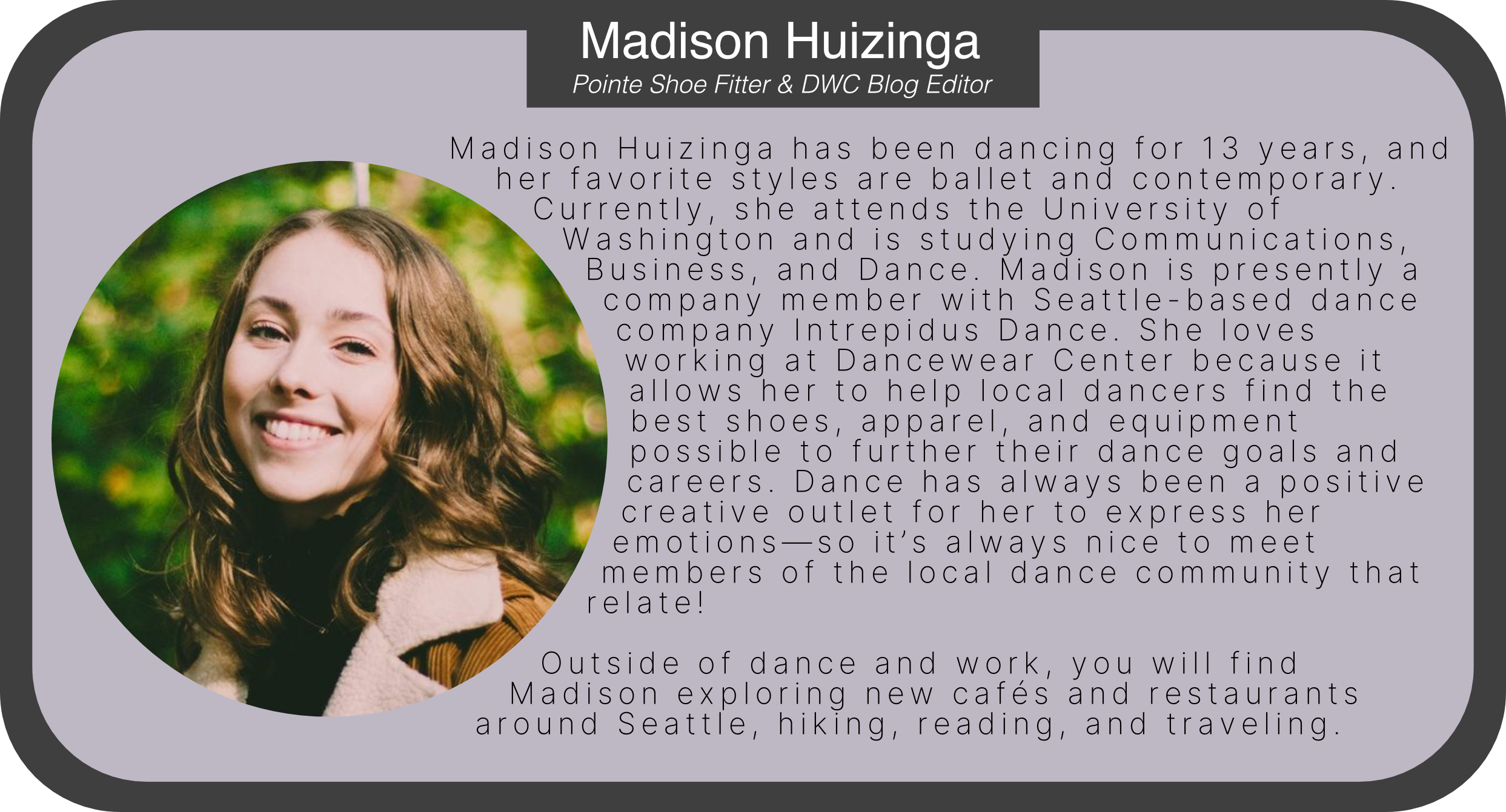
By Madison Huizinga, DWC Blog Editor


Photo by: Mandy McMahon
In Veronica Peters' life, dance has always been a family affair. Since she took over the British Dancing Academy from her mother in 2014, Veronica has continued carrying out her mother’s legacy and providing students with a thorough dance education that encourages them to be the best dancers they can be and learn life lessons along the way.
Veronica’s mother, Sandi Baca, moved from England to the United States in 1967. After meeting Veronica’s father, the couple moved around quite a bit before eventually landing in Washington in 1973. Following the move, Sandi started the British Dancing Academy where three-year-old Veronica began taking classes herself. She stuck with her dance training, eventually dancing ballet professionally throughout the country. Veronica worked for Sandi at the British Dancing Academy for around 25 years before her mother retired and she bought the school from her.
Since its origin, the British Dancing Academy has strived to “not only instill the love of dance in each and every student but teach the fundamentals as well.” The main focus of the school is to teach the technical aspects of ballet, tap, jazz, and modern dance and have dancers compete with themselves to improve, rather than seek competition with others.
BDA typically begins teaching students as young as four years old in creative movement dance classes. After a few years, when students are in second grade, they start BDA’s exam program in which students learn directly from a syllabus and perform combinations in front of an examiner. However, Veronica shares that when it comes to examinations, “it’s not just about the feet and the technical stuff.” The students get graded on their technique, but also their performance ability, musicality, ability to follow directions and put steps together, and more. Sandi is typically the examiner for the British Dancing Academy, as she is an examiner for the Imperial Society of Teachers of Dancing and Teacher Trainer for The Royal Academy of Dance. “She goes all over the world to educate other schools and students, and she trains other teachers as well,” Veronica shares.

Photo by: Mandy McMahon
Veronica points out that a benefit of BDA’s exam program is that it allows students to have a goal to work towards throughout their training. Further, students gain practical skills that are transferable to life outside of the dance realm, such as working quickly under pressure and being able to communicate with new people. “This past year we probably had about 13graduates of kids that have been with us all the way through [the program],” Veronica says. “It’s always kind of fun because...you watch them grow. It’s kind of like a family.”
In addition to classes in a variety of genres, the Academy also offers students the opportunity to perform in a large dance production every June. Past productions have included Alice in Wonderland, Aladdin, and The Little Mermaid. Senior dancers also perform in an annual Holiday Showcase each December, in which they show off some of their original choreography. BDA also uses the Holiday Showcase as an opportunity for attendees to donate to Northwest Harvest and give back to the community.
The experience of teaching dance during COVID-19 was an exhausting process for Veronica and many other studio owners and dance instructors alike. After taking a break from classes for a while, Veronica describes cleaning out the entire studio and setting up big monitors to teach online classes. She collaborated with the instructors to work out hybrid schedules and made sure students wore masks and were physically distanced so everyone’s comfort needs were considered. “I think we did pretty good,” Veronica says of BDA’s COVID-19 protocol. She also says it was nice to bond with other studio owners over the confusion and strain that the pandemic caused on all of their work.

Photo by: Mandy McMahon
In the larger dance world, Veronica hopes that the general population becomes more appreciative of the ballet art form. “My true passion is ballet. Everything about it,” Veronica says. “The original [purpose] of ballet was to tell a story, and I feel sometimes that’s missed...There’s a simplicity to ballet that is so underrated...I wish that there was more of an appreciation for the artistry.” Through her attentive work of teaching students the fundamentals of dance at the British Dancing Academy, Veronica will continue to pass this love of artistry down to future generations, just as her mother did with her.
“Anyone Can Dance”: The Dance School
It’s no secret that when studios are creating their classes for the school year, people with disabilities are more often than not left out of the equation. Within the mainstream industry, dance has a troubling history of exclusivity, often creating strict requirements and standards that prevent marginalized individuals from succeeding. Fortunately, to help rectify these problematic circumstances, Emmy Fansler has created the Best of My Abilities (BOMA) program as a way to introduce students with disabilities to dance…
Emmy Fansler’s BOMA Classes
By Madison Huizinga, DWC Blog Editor


It’s no secret that when studios are creating their classes for the school year, people with disabilities are more often than not left out of the equation. Within the mainstream industry, dance has a troubling history of exclusivity, often creating strict requirements and standards that prevent marginalized individuals from succeeding. Fortunately, to help rectify these problematic circumstances, Emmy Fansler has created the Best of My Abilities (BOMA) program as a way to introduce students with disabilities to dance and provide a space for dancers of all abilities to learn and build relationships. Her program has been implemented at Issaquah Dance Theater and is now being added at The Dance School in Everett.
Founded in 2006, The Dance School is a non-profit organization that strives to provide individuals of all abilities with a space to dance, sing, and perform. The school offers classes in ballet, tap, jazz, hip hop, and contemporary, as well as classes on storytelling, partnering, “Broadway Stage,” and more. “Anyone can dance” is The Dance School’s motto, and with its latest addition of the BOMA classes, it’s clear that the school is living up to the slogan.
The BOMA program was created by dance educator Emmy Fansler. Emmy fell in love with dance around age 15, as it was a safe space for her to seek refuge from childhood trauma. She was able to cultivate a strong community that made her feel secure with herself. She danced at the Midwest Regional Ballet in Joplin, Missouri before getting a dance scholarship at the University of Central Oklahoma. She eventually moved back to Missouri and danced two more seasons at the Midwest Regional Ballet. During her return to Missouri, Emmy found her passion for working with “populations that don’t usually access the dance world.”
As a para-educator in Oklahoma, Emmy ended up developing a dance-based after-school program. She was asked by a parent if her daughter with cerebral palsy could join. Emmy said yes. “I was greatly inspired by her in general,” she shares, discussing how she adapted the program to make it more accessible for the student with cerebral palsy. Not long after that experience, Emmy moved to Lawrence, Kansas to work as an adapted PE educator, where she helped modify activities in PE classes to make them inclusive. In 2008, Emmy describes “accidentally” creating a dance studio when she rented out the back of a warehouse to provide a dance space for a group of girls who couldn’t afford typical classes. That studio would later become Dance Hues Studio.

“At some point, there was an ‘ah ha’ moment,” Emmy says. From then on, Emmy knew that she wanted to dedicate her time to making dance accessible. She began teaching some specialized BOMA classes, one for dancers with physical disabilities and another for students with mental disabilities. Emmy expanded her thinking, asking herself what kept certain kids out of dance class and how she could create a class that caters to their needs. “I was really lucky that I had a beautiful community of people who wanted to try it too because they shaped it as much as I did,” she says.
The BOMA program at The Dance School is intended for dancers with a wide range of ability levels, including those with an array of intellectual, physical, and sensory disabilities. This includes students with autism, ADHD, Down syndrome, cerebral palsy, muscular dystrophy, traumatic brain injury, and more. The dance community that helped shape Emmy’s first BOMA classes was composed of peers, including students without disabilities. These dancers didn’t see BOMA as a class solely for “other” dancers with disabilities, but wanted to be a part of it themselves too. This is how the program became designated for all dancers of all ability levels, as well as peer-supported and centered on relationship building.
“What attracted me to this program was, first off, Emmy’s experience with youth and offering this class previously,” says Marika Jaffe, executive director of The Dance School. “What I like about this class is that Emmy adapts it to the students.” Emmy shares that the BOMA classes are relationship-based and centered around the students that show up.
“I think my goal is to have a few classes like this every week. Maybe with different age groups, maybe one is more [based on] floor work, maybe one [that] is more prop-related,” Marika shares of her objective with the BOMA program. “I just want those to experience something fun and maybe find a new skill that they’ve never had.”

The President of The Dance School’s Board of Directors Megen Nachreiner shares that one of the most valuable lessons that Emmy teaches students is to embrace who they are. She describes how Emmy discovers what each student needs and finds out how best to support each one. “I’m very excited about this program and giving more kids opportunities to feel connected.”
“Emmy is nothing short of a miracle worker,” Treasurer of the Board of Directors Julie Kafkalidis says. “She’s just an amazing human and she’s able to draw out creativity and earn the trust of all kinds of kids...I know that she’s just the right kind of person to teach this class.”
The sheer existence of the BOMA program is already making immense waves of impact. Having a class that makes dance accessible to people with disabilities is a resource that was unfathomable just a few years ago. Julie shares that she grew up dancing, but there weren’t any classes available to her late sister Tara who had Down syndrome. “She loved music. She loved listening to the radio...she’d sing along to the songs and she liked dancing,” Julie explains. She shares that about a year before Tara passed away at age 54, she received a video taken by one of her caretakers of her sitting in a chair and moving her hands to music that was playing. She was dancing. “I know Tara would have loved dance classes if there were some available for her when she was younger,” Julie says, tears in her eyes.
Marika hopes to see more accessibility in the dance world. Whether it’s making dance more available to those from lower socioeconomic backgrounds, those of varying ages, or those with disabilities, doing so can be life-changing. This is a vision that Emmy has as well, which is evident in her other projects, providing dance to people in foster care, homeless shelters, juvenile detention centers, and other spaces where it may otherwise not be.
“One of my biggest goals is building community and showing people that meaningful relationships can happen with people that don’t look like you,” Emmy shares. “I want it to be understood that dance is a universal thing, all you need is a body in space...I would like for wellexpression and connection and creation to be just as valued as technique.
“No matter who you are or where you are at in your life, it is never too late to start dancing. Get out there, and give it a try!” Marika says.
Interested in writing for the DWC Blog? Click below to fill out the DWC Contributor application!