
Ian Howe on His Journey with Mental Health & Dance
DWC Ambassador, Ian Howe, speaks about his journey through dance during the pandemic. His story is especially interesting as a studio owner! Often we don’t hear from that aspect of the dance industry and it’s refreshing to get a different perspective on the dance world. He also bravely speaks to his difficulties with mental health, anxiety and depression. Ian shares that while things can still be difficult, he is progressing forward and you may be able to relate. Watch the video for the full talk!

“One of the biggest things I needed to learn, is that it’s okay to not be able to do EVERY thing.”
DWC Ambassador, Ian Howe, speaks about his journey through dance during the pandemic. His story is especially interesting as a studio owner! Often we don’t hear from that aspect of the dance industry and it’s refreshing to get a different perspective on the dance world. He also bravely speaks to his difficulties with mental health, anxiety and depression. Ian shares that while things can still be difficult, he is progressing forward and you may be able to relate. Watch the video for the full talk!
Disclaimer
All content found on the Dancewear Center Website, Instagram, Facebook, Pinterest, and all other relevant social media platforms including: text, images, audio, or other formats were created for informational purposes only. Offerings for continuing education credits are clearly identified and the appropriate target audience is identified. The Content is not intended to be a substitute for professional medical advice, diagnosis, or treatment. Always seek the advice of your physician or other qualified health provider with any questions you may have regarding a medical condition. Never disregard professional medical advice or delay in seeking it because of something you have read on this Website.
If you think you may have a medical emergency, call your doctor, go to the emergency department, or call 911 immediately. Dancewear Center does not recommend or endorse any specific tests, physicians, products, procedures, opinions, or other information that may be mentioned on dancewearcenter.net. Reliance on any information provided by dancewearcenter.net, Dancewear Center employees, contracted writers, or medical professionals presenting content for publication to Dancewear Center is solely at your own risk.
Links to educational content not created by Dancewear Center are taken at your own risk. Dancewear Center is not responsible for the claims of external websites and education companies.
How To Tie Ballet Flats
Ballet shoes come in many different shapes and sizes. Some can be black, pink, or white and have strings or no strings, but for shoes with strings, it is important to know how to tie them for classes. DWC Staff Member Emma Neilson is here to help give you some tips and tricks on how to tie your strings properly! Read on to learn more!
By Emma Neilson, DWC Social Media Manager & Pointe Fitter

Ballet shoes come in many different shapes and sizes. Some can be black, pink, or white and have strings or no strings, but for shoes with strings, it is important to know how to tie them for classes. DWC Staff Member Emma Neilson is here to help give you some tips and tricks on how to tie your strings properly! Read on to learn more!
Materials needed:
Ballet flats with strings
Tape
To start, put the shoe onto your foot and pull the drawstring so the extra fabric around the shoe is flat against your skin.
Once the drawstring is pulled, tie the two elastic pieces into a bow.
Take off the shoe and get a small piece of tape.
Grab the ends of the bow, pull them together, and put the tape around the strings.
Tuck the strings into the front of the shoe and push the tape down on the front inside of the shoe.
Try on the shoe and make sure that the tape doesn’t fall off. If needed, use more tape!
We hope that these steps can help you if you need to tie your ballet flats. Each teacher is different so be sure that you find out what they would like first before cutting or tying your shoes! Be sure to watch the full video for a visual step-by-step on how to tie your shoes!
Disclaimer
All content found on the Dancewear Center Website, Instagram, Facebook, Pinterest, and all other relevant social media platforms including: text, images, audio, or other formats were created for informational purposes only. Offerings for continuing education credits are clearly identified and the appropriate target audience is identified. The Content is not intended to be a substitute for professional medical advice, diagnosis, or treatment. Always seek the advice of your physician or other qualified health provider with any questions you may have regarding a medical condition. Never disregard professional medical advice or delay in seeking it because of something you have read on this Website.
If you think you may have a medical emergency, call your doctor, go to the emergency department, or call 911 immediately. Dancewear Center does not recommend or endorse any specific tests, physicians, products, procedures, opinions, or other information that may be mentioned on dancewearcenter.net. Reliance on any information provided by dancewearcenter.net, Dancewear Center employees, contracted writers, or medical professionals presenting content for publication to Dancewear Center is solely at your own risk.
Links to educational content not created by Dancewear Center are taken at your own risk. Dancewear Center is not responsible for the claims of external websites and education companies.
What's In Your Dance Bag?
Everyone knows as dancers that our dance bag is a sacred place. It holds all of our stinky shoes after dancing for hours on end and seems to be an abyss for endless amounts of bobby pins. With each new dance season, new goodies are needed to last the dance season which can add up quickly. We asked some of our DWC Ambassadors what was in their dance bag to give a special look into their go-tos and their necessities they need for classes! Read on to learn more about what is in their dance bags!
By The DWC Ambassadors
Everyone knows as dancers that our dance bag is a sacred place. It holds all of our stinky shoes after dancing for hours on end and seems to be an abyss for endless amounts of bobby pins. With each new dance season, new goodies are needed to last the dance season which can add up quickly. We asked some of our DWC Ambassadors what was in their dance bag to give a special look into their go-tos and their necessities they need for classes! Read on to learn more about what is in their dance bags!

Caroline
Hair bands or claw clip
Water bottle
Snacks (fired mango or granola bar bc I am always hungry!)
Sweatshirt or long sleeve to wear for warmups
Kindle and computer if I have some downtime
Native deodorant
Apple Watch
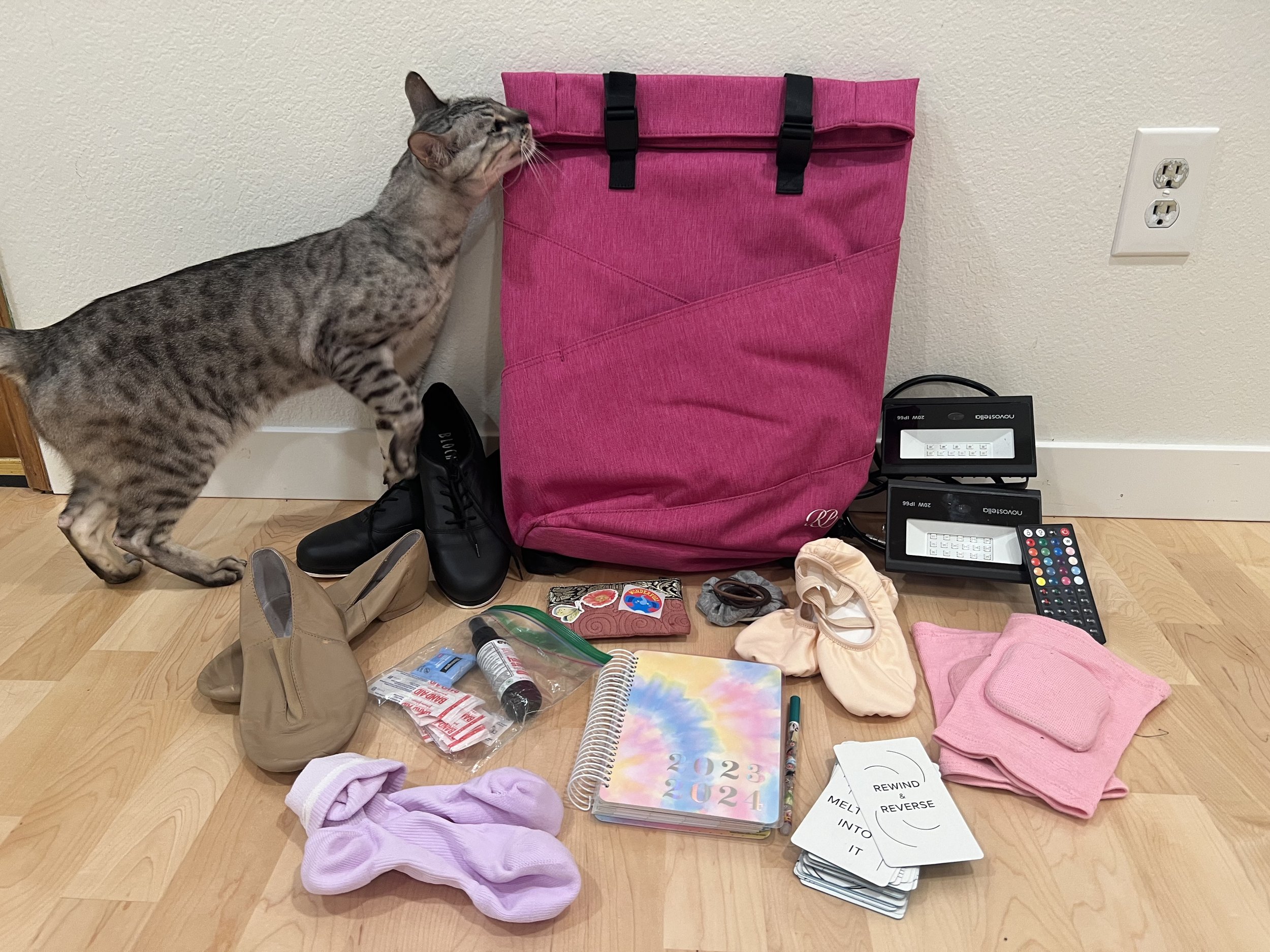
Marika
Band aids, hand sanitizer, makeup wipes
Sticker pouch
Hair ties
Planner
Movement cards
Knee pads
Colored room lights
I always carry a snack :) (Not shown)
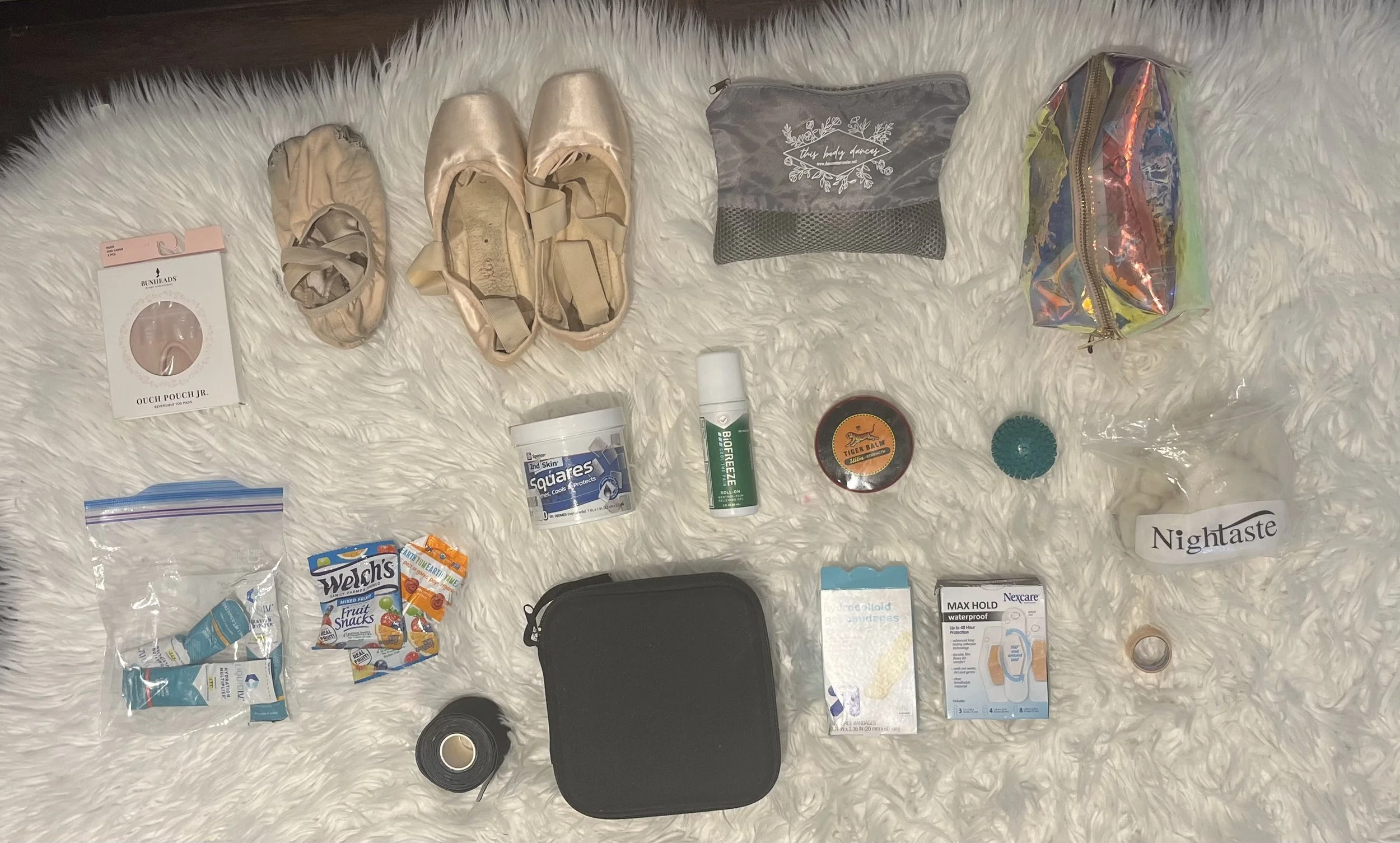
Alaina
In my dance bag I try to keep only the essentials, so I can have a clean and organized bag. I also keep my pointe shoes and flat ballet shoes with me. I currently love the SoDanca ballet flat shoes, and the Mirella whisper pointe shoes. I keep all of my pointe essentials in my Dancewear Center mini zip bag. My favorite toe pads are from Bunheads. 2nd Skin Squares are my favorite for blisters so I always keep them on hand. I also keep blister bandaids and other types of tape with me for injuries and injury prevention. Biofreeze and Tiger Balm are two of my absolute essential items. There is also a mini Thera gun I keep in my bag for post class muscle recovery. Finally I like to keep a few snacks that are high in sugar and easy to digest for quick in between class energy boosts.
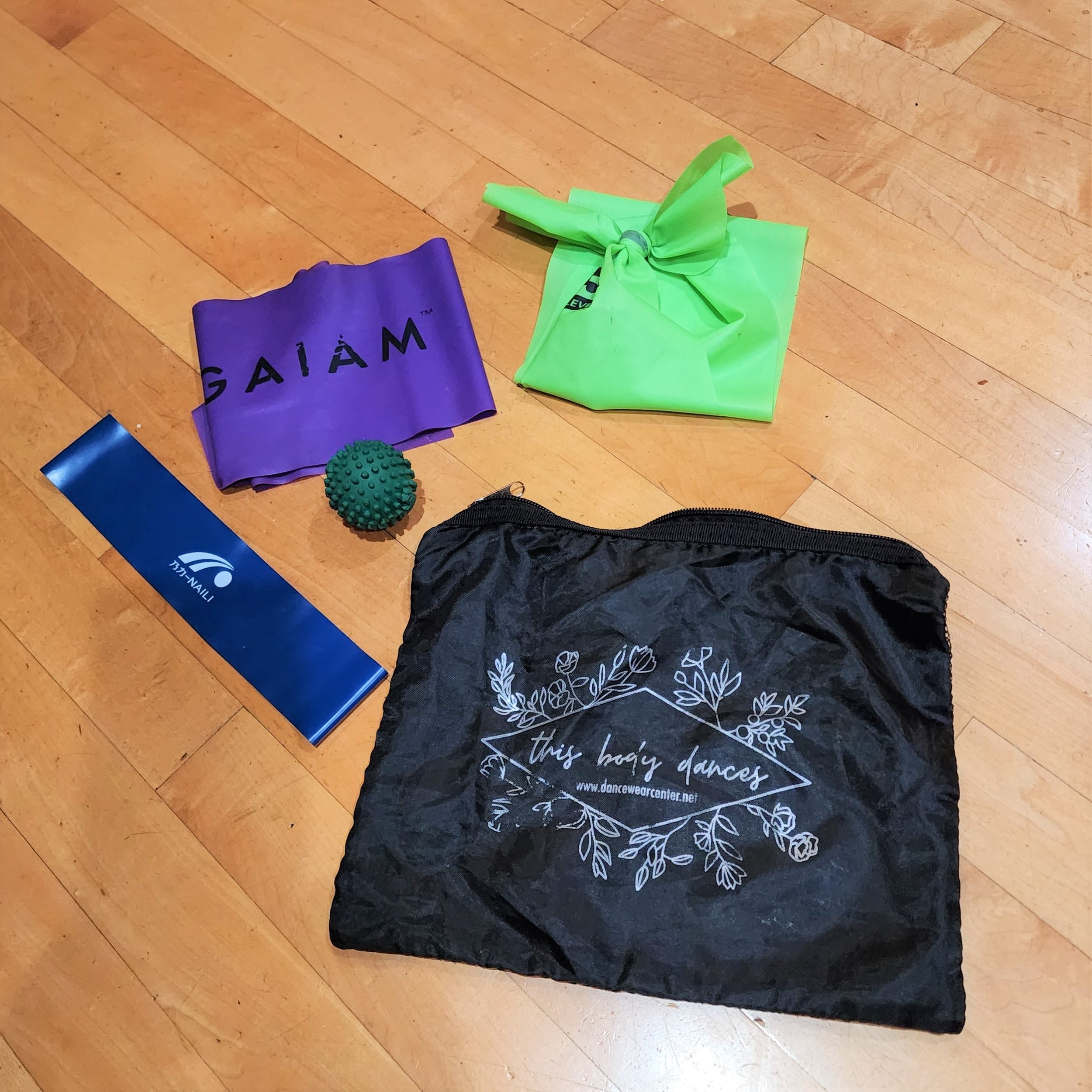
Vania
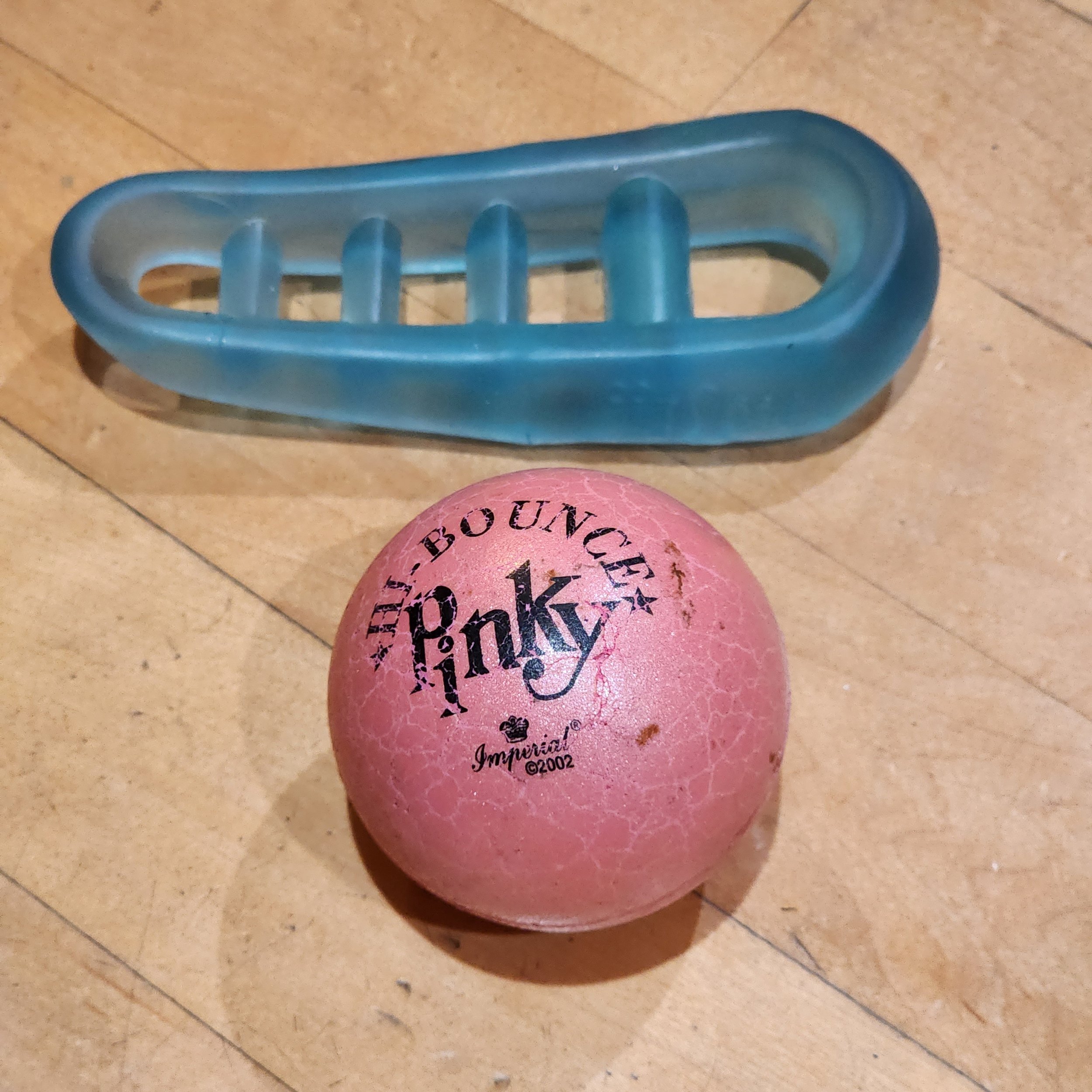
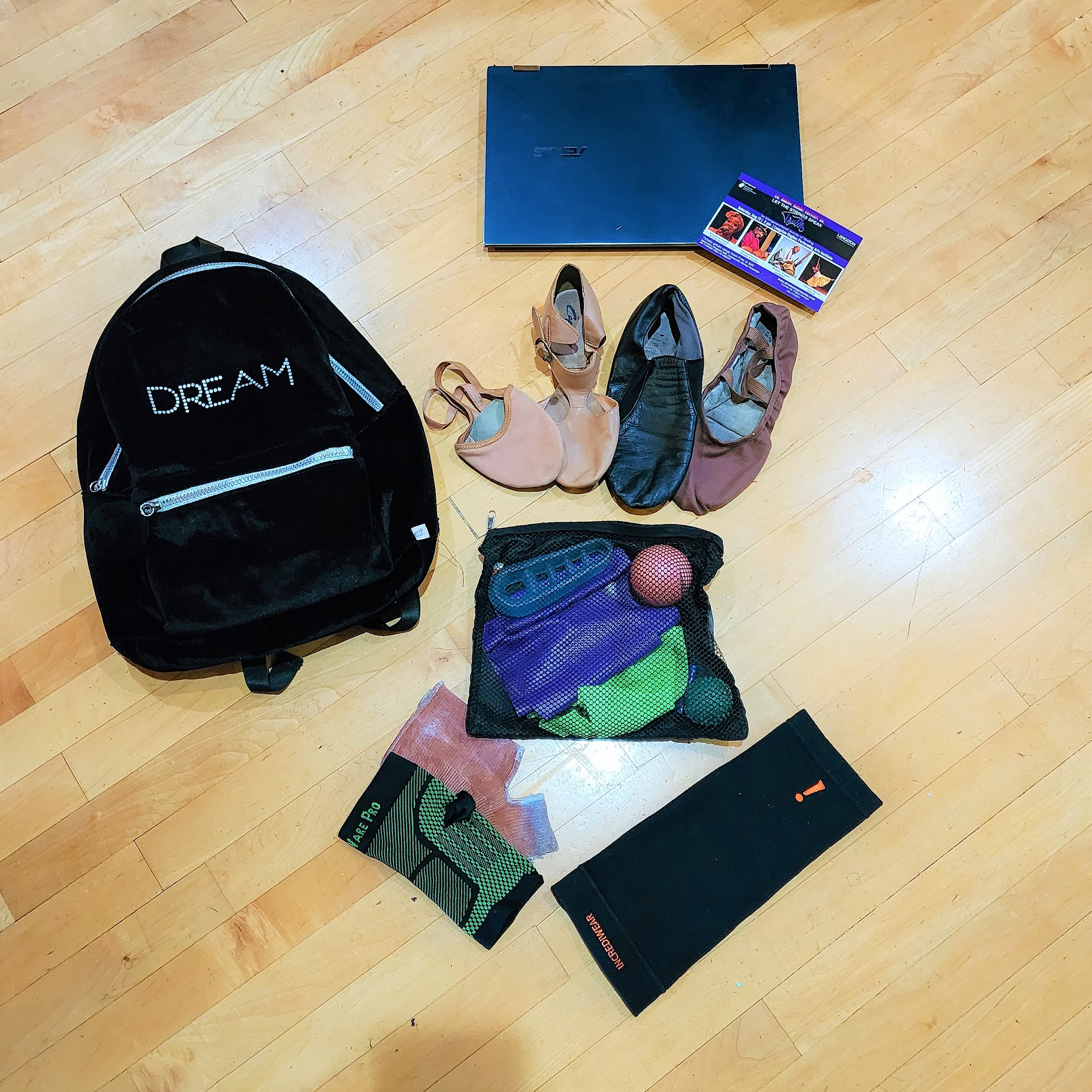
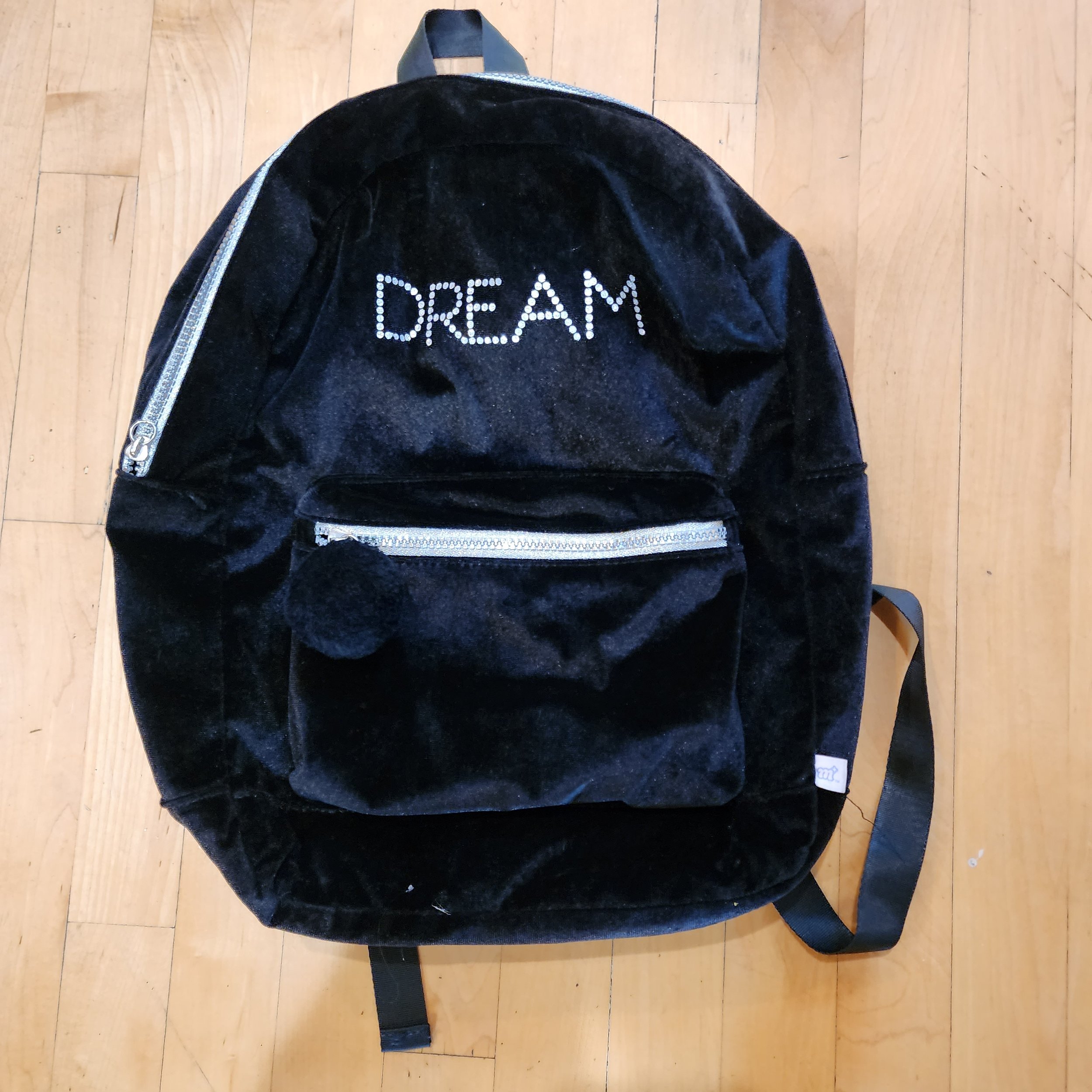
My dance bag (BACKPACK) varies based on whether I am taking class, teaching, choreographing, or working on a show. But in general, I like to make sure that I have jazz and ballet options. In addition, it is important to have a few things that help stretch, strengthen and release my body. When I looked in my dance bag, the first thing I saw was my black Dancewear Center pouch with TheraBands inside. :-) I also like to keep my Foot Rubz or Pinkie ball close by to help release my feet. And my ankle supports are a must have for heavy rehearsal times. When I travel, I like to take at least one of my yoga toes to increase circulation to my extra tight feet. :-) Last but not least, these days I need my computer for business and music editing. So, I carry it along with a portable speaker and a notebook/pencil.
Dancewear Center pouch - TheraBands, therapy balls for my feet and legs
Jazz shoes (regular and with a little heel sometimes for teaching)
Ankle braces/Knee brace
Yoga toes
My computer
The latest flyer for any events I am working on
Portable speaker and notebook - not shown
We hope you enjoyed finding out what is in our DWC Ambassadors dance bags! Shop for these necessities in store or online!
Disclaimer
All content found on the Dancewear Center Website, Instagram, Facebook, Pinterest, and all other relevant social media platforms including: text, images, audio, or other formats were created for informational purposes only. Offerings for continuing education credits are clearly identified and the appropriate target audience is identified. The Content is not intended to be a substitute for professional medical advice, diagnosis, or treatment. Always seek the advice of your physician or other qualified health provider with any questions you may have regarding a medical condition. Never disregard professional medical advice or delay in seeking it because of something you have read on this Website.
If you think you may have a medical emergency, call your doctor, go to the emergency department, or call 911 immediately. Dancewear Center does not recommend or endorse any specific tests, physicians, products, procedures, opinions, or other information that may be mentioned on dancewearcenter.net. Reliance on any information provided by dancewearcenter.net, Dancewear Center employees, contracted writers, or medical professionals presenting content for publication to Dancewear Center is solely at your own risk.
Links to educational content not created by Dancewear Center are taken at your own risk. Dancewear Center is not responsible for the claims of external websites and education companies.
How to Mentally Navigate Returning to Dance After a Summer Break
Returning to dance in the fall is always a challenge. Many of us spend the summer either taking a break from dancing or dancing significantly less than usual. Don’t get me wrong, rest is incredibly useful for dancers. It’s also important to spend time with friends and family and engage in other activities that bring dancers joy. Some may be fearful that they’ve lost a significant amount of their dance technique over the break or that their focus will be out of shape. No matter what type of nerves you’re feeling, there are small steps to take to ensure you’re mentally prepared to return to studio dancing.
Tips For Getting Into Dance After a Break
By Madison Huizinga, DWC Blog Editor

Returning to dance in the fall is always a challenge. Many of us spend the summer either taking a break from dancing or dancing significantly less than usual. Don’t get me wrong, rest is incredibly useful for dancers. It’s also important to spend time with friends and family and engage in other activities that bring dancers joy. Some may be fearful that they’ve lost a significant amount of their dance technique over the break or that their focus will be out of shape. No matter what type of nerves you’re feeling, there are small steps to take to ensure you’re mentally prepared to return to studio dancing.
Something that I find crucial when returning to dance is accepting the fact that my body will move differently after a break. It can be mentally challenging to reconcile with the fact that we’re not quite moving in the same way we were a few months ago. Our extensions might be a bit lower and our turn out may not be the same as it was before, and that’s okay! Accept the fact that your mobility is going to change slightly depending on your different levels of activity and inactivity. Feel free to cut yourself a little bit of slack for not quite meeting the expectations you set for yourself. Just because you find yourself in a different place than you were a few months ago, or even a year ago, doesn’t mean you won’t get back to where you were before. In fact, following a break from dance, I often find that my mind is more open and ready to absorb information. I can pick up choreography faster and learn how to do new moves more efficiently after my body and mind have taken time to heal and rest. Keeping this in mind can be helpful when transitioning back into dancing more regularly and rigorously.

Photo By Mathilde Langevin on Unsplash
A useful way I mentally adjust to getting back into dance, or starting any new routine, is journaling about my thoughts and feelings. According to the University of Rochester’s Medical Center, journaling is a helpful way to manage anxiety, reduce stress, and cope with depression. For me, journaling holds all of these benefits because it helps me understand the root causes of my fears, identify unhelpful thought patterns, and give myself positive affirmations about moving forward. When I notice that I’m not quite meeting my performance goals in dance, it can feel quite discouraging. I begin to feel like I’m being lazy, a slacker, or just downright losing my skills and won’t be able to get them back. When I journal about how I’m feeling, I’m able to realize that while I may be feeling these emotions in the moment, they aren’t necessarily true. Through writing, I can see that I’m feeling the way I’m feeling because I took a break from dancing and am getting into the rhythm of a new routine. By coming to this realization, I can reassure myself that I will be able to get back on track with some time and effort. Suddenly, my situation doesn’t seem like an utter catastrophe, but rather a natural symptom of taking time off.
Another helpful way to use journaling to prepare yourself for getting back into dance is to set realistic goals for yourself. A significant part of goal setting that people often neglect is setting attainable goals or those that you’re capable of achieving. For example, if I were to return to dance after a three-month break, setting a goal for myself to perfectly execute triple pirouettes my first week of class isn’t attainable. Instead, I need to be honest with myself about what I am capable of achieving.
“Finally, one of the most useful things to remember when getting back into dance is that you aren’t alone.”
To create some structure in my life, before I get started on my day, I like to set three goals about what I hope to accomplish, big or small. This is a simple practice that dancers can do before each dance class. These goals can be anything from paying more attention to your épaulement during barre exercises to asking questions about certain steps you want more assistance with. Setting these goals allows me to have a more systematic approach to getting back into dance, which can make me feel like I’m making more of an effort to progress back to where I once was.

Photo By Daria Nepriakhina on Unsplash
Finally, one of the most useful things to remember when getting back into dance is that you aren’t alone. Chances are most of your peers have also taken time off and may also be feeling insecure about getting back into dancing. The past year and a half of dancing through Zoom and/or taking time off is a universal experience for dancers, whether they’re beginners or professionals. Reach out to other dancers in your classes and connect with them about the challenges of returning to studio dancing. You can even create a plan to set goals together about what you hope to accomplish in the coming year and check in with each other regularly to see how you’re feeling.
Breaks are necessary for any field, they help us recharge and come back stronger. Regardless of how important they are, ending the break and returning to “regularly scheduled programming” can seem intimidating. But through journaling about your emotions, goal setting, and connecting with peers, getting back into dance can be a far less daunting feat than it seems on the surface.

Disclaimer
All content found on the Dancewear Center Website, Instagram, Facebook, Pinterest, and all other relevant social media platforms including: text, images, audio, or other formats were created for informational purposes only. Offerings for continuing education credits are clearly identified and the appropriate target audience is identified. The Content is not intended to be a substitute for professional medical advice, diagnosis, or treatment. Always seek the advice of your physician or other qualified health provider with any questions you may have regarding a medical condition. Never disregard professional medical advice or delay in seeking it because of something you have read on this Website.
If you think you may have a medical emergency, call your doctor, go to the emergency department, or call 911 immediately. Dancewear Center does not recommend or endorse any specific tests, physicians, products, procedures, opinions, or other information that may be mentioned on dancewearcenter.net. Reliance on any information provided by dancewearcenter.net, Dancewear Center employees, contracted writers, or medical professionals presenting content for publication to Dancewear Center is solely at your own risk.
Links to educational content not created by Dancewear Center are taken at your own risk. Dancewear Center is not responsible for the claims of external websites and education companies.
Preparing for Your First Year in College Dance
For the first time in 18 years, I am moving away to a new city and dancing with people that I have never met before. I’m hundreds of miles away from my family and friends that have made me into who I am today and my beloved dance community that I have had around me for the last 8 years. While this is going to be a drastic change in my life, I know that I am not alone. I know that there are thousands of other dancers across the country and even the world that are experiencing the same uneasy feeling as me.
Name pronunciation: Nick-ole Bear-et | Pronouns: she/her
By Nicole Barrett, DWC Blog Editor

For the first time in 18 years, I am moving away to a new city and dancing with people that I have never met before. I’m hundreds of miles away from my family and friends that have made me into who I am today and my beloved dance community that I have had around me for the last 8 years. While this is going to be a drastic change in my life, I know that I am not alone. I know that there are thousands of other dancers across the country and even the world that are experiencing the same uneasy feeling as me.
Life is full of changes that we are prepared for and some that we’re not. When it comes to moving away for college, that is one that we can control. As all of us college freshman are trying to adjust to this new change, it is important that we understand and acknowledge why we decided to pursue dance in the first place. Following your passion is the most important step in making a memorable year in college dance. To prepare myself for this change, I have spoken with multiple graduates from dance programs across the country and some other college freshman that are preparing for their first year in college dance, so here are some ways you can prepare.
Don’t compare yourself!
Knowing what you bring to the class is a big step to make sure that you are gaining what you need from that class. All those dancers are worrying about themselves, not you. Comparing yourself to other dancers doesn’t allow you to dance to the full ability that you know you have. They are here to dance for themselves, they aren’t watching to see if you messed up. Just because another dancer can do a cool trick doesn’t mean that you don’t bring amazing things to the table. Each dancer is unique in their own way and it is important in college dance and in the professional realm to know that.
Remember that it’s okay to make mistakes!
When switching to new teachers in college dance, it can be difficult to adjust to the new techniques they use and the pacingof the class itself. Be sure to give yourself some grace to get adjusted to the new teacher and new environment. Just know that everybody in the room is coming from different backgrounds that are going through the same things as you. As dancers we are conditioned to want to be perfect all the time, but we do need to realize it is human to make mistakes.
Be sure to have all the essentials in your bag
You never know what you may need in the class, so making sure you have everything is important. I know that forgetting a water bottle or a recovery tool can make or break a class for me, so making sure that my bag is stocked with everything I need is very imporrnat. This can help relieve a bit of the stress and allow piece of mind during a stressful transition.
Take some classes to get back into moving
Summer can be a long time to go without dance, so making sure that your stamina is up and your mind is ready for a new season of dance is very important. Summers for me are typically when I take a break from dance so I have been trying to find local drop in classes and classes at my old studio that I can take to get back into it before I leave for college. To help ease your mind try to see if you can take classes at your old studio to keep up that common routine before the big transition.
Have fun!
Don’t stress! Everyone that is in the class loves to dance. They know that this is a passion for them that they want to pursue so remember that you are around people that love dance just as much as you do. While change can be scary and bring stress, I know that dance is my outlet to make me feel better no matter what I am feeling. Doing what I love is worth it and doing what you love should be a top priority.

For me, this change is going to be a tough one. I have gotten accustomed to having my same group of people around me when dancing for many years and this transition feels scary. But, it is important to know that this change is going to be an incredibly exciting one. You are going to be one step closer to doing the thing you love for the rest of your life. Making connections that can last a lifetime and enhancing your craft for years to follow. Just know that you got this and to enjoy your first year! Doing the thing you love the most will make it all worth it.
Disclaimer
All content found on the Dancewear Center Website, Instagram, Facebook, Pinterest, and all other relevant social media platforms including: text, images, audio, or other formats were created for informational purposes only. Offerings for continuing education credits are clearly identified and the appropriate target audience is identified. The Content is not intended to be a substitute for professional medical advice, diagnosis, or treatment. Always seek the advice of your physician or other qualified health provider with any questions you may have regarding a medical condition. Never disregard professional medical advice or delay in seeking it because of something you have read on this Website.
If you think you may have a medical emergency, call your doctor, go to the emergency department, or call 911 immediately. Dancewear Center does not recommend or endorse any specific tests, physicians, products, procedures, opinions, or other information that may be mentioned on dancewearcenter.net. Reliance on any information provided by dancewearcenter.net, Dancewear Center employees, contracted writers, or medical professionals presenting content for publication to Dancewear Center is solely at your own risk.
Links to educational content not created by Dancewear Center are taken at your own risk. Dancewear Center is not responsible for the claims of external websites and education companies.
Everything You Need For Your First Ballet Class!
Are you or your little one getting ready for their very first ballet class? Follow along with DWC Fitter, Emma, as she guides you through everything you need to be ready for a ballet class!
By Emma Neilson, DWC Social Media Manager & Pointe Fitter
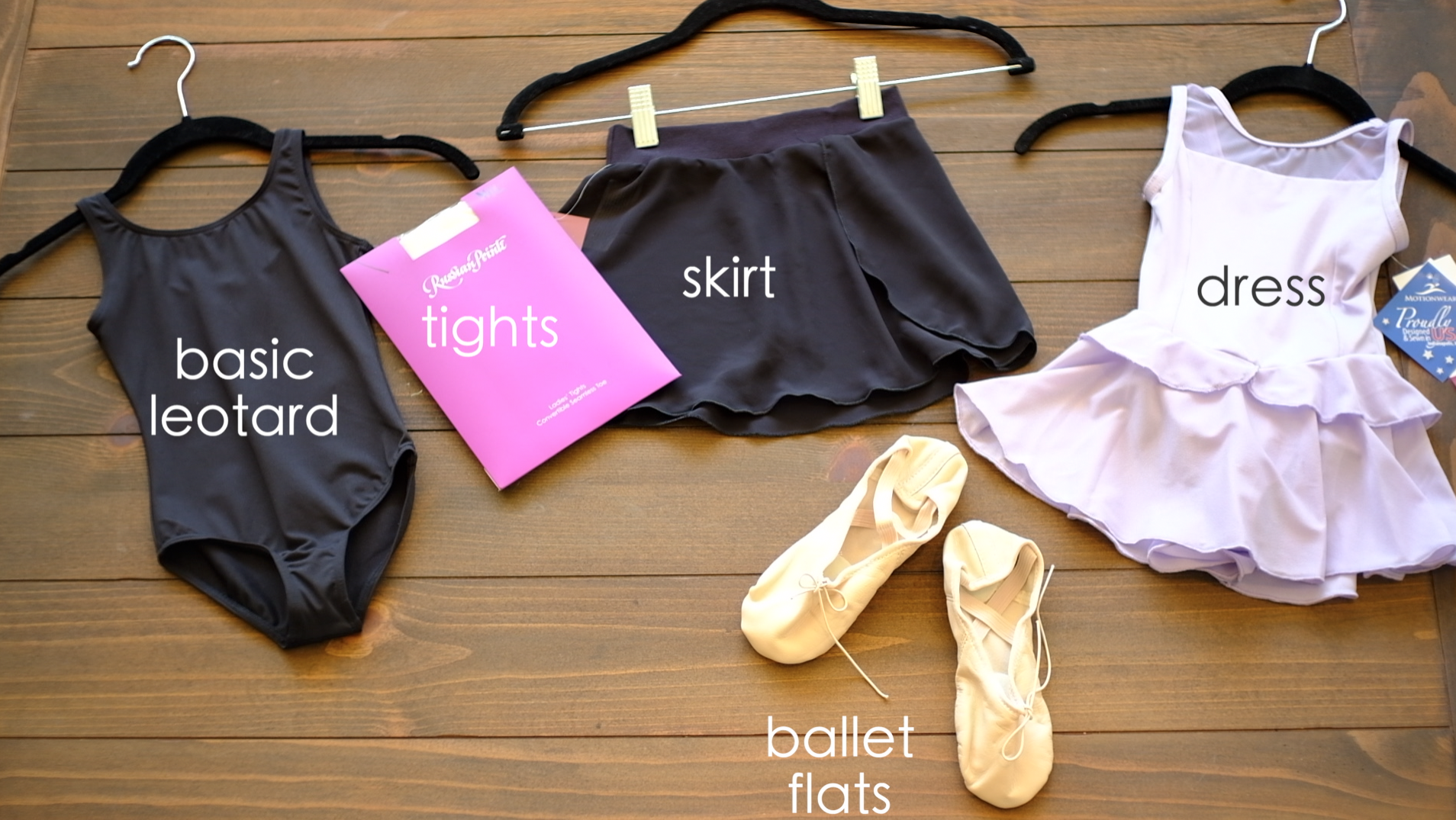
Are you or your little one getting ready for their very first ballet class? Follow along with DWC Fitter, Emma, as she guides you through everything you need to be ready for a ballet class!
Ballet Flats
Ballet shoes come in many varieties! There are leather and canvas, with or without drawstrings. Some people prefer the feel of leather, while others like that canvas can stretch. Often your studio will specify which they prefer so be sure to check what is required and then come in to Dancewear Center to try some on!
Transition Tights
Tights also have many varieties, often the go-to tights are transition or convertible tights, which allow you to roll them up off of your feet for before and after class. Check with your studio for color and style guidelines!
Leotards
Leotards are essential in ballet. They allow dancers to move freely and securely. And they are the best thing to wear so teachers can give adequate corrections to students. Colors vary by studio guidelines, feel free to try some on in one of our stores!
Skirts
Skirts are a classic ballet accessory that goes over your leotard. Be sure to check on styles and colors from your studio!
Dresses
Some studios require that younger dancers wear dresses instead of leotards to prevent fiddling with skirts. We have a variety of options and colors to try on!
Disclaimer
All content found on the Dancewear Center Website, Instagram, Facebook, Pinterest, and all other relevant social media platforms including: text, images, audio, or other formats were created for informational purposes only. Offerings for continuing education credits are clearly identified and the appropriate target audience is identified. The Content is not intended to be a substitute for professional medical advice, diagnosis, or treatment. Always seek the advice of your physician or other qualified health provider with any questions you may have regarding a medical condition. Never disregard professional medical advice or delay in seeking it because of something you have read on this Website.
If you think you may have a medical emergency, call your doctor, go to the emergency department, or call 911 immediately. Dancewear Center does not recommend or endorse any specific tests, physicians, products, procedures, opinions, or other information that may be mentioned on dancewearcenter.net. Reliance on any information provided by dancewearcenter.net, Dancewear Center employees, contracted writers, or medical professionals presenting content for publication to Dancewear Center is solely at your own risk.
Links to educational content not created by Dancewear Center are taken at your own risk. Dancewear Center is not responsible for the claims of external websites and education companies.
DWC Recovery Product Guide
After getting back into dance following a break, it’s typical for your body to need a little extra TLC (see Physical Therapist Colleen Bickel’s article on tips for physically returning to dance). Not to mention, many dancers are also gearing up for competition and convention season, which is always physically demanding. Taking time to rest and recover is often just as important as the dance training itself. This means rolling out and resting your sore muscles but also setting aside time to pamper yourself to feel mentally refreshed. Check out this list of our favorite recovery products at Dancewear Center to help provide yourself with some needed restoration in the coming dance year.
By Madison Huizinga, DWC Blog Editor
As dancers are coming back from summer intensives/vacation and preparing for the new dance year, it is vital that we as dancers take care of our bodies properly. After getting back into dance following a break, it’s typical for your body to need a little extra TLC (see Physical Therapist Colleen Bickel’s article on tips for physically returning to dance). Taking time to rest and recover is often just as important as the dance training itself. This means rolling out and resting your sore muscles but also setting aside time to pamper yourself to feel mentally refreshed. Check out this list of our favorite recovery products at Dancewear Center to help provide yourself with some needed restoration in the coming dance year.

Bloch Resistance Bands
Using latex material, this resistance band is perfect for dancers recovering from an injury or for young dancers preparing for their pointe shoes. This product comes in three different colors that indicate different weights, mint green is light, teal blue is medium and royal blue is heavy. The weights can determine which band is best for your recovery process and can target specific areas that are in need of strengthening. Shop for this product in-store or online here!

Flexistretcher
The Flexistretcher is leading the dance world as one of the top training tools for strength and flexibility. Using elastic resistance technology, this product effectively and safely improves flexibility and strength by strengthening the muscles as you stretch. The loops are fully adjustable to fit all bodies and have rubber stoppers that allow the loop to always stay in place without falling off. Be sure to find this product in-store or online! Be sure to check out our How To Videos on the Flexistretcher as well!

Footsie Roller
Do you have tension in your feet that just won’t go away? The Footsie Roller is just the product for you! This roller is designed to relieve tension in the arches of the feet from long rehearsals or sudden injury. Being made of wood and silicone allow for the roller to alleviate knots and tiredness in the feet instantly. Lightweight and durable, this product is easy to throw in your dance bag and carry around wherever you need it!
Apolla Performance
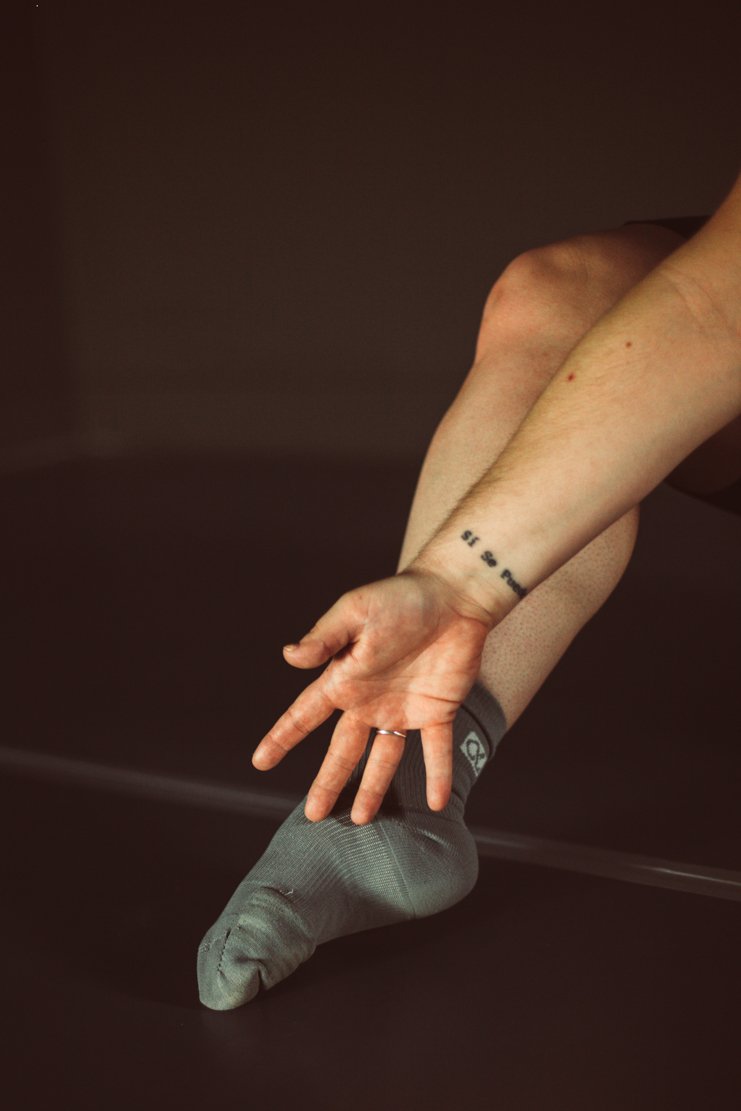
Apolla Performance products are known to be top-notch for dancers around the country for recovery and performance use. Recently featured on Shark Tank, Apolla’s compression socks and legwarmers leave dancers’ feet and legs feeling and looking great. Apolla Performance products use shock absorption technology to help comfort the balls of the feet and squeeze the arch of the foot for maximum comfort and support in any style of dance. The Amp Shock, Performance Shock, Infinite Shock, and the K-Warmer are perfect to help dancers’ feet recover and get prepped for the new dance season! Be sure to check out our How To Video on using traction spray with Apollas!

FLX Infinity Ball
Unlike your regular tennis ball, the FLX Infinity Ball is strategically designed for dancers that need to roll out their sore muscles. While this product is small, it packs a lot of power and is built to handle intense pressure to ensure that knots and soreness in muscles are alleviated. The contoured shape is perfect to get a targeted deep-tissue massage to diminish pain and restore mobility. DWC carries this product in two different colors so be sure to get one in-store or online!

Tiger Balm
Tiger balm is a topical ointment that is aimed to help relieve sore muscles for dancers and hurt areas on the dancer’s body. This product is perfect for use after a rough class or rehearsal where the body needs a little love. You can keep this product in your dance bag for easy access after classes that leave muscles feeling sore. Shop for this product in-store at either Dancewear Center location!
We hope this Recovery Guide can help make the recovery process a little easier!
Disclaimer
All content found on the Dancewear Center Website, Instagram, Facebook, Pinterest, and all other relevant social media platforms including: text, images, audio, or other formats were created for informational purposes only. Offerings for continuing education credits are clearly identified and the appropriate target audience is identified. The Content is not intended to be a substitute for professional medical advice, diagnosis, or treatment. Always seek the advice of your physician or other qualified health provider with any questions you may have regarding a medical condition. Never disregard professional medical advice or delay in seeking it because of something you have read on this Website.
If you think you may have a medical emergency, call your doctor, go to the emergency department, or call 911 immediately. Dancewear Center does not recommend or endorse any specific tests, physicians, products, procedures, opinions, or other information that may be mentioned on dancewearcenter.net. Reliance on any information provided by dancewearcenter.net, Dancewear Center employees, contracted writers, or medical professionals presenting content for publication to Dancewear Center is solely at your own risk.
Links to educational content not created by Dancewear Center are taken at your own risk. Dancewear Center is not responsible for the claims of external websites and education companies.
A DWC Back-to-School Shopping Guide
Just like that: back-to-school season is upon us! And as the summer winds to a close and students start stocking their pencil cases, that also means back to dance season is upon us. Back to dance season often calls for a trip to the dancewear store, as young kids grow out of their old leotards, and older dancers wear out their favorite dancing shoes. As always, Dancewear Center strives to set all dancers up for success year-round, and the back-to-school season is no exception. Here are some of our back-to-dance season must-haves!
Our Must-Have Picks For Fall
By Madison Huizinga & Nicole Barrett, DWC Blog Editor
Just like that: back-to-school season is upon us! And as the summer winds to a close and students start stocking their pencil cases, that also means back to dance season is upon us. Back to dance season often calls for a trip to the dancewear store, as young kids grow out of their old leotards, and older dancers wear out their favorite dancing shoes. As always, Dancewear Center strives to set all dancers up for success year-round, and the back-to-school season is no exception. Here are some of our back-to-dance season must-haves!
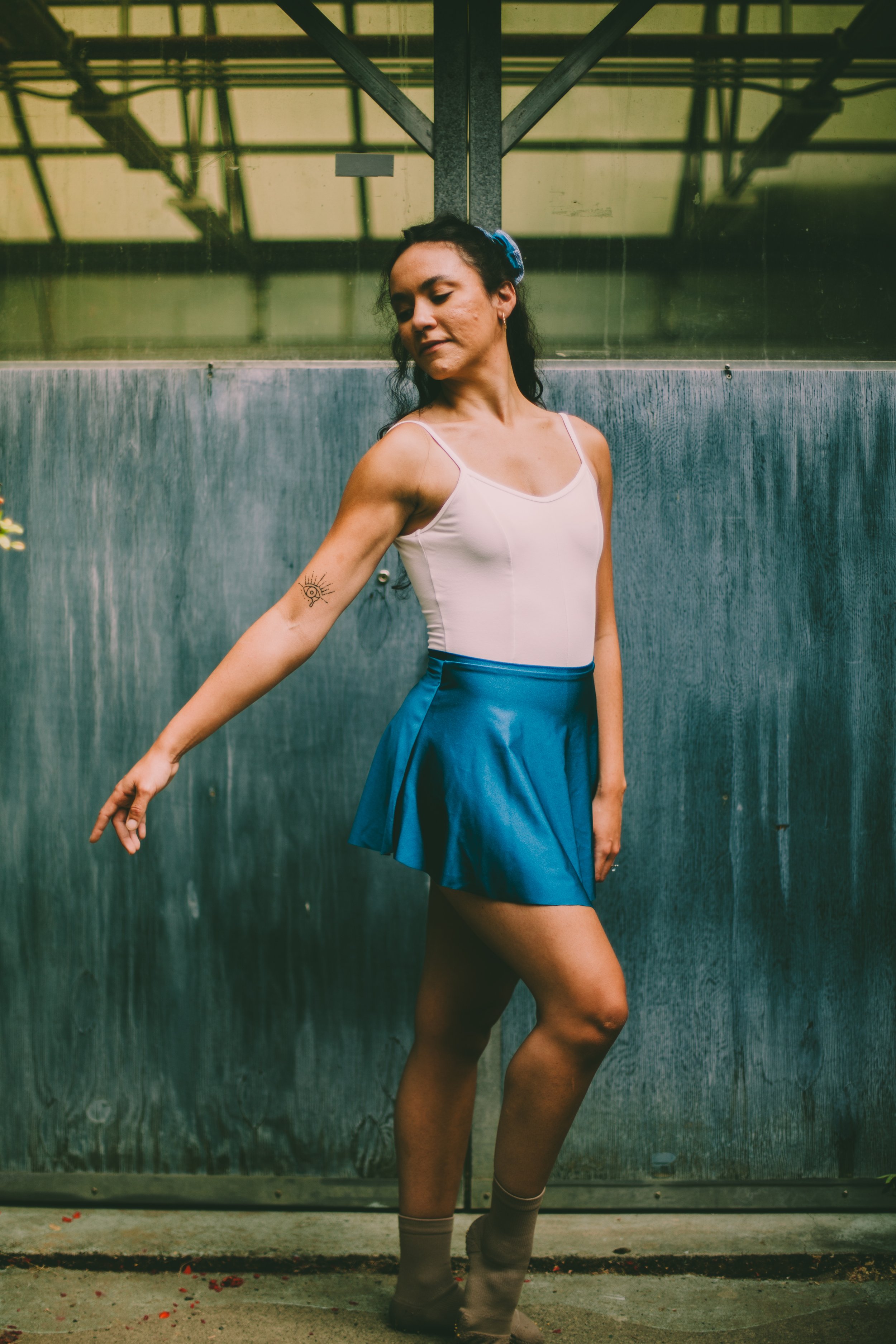
Basic Leotards
We love our fashion leotards just as much as the next dancer here at DWC. At the same time, we know that some dress codes are a bit more specific about what they expect students to wear. That’s why we’ve got our local community covered, offering leotards in camisole styles, tank styles, cap sleeves, long sleeves, and more in a variety of colors for both children and adults. We also offer a selection of basics for men, including leotards and dance shirts.
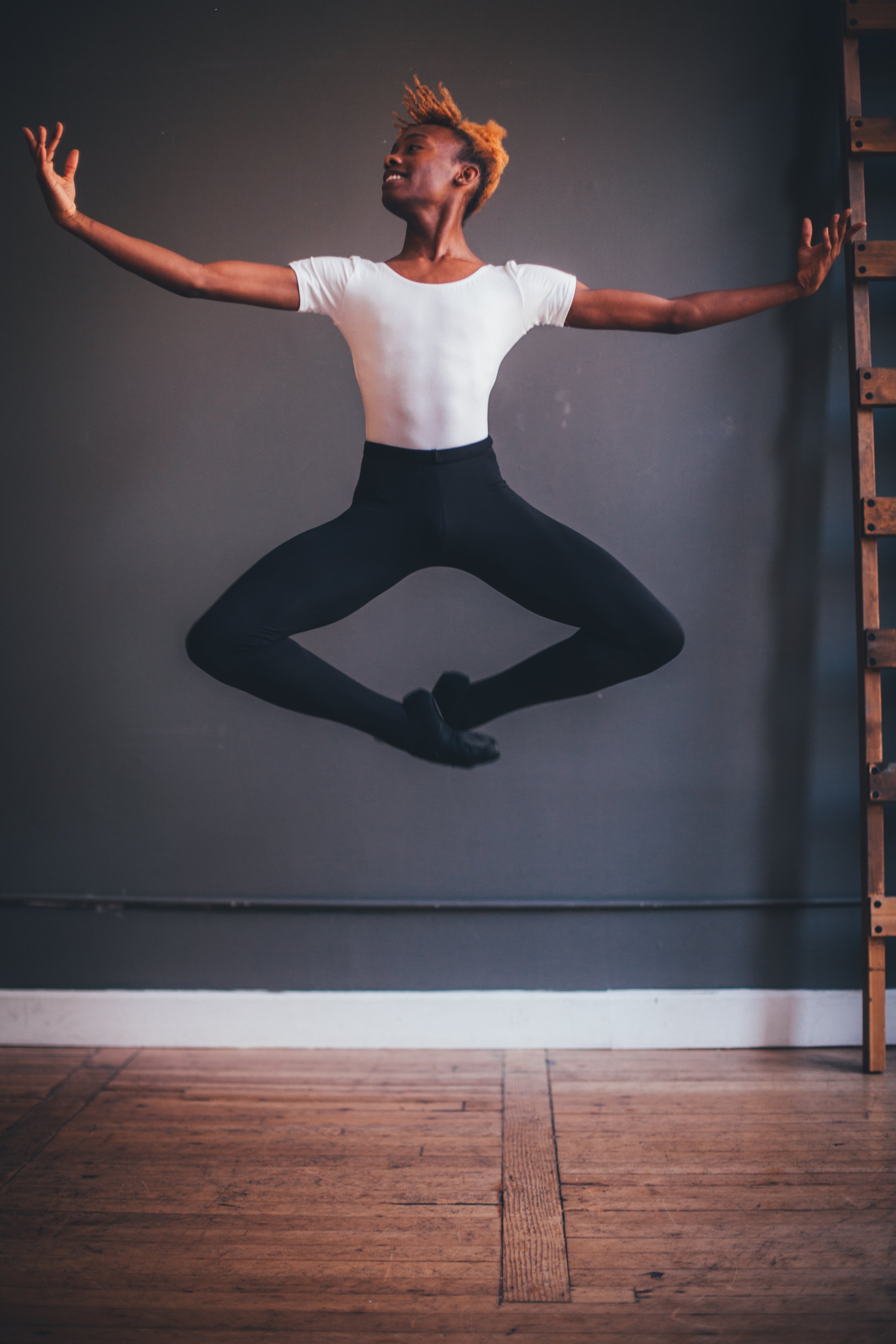
Tights
As a dancer, tights are an item I simply cannot have enough of. Having extra tights on hand is not only helpful in case of emergencies at performances and competitions, but also during a hefty class and rehearsal load each week. At DWC, we have an abundance of classic transition tights, perfect for the busy ballerina. We also carry footed tights, footless tights, fishnets, and men’s tights, so there is an option for whichever genre you’re exploring.

Hanami Stretch Canvas Ballet Shoe
For those taking ballet classes, having a trustworthy pair of ballet slippers is of the utmost importance. Of all the fabulous ballet slippers Dancewear Center carries, the ones I swear by are the Hanami Stretch Canvas Ballet Shoes by Capezio. With its soft canvas fabric, this ballet slipper stretches around the foot and holds it firmly, similar to a sock. The split sole of the ballet shoe allows for a seamless line when pointing the foot, and the no-drawstring design makes it completely hassle-free. This ballet slipper simply cannot be recommended enough!
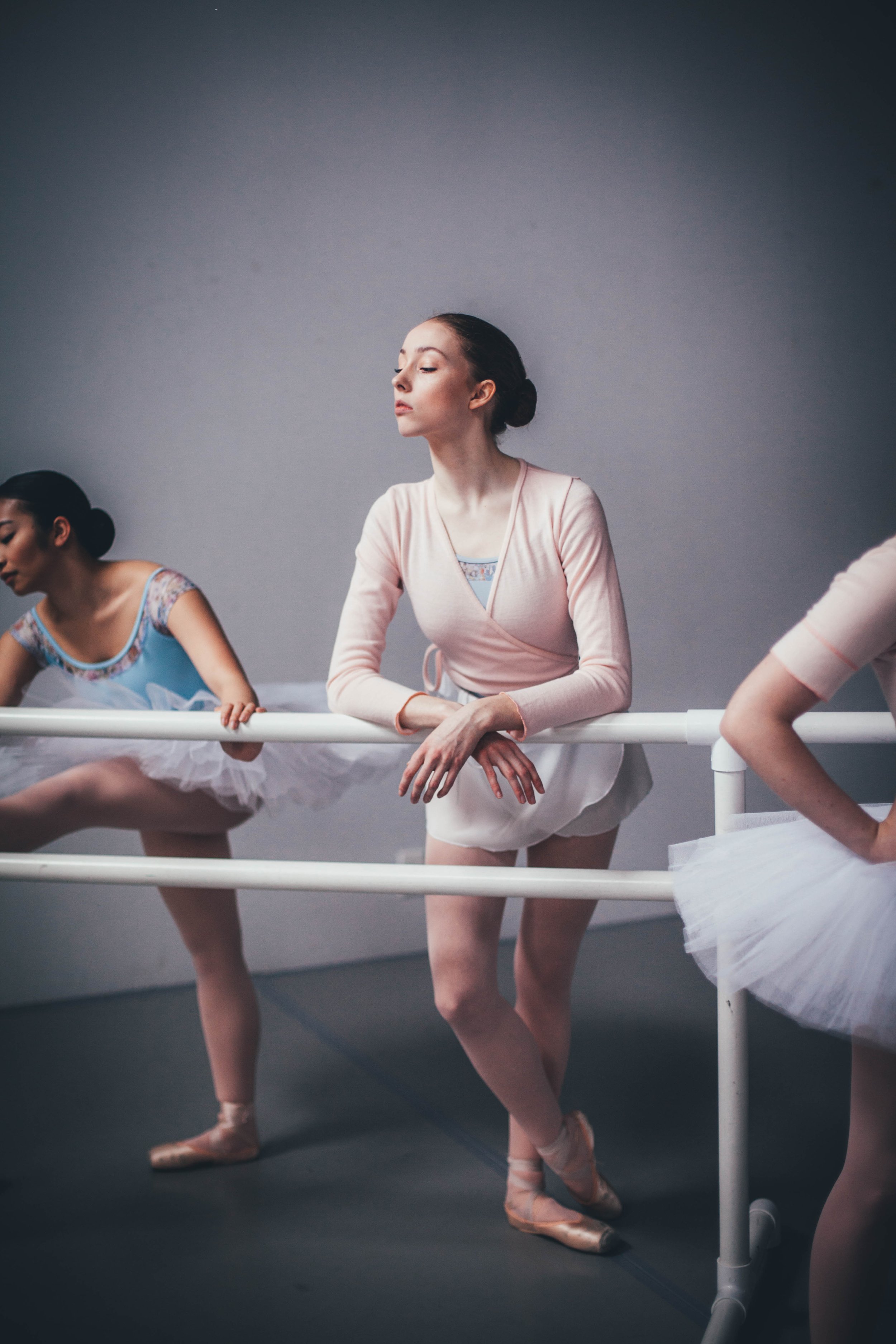
Warm-Ups
As the temperatures outside begin cooling down and dancers have more and more downtime in between classes and rehearsals, it’s important that they wear clothes that keep their muscles warm when they are resting. A wrap sweater is a classic option for bunheads, whereas the Dancewear Center hoodie is sure to keep you warm in the studio and at home. As far as pants go, the Eurotard Ripstop Warm-Up Pants are sure to keep dancers’ muscles insulated with heat, and the Claudia Dean World Tracksuit Pants are the perfect option for staying cozy.

Dance Bags
Back-to-school season is also the perfect time for dancers to try out a new dance bag to carry all their new goodies for the dance season ahead. The AK Multi-Purpose Backpack by AK Dancewear has all the features a dancer needs, including numerous pockets, an air-ventilated shoe compartment at the bottom of the bag, a padded zipper compartment for electronic devices, and a separate wet zipper pocket for temporary sweaty gear. The Claudia Dean World Pro Bag by Claudia Dean World similarly has an abundance of storage space, and insulation, and is complete with adorable rose gold detailing. Or this stylish RP Origami bag!
Tiger Balm
Tiger balm is a topical ointment that is aimed to help relieve sore muscles for dancers and hurt areas on the dancer’s body. This product is perfect for use after a rough class or rehearsal where the body needs a little love. You can keep this product in your dance bag for easy access after summer classes that leave muscles feeling sore. Shop for this product in store at either Dancewear Center location!

Capezio Ballerina Girl Water Bottle
Coming back to dance after a break requires dancers to make sure that they are keeping hydrated. The Capezio Ballerina Girl Water Bottle is perfect for this! This stainless steel water bottle is lightweight and small so it is perfect to travel with and includes a convenient clip on the lid to attach to your favorite dance bag. Be sure to stay hydrated dancers!

Hair Supplies
Every dancer knows the struggle of reaching into their dance bag, looking for the right materials to make the perfect bun and finding…nothing. All of the hair ties, bobby pins and hair nets fall deep into the abyss that is the dance bag. So, in order to be prepared for the inevitable, extra hair ties, hair nets and bobby pins are a must to get through the rough first classes back. DWC has all of your needs covered with different styles and brands to choose from in store or online!
The Flexistretcher
As you are coming back from the off-season you may have lost a little flexibility. Nothing to worry about! The Flexistretcher is designed for dancers to build flexibility safely and in control. With adjustable straps and padded brace, it will help you build your flexibility back and gain even more range than before! DWC also has you covered with how to videos to get you started with your Flexistretcher!
Disclaimer
All content found on the Dancewear Center Website, Instagram, Facebook, Pinterest, and all other relevant social media platforms including: text, images, audio, or other formats were created for informational purposes only. Offerings for continuing education credits are clearly identified and the appropriate target audience is identified. The Content is not intended to be a substitute for professional medical advice, diagnosis, or treatment. Always seek the advice of your physician or other qualified health provider with any questions you may have regarding a medical condition. Never disregard professional medical advice or delay in seeking it because of something you have read on this Website.
If you think you may have a medical emergency, call your doctor, go to the emergency department, or call 911 immediately. Dancewear Center does not recommend or endorse any specific tests, physicians, products, procedures, opinions, or other information that may be mentioned on dancewearcenter.net. Reliance on any information provided by dancewearcenter.net, Dancewear Center employees, contracted writers, or medical professionals presenting content for publication to Dancewear Center is solely at your own risk.
Links to educational content not created by Dancewear Center are taken at your own risk. Dancewear Center is not responsible for the claims of external websites and education companies.
Physically Returning to Dance: Tips on Handling Load Tolerance and DOMS
It’s an exciting time of the year: the leaves are just starting to change colors, there is a crispness to the morning air, and most importantly, we are returning to the studio to dance!
While dancers usually stay very active in the summer, it’s not usually the same intensity or type of training as during the school year. You might have been swimming, hiking, biking, playing beach volleyball, etc. You might have been dancing but the daily dance classes and training were probably less intense or more intermittent. And the classes might have been virtual.
By Colleen Bickel, Local Physical Therapist and Dancer

It’s an exciting time of the year: the leaves are just starting to change colors, there is a crispness to the morning air, and most importantly, we are returning to the studio to dance!
While dancers usually stay very active in the summer, it’s not usually the same intensity or type of training as during the school year. You might have been swimming, hiking, biking, playing beach volleyball, etc. You might have been dancing but the daily dance classes and training were probably less intense or more intermittent. And the classes might have been virtual.
So, picture this. Imagine that you are a marathon runner. And in the training season, you run up to 50 miles a week. In the off-season, you run maybe 6 miles per week just to “stay in shape.” Do you think the first week back in your training season you should go directly to 50 miles?
It’s easy to say in that scenario, “absolutely not.” But, as dancers, we usually go from not dancing to a full schedule, giving 100% to every class. We do it because we are excited to return to the studio and we love to dance. We do it because we don’t want to appear lazy or disappoint our teachers. But this mentality does sometimes lead to injury.
In the world of Physical Therapy, we talk about “load tolerance of tissue” (tissue, in this case, includes muscle, bone, and connective tissue like tendons and ligaments). Basically, what kind of “loads” can your body handle and how quickly can you progress those loads. If you load too fast and don’t allow your body adequate time to rest and repair, then we end up with things like tendonitis, stress fractures, shin splints, or other “over-use” injuries. “Over-use” is pretty much “over-loaded” without adequate chance to rest and repair.
A less worrisome (but often not enjoyable) bodily experience after returning to dance is DOMS (delayed-onset muscle soreness). DOMS is intense muscle soreness that occurs 12-72 hours after an activity. If you are dancing every day, sometimes it’s hard to know what you are feeling sore from; is it today’s ballet class or hip hop 2 days ago?
So, what things should dancers do to mitigate DOMS and possible over-use injuries when returning to dance?

The two big categories for injuries and over-use are jumps and relevés. These are movements that our bodies need to slowly build up a tolerance for and we are likely not performing the same amount of them in our off-season. Ultimately, be thoughtful about the amount of repetitive loading that is occurring each day. How many relevés and how many jumps are you performing each day? You might need to limit this amount and then slowly increase it while also allowing enough time for recovery in between sessions.
When returning from a break, recommendations include:
Make sure you are adequately warmed up.
Be careful about overstretching before class. Focus on improving flexibility after class and perform a dynamic warm-up before class.
Don’t try to perform challenging movements when you are fatigued.
Limit the amount of relevés you are performing daily. Maybe you perform some relevés at barre during ballet but not every combination in the center. Maybe you perform relevés during pointe class but limit them in your ballet class prior. Remember it’s about the total number per day and your body’s ability to have time to recover before performing that activity again.
Limit the number of jumps you are performing daily. Possibly limit the height of your jumps as you slowly return to dance. Focus on building up your tolerance for jumping with smaller jumps and working on good alignment and mechanics.
“Be careful about overstretching before class. Focus on improving flexibility after class and perform a dynamic warm-up before class.”

The two big categories for DOMS are pliés/grandpliés and planks/push-ups. These movements utilize large muscles that will get sore! With DOMS, you should feel the soreness with movement or stretching but not with rest. The soreness should be in the muscle belly and not in a tendon, ligament, or joint.
If dealing with DOMS, recommendations include:
Perform light gentle movement. This could be walking, a light elliptical or bike cardio workout, or going through a dynamic warm-up. This maintains blood flow which nourishes the muscle to heal quickly and does not allow lactic acid to build up.
Research has shown that stretching and releases (ball rolling, foam roller, massage gun, massage session, etc) won’t affect it either way. Won’t make it better, won’t make it worse.
Avoid NSAIDs like ibuprofen. These interfere in the natural process of soreness, recovery, and adaptation.
Overall, make sure you are getting enough sleep and good nutrition. The body recovers while you are sleeping, so if you are not getting enough sleep, you are not recovering to the best of your abilities. If you are not getting adequate nutrition, your body does not have the basic building blocks it needs to recover.
DOMS should resolve with time. If the pain persists for weeks, if you are markedly worse AFTER class, or if the pain is sharp/burning/tingling/searing then you may be dealing with an injury and these factors should be respected. At this point, seeing a physical therapist may be a good idea.
Ultimately, you know your body better than anyone else! Let your teacher know if you need to limit movements and self-advocate for what you need! And just know that after a few weeks of slowly increasing your tolerance, you will be back in great shape and able to go 110%.


DWC Ambassador Kendall Hadley On The Mental Challenges Of Injury
Overcoming the physical and mental challenges of my injury was one of the hardest things I have gone through as a dancer.
In both 7th grade and my sophomore year of high school, I dislocated my knee during dance class. The first time I came out of a jump and landed poorly and sat out for four months. The second time my pointe shoe slid out from under me and I sat out for six months.
By Kendall Hadley, DWC Ambassador
Pronunciation: Can-doll Had-lee | Pronouns: she/her

Overcoming the physical and mental challenges of my injury was one of the hardest things I have gone through as a dancer.
In both 7th grade and my sophomore year of high school, I dislocated my knee during dance class. The first time I came out of a jump and landed poorly and sat out for four months. The second time my pointe shoe slid out from under me and I sat out for six months.
As a dancer I’ve become accustomed to relying on my body to perform as it needs to as long as I take care of it. My injuries were both sudden, unpredictable, and devastating. I could no longer count on my body the way I used to. I had to rely on crutches to walk, and others to be kind enough to help me with simple tasks such as opening the door. During this time I had to repair the physical and mental relationship of my body during the time of my injury, and long after my recovery.
While tedious, my physical recovery is essential to my healing, and it still benefits me today. Having back-to-back doctors and physical therapy appointments was time consuming, but I also learned more about my body in that time than I ever had before. Finding a physical therapist that was supportive as well as knowledgeable of my recovery process was extremely helpful in my recovery. It’s important that your physical therapist knows you are returning to dance, not just to recreational activity. Dance is a physically demanding sport that requires strength and endurance. I had to advocate for myself and explain the physical demands that were required for my sport were not simple. My physical therapist and I both worked to develop a routine that would help me return to my regular dance activity.
After months of hard work, rest, and truly listening to my body I was able to slowly return to taking class. After my second injury I encountered many more mental obstacles than physical. I no longer trusted my body. I was always psyching myself out from trying new movements, compared myself to others, and encountered anxiety within the classroom.
Anytime I was introduced to new movements I encountered anxiety. Fearing re-injury, I found I was holding myself back in dance and wasn’t pushing myself. This stunted my growth as a dancer. I had to learn to overcome these physical and mental obstacles overtime.
The things that really aided me on me journey to mental recovery:
-Go to your dance classes and take notes

I know it can be hard to watch your friends get to dance and not be able to join them, but this will help you learn by watching and remembering your terminology. It also shows that you genuinely want to be there and your instructors will see that.
-Know the difference between pain and discomfort
This requires an elevated awareness of your body that not many people possess. There is a difference between doing something your body isn’t used to and dancing through pain. Learn what is your body entering new territory and what is your body’s way of saying it needs a break.
-Take care of your body
Beyond the doctors appointments and dance classes, there is so much you can do to take care of your body. The little things like cold showers or warm baths make all the difference. Take time to ice your feet, warmup, roll out, stretch, meditate, and do everything your body needs to before hitting the dance floor.
-Be patient with yourself
Being a dancer you require a lot from your body. Understanding that your body needs the time to work up to what it once was is difficult. I have found that in some ways my injury has made me stronger as a dancer and I go into dance with an appreciation for my body and what it is allowing me to do. It may take some time before your body is dancing at the level it used to, but you may be a better dancer because of it.
Disclaimer
All content found on the Dancewear Center Website, Instagram, Facebook, Pinterest, and all other relevant social media platforms including: text, images, audio, or other formats were created for informational purposes only. Offerings for continuing education credits are clearly identified and the appropriate target audience is identified. The Content is not intended to be a substitute for professional medical advice, diagnosis, or treatment. Always seek the advice of your physician or other qualified health provider with any questions you may have regarding a medical condition. Never disregard professional medical advice or delay in seeking it because of something you have read on this Website.
If you think you may have a medical emergency, call your doctor, go to the emergency department, or call 911 immediately. Dancewear Center does not recommend or endorse any specific tests, physicians, products, procedures, opinions, or other information that may be mentioned on dancewearcenter.net. Reliance on any information provided by dancewearcenter.net, Dancewear Center employees, contracted writers, or medical professionals presenting content for publication to Dancewear Center is solely at your own risk.
Links to educational content not created by Dancewear Center are taken at your own risk. Dancewear Center is not responsible for the claims of external websites and education companies.
Interested in writing for the DWC Blog? Click below to fill out the DWC Contributor application!