
Teaching Body Liberation in Dance
I think there are ways that dance teachers can focus on molding confident students who are gentle with themselves and love their bodies, over and above seeking technical excellence. I think studios can welcome in and effectively serve each dancer that walks in their doors. Punishing and accusing our bodies can be seen as an outmoded means to success. Exclusivity and unreachable standards don’t have to be what defines the dance world. Instead, body liberation can be the guiding force and joyful expression can be the ultimate goal of dance education.
Trigger Warning: Eating disorders, Mental Health Concerns
By Hannah Emory, DWC Blog Contributor

From my experience dancing at the collegiate level in the 2020s and beginning to develop my own pedagogical style, I see a lot of exciting room for growth in how dance teachers talk about, interact with, and allow space for the bodies in their studios. A huge wave of creative boundary-breaking has already begun as a result of more types of bodies having space in the dance world. This wave can only get bigger and have more impact as our teaching styles shift toward body liberation.
Cliona Byrne, body confidence coach and author of the Body Blog, writes:
“Body Liberation is freedom from all outside expectations of how your body should be/look, even your own [expectations]… Liberation is not being consumed with thoughts about your body. Liberation is not asking permission to be included in society’s ideal of beauty. Liberation is letting go of the concept that beauty = worth. Liberation is giving ourselves permission to live our lives in our bodies.”
I assume most of us were raised in dance spaces that were the opposite of body liberating. The majority of us probably experienced a rigid aesthetic being honored, dance movement having a narrow definition, and dancers being pigeon-holed into being a certain way of personal presentation. This certainly was the truth for me at many times throughout my formative dance years.
There are folks I watched walk away from dancing because the psychological pressure of ableist and sizeist standards created a toxicity in the studio that even sincere love for dance could not overcome. I was almost one of those people, until I realized that now more than ever we need dancers who know what it feels like to be on the margins and that seek to teach in ways that bring everybody in.
Body liberation has to begin with breaking our own negative thought patterns about the self. It starts with fundamentally believing that every body, including our own, is a dancing body. A succinct lens on body liberation comes from the University of Vermont’s (UVM) Center for Health and Wellbeing:

“the freedom from social and political systems of oppression that designate certain bodies as more worthy, healthy, and desirable than others. We do not believe that bodies that are white, able-bodied, cisgender, thin, or fit are superior, worthier, or inherently healthier than any other bodies.”
According to UVM, impacts of body discrimination extend to many areas of life, including social life, healthcare, mental wellbeing, and relationships with food and weight. Discrimination based on someone’s physical ability, body composition, and presentation of health can lead to a pervasive lack of self-value that stunts personal growth long-term. Arguably, the popular understanding of dance is still a largely discriminatory one.
In an aesthetic- and athletic-focused environment, like the dance industry, that largely thrives on opinions of the populace, it is a difficult thing to not view its participants through a dominant societal lens that promotes harmful messaging about bodies. In an environment where technique is often seen as king, it is not easy to let go of judgments and to not be consumed by body-centered critiques.
So, how do we take a genre like ballet, with specific stylistic hallmarks, and remove judgment from it? How do we make joy and authentic learning the focus instead of primarily focusing on objective outcomes that were handed down to us? These are questions that are not easily answered and it must be acknowledged that teaching always requires a form of constructive evaluation.
But, I think there are ways that dance teachers can focus on molding confident students who are gentle with themselves and love their bodies, over and above seeking technical excellence. I think studios can welcome in and effectively serve each dancer that walks in their doors. Punishing and accusing our bodies can be seen as an outmoded means to success. Exclusivity and unreachable standards don’t have to be what defines the dance world. Instead, body liberation can be the guiding force and joyful expression can be the ultimate goal of dance education.
Body liberation is a powerful mindset, but it can sometimes be difficult to know how to translate something from our headspace out into the real world. Yet, there are many intentional ways to apply a liberating mindset in the studio. A few pieces of constructive advice for teachers on this subject I’ve come across include:

“The cardinal rule of a body-positive teaching style: Correct your students’ dancing, not their bodies.” Comments about the bodies of dancers, especially young ones, should focus on highlighting their strengths and teaching injury prevention, rather than categorizing or critiquing their body composition. (Helen Rolfe, DanceTeacher.com)
Work towards a culture in the studio that “[views] the concepts and practices of wellness and wellbeing as a mindset and a way of life, not as specific behaviors deemed healthy or unhealthy by a dominant culture. Wellness and wellbeing look different to everyone.” (UVM)
Present your students with dance media and auxiliary instruction from creators of multiple backgrounds and physical presentations. Seek to show them concretely that dance is for every body and that discrimination doesn’t belong in dance spaces.
Through self-education, have your teaching honor the subjective nature of dance, respect dancers’ space, and bodily autonomy, and maintain a dialogue with students about positive approaches to movement and dance culture. (ausdance.)
It is not an easy thing to liberate our teaching from models that have been ingrained over generations, but I have seen that there is great momentum for change. Each time we walk into the studio as teachers, there is an opportunity to make dance a life-giving space for all who want to move.

Resources for further reading:
Disclaimer
All content found on the Dancewear Center Website, Instagram, Facebook, Pinterest, and all other relevant social media platforms including: text, images, audio, or other formats were created for informational purposes only. Offerings for continuing education credits are clearly identified and the appropriate target audience is identified. The Content is not intended to be a substitute for professional medical advice, diagnosis, or treatment. Always seek the advice of your physician or other qualified health provider with any questions you may have regarding a medical condition. Never disregard professional medical advice or delay in seeking it because of something you have read on this Website.
If you think you may have a medical emergency, call your doctor, go to the emergency department, or call 911 immediately. Dancewear Center does not recommend or endorse any specific tests, physicians, products, procedures, opinions, or other information that may be mentioned on dancewearcenter.net. Reliance on any information provided by dancewearcenter.net, Dancewear Center employees, contracted writers, or medical professionals presenting content for publication to Dancewear Center is solely at your own risk.
Links to educational content not created by Dancewear Center are taken at your own risk. Dancewear Center is not responsible for the claims of external websites and education companies.
Getting to Know DWC Ambassador Emmy Fansler
Today, Emmy has carved spaces for herself and others that have been long overdue in the dance industry, specifically through the creation of the Best of My Abilities (BOMA) program. The BOMA program, offered at Issaquah Dance Theater and The Dance School, introduces students with disabilities to dance and provides a space for dancers of all abilities to learn and build relationships. “I know that there are lots of people who are afraid to step into a dance studio because they feel like you have to be a certain way...My entire dance life has been [dedicated to] figuring out ways to use dance to show people how loved they are,” she shares.
On the Difference Between Accepting and Embracing
Name pronunciation: Em-me Fan-s-ler | Pronouns: she/her
**Trigger Warning: Trauma, Sexual Assault
By Madison Huizinga, DWC Blog Editor

Emmy largely fell in love with dance because of its healing qualities. “I had quite a bit of trauma in my middle school and high school life,” Emmy says. Due to these experiences, she went from being “somebody that cared about everything” to being “somebody that really didn’t care.” “I just didn’t care about myself anymore [and] didn’t feel like I was worthy of love or praise or attention,” Emmy says. When someone invited her to audition to be a ball guest for Midwest Regional Ballet’s Cinderella, these feelings of unworthiness began to shift.
“I just fell in love with the sense of community,” Emmy says of being a part of Cinderella. She shares that it wasn’t that she was particularly interested in dancing ballet choreography—rather, she was touched that somebody wanted her to be a part of something. In addition, after experiencing sexual trauma, dance helped show Emmy that physical touch could be anticipated, safe, and choreographed. “That was really healing to me,” she says. Since that first day of rehearsal, Emmy says that she hasn’t gone less than dancing twenty hours a week.
She ended up getting a scholarship to study dance at the University of Central Oklahoma after dancing for just three years. Nonetheless, over time, it became clear to Emmy that becoming a professional dancer wasn’t in her future, particularly after experiencing a hip injury and being diagnosed with a thyroid disorder.
“It felt natural that I would be a teacher and choreographer because I didn’t start dance with the idea of wanting to be a professional ballerina necessarily. I started dance because somebody invited me,” Emmy says, and she continued because of the way it made her feel. Today, she’s carved spaces for herself and others that have been long overdue in the dance industry, specifically through the creation of the Best of My Abilities (BOMA) program. The BOMA program, offered at Issaquah Dance Theater and The Dance School, introduces students with disabilities to dance and provides a space for dancers of all abilities to learn and build relationships. “I know that there are lots of people who are afraid to step into a dance studio because they feel like you have to be a certain way...My entire dance life has been [dedicated to] figuring out ways to use dance to show people how loved they are,” she shares.
Emmy loves that dance allows her to take huge feelings she experiences and stories that are challenging to tell and express them on a stage where people can witness her experiences as beautiful. Dancing reminds Emmy that her body is capable of amazing things. And after undergoing a procedure that left her without the ability to conceive children, having a life passion that allows her to connect with children is one of the most important things to her.

While she acknowledges the many challenges she’s experienced in the dance industry, Emmy says that a big one is “imposter syndrome,” or feeling like she doesn’t belong. She points out that there are so many dancers, and people in general, in the Seattle area who have extensive accolades to justify their qualifications. “I don’t have that,” she admits. “Part of me has felt like I have to jump into every situation and prove that I’m capable.” For those who have similarly felt like they don’t belong in certain dance spaces, Emmy says that they undoubtedly do. “Your experience is different than anybody else’s in the world. And there are things that you can contribute that other people cannot. And it’s also okay if they contribute things that you cannot,” she says.
Emmy was inspired to become a DWC ambassador because she strongly aligns with the values of the business. “I feel like this is a space and a platform that’s very authentic,” she says, sharing that she appreciates that DWC strives to help make all dancers feel welcomed and safe in the industry. As an Ambassador, Emmy looks forward to helping affirm this message to dancers and sharing her multiplicity of experiences as a teacher. In addition to her BOMA classes, Emmy teaches classes of all levels and works with the competition team at Issaquah Dance Theater. At The Dance School, Emmy also teaches classes relating to storytelling, partnering, embodied ballet, and more. And she’s the program director for the dance program at Si View Metro Parks. Emmy is excited to show people what it’s like to participate in all of these different spheres of dance.
In the future, Emmy strives to find ways to integrate more student-driven storytelling and choreography classes into her schedule. At Si View Metro Parks, she’s planning on hosting an expressive movement workshop once a month open to dancers of all experience levels. The workshop will be centered on a theme, featuring a discussion portion, a creation workshop, and a small performance that is open to the community. “I have a vision for it. I feel very excited about the possibilit[ies] for it,” Emmy shares of the workshop.
Emmy strongly believes that dance creates a platform for building relationships and in the larger dance industry, she hopes to see more people embracing the differences dancers have and the contributions they can make. “There’s a difference between accepting and embracing,” she points out, sharing her wish for all dancers to not only feel tolerated but cared for and even invited.

“It doesn’t have to be an exclusive space. It can be radically inclusive,” Emmy says of the dance world.
Stay tuned for more from Emmy Fansler in the coming weeks!
If you or someone you know has been sexually assaulted, help is available. The National Sexual Assault Hotline is available 24/7 and is completely confidential: 800-656-4673
Disclaimer
All content found on the Dancewear Center Website, Instagram, Facebook, Pinterest, and all other relevant social media platforms including: text, images, audio, or other formats were created for informational purposes only. Offerings for continuing education credits are clearly identified and the appropriate target audience is identified. The Content is not intended to be a substitute for professional medical advice, diagnosis, or treatment. Always seek the advice of your physician or other qualified health provider with any questions you may have regarding a medical condition. Never disregard professional medical advice or delay in seeking it because of something you have read on this Website.
If you think you may have a medical emergency, call your doctor, go to the emergency department, or call 911 immediately. Dancewear Center does not recommend or endorse any specific tests, physicians, products, procedures, opinions, or other information that may be mentioned on dancewearcenter.net. Reliance on any information provided by dancewearcenter.net, Dancewear Center employees, contracted writers, or medical professionals presenting content for publication to Dancewear Center is solely at your own risk.
Links to educational content not created by Dancewear Center are taken at your own risk. Dancewear Center is not responsible for the claims of external websites and education companies.
Getting to Know DWC Ambassador Grace Pilo
While there is still so much social progress that needs to be made in the dance world, it’s exciting to see studios and companies taking steps to celebrate inclusivity and diversity in ways that didn’t exist years ago. Celebrating inclusivity in the dance world involves inviting dancers with all kinds of backgrounds and identities into the industry, and making them feel welcomed as they are. This also includes celebrating dancers with autoimmune diseases. DWC Ambassador Grace Pilo is passionate about advocating for dancers with autoimmune diseases, particularly those with type 1 diabetes, like herself. Read on to learn more about Grace’s dance journey and advocation efforts!
A Local Dancer on Dancing with Type 1 Diabetes
Name pronunciation: Grace Pie-lo | Pronouns: she/her
By Madison Huizinga, DWC Blog Editor

While there is still so much social progress that needs to be made in the dance world, it’s exciting to see studios and companies taking steps to celebrate inclusivity and diversity in ways that didn’t exist years ago. Celebrating inclusivity in the dance world involves inviting dancers with all kinds of backgrounds and identities into the industry, and making them feel welcomed as they are. This also includes celebrating dancers with autoimmune diseases. DWC Ambassador Grace Pilo is passionate about advocating for dancers with autoimmune diseases, particularly those with type 1 diabetes, like herself. Read on to learn more about Grace’s dance journey and advocation efforts!
“I’ve always been such a wiggly kid,” Grace says, sharing that as a youngster, her mom sought to involve her in an activity where she could release some of her restless energy. She says her mom signed her up for dance and she instantly fell in love with it. Today, Grace dances with Momentum Dance Academy & Ensemble in Burien, Washington.
“In 2015, I was diagnosed with a life-threatening autoimmune disease: type 1 diabetes,” Grace shares. “When I was in the hospital, all I wanted to do was go back to dance.” Before her diagnosis, Grace’s involvement with dance was largely recreational. But after she learned she had diabetes, she shares that her passion for the art form deepened. “I realized why I love to dance,” Grace says. Dance is an opportunity for Grace to be herself and not think about anything else, particularly when she’s performing on stage.
According to the organization JDRF, type 1 diabetes is an autoimmune disease that results from the pancreas ceasing to produce insulin. Insulin is a hormone that the human body needs to get energy from food. Type 1 diabetes strikes both children and adults differently and has nothing to do with diet or lifestyle. To help manage her own diabetes, Grace wears an insulin pump, which delivers constant doses of insulin on a pre-programmed schedule, and allows her to input carbohydrate information for everything she eats or drinks into the pump to calculate and dose insulin. She also wears a continuous glucose monitor or CGM, which measures her body’s glucose levels every five minutes. This information is sent via Bluetooth to her pump and phone and is also shared with her mom to help monitor. She wears both of these devices constantly and they are often visible, including to audience members when she performs on stage.
A challenge that Grace has faced as a dancer with diabetes is dancing with her medical gear, due to the way it’s perceived by others in the industry. “I feel like some doors have been closed for me since my diagnosis,” she says. “I think that people worry about it too much or think I am limited by my medical needs.” Grace says that her medical gear doesn’t stop her from being a talented dancer. “I’m still doing what I love, I just have to work harder than some at times to help manage my condition, but in the end, I’m no different than any of the other [dancers] in my class. I can still be me,” she says.
For other dancers facing similar challenges in the dance world, Grace says to not let anything stop them from doing what they love. For her, communicating transparently with her dance teacher allowed her to realize that there is nothing holding her back from being successful in the studio and on stage. “There’s always people to talk to,” Grace says. “And if you’re feeling like there’s something not right or maybe you’re not having the same opportunities [as others], just bring it up. Talk to someone, let them know how you’re feeling.”
Grace applied to be a DWC Ambassador because of the opportunity the position allows for her to advocate for type 1 diabetics and other dancers like her. She also says that Dancewear Center’s message “every body is a dancing body” greatly resonates with her, which also inspired her to apply for the program. Grace looks forward to being able to utilize Dancewear Center’s platform to reach large groups of people with her messages, particularly through Instagram takeovers.
Outside of the DWC Ambassadorship, Grace advocates for type 1 diabetics on her personal Instagram and with the Pacific Northwest chapter of JDRF, a global organization funding type 1 diabetes research. As a youth ambassador for JDRF, Grace has been a part of public outreach programs, including speaking in front of crowds at events to share her own story.
In the larger dance world, Grace hopes to see a larger cultural shift towards inclusivity and celebrating diversity, especially when it comes to dancers with medical devices or gear. She also hopes to share her story of dancing with type 1 diabetes with others to show that people with medical needs can dance proudly. “I have to wear these medical devices. I’m still a dancer and I still love to dance,” Grace declares.
Sources:
https://www.cdc.gov/diabetes/basics/what-is-type-1-diabetes.html
https://my.clevelandclinic.org/health/articles/9811-insulin-pumps
https://my.clevelandclinic.org/health/drugs/11444-glucose-continuous-glucose-monitoring
Disclaimer
All content found on the Dancewear Center Website, Instagram, Facebook, Pinterest, and all other relevant social media platforms including: text, images, audio, or other formats were created for informational purposes only. Offerings for continuing education credits are clearly identified and the appropriate target audience is identified. The Content is not intended to be a substitute for professional medical advice, diagnosis, or treatment. Always seek the advice of your physician or other qualified health provider with any questions you may have regarding a medical condition. Never disregard professional medical advice or delay in seeking it because of something you have read on this Website.
If you think you may have a medical emergency, call your doctor, go to the emergency department, or call 911 immediately. Dancewear Center does not recommend or endorse any specific tests, physicians, products, procedures, opinions, or other information that may be mentioned on dancewearcenter.net. Reliance on any information provided by dancewearcenter.net, Dancewear Center employees, contracted writers, or medical professionals presenting content for publication to Dancewear Center is solely at your own risk.
Links to educational content not created by Dancewear Center are taken at your own risk. Dancewear Center is not responsible for the claims of external websites and education companies.
Getting to Know DWC Ambassador Emily Borders
There are more ways to be involved in the dance industry than just being a professional dancer. Community members like DWC Ambassador Emily Borders are proving this to be the case by partaking in community classes and studying physical therapy in hopes of making dance more accessible to a wider array of individuals. Read on to learn more about Emily’s personal dance journey, hopes for the larger dance community, and plans as a DWC ambassador!
A Local Dancer and PT Student on Increasing Dance Accessibility
Name pronunciation: Em-ill-ee Borders | Pronouns: she/her
By Madison Huizinga, DWC Blog Editor

There are more ways to be involved in the dance industry than just being a professional dancer. Community members like DWC Ambassador Emily Borders are proving this to be the case by partaking in community classes and studying physical therapy in hopes of making dance more accessible to a wider array of individuals. Read on to learn more about Emily’s personal dance journey, hopes for the larger dance community, and plans as a DWC ambassador!
Emily says that she was an active kid growing up, but it took her a while to realize that dance was her favorite activity. She laughs sharing that it took getting cut from her middle school volleyball team for her to pursue dance wholeheartedly. She danced and competed across many genres throughout high school and majored in kinesiology and minored in dance at Western Washington University. After graduating from college in 2018, Emily has been enjoying taking community classes, dancing around her living room, and trying out aerial silks. She is also in her second year of physical therapy school and plans to graduate in June 2023. Following graduation, Emily looks forward to helping make dance more accessible and affordable to all bodies, particularly to neurodivergent people.
In the larger dance world, Emily sees a great need to make dance teacher education more accessible and affordable as well. She also hopes to see more helpful and accurate information disseminated on how to be a healthy dancer, specifically information on how to nourish oneself, build strength, and cross-train in a sustainable way. For example, she thinks more dance teachers should be educated on how to provide screenings for the female athlete triad, as malnutrition, disordered eating, and a generally increased risk of injury are all common among dancers. Emily shares that when she was 19 she broke her arm by doing a simple cartwheel on a mat, an injury that may have been prevented if she and more dance professionals in the larger industry knew about phenomena like the female athlete triad.
When asked what her favorite thing about dance is, the first thing that comes to Emily’s mind is community. “I feel like my dance friends are probably my closest group of friends,” she says, sharing that they’ve spent so many long hours rehearsing together that it’s hard not to form a tight bond. To this day, the friends she’s made through dance are incredibly supportive of one another.
Emily also appreciates the creativity and artistry that dancers get to hone when practicing their craft. Particularly as an adult dancer, Emily has enjoyed shifting her focus in dance away from improving her technical facility and more on sharpening her artistic skills. “I love that there’s freedom just to move,” she says. Emily also loves that dance is a form of healing. “It’s just really helpful physically, emotionally, [and] mentally,” Emily says of the holistic nature of dancing.

Photo by Robert Borders
Emily says that growing up, she was extremely hard on herself when dancing. She says that being a perfectionist feels inherent in her personality, and can be exacerbated by principles widely disseminated in the dance industry. Dancers are taught that their work is never done - they can always get their legs higher, make their combinations cleaner, and generally improve their technique. But attaining perfection is impossible. For those struggling with this perfectionist mentality, Emily encourages them to acknowledge that this type of thinking comes naturally to them. She points out that having a lot of ambition and drive is helpful, but it’s important to also have balance. For Emily, acknowledging what she’s done well in addition to what she can improve upon is also useful for counteracting perfectionism.
Emily shares that she had been considering applying for the DWC ambassador program for a while. She had been following Dancewear Center on Instagram for some time and was impressed by the fact that the business strives to do much more than sell products. She loved seeing dancers from across the community use Dancewear Center’s platform to amplify their own messages as DWC ambassadors. Emily was hesitant about applying for the program because she hadn’t been dancing for a while and thought she may not be the best candidate. Nevertheless, she reminded herself that she’s a part of this community and has a lot of knowledge to contribute, which led her to fill out the application. As a DWC ambassador, Emily is looking forward to writing blog posts on topics she’s passionate about, especially sharing the physical therapy knowledge she’s gathered in PT school.
“I’ve learned a lot that I felt was lacking in my own life and dance experience growing up,” Emily says, sharing she hopes to give the physical therapy knowledge she’s learned today to others.
Keep an eye out for more from Emily Borders in the coming months!
Sources:
Disclaimer
All content found on the Dancewear Center Website, Instagram, Facebook, Pinterest, and all other relevant social media platforms including: text, images, audio, or other formats were created for informational purposes only. Offerings for continuing education credits are clearly identified and the appropriate target audience is identified. The Content is not intended to be a substitute for professional medical advice, diagnosis, or treatment. Always seek the advice of your physician or other qualified health provider with any questions you may have regarding a medical condition. Never disregard professional medical advice or delay in seeking it because of something you have read on this Website.
If you think you may have a medical emergency, call your doctor, go to the emergency department, or call 911 immediately. Dancewear Center does not recommend or endorse any specific tests, physicians, products, procedures, opinions, or other information that may be mentioned on dancewearcenter.net. Reliance on any information provided by dancewearcenter.net, Dancewear Center employees, contracted writers, or medical professionals presenting content for publication to Dancewear Center is solely at your own risk.
Links to educational content not created by Dancewear Center are taken at your own risk. Dancewear Center is not responsible for the claims of external websites and education companies.
What “Love Your Body Week” Means to Me
In talking with the older dancers, they all say that LYBW has really shaped their perspective of themselves and dance. It’s also found its way into their life outside dance. They’ve been quick to point out when a friend at school was being unkind to their body, and look at social media with less self-judgment. I’m so excited and proud that I’m able to work at a studio that holds this week with high regard. And we continue the ideas of LYBW throughout the year. It’s become so embedded in ATD’s culture, there’s a different feeling just walking into the building.
Promoting Self-Love in the Studio
By Dominique See DWC Ambassador

click below to shop the look:
Summit Track Pant | Dylan Tank Bra | by Girlfriend Collective
We use our bodies for our art. Our bodies are our medium. We strive to make the most interesting/beautiful/unique art with our bodies, sometimes forcing them into harmful situations. However, most of the time, we don’t take a moment to appreciate our bodies for what they are and can do. At All That Dance, there is a week dedicated to loving our bodies. It’s now become a national event, and the National Honor Society for Dance Arts has brought it to many studios around the country.
Love Your Body Week (LYBW) started in 2005, with Rachel Stewart. Rachel was teaching at All That Dance (ATD) and was concerned with the negative body image talk she would overhear students saying. The main idea is to take time out of each class during this week, and have discussions with the students about dance and self-love.
This program has grown over the years, and now makes use of student leadership to facilitate some class activities, overseen by Mary Pisegna Gorder. There is now a curriculum that Mary and Rachel develop each year, with different topics of discussion and activities for different classes. Each of these prompts culminates with each dancer writing or drawing a positive statement about their body. All the dancers then tape their artwork and words of love on the mirrors in the studios till the mirrors are completely covered with heartwarming messages.
As a new teacher at ATD, I experienced my first in-person LYBW in 2021. It was my first full year of teaching a full teaching track load. I was over the moon ecstatic to be a part of this incredible program and week long event. When I grew up, there wasn’t any such thing as LYBW. Looking back, I often ask myself if I could have avoided many nights of tears and frustration that my body wasn’t the perfect “ballet body” if I would have had this program. I struggled with my identity as a dancer since it was a dream to do ballet professionally. I didn’t know what else to do and I felt betrayed by my body. This was all when I was just 12 years old. It was horrible. The pressure I put on myself and the disappointment that I kept feeling left me so uncomfortable in my skin.
I started getting into modern more, and that is where I found my stride. I believed that in modern, it would be ok that I have a much more muscular frame, and shorter legs with a long torso. I believed that I could potentially be a professional modern dancer because of these physical traits.
Thinking about how I leaned into modern dance because I thought it would be more forgiving to different body shapes makes me sad. Don’t get me wrong, I do love modern dance. I love rolling around on the floor, and minimalistic hand gestures (not that that is all that modern dance is). But the fact that I fell in love with modern dance because I was “let down” by my non-ballet body, is not the healthy love story I’d like for my students to hear.

click below to shop the look:
Long story short, I still never got over how my body wasn’t “perfect” for dance. This led to me developing an eating disorder in my early 20’s out of anxiety and fear. This was a dark time for me, and it was during what was supposed to be a highlight of my dance career as well.
I met with Mary pre-LYBW to discuss what I would have to do as their teacher. The National Honor Society for Dance Arts runs LYBW, but the teachers are in the room still for support. I was concerned that my state of mental health and my eating disorder issues were going to get in the way of me holding space for my students. We looked over the curriculum and I felt pretty safe about all the topics besides one. Compliments. The students were going to discuss compliments and how giving compliments to others is easy, but giving a compliment to yourself is much more challenging, if not impossible. The thought of trying to give myself a compliment turned my stomach inside out. I was very concerned that I wouldn’t be able to keep steady in the room with this discussion. We came up with a game plan for me to keep my mental health safe during this day, and I’m so thankful that Mary was understanding.
LYBW kicked off with my Teen Ballet dancers. It was so much fun seeing them excited for LYBW since they’ve been a part of ATD and have experienced it for many years already. They were stoked. The mirrors started filling up with sweet messages. Lots of spelling errors from the little dancers, and big hearts from the older dancers. One said “Taylor Swift loves you just the way you are!” Another said “I love my tummy because it helps me eat.” It was heartwarming reading these messages and then watching my students read them as well. Some dancers had some trouble thinking about what they loved about their bodies. It made me sad for a second, but once I started pointing out the amazing things our bodies do for us, they were able to pick up one of those and run with it.
In talking with the older dancers, they all say that LYBW has really shaped their perspective of themselves and dance. It’s also found its way into their life outside dance. They’ve been quick to point out when a friend at school was being unkind to their body, and look at social media with less self-judgment. I’m so excited and proud that I’m able to work at a studio that holds this week with high regard. And we continue the ideas of LYBW throughout the year. It’s become so embedded in ATD’s culture, there’s a different feeling just walking into the building.

click below to shop the look:
By the end of the week, I was mentally exhausted. My brain was on overdrive trying to protect itself while also holding space and being a supportive teacher to my students. I took all the discussions to my personal therapy sessions and have been slowly picking away at the iceberg that is my mental health and body image. It’s a bummer that I didn’t grow up with LYBW to potentially save some of these issues from existing, but as a dance educator I’m so excited to see what LYBW does to the future of dance. It’s a promising future, and an idea that should never be overlooked. Dancers need the support and reminders that our bodies are amazing. No matter what shape, size, color, or ability. Our bodies are our medium for our art. And if we don’t treat our medium with love and respect, our mediums won’t be there to support us for long.

Disclaimer
All content found on the Dancewear Center Website, Instagram, Facebook, Pinterest, and all other relevant social media platforms including: text, images, audio, or other formats were created for informational purposes only. Offerings for continuing education credits are clearly identified and the appropriate target audience is identified. The Content is not intended to be a substitute for professional medical advice, diagnosis, or treatment. Always seek the advice of your physician or other qualified health provider with any questions you may have regarding a medical condition. Never disregard professional medical advice or delay in seeking it because of something you have read on this Website.
If you think you may have a medical emergency, call your doctor, go to the emergency department, or call 911 immediately. Dancewear Center does not recommend or endorse any specific tests, physicians, products, procedures, opinions, or other information that may be mentioned on dancewearcenter.net. Reliance on any information provided by dancewearcenter.net, Dancewear Center employees, contracted writers, or medical professionals presenting content for publication to Dancewear Center is solely at your own risk.
Links to educational content not created by Dancewear Center are taken at your own risk. Dancewear Center is not responsible for the claims of external websites and education companies.
A PNB Soloist on Mentorship and Being a Ballet Life Coach
When asked about what steps can be done to help alleviate these often harmful expectations, she shares that normalizing the concept of an everyday person dancing is something that needs to be more globally understood. She expresses that it can be hard for trained dancers to look at others’ dancing and not critique them in certain ways. Therefore, Santina believes that the mindset of seeing everyone as a dancer is something that needs to be adopted by dancers all around the world.
Cecilia Iliesiu on Tackling Tough Conversations in the Dance World
By Nicole Barrett, DWC Blog Co-Editor


Diving into the tough conversations about mental health and preparing for jobs that are engulfed in the dance world is something that Pacific Northwest Ballet Soloist Cecilia Iliesiu is very passionate about. Having danced professionally for thirteen years, she knows that the ups and downs in a dancer’s career can be very tough. By creating and running the Mentorship Program at PNB School (PNBS), she is tackling those issues head-on and providing pre-professional dancers with career support through Ballet Life Coach. Read on to learn more about Cecilia’s dance journey and the steps she’s taking to create a more open and supportive space for dancers.
Cecilia was born and raised in New York City, New York, and trained at the School of American Ballet from the ages of eight to eighteen. After her training, she landed a company job at the Carolina Ballet. She danced there for six seasons and became a soloist, but after dancing there for years she knew that she wanted to be on another path. Cecilia auditioned internationally and domestically for numerous ballet companies and Pacific Northwest Ballet offered her a job. She has now been dancing with the company for seven seasons and became a soloist in 2020. “I plan on dancing until I stop learning or my body tells me not to,” Cecilia shares.
Outside of dance, Cecilia loves to go swimming, kayaking, do yoga, and make pottery. She bikes to work every day and has many other hobbies that give her a perspective outside of dance. Cecilia also graduated from Fordham University with a Bachelor’s degree in Communications and Media Studies while dancing full time at Carolina Ballet and PNB.
Cecilia runs PNBS’s Mentorship Program with fellow PNB dancer Amanda Morgan. Starting in March 2020, this program was founded by Morgan and aimed to help with the mental health challenges dancers were facing during the pandemic. This program has evolved to work with dancers in the highest six levels of the PNBS and includes PNB company dancers as the student’s mentors. Cecilia and the mentors work very closely with PNBS consulting therapist Josh Spell to ensure that all the sessions meet the needs of the students. Each level of the Mentorship Program has two sessions per month, one with a company mentor and one with a therapist. The meetings discuss topics like body image, goal setting, work ethic, grappling with self-doubt, and much more. "I can see the students' confidence blossoming in each mentorship chat. The student's vulnerability to talk about their struggles in dance is incredible. The safe space allows them to verbilize, process, and connect with their classmates in a really meaningful way.” Cecilia says about the mentorship program.
During the pandemic in particular, Cecilia noticed a plethora of needs expressed by the pre-professional dancers she worked with in the PNBS Mentorship Program. In particular, dancers needed assistance with company auditions, including help with resumes and cover letters, which led her to give advice and create resources. Helping dancers with a business-side baseline to start their careers was something that motivated her to create Ballet Life Coach, an online resource to help dancers achieve their professional goals and guide them towards a successful career.
Ballet Life Coach currently offers a free 8-Step Audition Checklist with suggested timelines and to-do lists, a resume template, and audition template package that covers the important audition materials. Dancers can also now book one-on-one coaching sessions with Cecilia herself to review and fine-tune audition materials. Click here for more information! In the future, she hopes to see this kind of administrative and holistic support integrated into dance school education
Coming up, Cecilia is offering workshops for year-round schools and summer courses on pre-audition preparations. She was involved in workshops for the summer course at PNB in 2021 and is planning to expand to more schools this summer. One of her big goals is to not only do these workshops for PNB but include other companies in different areas and create more in-depth audition preparation programs.

One of Cecilia’s favorite things about dance is performing. She shares that when the pandemic started, it was very hard for her to switch over from a real audience to a screen. “I just love expressing myself on stage and creating different storylines and characters,” Cecilia shares about performing live. She also shares her love of seeing her coworkers dance along with her and just enjoying the presence of everyone onstage.
When asked about her biggest struggle in the dance world, Cecilia expresses that the mental blocks that dancers face can pose huge challenges. She shares that throughout a dancer’s training process, the physical aspects of learning how to do certain movements often come before the mental challenges that are endured when attempting such things. Cecilia ties this topic back to her work with the Mentorship Program, sharing that she wants to make these conversations about mental health more accessible for dancers. “To me, ballet is physically demanding, but the mental part of it isn’t talked about, and honestly is often the hardest part of dancing,” Cecilia shares.
Cecilia wants dancers that are struggling with similar mental health issues to know that they are not alone, and that they should not be afraid to ask for guidance. She expresses the importance of talking to your peers about any issues. Everyone is going through something, so having these open discussions, and not suppressing your feelings is something that is very important.
Moving forward into the dance world, Cecilia would like to see more normalization of tough conversations within the dance community. She shares that the transitions between what ballet is now versus what it has always been can be very hard for companies and dancers to grasp, so making that transition is something that Cecilia finds very important. “The next generation of dancers need to be the change that they want to see in the ballet world,” she shares.

Disclaimer
All content found on the Dancewear Center Website, Instagram, Facebook, Pinterest, and all other relevant social media platforms including: text, images, audio, or other formats were created for informational purposes only. Offerings for continuing education credits are clearly identified and the appropriate target audience is identified. The Content is not intended to be a substitute for professional medical advice, diagnosis, or treatment. Always seek the advice of your physician or other qualified health provider with any questions you may have regarding a medical condition. Never disregard professional medical advice or delay in seeking it because of something you have read on this Website.
If you think you may have a medical emergency, call your doctor, go to the emergency department, or call 911 immediately. Dancewear Center does not recommend or endorse any specific tests, physicians, products, procedures, opinions, or other information that may be mentioned on dancewearcenter.net. Reliance on any information provided by dancewearcenter.net, Dancewear Center employees, contracted writers, or medical professionals presenting content for publication to Dancewear Center is solely at your own risk.
Links to educational content not created by Dancewear Center are taken at your own risk. Dancewear Center is not responsible for the claims of external websites and education companies.
Promoting Empowerment and Body Positivity Through Movement
When asked about what steps can be done to help alleviate these often harmful expectations, she shares that normalizing the concept of an everyday person dancing is something that needs to be more globally understood. She expresses that it can be hard for trained dancers to look at others’ dancing and not critique them in certain ways. Therefore, Santina believes that the mindset of seeing everyone as a dancer is something that needs to be adopted by dancers all around the world.
Santina Rigano-Lesch on Breaking the Stereotypes of Dance
By Nicole Barrett, DWC Blog Writer
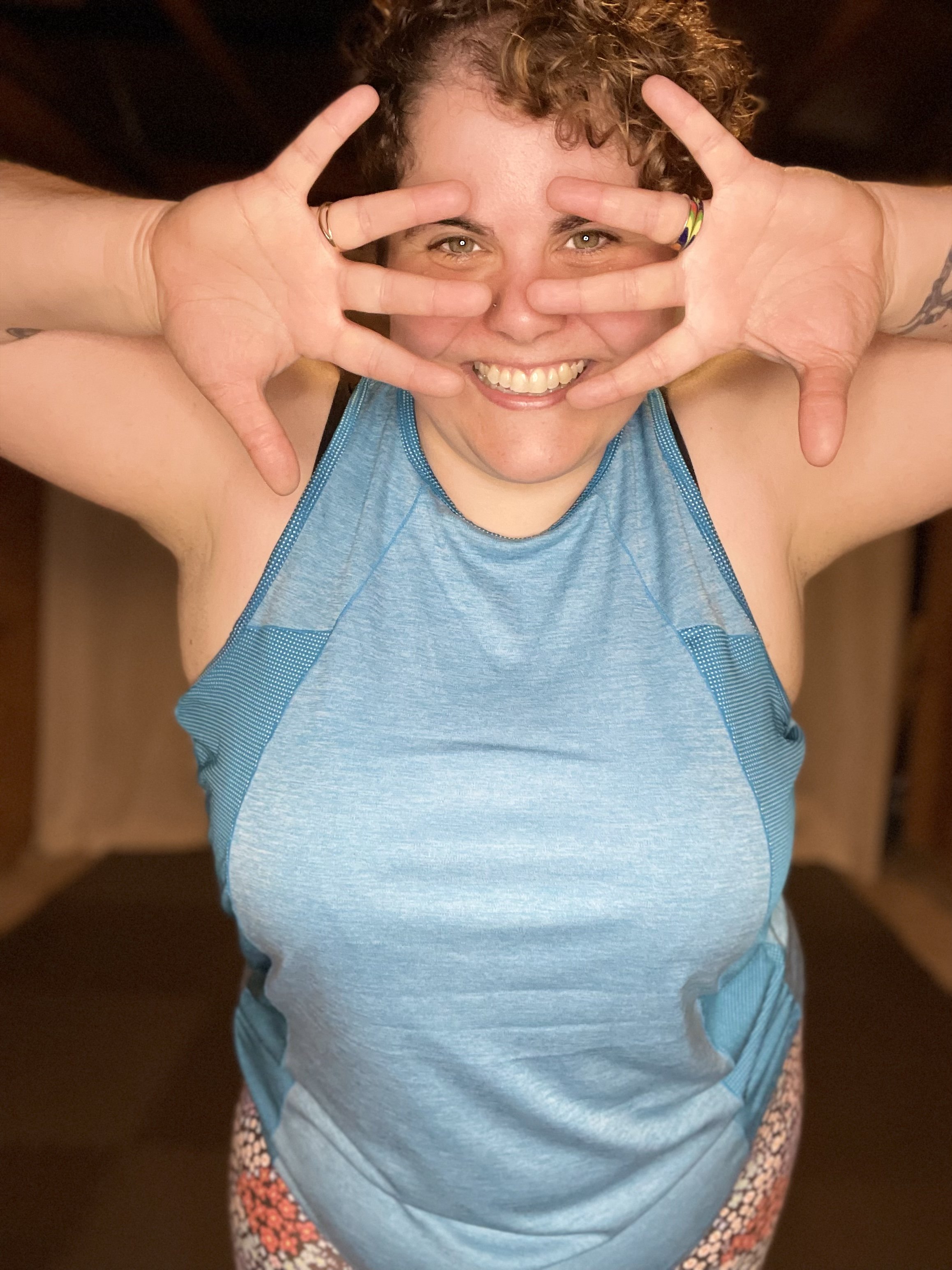
Like many, Santina Rigano-Lesch found the COVID-19 pandemic to be a time for herself to hone in on what she’s really passionate about. From this time of reflection, projects like Unstoppable You and Unstoppable Babes were born. Read on to learn about these projects and more about Santina’s dance journey and upcoming work!
Santina is originally from Australia and started dancing when she was four years old. Later on, she ended up managing a performance company, while she was coaching national hip hop championships and touring around Australia. What brought her to the U.S. was being an au pair in Philadelphia, Pennsylvania, and she began dancing there as well. In her job contract, she got moved to Seattle and wanted to stay here. She met her wife in Seattle and realized that she wanted to start her own dance studio near her where she could create a space for people to engage in the “alternative styles of dance.”
“Seattle has such a big contemporary and ballet scene,” Santina recalls being in Seattle’s established dance world. When she was building her studio, she realized that she had to start from the ground up to create a name that people would recognize, like in Australia. In the U.S., she faced challenges building such a name. Because of this, she worked with Seattle Parks and Recreation to get her name out there and to forge a partnership to help create what she envisioned.
One thing that was important for Santina regarding her dance studio was creating a space for people to explore their creativity. She started teaching children through daycare and elementary enrichment programs, along with teaching studio classes to 400 kids weekly. Santina wanted to create a non-traditional dance space, where she taught ballet to reggae music and worked to foster a safe, body-positive, and inclusive environment for everyone.
Once the pandemic hit, everything about the studio changed. Regulations based upon quarantine guidelines created a nearly impossible environment for Santina to continue doing the thing she loved. So, she made the conscious and bittersweet decision to shut down the studio in May 2020. She then pivoted her focus to create a new business called Don’t Do It Yourself Virtual Assistance Services where she started her work with studio owners who were having trouble with their social media and virtual assistant tasks.
Adding to her many other projects, she started her podcast Unstoppable You, which is all about empowering women in the body love space and crushing the body standards in society. Tagging onto Unstoppable You and her larger Confidently You brand, she started an online monthly membership Unstoppable Babes that is aimed at women wanting to get involved in loving their skin and their body. Santina’s main goal in creating these spaces was to speak up about the empowerment of women. She shares that because of COVID, she was able to sit down and assess what she was truly passionate about. She realized that what she was truly enthusiastic about was working with women like herself and helping empower them by bringing them in closer touch with their femininity. “[There’s] this avenue that I’ve gone down of helping women get confident within themselves, whether that’s dance-wise or business-wise,” she shares.
Santina’s favorite thing about dancing is the ability to express yourself in ways that in everyday life you just can’t. Growing up in Australia, the “you can only speak when you are spoken to” mindset was prevalent and she shares that she struggled with expressing herself verbally. Dance is what allowed her the ability to express herself and show how she feels without the hassle of using words.
One of Santina’s biggest struggles in dance has always been the way that she looks. She recalls being told by one of her ballet teachers that she was “too fat” to be a ballet dancer and she shares that it completely crushed her. Santina struggles with Polycystic Ovarian Syndrome (PCOS) which inflames the entire body and can cause weight gain, among other things. This thin-bodied stereotype in the dance world is what made her look into other styles of dance, which is what she mainly practices now. Because of this, Santina’s advice for anyone going through the same issue is “don’t care about what anyone else thinks.” She shares that everyone struggles with something in or out of dance so if you love to dance, it doesn’t matter what your body looks like, just get moving.
Something that Santina would like to see change in the dance world is breaking the stereotype that dance is only for a trained dancer. “Based on conversations I have with women every day that want to dance, they feel this judgment that they didn’t start dancing sooner and feel immense anxiety attempting a dance class full of trained dancers,” Santina shares about the expectations in the dance world. She believes that dance is for everybody no matter who you are or what you do.
When asked about what steps can be done to help alleviate these often harmful expectations, she shares that normalizing the concept of an everyday person dancing is something that needs to be more globally understood. She expresses that it can be hard for trained dancers to look at others’ dancing and not critique them in certain ways. Therefore, Santina believes that the mindset of seeing everyone as a dancer is something that needs to be adopted by dancers, and by all, around the world.

At the same time, Santina mentions that she doesn’t like to use the word “normalize.” She shares that her wife has experiences with mental illness and has developed an unfavorable opinion of the word. “The reason why I don’t like using the word normalize comes from me educating myself in mental health and being there for an advocate and [in] support [of] my wife,” Santina shares. The word “normal” can be perceived in a marginalizing way and Santina doesn’t use it out of respect for the way it makes her wife feel and to show more understanding to the community that experiences mental illness as well.
Santina has many different projects coming up! Free Your Body, a dance-inspired bootcamp that ran from May 17th to May 22nd using movement to unleash trauma, is now available in recorded replay format. She also has her Unstoppable Babes membership program online that has classes on Wednesdays and Saturdays allowing the everyday woman to tap into their sensual and embodied side to reclaim themselves, let go of stories holding them back and put themselves first. Lastly, something that is in the works right now for Santina is a group coaching program for female entrepreneurs that aims to help them feel more comfortable with getting visible online in their businesses.
Be sure to check out Santina’s work on her website www.santinarigano.com for more information!
Disclaimer
All content found on the Dancewear Center Website, Instagram, Facebook, Pinterest, and all other relevant social media platforms including: text, images, audio, or other formats were created for informational purposes only. Offerings for continuing education credits are clearly identified and the appropriate target audience is identified. The Content is not intended to be a substitute for professional medical advice, diagnosis, or treatment. Always seek the advice of your physician or other qualified health provider with any questions you may have regarding a medical condition. Never disregard professional medical advice or delay in seeking it because of something you have read on this Website.
If you think you may have a medical emergency, call your doctor, go to the emergency department, or call 911 immediately. Dancewear Center does not recommend or endorse any specific tests, physicians, products, procedures, opinions, or other information that may be mentioned on dancewearcenter.net. Reliance on any information provided by dancewearcenter.net, Dancewear Center employees, contracted writers, or medical professionals presenting content for publication to Dancewear Center is solely at your own risk.
Links to educational content not created by Dancewear Center are taken at your own risk. Dancewear Center is not responsible for the claims of external websites and education companies.
How to Recover From a Tough Class: A Guide for Students and Teachers
We have all been there as dancers. We’ve all had that class where nothing seems to be going our way. We mess up every combination, we can’t balance longer than a couple of seconds, we fall out of every turn, or completely botch a petite allegro. It’s so easy to let self doubt and negativity completely destroy us. It’s easy to let those feelings of failure take over. Sometimes it feels like every combination gets worse and worse to the point you want to give up and run out crying. As teachers, we’ve also been there when we can see students starting to struggle and then it causes us to doubt ourselves as valuable educators.
By Austin Sexton, DWC Ambassador
Medical Disclosure: Dancewear Center does not claim to have any medical expertise on any circumstances or diseases discussed. This is Austin’s personal experience and opinions. If you need help see the resources listed at the bottom of this post. If you or someone you know needs immediate medical attention, call 911.

click below to shop the look:
We have all been there as dancers. We’ve all had that class where nothing seems to be going our way. We mess up every combination, we can’t balance longer than a couple of seconds, we fall out of every turn, or completely botch a petite allegro. It’s so easy to let self doubt and negativity completely destroy us. It’s easy to let those feelings of failure take over. Sometimes it feels like every combination gets worse and worse to the point you want to give up and run out crying. As teachers, we’ve also been there when we can see students starting to struggle and then it causes us to doubt ourselves as valuable educators.
Most of the time, the reasons for having a hard class have nothing to do with our technical ability or worthiness as educators and everything to do with outside factors. Maybe you had a tough day at school, maybe your body is processing some trauma, maybe your body needed more nourishment that day, and you didn’t realize it until you were halfway through a tendu combination. But sometimes, maybe the class is harder than you expected and you weren’t prepared for the challenge because of those outside factors.
As a teacher, I have also had classes where I go into it with good intentions, but I’ve let my outside factors take over and things start to spiral. I can see that I’m not connecting with the students in the way I intended, and I can see their self doubt kicking in, which then in turn, causes my own self doubt to kick in. I start to question if I’m a good teacher, if they trust me, and imposter syndrome tries to take hold of the truth.
It’s important to not let one rough class define your worth as a dancer or teacher and more importantly your worth as a human.

click below to shop the look:
Officially En Pointe Tee by DWC | This body dances beanie by DWC
Here are some ways to recover when you’ve had a class that makes you want to quit:
CRY. I mean it. It is okay to cry. Crying releases so much tension and emotion out of the body, that I promise you will feel better afterwards. Crying is not weak (this is something I’ve really had to work on for myself). Crying is the body's natural way of releasing negative emotions so that it doesn’t hold it in and manifest in the body through pain or injury. As a teacher, sometimes it can be very scary to see a student crying, because it feels like a personal attack on our teaching ability, or our worth as a teacher. But I have been trying to understand that maybe sometimes the student can’t control it and that it's genuinely the body doing what it’s supposed to do. However, if it is a result of my inability to meet a student’s needs, I try to hold accountability and take action to reconcile through communication and redirection. I recommend finding a safe space and/or a safe person and crying as much as you need to.
Take a break. If you’re in the middle of class and you feel tension rising in your body and self-doubt kicking in. Attempt to communicate to your teacher that you need a moment. As a teacher, I try to be in tune with my students and notice if they’re struggling, but not every teacher does. So, try to find an appropriate moment to say something like, “I need a moment to collect myself” or “I’m having some anxiety, may I please be excused for a moment?” The most obvious moment is between barre and center or warm up and progressions, but we can’t control when we reach our limit, so in extreme cases, if you just need to step out without saying anything, that’s okay too. Your mental health is more important than five minutes of class. As long as there is communication with your teacher either before or afterwards, then it is okay to take a break.
Do some grounding exercises after class. It’s easy to let yourself spiral into all of the negative moments in class and to fixate on every missed tendu or stumbled glissade. Breathing helps so much. Take some deep breaths and try to de-center your thoughts of negativity and tell yourself that you are safe and that you are worthy. As you’re breathing, try to recall three positive moments in the class and let those be the light that carries you through. Choosing to recall the good moments over the bad can help you realize that the class was not completely terrible and that although sometimes class is hard, you are still strong and powerful. Pick a color and identify items in the room of that color. This activity helps to bring your consciousness out of your head and into the room so you can begin to think logically about the class and identify what went well and what didn’t. For more grounding techniques visit: https://www.healthline.com/health/grounding-techniques#physical-techniques
Self-affirm. Remind yourself that you matter and that you are worthy of having access to the joy of dance. Remind yourself that you are doing your best with the tools that you have in your box that day, and that the goal is not to be perfect. The goal is to do your best and give 100% of what you have to offer that day. That might change from day to day, depending on your stress levels and outside factors and that’s okay. Tell yourself that you did your best. But also, have a conversation with yourself about what you could have done differently. It’s good to hold yourself accountable, while also reminding yourself that it’s okay to make mistakes, because mistakes are where you learn the valuable lessons in life.
Lastly, as teachers, we hold the power and therefore, we are responsible for taking accountability for the outcome of the class. After a tough class, talk to your students. Have a moment with them to not only take accountability for how you could have improved in the moment and also tell them what your intentions were. Show students that they deserve respect and that you are capable of apologizing and reconciling after tough moments. Assure them that you want to see them doing their best and that you are also doing your best. Tell them you don’t ever expect perfection from them, but you expect intention and for them to simply try, even if they make mistakes. Showing students your own vulnerability can create a safe space for them to be able to take risks and not give up on themselves, because you won’t give up on them.

click below to shop the look:
Not every dance class you take is going to be perfect. Not every pirouette you do is going to be flawless. Sometimes, class is going to be hard-and that’s okay. Sometimes, you’re going to completely screw up a combo-and that’s okay. It is 100% okay to have a “bad class.” But when you let that one pirouette, or missed pas de bourre completely ruin the rest of class for you, that’s when you’re letting yourself down. Don’t let one tough moment in time define your worth as a dancer. You are still worthy, you are still strong, and most importantly the work that you’re doing matters. When you give up on yourself, you give up on the possibility of a successful moment and give the one flaw too much power. No one is perfect, but what you can do is decide to do your best, every day. Even if that looks different from day-to-day. Your best is best.
RESOURCES
https://www.healthline.com/health/grounding-techniques#physical-techniques
Students, please talk to your parents or an adult you trust if you need help. They can connect you with a doctor. If you need immediate help, here are some resources:
Getting to Know DWC Ambassador Claire Kaskel
Many dancers experience common challenges that aren’t often brought into conversation in class settings, including feelings of physical and technical insecurity. DWC Ambassador Claire Kaskel is an advocate for fostering open communication across dancers, instructors, and studio owners to ensure dancers know they are valued for their uniqueness. Read on to learn more about Claire’s dance journey, the changes she wants to see made in the dance industry, and her plans as an ambassador.
A Conversation About Embracing Uniqueness
By Madison Huizinga, DWC Blog Editor
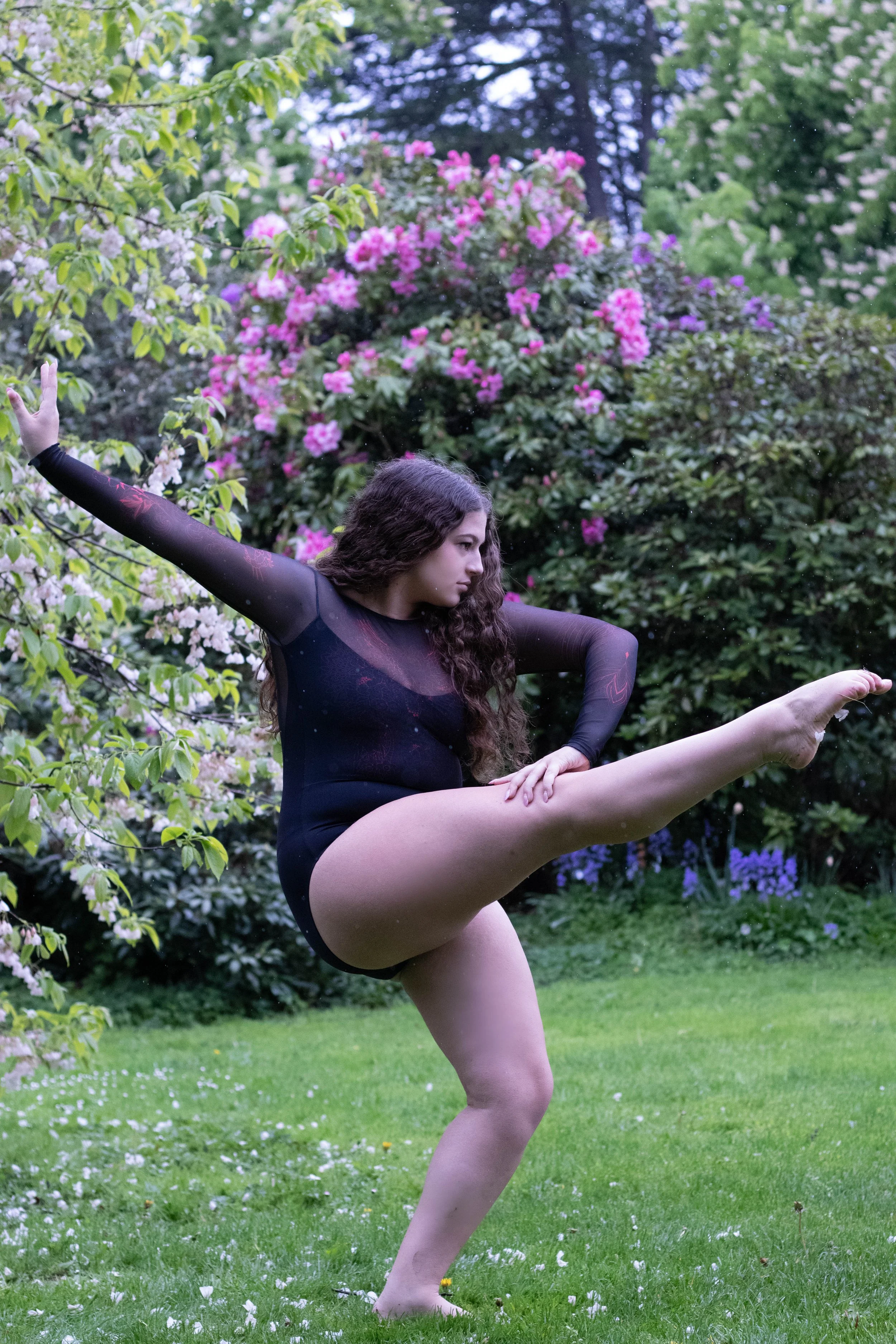
Photo by Catlyn Griswell | click below to shop the look!
Many dancers experience common challenges that aren’t often brought into conversation in class settings, including feelings of physical and technical insecurity. DWC Ambassador Claire Kaskel is an advocate for fostering open communication across dancers, instructors, and studio owners to ensure dancers know they are valued for their uniqueness. Read on to learn more about Claire’s dance journey, the changes she wants to see made in the dance industry, and her plans as an ambassador.
Like many dancers, Claire began in a ballet class around age three. As she got older, she began exploring other styles, including jazz and lyrical. When she was eight years old, Claire began competing mainly in jazz and lyrical genres, later dabbling in salsa, Paso Doble, hip hop, tap, and contemporary.
“I really love competing and I really love being a part of a studio. For me, that’s one of the best parts [of dance],” Claire says. She shares that she’s also gotten the opportunity to teach dance to younger students, which has been a great source of joy. Claire loves that teaching allows her the chance to help children cultivate what might be their own lifelong passion for dance. Claire also loves the therapeutic qualities of dancing, sharing that attending dance class allows her to release stress and feel grounded.
“Something that I’ve struggled with a little bit throughout my time as a dancer [is] feelings, here and there, of not being enough,” Claire shares. She says that whether it’s feeling like her dance technique is subpar or feeling like her body isn’t the “right” look to be attempting a certain style, dance can bring out some uncomfortable emotions from time to time. “It makes you second guess yourself and it makes you feel super insecure and confused,” Claire speaks on these feelings. She points out that settings like competitions and conventions can sometimes foster an environment of comparison that encourages this unfavorable self-evaluation.
To help manage these unpleasant feelings, Claire advises dancers to rethink and reassess their thoughts and remember that who they are as a dancer is valuable. “[Each] different dancer is going to bring something unique and special to the table,” she says. Claire, herself, is always enamored by dancers who put their own special spins on their movements, making them their own. “You should always be working to continue improving, but you also need to be appreciative of what you have and the body that allows you to dance and the mind that allows you to learn,” Claire says.
One change Claire hopes to see made in the dance world is more diversity across every facet of the industry, in terms of racial backgrounds, body sizes, and more. She hopes that all types of people can be welcomed and embraced in the dance industry, by actors on all levels helping foster a more inclusive environment. She also hopes to see the dance industry make more efforts to keep dancers safe, particularly in the competition world, and listen to young dancers when they voice the challenges they’re experiencing.
Claire says that she’s been shopping at Dancewear Center for years, but learned about the ambassador program recently through DWC Ambassador Kristina Koumaeva, as she is a teacher of hers at Premiere Dance Center in Redmond, Washington. After seeing Kristina’s social media posts about the ambassador program, Claire felt inspired to apply herself. “I’m really excited that I get to be here and I get this opportunity!” Claire says.
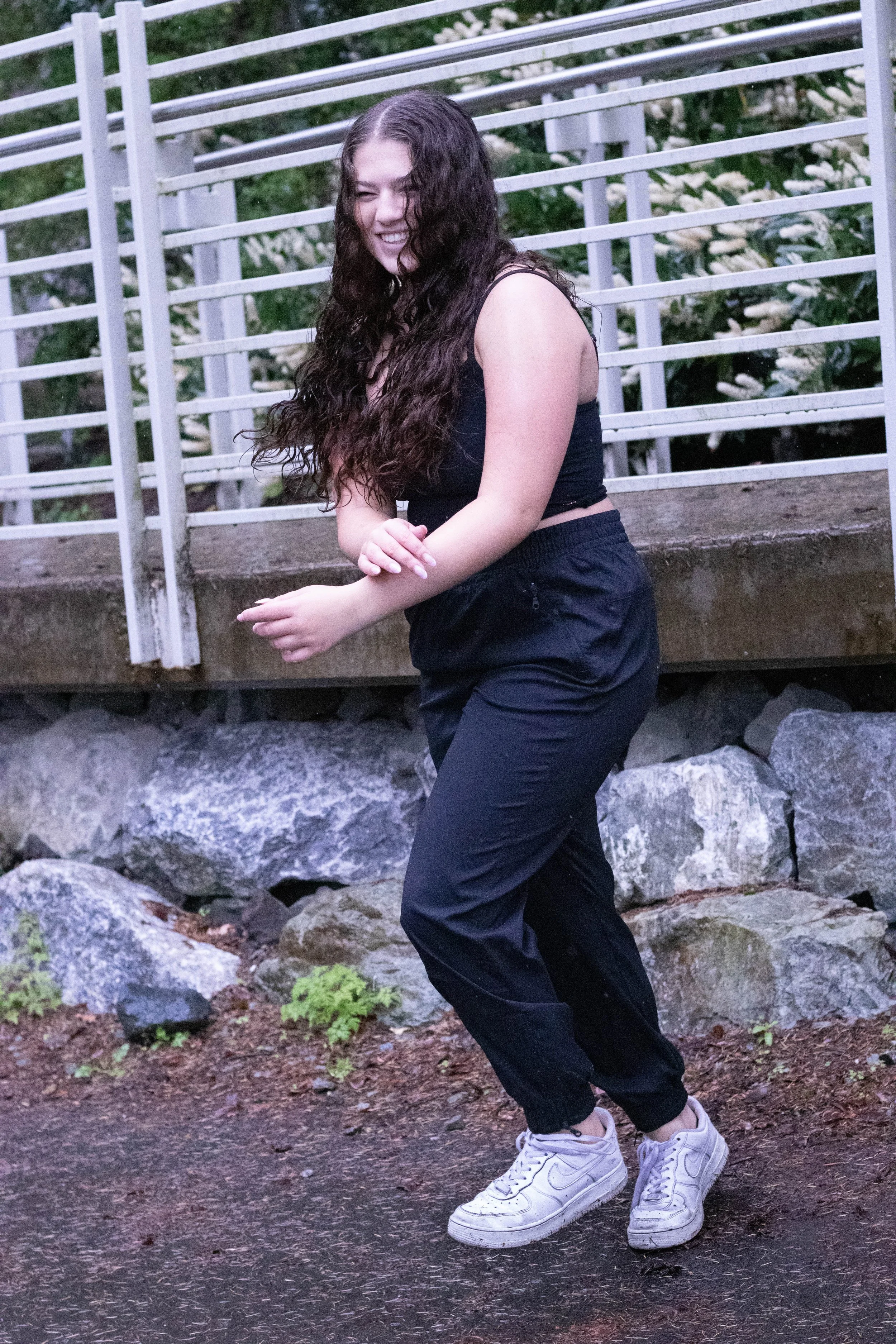
Photo by Catlyn Griswell | click below to shop the look!
In general, as an ambassador, Claire looks forward to being able to help support a local business and have a platform of her own to share her love for dance. She loves the idea of potentially inspiring others through the messages she puts out.
In addition to the DWC ambassadorship, in the coming weeks, Claire is looking forward to performing in her studio’s end of the year recital with Premiere Co., a pre-professional dance company at Premiere Dance Center. She is also preparing for the company’s auditions for the 2022-2023 season and getting ready to attend a national dance competition this summer.
We’re thrilled to have Claire as a DWC ambassador! Stay tuned for more from her in the coming months!
Disclaimer
All content found on the Dancewear Center Website, Instagram, Facebook, Pinterest, and all other relevant social media platforms including: text, images, audio, or other formats were created for informational purposes only. Offerings for continuing education credits are clearly identified and the appropriate target audience is identified. The Content is not intended to be a substitute for professional medical advice, diagnosis, or treatment. Always seek the advice of your physician or other qualified health provider with any questions you may have regarding a medical condition. Never disregard professional medical advice or delay in seeking it because of something you have read on this Website.
If you think you may have a medical emergency, call your doctor, go to the emergency department, or call 911 immediately. Dancewear Center does not recommend or endorse any specific tests, physicians, products, procedures, opinions, or other information that may be mentioned on dancewearcenter.net. Reliance on any information provided by dancewearcenter.net, Dancewear Center employees, contracted writers, or medical professionals presenting content for publication to Dancewear Center is solely at your own risk.
Links to educational content not created by Dancewear Center are taken at your own risk. Dancewear Center is not responsible for the claims of external websites and education companies.
Getting to Know DWC Ambassador Dominique See
One of the things that Dominique is looking forward to about being an ambassador is that it can allow her to become more of an advocate for mental health in the dance world. Having gone through these experiences herself, she wants to be able to raise awareness for these issues that are very common in the dance world. At All That Dance where Dominique teaches, there is Love Your Body Week that has been picked up by numerous other studios around the country where time is taken out of dance classes during the week to discuss loving your body. Dominique shares that this week is something that has helped her want to lift up the voices of people struggling with these issues and advocate for more awareness.
By Nicole Barrett, DWC Blog Writer

Photo by Catlyn Griswell | click below to shop the look!
Advocating for mental health around the dance community is something very important to one of our new DWC ambassadors, Dominique See. Starting at the age of three, Dominique has always been involved in the dance world and has strived to achieve the acceptance everyone deserves. Read on to learn more about Dominique’s dance journey and work at All That Dance and Genki Pilates!
Dominique is from a small town in southern Washington State called White Salmon where she started dancing at the age of three. She signed up for dance classes with her friend and ultimately, she just never stopped dancing. She was involved in the performance companies at her studio where she shared that she learned she wanted to dance forever. She majored in dance at the University of Washington and graduated in 2017. While dancing at UW, she was the President of the Dance Student Association and worked with the Chamber Dance Company. Dominique wanted to be as involved as she could in the dance community at UW and that is what she did.
Post-graduation, Dominique went into the pilates teacher training program to become a pilates instructor and was dancing here and there in different places around the Seattle area. While dancing in Seattle, she was involved in the Tint Dance Festival and danced with Pat Graney for about two and half years during this time. Dominique then began performing with MALACARNE and did a virtual zoom performance in 2021. She then began teaching at All That Dance in Seattle and has been involved in the dance company there.
Growing up, Dominique was always drawn to ballet more than any other style. “I was very much drawn to ballet with the structure and the precision and the thought that ‘this is what you do when you do it,’” Dominique shares. She describes a sense of comfort when dancing in a style like this where she can tell her body exactly what she wants to do and how to do it and she felt that it was a grounding point for her.

Photo by Catlyn Griswell | click below to shop the look!
As she got older, she started shifting over to more modern dance instead of ballet. Dominique mentions that the physical aspects of the dance world and the stereotypical body types that were required for ballet dance as an adult were something that made her switch over to modern dance instead. “What I love most about dance is you have all the control in it, but you also have control in how much you let go,” Dominique shares.
When asked about her biggest challenge in the dance world, Dominique shares that it was her inability to say no. She mentions that this realization occurred for her when she became more aware that you don’t have to do the things that hurt. She also mentions this need to please the choreographer and feel appreciated when they show attention to you, which is something very common in the dance world. Because of this, she wants other dancers to know that no matter what “you are your own body, your own dancer, your own artist, and you are your own person.” She wants dancers to be mindful of their own health and safety and know when to say no.
One of the things that Dominique is looking forward to about being an ambassador is that it can allow her to become more of an advocate for mental health in the dance world. Having gone through mental health challenges herself, she wants to be able to raise awareness for similar issues that are very common in the dance world. At All That Dance where Dominique teaches, there is a “Love Your Body Week” that has been picked up by numerous other studios around the country where time is taken out of dance classes during the week to discuss loving your body. Dominique shares that this week is something that has helped her want to lift up the voices of people struggling with these issues and advocate for more awareness.
Dominique just got finished with a five-hour duration show at the Georgetown Steam Plant that she did with Malacarne. “[This performance] was epic, it was amazing and so fulfilling,” Dominique shares about the show. She is looking forward to the end-of-year recital for All That Dance where she gets to watch all the kids that she teaches perform.

Photo by Catlyn Griswell | click below to shop the look!
Outside of teaching at All That Dance, Dominique is a pilates instructor. She was trained by Lori Coleman Brown in downtown Seattle through a very intensive training process that is very deeply integrated with how to look into the body. She mentions that dancers could utilize pilates greatly to help feel safe and secure in their muscles when performing. Because of this, Dominique opened up her own pilates studio Genki Pilates for more artists to have access to these utilities. This summer, Dominique hopes to put in more time to Genki Pilates to help serve the whole dance community.
Moving forward in the dance world, Dominique would like to see more studios pick up the ideas of Love Your Body Week as they have at All That Dance. She wants everyone in the dance community to feel that they are enough and that their body doesn’t limit what they can and can’t do. Seeing that incorporated into the dance world makes Dominique very hopeful for the future of dancers and she hopes to see these changes happen in more places.
We are so excited to have Dominique as one of our new ambassadors!

Sources:
Disclaimer
All content found on the Dancewear Center Website, Instagram, Facebook, Pinterest, and all other relevant social media platforms including: text, images, audio, or other formats were created for informational purposes only. Offerings for continuing education credits are clearly identified and the appropriate target audience is identified. The Content is not intended to be a substitute for professional medical advice, diagnosis, or treatment. Always seek the advice of your physician or other qualified health provider with any questions you may have regarding a medical condition. Never disregard professional medical advice or delay in seeking it because of something you have read on this Website.
If you think you may have a medical emergency, call your doctor, go to the emergency department, or call 911 immediately. Dancewear Center does not recommend or endorse any specific tests, physicians, products, procedures, opinions, or other information that may be mentioned on dancewearcenter.net. Reliance on any information provided by dancewearcenter.net, Dancewear Center employees, contracted writers, or medical professionals presenting content for publication to Dancewear Center is solely at your own risk.
Links to educational content not created by Dancewear Center are taken at your own risk. Dancewear Center is not responsible for the claims of external websites and education companies.
Interested in writing for the DWC Blog? Click below to fill out the DWC Contributor application!